


 Top Rated Course


We may not have the course you’re looking for. If you enquire or give us a call on 0800 446148 and speak to our training experts, we may still be able to help with your training requirements.
Objectives of GST: A Comprehensive Overview
Olivia Taylor 13 January 2026Goods and Services Tax (GST), is a unified indirect tax introduced to streamline India's tax system. The Objectives of GST include promoting ease of doing business, curbing tax evasion, and ensuring transparency in the tax collection process. This blog delves into the primary goals and benefits of GST. Read on to learn more!

Training Outcomes Within Your Budget!
We ensure quality, budget-alignment, and timely delivery by our expert instructors.
Table of Contents

"One Nation, One Tax"—this mantra encapsulates the vision of India's new tax system. While the Goods and Services Tax (GST) has significantly benefited both businesses and individuals, confusion still lingers for many. This innovative approach aims to simplify and unify the complex world of indirect taxation, ensuring a smoother compliance process and fostering economic growth. In this blog, we will discuss the Objectives of GST and see how it contributes to a more efficient and equitable tax framework for everyone.
Table of Contents
1) What is Goods and Services Tax (GST)?
2) Objectives of Goods and Services Tax (GST)
3) Advantages of GST
4) Disadvantages of GST
5) Conclusion
What is Goods and Services Tax (GST)?
GST is a comprehensive indirect tax imposed on the supply of goods and services in India in multiple stages. It was put into effect on 1st July 2017 to substitute indirect taxes such as VAT, service tax, and excise duty.
GST uses a value-added system, where tax is gathered at every phase of production or distribution but refunded to all parties except the final consumer. This results in a simplified and cohesive tax system, simplifying compliance for businesses and encouraging transparency, with provisions like Council Tax Empty Property regulations further streamlining the process for property owners.
GST is divided into Central GST (CGST) and State GST (SGST) for transactions within the same state and Integrated GST (IGST) for trade between different states. The aim is to eliminate the ripple effect of taxes, lessen the burden of compliance rules, and promote the unrestricted flow of goods throughout India. The Union Territory GST (UTGST) is implemented on goods and services transactions within the territories. Understanding the Types of GST is essential for businesses to ensure Council Tax Reduction for Pensioners.
Who Takes GST-Related Decisions?
The GST Council is a high-level committee responsible for important decisions regarding GST implementation throughout India. Its responsibilities include:
a) Suggesting new laws
b) Establishing specific state GST rates
c) Deciding on threshold limits and tax rates for different goods and services
Led by the Union Finance Minister, the council, which includes state finance ministers, plays a vital role in establishing guidelines for key GST matters such as registration, ITC in GST, refund claims, and GST returns. Similarly, the Council Tax Reduction plays a crucial role in ensuring fairness and uniformity in the council tax system. Its significance is essential in maintaining consistency and ensuring the smooth functioning of tax systems across the nation.

Objectives of Goods and Services Tax (GST)
The Goods and Services Tax is created to benefit the economy in all possible ways. Let’s discuss some of the main Objectives of GST:
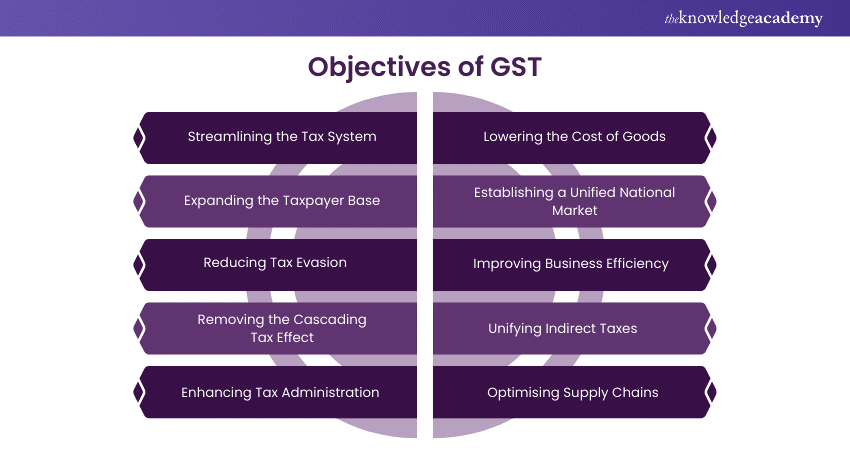
1) Streamlining the Tax System
GST simplifies the tax system by combining indirect taxes into one single tax, decreasing the administrative workload for businesses and the government. This simplification helps to improve the efficiency and manageability of tax compliance. All GST operations, such as registration, tax filing, and the GST Refund Process, are carried out online using the GST portal, backed by a digital-first strategy. This digital system makes compliance easier, reduces mistakes, and speeds up tax processing.
Impact
Streamlining the tax system through GST has significantly improved the business environment in India. Digitising tax processes has reduced paperwork, minimised errors, and simplified compliance, saving time. This is particularly beneficial for small and medium enterprises (SMEs), which frequently face challenges with complex tax laws. Moreover, a simpler tax system has boosted compliance rates, increasing government revenue collection.
2) Expanding the Taxpayer Base
GST has effectively expanded the number of businesses required to register for taxation by setting a lower threshold than past indirect tax systems. Expanding the tax base increases tax revenues and creates a fairer tax system by spreading the tax burden more evenly. Expanding the range of taxpayers helps formalise the economy by increasing the number of businesses adhering to tax laws. This process helps businesses improve their ability to obtain credit and financial services while boosting government income for public welfare and infrastructure projects.
Impact
The broadening of the tax base through GST has brought many informal businesses into the formal sector, resulting in positive effects like better financing opportunities, increased consumer confidence, and enhanced eligibility for government programs and benefits. Having a broader tax base means the economy will have a more significant and steadier source of revenue for the government to finance public goods and services, ultimately supporting social and economic growth.
3) Reducing Tax Evasion
GST promotes a clearer and simpler tax system. With GST, all transactions and sales are recorded in a single system, making it harder for businesses to hide or adjust sales numbers to avoid paying taxes. This system requires businesses to report sales and purchases accurately to qualify for tax credits, promoting the importance of maintaining honest records. As a result, the government can more easily monitor transactions and ensure the accurate collection of taxes, leading to a significant decrease in tax evasion.
Impact
The consequences of decreasing tax evasion via GST are significant. Initially, it encourages equality; ensuring all individuals contribute fairly reduces the weight on upright taxpayers. Additionally, it boosts government income without increasing tax rates, allocating more resources to public services like education, healthcare, and infrastructure.
Decreasing tax evasion results in a fair competition environment for every company. When companies fulfil their tax obligations, it becomes more challenging for dishonest businesses to gain an advantage over competitors by evading taxes. Thus,, promoting fair competition and ultimately resulting in improved consumer services and better prices.
Know tax filing processes with our Tax Filing Course today!
4) Removing the Cascading Tax Effect
Before the implementation of GST, businesses frequently struggled with the "tax on tax," which involved passing on multiple layers of taxation to the end consumer, resulting in increased prices of products and services. GST solves this problem by establishing an extensive input tax credit mechanism, enabling companies to claim taxes paid on input services. This system greatly minimises the domino effect, ensuring that tax is imposed solely on the added value at each level of the distribution process. Therefore, customers enjoy reduced prices and a clearer tax system.
Impact
The removal of the cascading effect of taxes has led to a pricing system that is fairer and clearer, showing the true value added to the final cost for buyers. As a result, Indian products have increased their competitiveness in global markets due to more affordable goods and services.
Moreover, it has played a role in enhancing the efficient distribution of resources in the economy. For companies, this results in better profit margins and lower tax obligations, creating a favourable atmosphere for development and expansion.
5) Enhancing Tax Administration
GST improves tax management by streamlining compliance procedures and consolidating multiple tax systems within a unified structure. The digital setup of GST enables automatic filing and live monitoring of transactions, minimising errors and making the tax process more efficient. Companies must keep clear and open records of their sales and purchases to simplify audits and evaluations. Moreover, adopting standardised procedures among states ensures uniformity in tax administration, simplifying the process for taxpayers and tax authorities.
Impact
GST's enhancements in tax administration result in increased compliance rates decreased tax evasion and boosted government revenue. Efficient procedures lead to quicker refunds and simpler access to tax credits, incentivising businesses to adhere to regulations.
GST transparency builds trust between taxpayers and authorities, promoting a collaborative atmosphere. Additionally, the decreased workload for tax authorities enables them to concentrate on important projects and improve tax collection and enforcement effectiveness, ultimately leading to a stronger economy.
6) Lowering the Cost of Goods
GST reduces the prices of goods by removing the cascade effect of taxes that previously affected consumers. In the previous tax system, businesses frequently encountered numerous levels of taxation, which resulted in higher prices. GST simplifies this procedure by implementing a thorough input tax credit system that enables companies to recover taxes spent on inputs. This ensures that tax is only imposed on the increase in value at each step of the distribution process, lessening the total tax load.
In addition, GST ensures consistency and anticipation by standardising tax rates throughout the nation. This decreases the expenses companies must meet regulations and promotes favourable pricing competition. Lower operational expenses allow companies to sell goods at discounted rates, ultimately giving customers a direct advantage.
Impact
The reduction in the price of goods due to GST has a notable impact. Consumers benefit from lower prices, which make necessary goods and services more cost-effective. This heightened ability to buy things can boost demand, fuelling economic expansion.
Furthermore, exporters benefit from the improved competitiveness of Indian products in the international market. The enhanced profit margins and lower tax burdens benefit businesses by creating a conducive atmosphere for increased growth and expansion, ultimately boosting the economy.
7) Establishing a Unified National Market
The Goods and Services Tax (GST) simplifies India's market by bringing all states under one tax system, replacing the previous mix of state and central taxes that differed by state. This legislation promotes consistency in taxation, streamlining the tax system and enabling goods and services to flow freely between states without facing extra taxes.
Through promoting a unified and diverse economic atmosphere, GST promotes equality in competition and allows companies, especially new and small ones, to grow their businesses across the country without worrying about dealing with various tax rules.
Impact
The objectives of GST have greatly lessened the logistic and regulatory challenges that companies used to encounter while operating in multiple states. GST has played a role in reducing the prices of products and services and enhancing the effectiveness of distribution networks.
This helps companies by decreasing expenses related to transactions and expanding consumer reach to more products at reduced costs, which boosts demand and fuels economic expansion.
8) Improving Business Efficiency
GST enhances business efficiency by simplifying the tax structure and streamlining compliance processes. Businesses can simplify tax management by replacing many indirect taxes with one single tax. The integrated GST system enables companies to easily claim input tax credits, reducing their tax burden and enhancing cash flow. Moreover, the digital framework that sustains GST allows companies to streamline tasks like registration, submitting returns, and handling claims, resulting in considerable time and cost savings.
Impact
Businesses are greatly affected by the wide-ranging repercussions of the efficiency improvements resulting from the implementation of GST. Firstly, efficiency in meeting requirements decreases the amount of time and resources used for tax tasks, enabling companies to concentrate on fundamental operations and strategic plans.
Furthermore, enhanced cash flow allows companies to increase their investment in growth prospects, stimulating innovation and growth. Ultimately, a streamlined tax system promotes fair competition, boosting market competitiveness and encouraging equality among businesses.
In general, the GST fosters a climate that is favourable for advancement, efficiency, and financial success.
Learn to calculate your VAT taxes with our VAT Training – Register now!
9) Unifying Indirect Taxes
One main goal of GST is to combine most current indirect taxes levied by state and central governments, such as excise duty, service tax, and VAT, among others. This merging has greatly decreased multiple taxes, regulatory obligations, and the chance of being taxed twice, streamlining the tax environment for companies. Furthermore, it has streamlined the government's tax administration processes, improving the effectiveness of tax collection and enforcement.
Impact
The consolidation of different indirect taxes into one levy has made tax administration more straightforward and reduced disagreements over tax jurisdiction and interpretation. This has established a steady and anticipated tax setting, promoting investment from both local and foreign sources. Also, the implementation of GST has resulted in lower tax collection expenses and enhanced operational efficiency for the government.
10) Optimising Supply Chains
Prior to the introduction of GST, traders and manufacturers had to deal with a complex paperwork procedure when supplying goods. One important result of GST is the removal of checkpoints on state boundaries, which frequently led to traffic congestion and delays in the shipment of goods. Eliminating these checkpoints has lowered transit times, leading to reduced expenses for warehousing and storage.
Impact
Eliminating check posts due to GST has significantly improved the effectiveness of transporting goods, resulting in quicker delivery times and decreased operating expenses for companies. This enhancement reduces supply chain delays and improves overall market competitiveness. In addition, it helps facilitate the movement of goods between states, which boosts economic development and supports trade domestically.
Advantages of GST
GST offers numerous benefits to stakeholders, including state and central governments, businesses, and citizens. Let’s explore the advantages of GST:

a) Consolidation of Taxes: It combines multiple indirect taxes from central and state governments into a single tax code.
b) Reduction of Cascading: It minimises the cascading effect, making Indian industries and products more competitive.
c) Cross Utilisation of Tax Credits: It enables the cross-utilisation of tax credits.
d) Uniform Taxation: IGST, CGST, and SGST introduce uniformity in taxation for both imports and local products.
e) Provisional Refunds for Exporters: Exporters can receive a provisional refund of 90%, streamlining their operations.
f) Increased Taxpayer Base: It is likely to expand the taxpayer base.
g) Reduction of Fraud: Uniform GST rates diminish opportunities for tax fraud.
h) Standardised Compliance: It creates a consistent set of laws, procedures, and tax rates, facilitating better compliance.
i) Technology-driven Platform: Its automated interface simplifies registration, filing, and payment of returns, as well as claims.
j) Enhanced Transparency: GST improves overall transparency in the taxation system.
k) Lower Tax Burden: Reducing the tax burden on industries lowers the prices of goods, leading to increased consumer spending and stimulating the economy.
l) Boost to Domestic Demand: GST can enhance domestic demand and production, creating more employment opportunities.
Disadvantages of GST
With benefits, GST comes with lots of drawbacks and challenges. Let’s discuss some of the major disadvantages of GST:

a) Complexity for Small Businesses: Small businesses often find GST complicated, especially if they are not accustomed to online processes. Keeping up with GST regulations can be labour-intensive.
b) Higher Costs for Certain Services: Services such as dining out or getting a haircut may become more expensive due to increased tax rates, leading to higher costs for customers.
c) Technological Challenges: GST requires reliable internet and computer skills. Businesses in areas with poor connectivity or limited technological expertise may struggle to comply with GST regulations.
d) Initial Confusion: The rollout of GST was confusing, with many businesses facing difficulties understanding the new rules and navigating the GST software.
e) Extensive Paperwork: Despite the intention to simplify taxation, GST still involves significant paperwork and regular online filing, which can be overwhelming for small businesses.
f) Cash Flow Issues: Businesses must pay GST at the time they bill customers, not when they receive payment, which can create cash flow challenges, especially for those who typically receive delayed payments.
g) Variable Tax Rates: While some essential items like food may be taxed less or not at all, other goods may incur higher taxes, leading to increased prices.
h) Service Challenges Across States: Although the movement of goods across state lines is smoother, providing services across different states remains complicated and can create confusion.
Conclusion
The Objectives of GST include establishing an effective and organised tax system that benefits all parties involved. By combining various indirect taxes, it makes it easier for businesses to follow regulations while also promoting economic expansion and improving competitiveness. Moreover, GST ensures that taxpayers contribute equitably and promotes transparency and fairness in the taxation process. Ultimately, these goals not only enhance government income but also promote a more connected economy, leading to sustainable progress and enhanced public well-being.
Master GST for business success with our GST Courses – Sign up now!
Frequently Asked Questions
What is the Nature Of GST?

GST is an indirect tax that unifies multiple taxes into one. It simplifies the process of taxation for goods and services.
What is the Principle Of GST?
The principles of GST are:
a) Value addition
b) Promoting transparency
c) Reducing cascading taxes
What are the Other Resources and Offers Provided by The Knowledge Academy?
The Knowledge Academy takes global learning to new heights, offering over 3,000 online courses across 490+ locations in 190+ countries. This expansive reach ensures accessibility and convenience for learners worldwide.
Alongside our diverse Online Course Catalogue, encompassing 19 major categories, we go the extra mile by providing a plethora of free educational Online Resources like News updates, Blogs, videos, webinars, and interview questions. Tailoring learning experiences further, professionals can maximise value with customisable Course Bundles of TKA.
What is The Knowledge Pass, and How Does it Work?
The Knowledge Academy’s Knowledge Pass, a prepaid voucher, adds another layer of flexibility, allowing course bookings over a 12-month period. Join us on a journey where education knows no bounds.
What are the Related Courses and Blogs Provided by The Knowledge Academy?
The Knowledge Academy offers various Tax Courses, including the GST Course, Tax Filing Course, and VAT Training. These courses cater to different skill levels, providing comprehensive insights into How to Pay Council Tax.
Our Accounting and Finance Blogs cover a range of topics related to Finance, offering valuable resources, best practices, and industry insights. Whether you are a beginner or looking to advance your Accounting skills, The Knowledge Academy's diverse courses and informative blogs have got you covered.

Olivia Taylor


Chartered Accountant and Financial Training Specialist
Olivia Taylor is a qualified chartered accountant with over a decade of experience in financial management, auditing and corporate reporting. Having worked with leading firms in both the public and private sectors, Olivia brings clarity to complex financial topics. Her writing focuses on helping professionals build confidence in key areas of accounting, compliance and financial planning.
View Detail

 If you wish to make any changes to your course, please


