


 Top Rated Course

We may not have the course you’re looking for. If you enquire or give us a call on 0800 446148 and speak to our training experts, we may still be able to help with your training requirements.
What is a Cyber Security Audit :Full Guide
John Davies 17 April 2026A Cyber Security Audit reviews your IT systems, assessing controls, policies, and vulnerabilities to ensure strong organisational protection. It highlights weak points that could expose your business to growing threats. The findings help you strengthen defences and maintain ongoing security resilience and readiness.

Training Outcomes Within Your Budget!
We ensure quality, budget-alignment, and timely delivery by our expert instructors.
Table of Contents
A Cyber Security Audit has become a requirement for companies with reliance on digital systems for safe operation. To protect themselves from increasing security risks and meeting new compliance, companies need to know their weak points. In this blog, we will discuss the basics before entering the details of the process and its importance.
Table of Contents:
1) What is a Cyber Security Audit?
2) What Does a Cyber Security Audit Cover?
3) Types of Cyber Security Audit
4) Importance of Cyber Security Audit
5) How is a Cyber Security Audit Performed?
6) Benefits of Cyber Security Auditing
7) Conclusion
What is a Cyber Security Audit?
A Cyber Security Audit is a comprehensive examination of the controls systems and infrastructure of an organisation in order to find weaknesses and to ensure that it adheres to regulations. It brings to light the flaws, confirms the security standards, and provides unambiguous advice to reinforce the total safety.

What Does a Cyber Security Audit Cover?
A cyber security audit inspects an organisation’s IT systems, software, infrastructure and devices to assess overall resilience.
a) Data security (such as encryption, access controls, information flows)
b) Operational security (policies, procedures, control frameworks)
c) Network security (traffic monitoring, antivirus, firewalls)
d) System security (patch management, privileged accounts, access rights)
e) Physical security (premises, hardware protection, device storage)
Types of Cyber Security Audit
Cyber Audit has become essential to how companies manage their digital infrastructure and safeguard their data and systems. Cyber Security Audits are of two types – internal and external.
1) Internal Audit
When a business uses its resources and internal audit department, it is known as Internal Audit. The primary purpose of such an audit is to validate the business systems to ensure compliance with policies and procedures.
2) External Audit
These audits are carried out by third parties, usually outside the organisation. Through these audits, the company wants to ensure that it follows all the regulations, guidelines, and government policies.
Importance of Cyber Security Audit
A Cyber Security Audit is a very important measure that brings the understanding of the capability of an organisation's systems to withstand the risks of modern threats. It reveals the security gaps, the resilience levels, and the compliance readiness of the organisation, which are all very necessary before the problems become huge.
a) Identifies Security Gaps: Assessing the extent to which the organisation's current controls, processes, and technologies protect against real-world threats.
b) Improves Overall Cyber Resilience: By recommending targeted actions that will enhance your organisation's capability to prevent, detect, and respond to attacks.
c) Provides Independent Assurance: Shows that your security controls meet critical industry and regulatory requirements.
Acquire skills in deploying firewalls with an Introduction to System and Network Security course.
How is a Cyber Security Audit Performed?
An audit process that is well-structured leads companies to analyse policies, infrastructure and controls in order to guarantee that they not only comply with the most recent standards but also mitigate risk.
Step #1: Review the Existing Policies and Procedures
This step will analyse your ICT security policy, incident response policy, and data retention policy to see if they form a shield of protection for a company/company entity against vulnerabilities of any type.
Step #2: Review the Network Architecture
The auditors examine your network, listing all linked systems, and making sure there are no insecure areas like open Wi-Fi hotspots or neglected security systems, for instance.
Step #3: Review the Access Controls
Audits will test user authentication, user authorisation and privileged account access to ensure that only the right persons hold the right privileges.
Step #4: Review the Incident Response Plan
An independent evaluation of your incident response plan is conducted: to determine if it is current; to ascertain if roles are clearly defined; and to ensure all team members know the correct way to proceed when a breach is detected.
Step #5: Review the Compliance With Data Protection and Privacy Regulations
The last part is to ensure compliance with legislation and standards, such as the General Data Protection Regulation and the one based on the NIS directive, to evade legal actions and ensure good standing.
Learn to protect Data better with the Computer Forensics Foundation Training course.
Benefits of Cyber Security Auditing
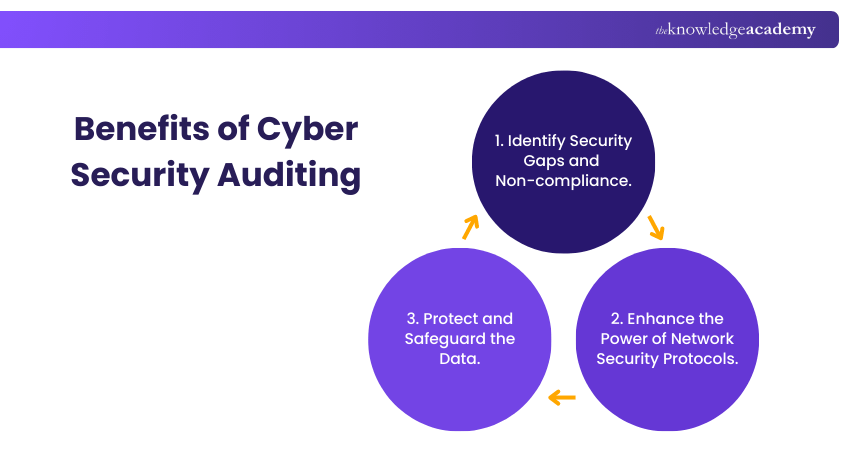
A Cyber Security Audit is a process that can be very beneficial to the whole security system of the organisation and can be considered as a strong support.
a) Identify Security Gaps and Non-compliance: Draws attention to the defects in the current system and gives a detailed account of the areas where the organisation is not conforming to the required standards.
b) Strengthen Network Security Protocols: Involves securing the weak points in the network and reinforcing the measures of protection, which will consequently lead to a decrease in the chances of cybercriminals taking advantage of the networks.
c) Protect and Safeguard Data: The company will have an extra guarantee that its reputation is not at risk, since the data is treated with the utmost care by the company, which uses prevention measures that no longer have any or very little chance of working.
Conclusion
Organisations that depend on digital systems have no choice but to undergo a Cyber Security Audit. It allows firms to be proactive in the fight against threats, reinforce their security, and gain the trust of the stakeholders. By adopting a security-first approach, organisations can secure their future and be more robust in their operations.
Enhance your understanding of Cyber Threats with the Cyber Security Awareness course.
Frequently Asked Questions
How Often Should you Conduct a Cyber Security Audit?

The minimum frequency of conducting a cyber security audit by organisations should be once a year, whereas if there are significant changes or increased risks, the audit should be reviewed more often.
Why is it Worth Conducting a Cyber Security Audit?
A cybersecurity audit is an effective way of pinpointing weaknesses in the system, and auditing the developed security measures through compliance, hence it is a good practice in the overall process of maintaining and demonstrating the effectiveness of your security controls.
What are the Other Resources and Offers Provided by The Knowledge Academy?
The Knowledge Academy takes global learning to new heights, offering over 3,000+ online courses across 490+ locations in 190+ countries. This expansive reach ensures accessibility and convenience for learners worldwide.
Alongside our diverse Online Course Catalogue, encompassing 19 major categories, we go the extra mile by providing a plethora of free educational Online Resources like Blogs, eBooks, Interview Questions and Videos. Tailoring learning experiences further, professionals can unlock greater value through a wide range of special discounts, seasonal deals, and Exclusive Offers.
What is The Knowledge Pass, and How Does it Work?
The Knowledge Academy’s Knowledge Pass, a prepaid voucher, adds another layer of flexibility, allowing course bookings over a 12-month period. Join us on a journey where education knows no bounds.
What are the Related Courses and Blogs Provided by The Knowledge Academy?
The Knowledge Academy offers various Cyber Security Courses, including the Cyber Security Awareness Course, Cyber Security Risk Management Training, and Digital Forensics Training. These courses cater to different skill levels, providing comprehensive insights into Spyware.
Our IT Security & Data Protection Blogs cover a range of topics related to Cyber Security Audit, offering valuable resources, best practices, and industry insights. Whether you are a beginner or looking to advance your IT Security & Data Protection skills, The Knowledge Academy's diverse courses and informative blogs have got you covered.

John Davies


Cyber Security Governance & Assurance Specialist
John Davies is a cybersecurity expert specialising in governance, risk management, and compliance. With over 15 years in the field, he has led enterprise-wide security programmes across finance, healthcare and public sector organisations. His content provides practical guidance on building secure environments, managing risk and aligning with regulatory frameworks.

Upcoming IT Security & Data Protection Resources Batches & Dates
Date
 Certified Cyber Security Professional (CCS-PRO)
Certified Cyber Security Professional (CCS-PRO)
Fri 28th Aug 2026
Certified Cyber Security Professional (CCS-PRO)
Fri 25th Sep 2026

 If you wish to make any changes to your course, please


