


 Top Rated Course

We may not have the course you’re looking for. If you enquire or give us a call on +358 942454206 and speak to our training experts, we may still be able to help with your training requirements.
25 Customer Service Manager Interview Questions and Answers
The Knowledge Academy 27 April 2026Customer Service Managers cover leadership, conflict resolution and are for candidates aiming to showcase their skills, experience, and customer-first mindset. Each answer offers professionalism and customer-centric approaches, helping candidates prepare for interviews. Boost your confidence and demonstrate your management skills.
Home
 Resources
ILM Leadership & Management
25 Customer Service Manager Interview Questions and Answers
Resources
ILM Leadership & Management
25 Customer Service Manager Interview Questions and Answers
Resources
ILM Leadership & Management
25 Customer Service Manager Interview Questions and Answers
Training Outcomes Within Your Budget!
We ensure quality, budget-alignment, and timely delivery by our expert instructors.
Table of Contents
If you’ve ever handled multiple customer complaints, kept your cool under pressure, and still managed to hit KPIs, congrats, you’ve already done the hard part. Now it's time to step into the spotlight as a Customer Service Manager.
Nerve-wracking? Totally normal. Don’t worry, we’ve got you. This blog gives you 25+ Customer Service Manager Interview Questions with sample answers. These will help you sound polished, confident, and totally prepared. Get ready to show them you’re more than just a people person, but a service leader in the making.
Table of Contents
1) Customer Service Manager Interview Questions with Answers
a) Tell me about yourself.
b) Why did you leave your previous job?
c) Why do you want to join this job?
d) What attracted you to this position?
e) How do you stay motivated?
f) How do you manage changes?
g) How would your current manager describe you?
h) What is your biggest achievement so far?
i) Explain your strengths and weaknesses.
j) What are the factors which have driven you to this job?
2) Conclusion
Customer Service Manager Interview Questions with Answers
Let's look at some of the most common Customer Service Manager Interview Questions with simple answers. Learning them can help you be prepared, feel confident, and make a great impression in your next interview. If you’re ready to lead officially, you're in the right place.
Tell me about yourself

This question helps the interviewer understand your background and what makes you suitable for the role.
Sample Answer:
“I’m a passionate customer service professional with over seven years of experience managing service teams in fast-paced environments. I started as a support agent and gradually moved up due to my ability to solve problems efficiently and keep teams motivated.
I take pride in building service cultures where the customer always comes first. I enjoy mentoring others and driving continuous improvement to exceed customer expectations.”

Why did you leave your previous job?
This helps the interviewer evaluate your reasons for job change and professionalism.
Sample Answer:
“I enjoyed my time at my previous company and learned a lot, but I felt I had reached a point where there were limited growth opportunities. I’m now looking for a role where I can continue developing my leadership skills.
I’m now looking for a role that allows me to expand my leadership responsibilities and contribute to a customer-focused team in a more strategic way.”
You’ve got potential - Unlock it with CMI Level 4 Award in Management and Leadership today!
Why do you want to join this job?
The interviewer wants to know your motivation for applying and how well you understand the role.
Sample Answer:
“I’m drawn to your company’s reputation for putting customers at the heart of everything. I’ve followed your recent service initiatives and believed this is a place where I can make a real difference.
These can be achieved by applying my skills in team leadership and service excellence. I see this as an opportunity to contribute meaningfully, grow professionally, and be part of a culture that values both people and performance.”
What attracted you to this position?
This question tests how well you’ve aligned your goals with the job description.
Sample Answer:
“What attracted me most to this position was the chance to lead a dynamic, diverse customer service team while actively contributing to process and service improvements. I’m passionate about driving meaningful change.
What stood out to me was the opportunity to lead a diverse team while also being involved in the process of improvement. The focus on innovation in customer experience aligns well with my approach to continuous service enhancement.”
How do you stay motivated?
This helps assess your internal drive and attitude toward work.
Sample Answer:
“I stay motivated by setting small daily goals and celebrating wins with my team. Seeing positive customer feedback and watching my team members grow keeps me driven. I also enjoy tackling service challenges that require creative solutions.
I also find great satisfaction in mentoring team members and watching them grow in their roles. Seeing their development and confidence increase over time drives me to keep improving as a leader.”
How do you manage changes?
The interviewer wants to assess your adaptability and change management skills.
Sample Answer:
“I approach change with a positive mindset and clear communication. I ensure my team understands the ‘why’ behind changes and involves them early in the process. I also provide training and resources where needed to support the shift.
I monitor progress closely to address any concerns. This helps reduce resistance and builds ownership.”
How would your current manager describe you?
This reveals your self-awareness and how you perceive your working relationships.
Sample Answer:
“My current manager would describe me as dependable, calm under pressure, and highly committed to delivering excellent service. They often commend my leadership style and how I support the team through challenges.
My manager also appreciates how I consistently look for ways to improve service delivery and support individual team growth. Overall, they see me as someone who leads with empathy and remains committed to delivering high-quality customer service.”
What is your biggest achievement so far?
This helps the interviewer gauge the impact you've made in previous roles.
Sample Answer:
“One of my proudest achievements was reducing response times by 40% in six months by restructuring the support process and introducing a triage system. It significantly boosted customer satisfaction and team morale.
I also reallocated team shifts to better match peak hours and introduced weekly performance huddles. These changes not only improved our response efficiency but also boosted our CSAT scores significantly.”
Explain your strengths and weaknesses.
The interviewer is looking for self-insight and honesty.
Sample Answer:
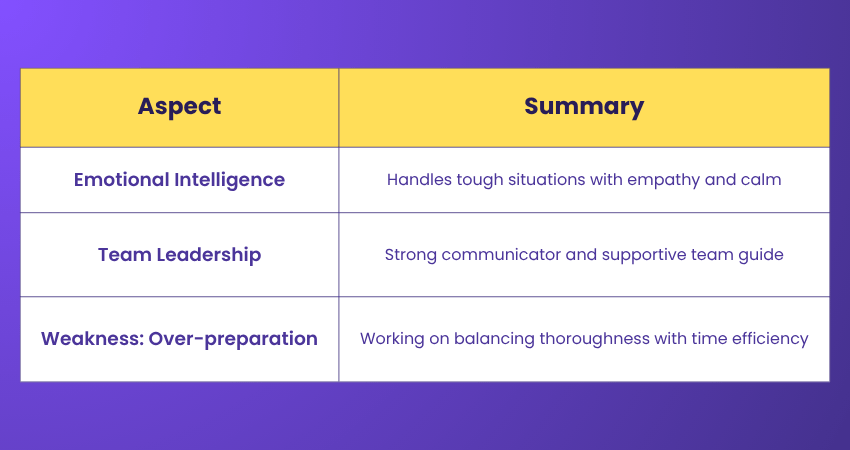
“One of my strengths is emotional intelligence, I can empathise and de-escalate tough customer situations effectively. I also bring strong team leadership and communication skills, which help me guide and support my team effectively.
As for weaknesses, I tend to over-prepare for meetings, but I’m learning to balance thoroughness with efficiency. I’ve been working on finding the right balance between being well-prepared and being efficient with my time.”
You're meant to lead - CMI Level 4 Certificate in Management and Leadership helps you prove it!
What are the factors which have driven you to this job?
Here, the interviewer wants to check your motivation and cultural fitness.
Sample Answer:
“I’m driven by a desire to lead teams that create real impact. Your company’s values around customer-first service, innovation, and employee growth strongly align with what I look for in a role.
I’m particularly drawn to your focus on continuous improvement and employee development Knowing that I’ll be part of a team that not only values service quality but also encourages new ideas and nurtures talent truly motivates me to be a part of this organisation.”
What are your approaches to promoting great customer service?
This answer reveals your service philosophy and strategies.
Sample Answer:
“I focus on training, empowerment, and accountability. I ensure the team understands customer needs, provides regular coaching, and recognise great service. I also encourage feedback loops to improve experiences continuously.
I also make accountability a priority by setting clear performance expectations and reviewing results regularly. Lastly, I maintain an open feedback loop with both customers and staff, so we’re always learning and improving our service delivery.”
How do you motivate and lead a customer service team?
This assesses your leadership and team management skills.
Sample Answer:
“I lead by example and create a supportive environment. I set clear goals, celebrate wins, and provide regular feedback. Tailoring motivation, whether recognition, growth opportunities, or challenges keeps each team member engaged.
Motivation isn’t one-size-fits-all, so I take time to understand what drives each person. By aligning my approach to individual needs, I keep the team engaged, inspired, and aligned with our customer service vision.”
How do you handle a high volume of customer inquiries?
The interviewer evaluates your efficiency and resource management.
Sample Answer:
“I prioritise and categorise inquiries using ticketing systems and automation. During peak times, I redistribute workloads and ensure the team is aligned on response protocols to maintain quality and speed.
It keeps the team aligned through clear protocols and quick stand-up meetings to adjust strategies in real-time. This approach helps us stay responsive without compromising service quality, even under pressure.”
What do you believe is the biggest challenge facing customer service today, and how would you address it?
This tests your industry awareness and problem-solving.
Sample Answer:
“Maintaining a human touch in digital channels is a big challenge. I’d address it by balancing automation with empathy, training staff to personalise interactions while using tools to streamline repetitive tasks.
At the same time, I use automation to handle repetitive tasks like order tracking or FAQs, so agents can focus more on complex, relationship-driven issues. This approach helps us deliver fast service without losing the personal touch customers value.”
How do you measure the success of your customer service team?
The interviewer wants to understand your performance tracking methods.
Sample Answer:
Success is measured using KPIs like CSAT, NPS, first contact resolution, and average response time. I also track team morale, training progress, and customer feedback to ensure consistent service quality.
I pay close attention to team morale, engagement levels, and feedback from both customers and staff. A successful team, in my view, consistently meets service goals while maintaining a positive, collaborative work environment.”
Describe a situation wherein you helped to exceed customer expectations.
This question tests your ability to go above and beyond and exceed customer expectations.
Sample Answer:
“A customer had a complex issue with multiple delays. I personally followed up, fast-tracked their case, and offered goodwill credit. They were impressed by the proactive support and wrote a glowing review.
I also provided regular updates to the customers, so they felt heard and informed. To make up for the inconvenience, I offered a goodwill credit, and a personalised apology note.”
Tell us about a time you had to give a team member candid feedback on their work.
The interviewer wants to evaluate your communication and leadership skills.
Sample Answer:
“One rep was struggling with tone during customer calls. I scheduled a private one-on-one, used specific examples, and offered coaching. With support, they improved significantly and later became one of our top performers.
I shared specific examples from recorded calls and explained how tone can influence the overall customer experience. I then worked with them to create a development plan, including shadowing a peer and participating in roleplay sessions”
Join our CMI Level 4 Diploma in Management and Leadership - Become the leader others look up to!
How do you handle a situation where a customer is dissatisfied with your product or service?
This question and your answer will explore your conflict resolution and empathy.
Sample Answer:
“I listen actively, acknowledge their frustration, and clarify the issue. Then, I offer a suitable solution or escalate if needed. I always follow up to ensure they feel heard and valued.
If it’s beyond my scope, I escalate it promptly while keeping the customers updated. Finally, I follow up after the resolution to ensure they’re satisfied with the outcome. This not only shows we care but often turns a negative experience into a positive relationship.”
What is the most challenging aspect of working in customer service?
With this question, the interviewer will identify your resilience and understanding of the role.
Sample Answer:
“The emotional toll of handling frustrated customers can be challenging. I manage it by staying composed, separating emotions from issues, and supporting my team with stress management strategies.
I also encourage a culture where team members feel supported, we talk openly about tough calls, share coping strategies, and I regularly check their well-being. By promoting emotional resilience and offering practical support, we’re able to maintain high service standards.”
The product team asks for your opinion on the next feature to implement. What would you recommend?
With this question, the interviewer wants to check your collaboration and customer insight.
Sample Answer:
“I’d recommend a feature based on recurring customer feedback. For example, if users consistently request live chat for quicker help, I’d suggest improving satisfaction and reducing email volume.
This would not only improve customer satisfaction through quicker resolutions but also reduce the email backlog and improve agent productivity. I’d also present supporting data to the product team to back the recommendation, ensuring decisions are driven by customer needs.”
What strategies do you use to ensure consistent quality of customer service across all channels?
This checks your ability to manage multichannel support effectively across various channels.
Sample Answer:
“I implement unified guidelines, regular training, and quality checks across all platforms. I also monitor channel-specific metrics and use customer feedback to ensure tone, accuracy, and service levels stay consistent.
Additionally, I monitor channel-specific KPIs like response time, resolution rates, and customer satisfaction to identify any gaps. I also gather and act on customer feedback, which gives direct insight into how well we’re performing across each touchpoint.”
How do you manage your time and objectives as a team leader?
The interviewer wants to assess your organisational skills as a team leader.
Sample Answer:
“I plan weekly goals, prioritise urgent tasks, and use tools like calendars and dashboards to track progress. I also set aside time for team check-ins, coaching, and performance reviews.
This structured approach helps me stay on top of my responsibilities while remaining accessible to my team. Balancing strategic planning with day-to-day support ensures we stay aligned and productive.”
Make your next move bold – Get CMI Level 4 Award in Management and Leadership now!
How often do you question how your current firm operates?
This explores your mindset and knowledge towards process improvement.
Sample Answer:
“I regularly evaluate processes, especially when I spot inefficiencies or recurring issues. I believe questioning and constructive feedback lead to innovation and better service outcomes.
By staying curious and open to new ideas, I’ve been able to suggest small but impactful changes that have improved both team efficiency and customer satisfaction.”
How do you assess the effectiveness of your incentives?
This tests your understanding of team motivation and performance metrics.
Sample Answer:
“I track performance before and after incentives, look at participation rates, and gather team feedback. If morale and key metrics improve, it’s a success. If not, I will refine the approach.
Equally important is gathering direct feedback from the team to understand what is motivating and what isn’t. I adjust the incentive structure, a good incentive plan should energise the team while aligning with our service objectives.”
How do you manage daily and weekly activities?
This answer will reveal your time management and planning skills.
Sample Answer:
“I begin each week by outlining top priorities, assigning tasks, and checking schedules. Daily, I review progress, address blockers, and realign goals as needed. This keeps the team focused and agile.
If adjustments are needed, I realign tasks to stay on track. I also reserve time for unexpected issues, which helps us stay flexible without losing focus. This structured yet adaptable approach keeps the team organised, efficient, and goal-driven throughout the week.”

The Knowledge Academy


Global Training Provider
The Knowledge Academy is a world-leading provider of professional training courses, offering globally recognised qualifications across a wide range of subjects. With expert trainers, up-to-date course material, and flexible learning options, we aim to empower professionals and organisations to achieve their goals through continuous learning.


 If you wish to make any changes to your course, please


