


 Top Rated Course

We may not have the course you’re looking for. If you enquire or give us a call on +358 942454206 and speak to our training experts, we may still be able to help with your training requirements.
ITIL Certification Renewal: A Complete Guide
John Davies 28 May 2026ITIL Certification Renewal offers several options, including retaking the exam before it expires, completing further ITIL courses, or earning CPD points. These methods ensure your skills stay up-to-date and help you remain certified in the latest ITIL frameworks, methodologies, industry standards, and best practices.

Training Outcomes Within Your Budget!
We ensure quality, budget-alignment, and timely delivery by our expert instructors.
Table of Contents
In the fast-moving world of IT, keeping your certifications current isn’t just a formality—it’s essential for staying relevant. That’s why ITIL Certification Renewal has become a hot topic among IT professionals across the globe. With PeopleCert’s new requirement making renewal mandatory every three years, the once ‘lifetime’ ITIL Certifications now come with an expiry date. This shift has sparked plenty of questions: Why the change? What do you need to do? And how can you turn this into a career advantage?
ITIL Certification Renewal is more than a policy update- it’s a chance to refresh your knowledge, expand your skill set, and demonstrate your commitment to best practices in IT service management. In this blog, we’ll walk you through everything you need to know - from renewal options and certification levels to benefits and common queries, so you’re fully prepared for your next step.
Table of Contents
1) ITIL Certification Renewal Process
2) What are the Levels of ITIL 4 Courses?
3) How do I Get Certified?
4) List a few job roles related to ITIL 4
5) How Will the Certification Help You?
6) What if I Have to Renew More Than One ITIL Certification?
7) What is the Life Cycle of ITIL?
8) Conclusion
ITIL Certification Renewal Process
As of 1st January 2023, all the ITIL Certificate holders are supposed to renew their certification every three years mandatorily. This news might shock many ITIL Certificate holders and aspirants, as ITIL was earlier to be a lifetime certificate.
However, the decision to renew the ITIL certification every three years was recently made public in PeopleCert’s new Continuing Professional Development initiative. The renewal processes for ITSM vs ITIL differ drastically from each other.

Renewal Process
Based on when you originally got your certification, you will be expected to renew your certification according to the following guidelines:
a) If you are certified before 30 June 2020 - you must renew your certificate before 1 July 2023, regardless of when you first obtained the certificate.
b) If you are certified after June 2020 – You have to renew your certificate within three years of when you were awarded the certificate.
For ITIL renewal, you must complete any of the qualifications mentioned below. This will include all the modules, including the ITIL foundation certification renewal:
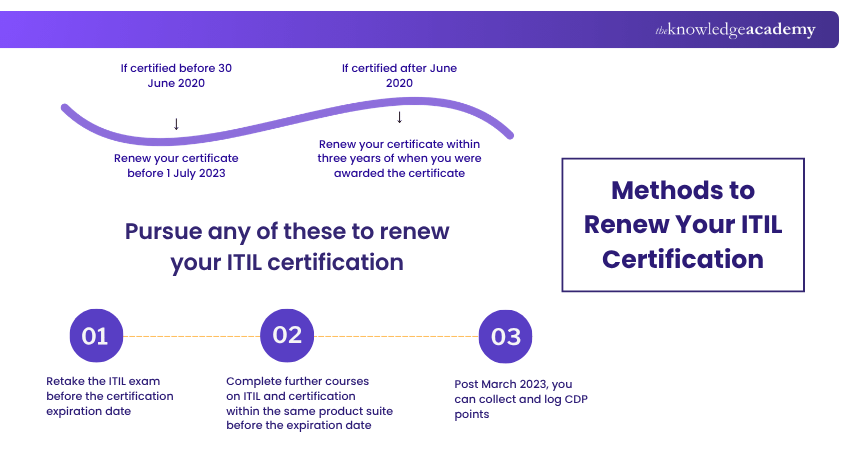
a) Retake your current ITIL exam before it expires
b) Complete another ITIL Certification within the same product suite
c) Earn and maintain the required (60) CPD points over the three-year period
What if I Don’t Renew my ITIL Certificate?
Even if you can't complete the ITIL Certification Renewal process before the renewal deadline, you will be included on the Successful Candidates Register (SCR) and the Candidate Verification Service. But you must remember that a note will be added to your records that show that your certification requires renewal to remain current.
Understand governance, AI, automation, and DevOps in product-driven service delivery with the ITIL® 5 Product Certification Training – Join now!
What are the Pathways to ITIL 5 Certification?
The ITIL (Version 5) pathway is structured to help professionals progress from basic knowledge to advanced expertise in IT Service Management and digital transformation.
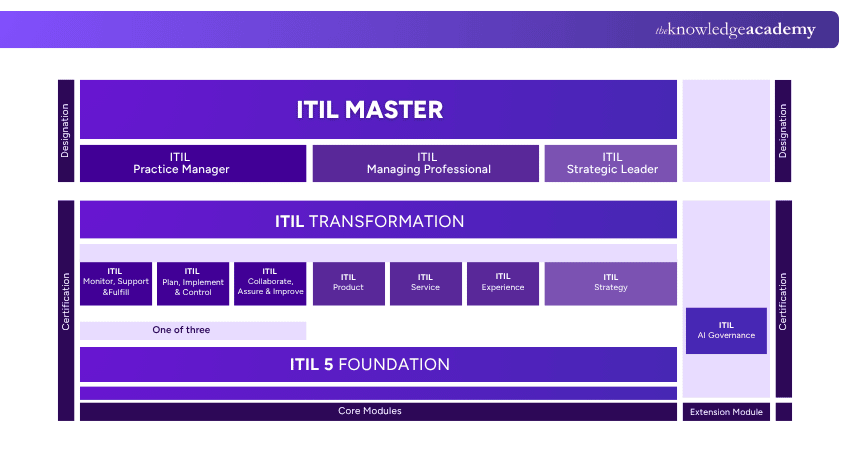
1) ITIL 5 Foundation Certification
1) Entry-level certification introducing core concepts, terminology, and principles
2) Focuses on Service Value System, value co-creation, and digital product thinking
3) Covers modern topics like AI-enabled environments and experience management
4) Valid for three years and acts as a prerequisite for all advanced levels
2) ITIL 5 Managing Professional
1) Focuses on practical application of ITIL in real-world environments
2) Requires completion of: ITIL Product, ITIL Service, ITIL Experience, and ITIL Transformation
3) Covers service lifecycle, product delivery, and customer experience
4) Helps professionals manage IT services and operations effectively
5) Includes a transition module for ITIL 4 professionals
3) ITIL 5 Strategic Leader Certifications
1) Designed for leadership and strategic roles
2) Requires ITIL Strategy and ITIL Transformation modules
3) Focuses on governance, digital strategy, and long-term value creation
4) Aligns IT services with organisational goals
5) Suitable for senior professionals and decision-makers
4) ITIL 5 Practice Manager
1) Focuses on managing specific ITIL practices in operational environments
2) Requires one practice group (not all three) plus ITIL Transformation
3) Practice groups to choose from:
a) Monitor, Support and Fulfil
b) Plan, Implement and Control
c) Collaborate, Assure and Improve
5) ITIL Transformation
1) Focuses on leading organisational change and embedding new ways of working
2) Connects strategy, governance, and execution to deliver value
3) Covers digital evolution and sustainable transformation
4) Mandatory shared module across all three advanced designations; Managing Professional, Strategic Leader, and Practice Manager
6) ITIL 5 Extension Modules Certifications
1) Includes specialised modules such as AI Governance
2) Focuses on ethical and responsible use of AI in digital services
3) Expands knowledge beyond core ITIL practices
4) Helps professionals stay relevant in modern digital environments
5) AI Governance has been formally announced as part of the ITIL Version 5 scheme, however its official launch date has not yet been confirmed
7) ITIL Master (Highest Level)
1) Highest level of ITIL designation
2) Achieved after completing Managing Professional, Strategic Leader, and Practice Manager
3) Demonstrates deep, end-to-end expertise in ITIL practices
4) Validates ability to apply ITIL concepts in complex, real-world scenarios
Those who wish to be involved in learning the diagnosis problems, you can master the Root Cause Analysis Training now!
How do I Get Certified?
There are two ways to gain an ITIL Certificate:
Apply with an accredited training organisation for a course which includes the exam as a part of the training course.
Another option would be to do a self-study by using the core ITIL manual. Once you start preparing for the exam, you can book the ITIL exam directly with the People Cert. (Note that this option might not be available for all ITIL modules. It is advisable for you to kindly go through the modules for individual requirements).
List of Job Roles Related to ITIL 5
Here are some key roles you can pursue with ITIL (Version 5) across different career levels:
1) IT Service Desk Analyst
2) IT Project Coordinator
3) IT Service Manager
4) Service Delivery Manager
5) Change Manager
6) IT Operations Manager
7) IT Governance Manager
8) Digital Transformation Lead
How Will the Certification Help You?
As you explore the benefits of ITIL (Version 5) Certification, it is important to understand how it enhances modern IT service delivery in digital and AI-driven environments. Here are some key ways ITIL 5 can support your career:
1) Helps you understand how IT supports business strategy, including digital products, value streams, and AI-enabled services.
2) Enables you to improve workflows and adopt flexible, collaborative ways of working using updated guiding principles.
3) Promotes a value-driven approach focused on collaboration, co-creation, and customer experience.
4) Strengthens communication skills to build reliable and effective stakeholder relationships.
5) Prepares you to work in complex, fast-changing digital environments with greater adaptability.
6) Provides a common language for managing modern IT services, helping you stand out and grow your digital career.
Build practical understanding of service lifecycles, relationships, and governance through the ITIL® 5 Service Certification Training – Join now!
What if I Have to Renew More Than One ITIL Certification?
If you need to renew multiple ITIL Certifications, you can streamline the process by scheduling exams close together, using combined study materials, and leveraging any overlapping content to save time and effort.
What is the Life Cycle of ITIL?
The ITIL life cycle consists of five stages:
a) Service Strategy
b) Service Design
c) Service Transition
d) Service Operation
e) Continual Service Improvement
These stages ensure efficient service management and continuous enhancement of IT services.
Conclusion
We have given an in-depth understanding of ITIL and how it can help you grow your ITIL career. This blog also includes the latest updates on ITIL Certification Renewal and recertification. If you're aiming to stay ahead of your competition, exploring ITIL Interview Questions can be a valuable part of your preparation and continuous learning. Follow the ITIL renewal process given above to stay ahead of your competition.
Join the ITIL® 4 Specialist: Create Deliver And Support Certification today and advance your IT expertise!
Frequently Asked Questions
What Role Does ITIL Play in Ensuring Compliance with Industry Standards and Regulations?

ITIL helps organisations meet industry standards and regulations by providing structured processes, governance, and clear documentation. It ensures consistent service delivery, risk control, and audit readiness, helping organisations stay compliant while improving service quality and operational efficiency.
What are the Job Roles That Specifically Require ITIL Expertise?
Roles that specifically require ITIL expertise include IT Service Manager, Service Delivery Manager, Change Manager, Problem Manager, and IT Operations Manager. These roles rely on ITIL practices to manage services, control risks, improve processes, and ensure consistent, high-quality IT service delivery.
What are the Other Resources and Offers Provided by The Knowledge Academy?
The Knowledge Academy takes global learning to new heights, offering over 3,000+ online courses across 490+ locations in 190+ countries. This expansive reach ensures accessibility and convenience for learners worldwide.
Alongside our diverse Online Course Catalogue, encompassing 17 major categories, we go the extra mile by providing a plethora of free educational Online Resources like Blogs, eBooks, Interview Questions and Videos. Tailoring learning experiences further, professionals can unlock greater value through a wide range of special discounts, seasonal deals, and Exclusive Offers.
What is The Knowledge Pass, and How Does it Work?
The Knowledge Academy’s Knowledge Pass, a prepaid voucher, adds another layer of flexibility, allowing course bookings over a 12-month period. Join us on a journey where education knows no bounds.
What are the Related Courses and Blogs Provided by The Knowledge Academy?
The Knowledge Academy offers various ITIL® Certification Training, including the ITIL® 5 Foundation Certification Training, ITIL® 5 Product Certification Training, and the ITIL® 5 Service Certification Training. These courses cater to different skill levels, providing comprehensive insights into ITIL® Version 5.
Our IT Service Management Blogs cover a range of topics related to ITIL Certification Renewal, offering valuable resources, best practices, and industry insights. Whether you are a beginner or looking to advance your IT Service Management skills, The Knowledge Academy's diverse courses and informative blogs have got you covered.

John Davies


Cyber Security Governance & Assurance Specialist
John Davies is a cybersecurity expert specialising in governance, risk management, and compliance. With over 15 years in the field, he has led enterprise-wide security programmes across finance, healthcare and public sector organisations. His content provides practical guidance on building secure environments, managing risk and aligning with regulatory frameworks.

Upcoming IT Service Management Resources Batches & Dates
Date
 ITIL® 5 Foundation Certification
ITIL® 5 Foundation Certification
Wed 24th Jun 2026
ITIL® 5 Foundation Certification
Mon 29th Jun 2026
ITIL® 5 Foundation Certification
Wed 1st Jul 2026
ITIL® 5 Foundation Certification
Mon 6th Jul 2026
ITIL® 5 Foundation Certification
Wed 8th Jul 2026
ITIL® 5 Foundation Certification
Mon 13th Jul 2026
ITIL® 5 Foundation Certification
Wed 15th Jul 2026
ITIL® 5 Foundation Certification
Mon 20th Jul 2026
ITIL® 5 Foundation Certification
Wed 22nd Jul 2026
ITIL® 5 Foundation Certification
Mon 27th Jul 2026
ITIL® 5 Foundation Certification
Wed 29th Jul 2026
ITIL® 5 Foundation Certification
Mon 3rd Aug 2026
ITIL® 5 Foundation Certification
Wed 5th Aug 2026
ITIL® 5 Foundation Certification
Mon 10th Aug 2026
ITIL® 5 Foundation Certification
Wed 12th Aug 2026
ITIL® 5 Foundation Certification
Mon 17th Aug 2026
ITIL® 5 Foundation Certification
Wed 19th Aug 2026
ITIL® 5 Foundation Certification
Mon 24th Aug 2026
ITIL® 5 Foundation Certification
Wed 26th Aug 2026
ITIL® 5 Foundation Certification
Tue 1st Sep 2026
ITIL® 5 Foundation Certification
Mon 7th Sep 2026
ITIL® 5 Foundation Certification
Wed 9th Sep 2026
ITIL® 5 Foundation Certification
Mon 14th Sep 2026
ITIL® 5 Foundation Certification
Wed 16th Sep 2026
ITIL® 5 Foundation Certification
Mon 21st Sep 2026
ITIL® 5 Foundation Certification
Wed 23rd Sep 2026
ITIL® 5 Foundation Certification
Mon 28th Sep 2026
ITIL® 5 Foundation Certification
Wed 30th Sep 2026
ITIL® 5 Foundation Certification
Mon 5th Oct 2026
ITIL® 5 Foundation Certification
Wed 7th Oct 2026
ITIL® 5 Foundation Certification
Mon 12th Oct 2026
ITIL® 5 Foundation Certification
Wed 14th Oct 2026
ITIL® 5 Foundation Certification
Mon 19th Oct 2026
ITIL® 5 Foundation Certification
Wed 21st Oct 2026
ITIL® 5 Foundation Certification
Mon 26th Oct 2026
ITIL® 5 Foundation Certification
Wed 28th Oct 2026
ITIL® 5 Foundation Certification
Mon 2nd Nov 2026
ITIL® 5 Foundation Certification
Wed 4th Nov 2026
ITIL® 5 Foundation Certification
Mon 9th Nov 2026
ITIL® 5 Foundation Certification
Wed 11th Nov 2026
ITIL® 5 Foundation Certification
Mon 16th Nov 2026
ITIL® 5 Foundation Certification
Wed 18th Nov 2026
ITIL® 5 Foundation Certification
Mon 23rd Nov 2026
ITIL® 5 Foundation Certification
Wed 25th Nov 2026
ITIL® 5 Foundation Certification
Mon 30th Nov 2026
ITIL® 5 Foundation Certification
Wed 2nd Dec 2026
ITIL® 5 Foundation Certification
Mon 7th Dec 2026
ITIL® 5 Foundation Certification
Wed 9th Dec 2026
ITIL® 5 Foundation Certification
Mon 14th Dec 2026
ITIL® 5 Foundation Certification
Mon 21st Dec 2026
ITIL® 5 Foundation Certification
Wed 23rd Dec 2026
ITIL® 5 Foundation Certification
Tue 29th Dec 2026

 If you wish to make any changes to your course, please


