


 Top Rated Course


We may not have the course you’re looking for. If you enquire or give us a call on +358 942454206 and speak to our training experts, we may still be able to help with your training requirements.
Chi-Square Test: Everything You Need to Know
William Brown 25 February 2026The Chi-Square (χ²) Test is a statistical method used to analyse categorical data, compare observed and expected results, and identify significant relationships. It checks whether differences between groups are likely due to chance. Common uses include survey responses, A/B test outcomes, defect counts and customer preference studies too.

Training Outcomes Within Your Budget!
We ensure quality, budget-alignment, and timely delivery by our expert instructors.
Table of Contents

Have you ever noticed patterns in everyday life and wondered if they truly mean something? For example, are hip-hop listeners actually more likely to prefer streaming platforms over radio, or is that simply coincidence? This is where the Chi-Square Test becomes useful.
The Chi-Square Test is a statistical method used to determine whether there is a significant association between categorical variables. It compares the frequencies you observe in your data with the frequencies you would expect if no relationship existed. If the difference is large enough, it suggests the pattern is unlikely to be due to chance. Let’s explore how this statistical tool works and turn your observations into meaningful, data-backed insights!
Table of Contents
1) What is a Chi-Square Test?
2) Chi-Square Test Formula
3) When Should You Use a Chi-Square Test?
4) Types of Chi-Square Tests
5) Key Properties of the Chi-Square Test
6) How to Perform a Chi-Square Test?
7) Real-world Applications of the Chi-Square Test
8) Limitations of the Chi-Square Test
9) Conclusion
What is a Chi-Square Test?
The Chi-Square Test (χ²) is a statistical test that is applied to investigate the relationship between two or more categorical data. It helps determine whether there is a significant association between two variables or whether the distribution of a single categorical variable differs from what would be expected. In simple terms, it provides the answer to the question: are the noticed patterns significant, or might they have been accidental?
Chi-Square Tests are very popular in testing of hypothesis in categorical data. They compare the observed frequencies in a set of data with the expected frequencies as calculated under the null hypothesis. Common applications include analysing relationships in contingency tables, testing for independence between variables, and evaluating the goodness-of-fit between observed data and a theoretical distribution.

Chi-Square Test Formula
The general formula in a Chi-Square Test is to compute the frequency of seeing categories in your data and the frequency with which you should have seen them had there been no real relationship. Both the chi-square goodness-of-fit test and the Chi-Square Test of independence share the same basic formula to compute the test statistic which is represented by Χ².
The formula is:

Where:
1) Χ² is the chi-square statistic (the value you calculate to assess significance)
2) Σ means “sum of” across all categories
3) O is the observed frequency (the actual count in your data)
4) E is the expected frequency (the number that you would get in case there were no association of variables)
The formula is basically a measure of squared differences between what you actually saw and what you thought you would see, divided by the things you would have expected to see. A large Χ² value suggests that the observed data deviate more than would be expected by chance, indicating a potentially significant relationship or distribution difference.
You compare the calculated Χ² to a critical value from a chi-square distribution (based on degrees of freedom) to decide whether the result is statistically significant.
When Should You Use a Chi-Square Test?
The Chi-Square Test is most suitable when you are working with Categorical (non-numeric) Data to compare across groups or categories. Here are common scenarios where Chi-Square Tests are most effective:
1) Testing Independence: You have two categorical variables and want to know if they are related to each other (e.g., gender, and shopping preferences).
2) Goodness of Fit: You are interested in seeing if your data fits the expected distribution.
The test is also appropriate when you have a large enough sample size and when each observation is independent of others.
Register now for our Mathematical Optimisation for Business Problems Course to harness advanced optimisation tools proficiently!
Types of Chi-Square Tests
There are two types of Chi-Square Tests, each serving a specific purpose:
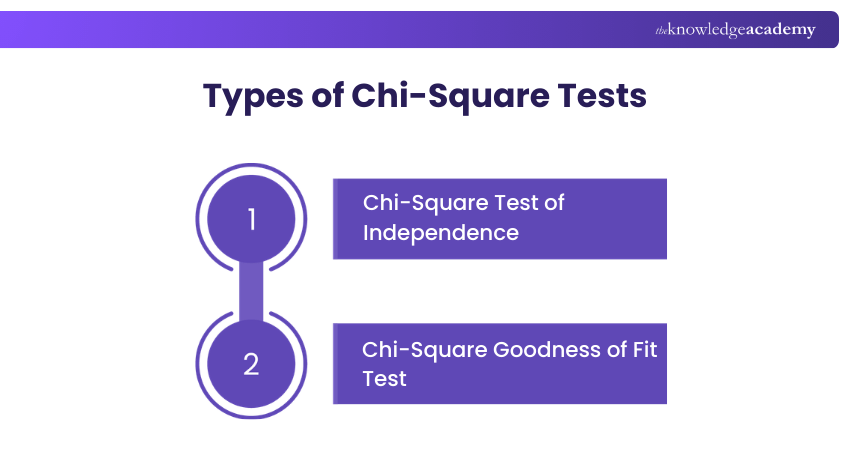
1) Chi-Square Test of Independence
This test analyses whether two categorical variables are independent of each other. For instance, you might want to know if an education level and voting preference link exists. By applying the Chi-Square Test of Independence, you can test the significance of observed differences.
2) Chi-Square Goodness of Fit Test
Title: Components of the Chi-Square Formula

Essentially, this formula measures our observation versus our expectation deviation. A higher Chi-Square value indicates a greater difference, suggesting a significant variable relationship.
Key Properties of the Chi-Square Test
1) Non-parametric: Unlike many statistical tests, it doesn’t assume a normal distribution, making it versatile for Categorical Data.
2) One-tailed Test: Since we only test if there’s a significant difference, it’s usually a One-tailed test, as the focus is solely a one-direction deviation.
3) Degrees of Freedom: The Chi-Square distribution depends on Degrees of Freedom (DoF), which is derived from the number of categories or groups.
4) Sensitivity to Sample Size: Larger sample sizes can yield more reliable results in Chi-Square Tests.
Register now for our Mathematical Optimisation for Business Problems Course to harness advanced optimisation tools proficiently!
How to Perform a Chi-Square Test?
Follow these structured steps to accurately conduct a Chi-Square test and interpret its results with confidence.
1) Define Hypotheses: Clearly state the null and alternative hypotheses before collecting data.
2) Choose the Alpha Level (α): Decide the acceptable risk level, commonly 0.05, for making an incorrect conclusion.
3) Check Data Accuracy: Review your dataset for errors, missing values, or inconsistencies.
4) Verify Assumptions: Ensure the data is categorical and that expected frequencies meet test requirements.
5) Calculate Expected Values: Determine expected frequencies based on the null hypothesis.
6) Compute the Chi-square Statistic: For each category, subtract expected from observed values, square the difference, divide by expected, and sum all results.
7) Determine Degrees of Freedom: Calculate based on the test type and number of categories.
8) Compare with the Critical Value: Use the Chi-square distribution table based on α and degrees of freedom.
9) Draw Your Conclusion: Reject or fail to reject the null hypothesis based on the comparison result.
Develop in-demand Business Analysis skills and boost your career with our Business Analyst Courses.
Real-world Applications of the Chi-Square Test
To get a better understanding, try applying the Chi-Square Test to some practical problems:
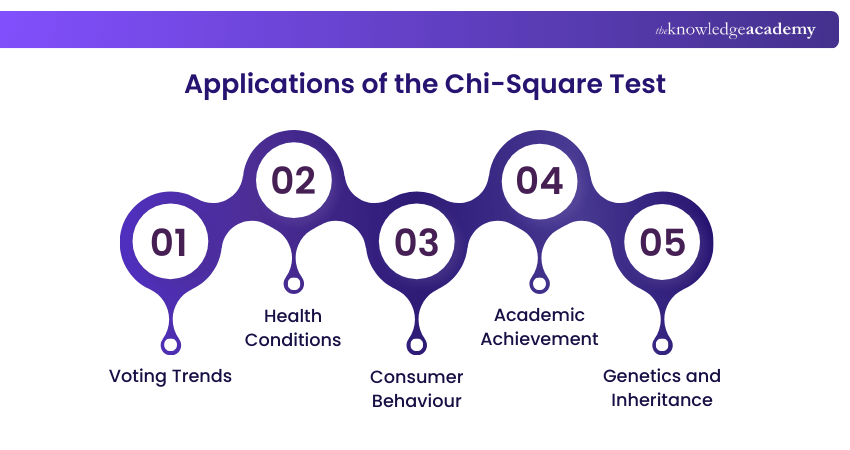
1) Voting Trends
Examine if age affects voting preferences across different age groups and parties. This analysis can determine if there is a significant association between a voter’s age and their tendency to support specific parties or candidates.
2) Health Conditions
Explore if there is lifestyle factors (like exercise frequency) and chronic conditions (such as Diabetes or Hypertension) relationships. This investigation helps reveal if healthier lifestyle choices correlate with a reduced risk of such health issues.
3) Consumer Behaviour
Perform shopping data analysis to see if brand preference is influenced by categories like electronics, apparel, and groceries. This study can highlight the purchasing patterns of consumers and how they differ significantly between men and women, influencing marketing strategies.
4) Academic Achievement
Investigate if extracurricular involvement has an impact on students' academic performance levels. This analysis seeks to understand if students involved in clubs, sports, or arts tend to perform better academically compared to those with less involvement.
5) Genetics and Inheritance
Look into whether certain traits (like eye colour) follow an expected pattern of inheritance in a family dataset. This study aims to determine if genetic factors are statistically significant in passing traits from one generation to the next.
Learn essential business analysis techniques with our Business Analyst Black Belt Course – Join now!
Limitations of the Chi-Square Test
While the Chi-Square Test is powerful, it does come with some limitations:
1) Sensitive to Sample Size: A large sample can make minor differences appear significant, while a small sample might miss genuine relationships.
2) Expected Frequency Requirement: Chi-Square Tests work best when the expected frequency in each category is at least 5.
3) Applicability to Categorical Data: This test is only suitable for categorical variables, not continuous data.
Become a quality control expert! Learn SPC with our Statistical Process Control Training - Join us today!
Conclusion
Mastering Chi-Square Tests is like uncovering the hidden stories in your data—transforming simple numbers into powerful insights. From revealing consumer preferences to highlighting intriguing trends, these tests equip you to make smarter, data-driven decisions. So, why not let statistics reveal the story behind your numbers?
Frequently Asked Questions
How do you Interpret the Results of a Chi-Square Test?

If the Chi-Square Test statistic is higher than the set significance level’s critical value, you reject the Null Hypothesis, indicating a variable relationship. If it’s lower, you accept the Null Hypothesis, suggesting no significant association.
What is the Advantage of the Chi-Square Test?
The Chi-Square Test is Non-parametric and versatile, meaning it doesn’t require a normal distribution. It’s suitable for Categorical Data, making it widely applicable for testing relationships in diverse datasets. This is true for real-world grouped or Categorical Data-driven scenarios.
What are the Other Resources and Offers Provided by The Knowledge Academy?
The Knowledge Academy takes global learning to new heights, offering over 3,000+ online courses across 490+ locations in 190+ countries. This expansive reach ensures accessibility and convenience for learners worldwide.
Alongside our diverse Online Course Catalogue, encompassing 19 major categories, we go the extra mile by providing a plethora of free educational Online Resources like Blogs, eBooks, Interview Questions and Videos. Tailoring learning experiences further, professionals can unlock greater value through a wide range of special discounts, seasonal deals, and Exclusive Offers.
What is The Knowledge Pass, and How Does it Work?
The Knowledge Academy’s Knowledge Pass, a prepaid voucher, adds another layer of flexibility, allowing course bookings over a 12-month period. Join us on a journey where education knows no bounds.
What are the Related Courses and Blogs Provided by The Knowledge Academy?
The Knowledge Academy offers various Business Analyst Courses, including the Statistics Course and the Process Mapping Training. These courses cater to different skill levels, providing comprehensive insights into Mind Map.
Our Business Analysis Blogs cover a range of topics related to Business Analysis, offering valuable resources, best practices, and industry insights. Whether you are a beginner or looking to advance your Business Analysis skills, The Knowledge Academy's diverse courses and informative blogs have got you covered.

William Brown


Senior Business Analyst and Strategic Advisor
William Brown is a senior business analyst with over 15 years of experience driving process improvement and strategic transformation in complex business environments. He specialises in analysing operations, gathering requirements and delivering insights that support effective decision making. William’s practical approach helps bridge the gap between business goals and technical solutions.
View Detail

 If you wish to make any changes to your course, please


