


 Top Rated Course


We may not have the course you’re looking for. If you enquire or give us a call on +358 942454206 and speak to our training experts, we may still be able to help with your training requirements.
Benefits of Kubernetes | Key Advantages
Lily Turner 17 April 2026Benefits of Kubernetes include efficient Resource Management, automated scaling, enhanced security, seamless integration, and operational consistency. It streamlines deployment, enhances portability, and supports self-healing. Key use cases include multi-cloud, Microservices, and optimising DevOps workflows for reliable applications.

Training Outcomes Within Your Budget!
We ensure quality, budget-alignment, and timely delivery by our expert instructors.
Table of Contents
Want to take your Application Management to the next level? The numerous Benefits of Kubernetes can make it happen. Imagine effortlessly scaling your apps, enhancing security, and automating tasks all while keeping everything running smoothly across different environments. Kubernetes does all of this and more, making your workflow seamless.
The Benefits of Kubernetes go beyond just Container Management, they unlock flexibility, boost reliability, and supercharge your DevOps processes. Whether you’re tackling multi-cloud strategies, managing Microservices, or optimising performance, Kubernetes is the secret weapon that keeps you agile and ahead of the competition.
Table of Contents
1) What is Kubernetes?
2) Top Benefits of Kubernetes
3) Why Choose Kubernetes Over Other Alternatives?
4) Difference Between Kubernetes and Multi-cloud Deployment
5) Conclusion
What is Kubernetes?
To fully grasp Kubernetes (K8s), it's important to first understand Containers. These are self-contained software units with all necessary dependencies to ensure consistency across environments. Kubernetes is an open-source platform that automates the deployment, scaling, and management of these containerised applications, making it essential for Cloud-native development.
Kubernetes allows you to run and scale applications without managing servers directly. It offers key features like automated load balancing, self-healing, and seamless updates. By grouping containers into pods and distributing them across machines, Kubernetes ensures reliable and efficient app performance based on your defined configuration.

Top Benefits of Kubernetes
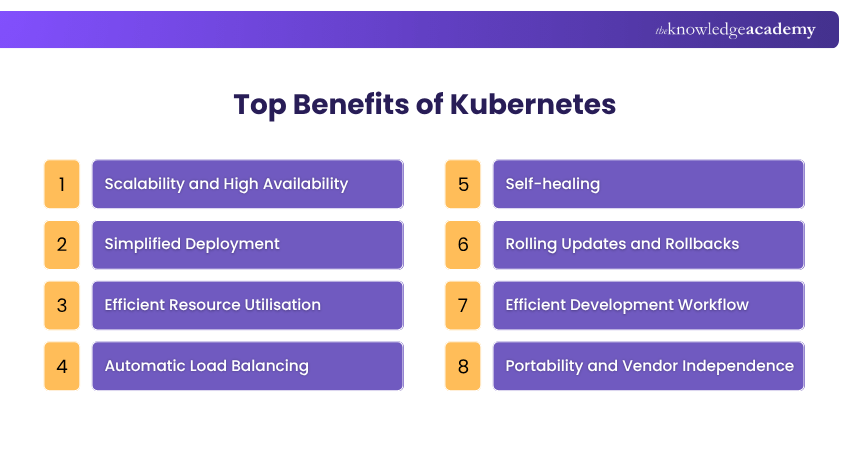
As mentioned above, Kubernetes is an open-source platform for automating the deployment, scaling, management, and operation of applications in containers. However, some businesses may consider a Kubernetes Alternative depending on their specific infrastructure needs. Now let’s explore the top Benefits of Kubernetes:
1) Scalability and High Availability
Kubernetes ensures scalability and high availability by dynamically scaling applications, optimising resources, auto-scaling during traffic surges, and providing self-healing capabilities to minimise downtime and maintain reliability.
Scalability and high availability are vital for modern applications, and Kubernetes excels at both by:
1) Effortlessly scaling applications based on demand.
2) Distributing containers effectively to optimise resource use.
3) Auto-scaling to manage traffic surges.
4) Ensuring reliability through automatic restarts and healthy node scheduling.
5) Reducing downtime with self-healing capabilities.
2) Simplified Deployment
Kubernetes streamlines the deployment process by abstracting infrastructure complexities, allowing developers to define application specifications using declarative YAML or JSON files. This approach ensures consistent deployments across various environments, reducing errors and enhancing reliability throughout the development lifecycle.
This deployment strategy serves the following purpose:
1) Saves time and resources.
2) Boosts team productivity and efficiency.
3) Promotes DevOps collaboration between development and operations.
Get DevOps Certified and engineer seamless innovation! Sign up for our DevOps Certification now!
3) Efficient Resource Utilisation
Kubernetes effectively manages resources by optimising allocation, balancing workloads, and minimising costs. Its key functions include:
1) Allocating resources based on application needs, ensuring optimal performance.
2) Adjusting container placement to distribute workloads evenly.
3) Preventing resource underutilisation and overprovisioning.
4) Reducing infrastructure costs and maximising ROI.
5) Aligning resource usage with billing in Cloud environments.
6) Scaling resources based on demand to optimise spending.
7) Enhancing cost-efficiency and operational effectiveness.
4) Automatic Load Balancing
In distributed applications, Kubernetes manages incoming traffic by evenly distributing it across containers or pods, ensuring optimal performance. Key functions include:
1) Automatically routing traffic to prevent overload.
2) Balancing workloads to optimise resource utilisation.
3) Enhancing scalability and fault tolerance.
4) Simplifying Traffic Management without manual configuration.
5) Handling high traffic loads seamlessly.
5) Self-healing
Kubernetes enhances application reliability through its self-healing mechanism. It monitors container health, detects failures, and automatically restarts, reschedules, or replaces faulty containers, minimising downtime and maintaining availability. Key Benefits of Kubernetes Functions include:
1) Monitoring container and node health within the cluster.
2) Detecting and addressing failures proactively.
3) Restarting or rescheduling failed containers to healthy nodes.
4) Reducing manual intervention and downtime.
5) Ensuring consistent application performance and user experience
6) Rolling Updates and Rollbacks
Kubernetes streamlines application updates through rolling updates, gradually replacing old containers with new ones to prevent downtime. Key points include:
1) Ensuring zero downtime during updates by gradually replacing containers.
2) Maintaining continuous availability and user experience.
3) Enabling seamless rollbacks to previous versions in case of issues.
4) Minimising disruptions and maintaining service stability.
Dive into Amazon EKS and power up your Cloud-native Skills. Sign up for our Running Containers On Amazon Elastic Kubernetes Service EKS Training now!
7) Efficient Development Workflow
Kubernetes empowers developers to run containers locally, creating consistent development environments and supporting Microservices architecture. Key functions include:
1) Automating deployment and scaling processes.
2) Integrating CI/CD pipelines for seamless transitions to production.
3) Efficient resource utilisation and faster iterations.
4) Leveraging tools like Skaffold, Tilt, and Telepresence.
5) Promoting collaboration between development and operations.
8) Portability and Vendor Independence
Kubernetes enables applications to run seamlessly across multiple Cloud providers or on-premises, preventing vendor lock-in. Key points include:
1) Running applications across diverse environments without platform restrictions
2) Offering flexibility based on cost, compliance, or specific needs
3) Abstracting infrastructure complexities for consistent deployment
4) Simplifying workload migration between platforms
5) Empowering infrastructure optimisation and adaptabilit
9) Ecosystem and Community Support
Kubernetes offers a robust ecosystem of tools and services, extending its capabilities through third-party integrations. Key points include:
1) Seamless integration with monitoring, logging, networking, and storage solutions.
2) Active community support for troubleshooting, updates, and best practices.
3) Continuous development and security enhancements from a global network of contributors.
4) Access to resources for optimising Kubernetes deployments effectively.
10) Enhanced Security
Kubernetes strengthens application security through comprehensive access controls and network policies, safeguarding data and workloads. Key points include:
1) Defining user permissions to limit resource access based on roles
2) Controlling traffic between pods to minimise vulnerabilities
3) Implementing security policies to prevent unauthorised access
4) Regular security audits and updates to mitigate emerging threats
5) Protecting sensitive data in containerised environments
6) Ensuring compliance with industry security standards
11) Efficient Resource Scaling
Kubernetes adjusts resource allocation based on application demand using Horizontal and Vertical Pod Autoscaling (HPA and VPA). Key points include:
1) HPA scales pods based on CPU and memory usage.
2) VPA dynamically adjusts resource limits for optimal performance.
3) Efficiently allocates resources to handle workload fluctuations.
4) Enhances application performance and cost-effectiveness.
5) Minimises infrastructure costs through smart scaling.
Master the tools, streamline your pipelines, and automate your way to seamless software releases. Sign up for our DevOps Engineering Foundation Course now!
12) Application Portability and Multi-cloud Deployment
Kubernetes enables seamless application deployment across Cloud providers and on-premises, preventing vendor lock-in. Key points include:
1) Building once, running anywhere without modifications.
2) Providing a standardised deployment platform for consistency.
3) Simplifying workload migration between Clouds or hybrid environments.
4) Optimising infrastructure choices based on cost, performance, or compliance.
13) Improved Observability and Monitoring
Kubernetes enhances application monitoring through integration with various tools, offering comprehensive insights into performance and health. Key points include:
1) Collecting and analysing metrics, logs, and traces for proactive issue detection.
2) Implementing health checks and readiness probes to maintain stability and prevent downtime.
3) Identifying performance bottlenecks to optimise resource allocation.
4) Ensuring the reliability and availability of containerised workloads.
5) Supporting integration with tools like Prometheus, Grafana, and Elasticsearch for advanced monitoring.
6) Enabling real-time alerts to swiftly address potential issues.
Why Choose Kubernetes Over Other Alternatives?
Kubernetes is the go-to container orchestration platform for its scalability, automation, and flexibility. It streamlines Resource Management, automates deployment, and ensures high availability across multi-cloud and hybrid environments. Moreover, Kubernetes’ self-healing, resource scaling, and monitoring integrations are vital.
Difference Between Kubernetes and Multi-cloud Deployment
Kubernetes manages containerised applications across nodes, automating tasks like scaling, deployment, and load balancing. Multi-cloud deployment involves employing multiple Cloud providers to distribute workloads. Kubernetes’s key focus is on Container Management, and multi-cloud deployment is about performance and cost efficiency.
Conclusion
In a world where agility and scalability are crucial, the Benefits of Kubernetes are undeniable. It simplifies deployment, boosts flexibility, and ensures reliability across Cloud environments. By optimising DevOps workflows and managing multi-cloud and Microservices, Kubernetes helps businesses stay ahead, adapt quickly, and maintain top-tier performance.
Build the future of scalable infrastructure with our Architecting With Google Kubernetes Engine Training - Sign up now!
Frequently Asked Questions
What are Some of the Main Benefits Associated with Using Kubernetes?

Key Benefits of Kubernetes include:
1) High efficiency and reliability
2) Portability across environments
3) Strong security and effective resource management
4) Compatibility with Docker
5) Robust support from the open-source community
What are the Security Benefits of Kubernetes?
Kubernetes offers strong security benefits, including automated secrets management, Role-Based Access Control (RBAC), and network policies to restrict traffic. It enhances container isolation, supports regular security updates, and allows fine-grained control over resource permissions and configurations.
What are the Other Resources and Offers Provided by The Knowledge Academy?
The Knowledge Academy takes global learning to new heights, offering over 3,000 online courses across 490+ locations in 190+ countries. This expansive reach ensures accessibility and convenience for learners worldwide.
Alongside our diverse Online Course Catalogue, encompassing 19 major categories, we go the extra mile by providing a plethora of free educational Online Resources like Blogs, eBooks, Interview Questions and Videos. Tailoring learning experiences further, professionals can unlock greater value through a wide range of special discounts, seasonal deals, and Exclusive Offers.
What is The Knowledge Pass, and How Does it Work?
The Knowledge Academy’s Knowledge Pass, a prepaid voucher, adds another layer of flexibility, allowing course bookings over a 12-month period. Join us on a journey where education knows no bounds.
What are the Related Courses and Blogs Provided by The Knowledge Academy?
The Knowledge Academy offers various DevOps Certification Courses, including the Certified DevOps Professional Course and the DevOps Foundation® Course. These courses cater to different skill levels, providing comprehensive insights into DevOps Case Studies.
Our Programming & DevOps Blogs cover a range of topics related to Kubernetes, offering valuable resources, best practices, and industry insights. Whether you are a beginner or looking to advance your DevOps skills, The Knowledge Academy's diverse courses and informative blogs have got you covered.

Lily Turner


Senior AI/ML Engineer and Data Science Author
Lily Turner is a data science professional with over 10 years of experience in artificial intelligence, machine learning, and big data analytics. Her work bridges academic research and industry innovation, with a focus on solving real-world problems using data-driven approaches. Lily’s content empowers aspiring data scientists to build practical, scalable models using the latest tools and techniques.
View Detail

 If you wish to make any changes to your course, please


