


We may not have the course you’re looking for. If you enquire or give us a call on +356 8006 2654 and speak to our training experts, we may still be able to help with your training requirements.
Home
 Resources
IT Security & Data Protection
CISSP Exam Requirements: Eligibility, Structure and Domains
Resources
IT Security & Data Protection
CISSP Exam Requirements: Eligibility, Structure and Domains
CISSP Exam Requirements: Eligibility, Structure and Domains
ByThe Knowledge AcademyLast updated on: 18 November 2026
Explore the CISSP exam requirements, including eligibility criteria, work experience, exam format, question types, passing score and the eight security domains, to understand what to expect and prepare effectively for the examination.
What's in This Blog?
1. CISSP Eligibility: Five years of relevant experience across at least two domains is required for certification, but not to sit the exam.2. Experience Waivers: Eligible qualifications can reduce the experience requirement by one year.3. Exam Format: CAT-based examination with 100–150 questions and a three-hour limit.4. Passing Score: 700 out of 1,000 scaled points.5. 2027 Updates: Revised domain weightings and examination content take effect on 15 April 2027.
You've decided to begin your CISSP journey. What should you do first?
Start studying? Book your examination? Check your professional experience?
Before taking any of these steps, it's important to understand how the examination works, who can take it and what experience is required to earn the certification. Getting familiar with these requirements early can help you avoid surprises, plan your next steps and make the most of your preparation.
So, what should you know before taking the CISSP exam? Let's find out the CISSP exam requirements in this blog!
CISSP Exam Eligibility and Experience Requirements
The CISSP examination, offered by the International Information System Security Certification Consortium (ISC2), evaluates candidates' ability to apply cyber security knowledge, assess security risks and make informed decisions in professional situations. Rather than focusing solely on theoretical understanding, it measures how effectively candidates interpret and respond to security-related challenges.
Let's check the eligibility criteria for taking the CISSP exam, along with the experience requirements for obtaining certification:
1) Professional Work Experience
ISC2 requires at least five years of cumulative, full-time professional experience in two or more of the eight domains covered by the CISSP exam outline. Relevant experience may include security operations, risk management, network security, identity and access management, and other information security responsibilities.

2) Accepted Types of Work Experience
ISC2 accepts full-time employment, qualifying part-time work and appropriately documented paid or unpaid internships when calculating professional experience requirements.
|
Experience Type |
ISC2 Requirement |
|---|---|
|
Full-time Employment |
At least 35 hours per week for four weeks counts as one month of experience |
|
Part-time Employment |
Between 20 and 34 hours per week; 1,040 hours equals six months of full-time experience and 2080 hours equals 12 months of full-time experience |
|
Internships |
Paid and unpaid internships may qualify with supporting documentation |
Internship experience must be supported by documentation on company or organisational letterhead, or on the academic registrar's stationery for school-based internships.
3) CISSP Experience Waivers
ISC2 allows candidates to reduce the five-year experience requirement by a maximum of one year by holding an eligible educational qualification or a professional certification included on its approved waiver list.
The recognised waiver options include:
1) Educational Qualification: A bachelor's or master's degree in computer science, Information Technology (IT) or a related field may satisfy up to one year of experience.
2) Approved Professional Certification: Credentials recognised on ISC2's approved waiver list may also satisfy one year.
Examples of approved certifications include:
a) CompTIA Security+
b) Certified Information Security Manager (CISM)
c) Certified Cloud Security Professional (CCSP)
d) AWS Certified Security – Speciality
ISC2 updated its approved certification waiver list on 1 April 2026. Candidates should check whether their qualifications appear on the latest list before applying.
Important
Candidates can claim a maximum one-year experience waiver, even if they hold multiple eligible qualifications or certifications. Educational and certification-based waivers cannot be combined to reduce the requirement by two years.
4) Eligibility Without the Required Experience
Candidates who have not completed the required professional experience can still sit the CISSP examination. After passing, they can pursue Associate of ISC2 status and have up to six years to obtain the necessary experience.
However, passing the examination alone does not grant CISSP certification. Candidates must meet the professional experience requirements before becoming fully certified.
Develop the strategic leadership skills to manage cybersecurity risks with our Chief Information Security Officer Training – Register now!
CISSP Exam Format and Passing Requirements
The CISSP exam follows a structured assessment process designed to evaluate candidates' knowledge and ability to apply cyber security concepts in professional situations.
Understanding the exam duration, question types, scoring system and passing criteria helps candidates know what to expect and plan their preparation effectively. Let's take a closer look at the CISSP exam format and passing requirements.
CISSP Exam Structure
The CISSP exam structure defines the examination duration, number of questions, question formats and passing standards established by ISC2. The following table summarises the exam requirements.
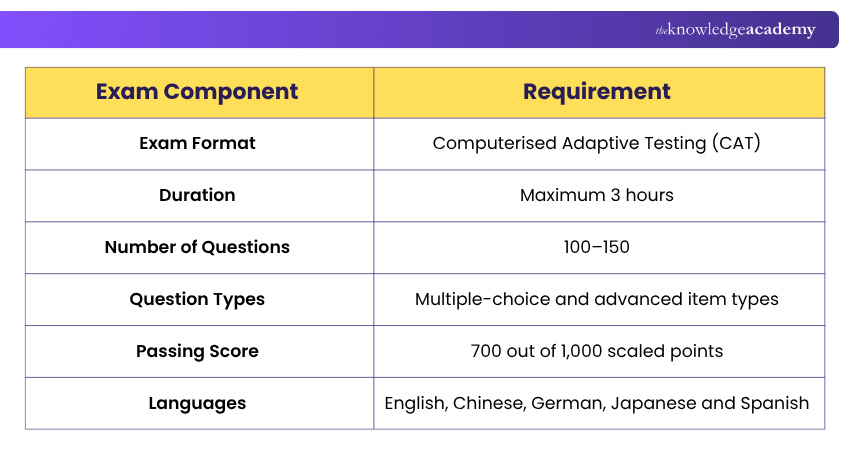
The three-hour exam duration includes any breaks taken, as the examination timer continues running. Candidates should therefore manage their time carefully to ensure they can complete the assessment within the allotted period. Also, the number of questions varies from 100 to 150 because CAT adjusts the examination based on each candidate's responses and the system's assessment of their ability.
How Does CISSP Computerised Adaptive Testing Work?
CAT evaluates individuals' proficiency by adjusting question difficulty based on previous responses. Rather than presenting a fixed set of questions, the system continuously estimates a candidate's ability.
The process follows these principles:
a) Adaptive Question Selection: The system selects subsequent questions based on the candidate's estimated ability.
b) Continuous Performance Evaluation: Each response contributes to an updated assessment of the candidate's proficiency.
c) Variable Exam Length: The examination may end after 100 questions or continue up to a maximum of 150, depending on the applicable stopping rules.
d) No Question Review: Candidates cannot revisit or change answers once they have submitted them.
This approach allows ISC2 to evaluate professional knowledge without requiring every candidate to answer the same number of questions.
Pro Tip
Look for words such as BEST, MOST and FIRST in examination questions. These often indicate that multiple answers could be technically correct, but only one best addresses the specific situation.
CISSP Passing Score and Scoring System
Candidates must achieve a scaled passing score of 700 out of 1,000 points. However, this does not mean answering exactly 70% of the questions correctly, as CAT scoring considers the difficulty of the questions and the candidate's estimated proficiency.
ISC2 determines examination results using three primary scoring rules:
a) Confidence Interval Rule: After at least 100 questions, the examination can end when the system determines with 95% statistical confidence whether the candidate's ability is above or below the passing standard.
b) Maximum-length Rule: If the examination reaches 150 questions, the final ability estimate determines whether the candidate passes or fails.
c) Run-out-of-time Rule: If the three-hour limit expires, the final ability estimate determines the result, provided the candidate has answered at least 100 questions.
The examination also includes 25 unscored pretest questions, which candidates cannot distinguish from scored questions. Therefore, every question should receive careful consideration.
CISSP Examination Results and Retake Policy
ISC2 provides a provisional pass or fail result after candidates complete the examination. Numerical scaled scores are not disclosed, although unsuccessful candidates receive diagnostic feedback identifying their proficiency across examination domains.
Candidates who do not pass can retake the examination according to ISC2's waiting-period requirements:
a) After the First Attempt: Wait at least 30 test-free days.
b) After the Second Attempt: Wait at least 60 test-free days from your most recent exam attempt.
c) After the Third and Subsequent Attempts: Wait at least 90 test-free days from your most recent exam attempt.
ISC2 permits a maximum of four attempts for each certification examination within a 12-month period.
Eight CISSP Exam Domains
The CISSP examination covers eight domains within the Common Body of Knowledge (CBK). These domains define the subjects candidates must understand and the areas of professional knowledge assessed during the examination.
The following table shows their focus areas and examination weightings:
|
CISSP Domain |
Key Exam Topics |
Weightage |
|---|---|---|
|
Security and Risk Management |
Security governance, risk management, compliance and professional ethics |
16% |
|
Asset Security |
Information classification, asset handling, retention and data protection |
10% |
|
Security Architecture and Engineering |
Secure system design, cryptography and security engineering principles |
13% |
|
Communication and Network Security |
Secure network architecture, communication protocols and network protection |
13% |
|
Identity and Access Management (IAM) |
Identification, authentication, authorisation and access control |
13% |
|
Security Assessment and Testing |
Security testing, vulnerability assessments, audits and control validation |
12% |
|
Security Operations |
Incident response, investigations, security monitoring and disaster recovery |
13% |
|
Software Development Security |
Secure software development, application security and lifecycle controls |
10% |
|
Total |
|
100% |
The weightings indicate the approximate proportion of examination content allocated to each domain. They are not separate passing thresholds.
CISSP Exam Requirements: What's Changing in 2027?
The CISSP examination currently follows the exam outline introduced by ISC2 on 15 April 2024. However, ISC2 has confirmed that a revised exam outline will take effect on 15 April 2027, introducing changes to domain weightings and updating the topics covered to reflect developments in cyber security.
These updates are stated to primarily affect the examination content rather than its overall structure. Understanding the changes can help candidates stay informed about the knowledge areas assessed and the requirements associated with the updated examination.
Keep This in Mind
Understanding the CISSP exam requirements is an important step towards earning this globally recognised cyber security certification. From eligibility and professional experience to exam structure, passing criteria and security domains, each aspect plays a role in planning your certification journey.
By understanding what to expect and preparing accordingly, individuals can approach the CISSP examination with greater confidence and work towards achieving their certification goals.
Enhance your cybersecurity credentials with advanced security architecture knowledge through the CISSP-ISSAP Training – Join now!

The Knowledge Academy develops accessible learning content across Project Management, IT, Cybersecurity, Data Science, Business Analysis, HR, Accounting and Finance, Leadership and Health and Safety. Its resources combine subject research with clear explanations to help professionals build practical knowledge across a wide range of disciplines.
View Detail

 If you wish to make any changes to your course, please


