




We may not have the course you’re looking for. If you enquire or give us a call on +44 1344 203 999 and speak to our training experts, we may still be able to help with your training requirements.
Home
 Resources
IT Security & Data Protection
CISA Exam Questions and Answers: A Complete Practice Guide
Resources
IT Security & Data Protection
CISA Exam Questions and Answers: A Complete Practice Guide
CISA Exam Questions and Answers: A Complete Practice Guide
ByThe Knowledge AcademyLast updated on: 24 November 2026
Build familiarity with CISA exam topics through 20 practice questions, each supported by an explanation. Review essential auditing and security concepts and recognise areas that need further attention.
The Gist
1. The CISA exam covers five domains, including information systems auditing, IT governance, business resilience and information security.2. Practising scenario-based questions helps candidates apply auditing principles to real-world situations.3. Understanding why an answer is correct is just as important as selecting the right option.4. Regular practice across all five domains helps identify knowledge gaps and improve exam readiness.
Preparing for the Certified Information Systems Auditor (CISA) exam can feel challenging, especially when several answers seem equally convincing. The key is not just knowing auditing concepts but understanding how to apply them in real-world situations.
Practising CISA exam questions can help you strengthen your knowledge base, identify areas for improvement and approach the examination with greater confidence. This blog explores 20 CISA exam questions and answers, giving you an opportunity to put your auditing knowledge to the test. Let's get started!
Top 20 CISA Exam Questions and Answers
The following CISA exam-based practice questions cover important concepts from all five domains. Each question includes multiple-choice options, the correct answer and the associated explanation to help you understand the reasoning behind it:
1) Information System Auditing Process
This domain focuses on audit planning, risk assessment, evidence collection, sampling techniques and reporting. It also covers the professional standards and ethical responsibilities that guide Information Systems Auditors.
1) Which of the following is NOT a component of ISACA's IT Audit Framework (ITAF)?
a) IT audit and assurance standards
b) IT audit and assurance guidelines
c) An organisation's internal IT budget
d) Professional practices and ethical requirements
Answer: Option c) An organisation's internal IT budget
Explanation: ISACA's IT Audit Framework (ITAF) provides professional standards and guidance for conducting IT audit and assurance engagements. An organisation's internal IT budget is a management resource rather than a component of ITAF. The framework helps auditors maintain consistency, professional conduct and appropriate audit practices.

2) An audit project has exceeded its planned schedule, and management is concerned about its completion. What is the MOST likely area requiring review?
a) Cooperation from the individuals being audited
b) Technical qualifications of the auditors
c) Organisational security policies
d) Effectiveness of audit project management
Answer: Option d) Effectiveness of audit project management
Explanation: Effective audit project management involves planning activities, allocating resources, monitoring progress and managing timelines. The scenario identifies weaknesses in progress monitoring and resource management, making audit project management the most appropriate area to review.
3) An IT Auditor selects transactions based on their professional judgement, focusing on those involving privileged access. Which sampling technique is being used?
a) Random sampling
b) Statistical sampling
c) Systematic sampling
d) Judgmental sampling
Answer: Option d) Judgmental sampling
Explanation: Judgmental sampling involves selecting items based on the auditor's professional judgement and the audit objective. In this scenario, privileged access transactions are selected because they present potentially higher risks. Unlike random sampling, the selection is not based entirely on chance.
4) Can an IT Auditor use an organisation's existing risk assessment when planning an audit?
a) No, the auditor must always perform an entirely new assessment.
b) Yes, without reviewing its reliability.
c) No, risk assessments are unnecessary for audit planning.
d) Yes, provided the auditor evaluates its reliability and relevance.
Answer: Option d) Yes, provided the auditor evaluates its reliability and relevance.
Explanation: An IT Auditor may use an existing risk assessment when it is sufficiently reliable, current and relevant to the audit objectives. However, the auditor remains responsible for evaluating the assessment and determining whether additional work is necessary.
Pro Tip: When answering audit-related questions, distinguish between identifying risks, gathering evidence and evaluating controls. The correct answer depends on the audit objective and the information available.
2) Governance and Management of IT
This domain evaluates how organisations align IT activities with business goals. It covers IT governance, policies, resource management, risk management and organisational accountability.
5) What is the PRIMARY objective of IT governance within an organisation?
a) Managing daily technical support requests
b) Ensuring IT activities support business objectives
c) Installing and configuring network devices
d) Performing routine system maintenance
Answer: Option b) Ensuring IT activities support business objectives
Explanation: IT governance establishes direction, accountability and oversight to ensure technology investments support organisational objectives. While technical support and system maintenance are important, they primarily relate to operational IT management rather than governance.
6) An organisation has implemented an IT governance framework. Which of the following provides the BEST indication that the framework supports organisational objectives?
a) The number of employees in the IT department
b) The age of the organisation's IT infrastructure
c) Alignment between IT objectives and business strategy
d) The frequency of software upgrades
Answer: Option c) Alignment between IT objectives and business strategy
Explanation: Effective IT governance ensures that technology initiatives support business priorities. Assessing this alignment helps the auditor determine whether the governance framework provides appropriate direction and oversight.
7) Who is responsible for ensuring that appropriate IT governance arrangements are established?
a) The external auditor
b) The governing body or Board of Directors
c) The IT helpdesk
d) Individual system users
Answer: Option b) The governing body or Board of Directors
Explanation: The governing body has ultimate accountability for organisational governance, including oversight of IT-related risks and strategic decisions. Management implements governance arrangements, while auditors independently assess their effectiveness.
8) An organisation relies heavily on an external cloud service provider. What should an IT Auditor prioritise when reviewing vendor management?
a) The vendor's advertising strategy
b) The number of employees working for the vendor
c) Contractual obligations, service performance and risk management
d) The vendor's office location
Answer: Option c) Contractual obligations, service performance and risk management
Explanation: Effective vendor management requires clear contractual responsibilities, performance monitoring and appropriate risk controls. These measures help organisations manage service dependencies and ensure that outsourced services meet business and security requirements.
Trainer's Insight
IT governance focuses on strategic oversight and accountability, while IT management handles implementation and daily operations. In exam scenarios, identify whether the question concerns governance or execution before selecting an answer.
Take your auditing expertise further with the CISA Certified Information Systems Auditor Training – Sign up now!
3) Information Systems Acquisition, Development and Implementation
This domain focuses on evaluating IT projects throughout their development and implementation. It covers system requirements, project governance, testing, migration and post-implementation reviews.
9) What is the PRIMARY purpose of a business case when acquiring a new information system?
a) To document the system's source code
b) To justify the investment based on business needs and expected benefits
c) To replace the organisation's risk management policies
d) To determine the number of system users
Answer: Option b) To justify the investment based on business needs and expected benefits
Explanation: A business case evaluates the expected benefits, costs, risks and feasibility of an investment. It helps decision-makers determine whether a proposed information system supports organisational objectives and offers sufficient value.
10) An organisation is preparing to implement a new payroll system. What is the MOST important objective of User Acceptance Testing (UAT)?
a) To verify that the system meets business requirements
b) To confirm that all developers have completed their training
c) To replace security testing
d) To measure the organisation's internet speed
Answer: Option a) To verify that the system meets business requirements
Explanation: User acceptance testing helps determine whether a system supports the required business processes and functions as expected. It provides users and stakeholders with an opportunity to identify issues before the system becomes operational.
Here are the key elements of UAT:
11) During a system migration, an IT Auditor discovers inconsistencies between the old and new databases. What should be reviewed FIRST?
a) The software vendor's marketing materials
b) The organisation's employee attendance records
c) Data conversion and reconciliation procedures
d) The system's visual design
Answer: Option c) Data conversion and reconciliation procedures
Explanation: Data conversion and reconciliation controls help ensure information is transferred accurately and completely during migration. Reviewing these procedures can help the auditor identify the cause of inconsistencies and assess the reliability of migrated data.
12) What is the PRIMARY objective of a post-implementation review?
a) To identify new software vendors
b) To replace existing audit procedures
c) To approve the project's initial budget
d) To determine whether the implemented system meets its intended objectives
Answer: Option d) To determine whether the implemented system meets its intended objectives
Explanation: A post-implementation review evaluates whether the system meets business requirements, delivers expected benefits and operates with appropriate controls. It also helps identify lessons that can improve future projects.
Navigate complex security challenges with confidence through Chief Information Security Officer Training – Sign up soon!
4) Information Systems Operations and Business Resilience
This domain covers IT operations, incident management, system availability, business continuity and disaster recovery. It assesses an organisation's ability to maintain essential services and respond effectively to disruptions.
13) What is the PRIMARY purpose of a Business Impact Analysis (BIA)?
a) To identify the business impact of operational disruptions
b) To evaluate employee attendance
c) To determine the cost of office equipment
d) To replace an organisation's information security policy
Answer: Option a) To identify the business impact of operational disruptions
Explanation: A business impact analysis identifies critical business activities and evaluates the potential consequences of disruptions. It also helps determine recovery priorities and requirements that support business continuity planning.
14) An organisation experiences a major system failure affecting critical operations. What should be the PRIMARY consideration when prioritising recovery?
a) The age of the affected equipment
b) The business impact and recovery requirements of affected services
c) The number of employees in the IT department
d) The original purchase price of the systems
Answer: Option b) The business impact and recovery requirements of affected services
Explanation: Recovery priorities should reflect business criticality, dependencies and established recovery objectives. Restoring the most important services first helps minimise operational disruption and supports business continuity.
15) What does the Recovery Time Objective (RTO) represent?
a) The target time within which a disrupted service or system should be restored
b) The number of backup copies maintained
c) The amount of data transferred during recovery
d) The total cost of implementing a disaster recovery plan
Answer: Option a) The target time within which a disrupted service or system should be restored
Explanation: The Recovery Time Objective (RTO) defines the target period within which a disrupted service should be restored. It helps organisations plan appropriate recovery arrangements based on business needs.
Pro Tip
For recovery-related questions, distinguish between the time needed to restore a service and the amount of data an organisation can afford to lose. RTO addresses recovery time, while Recovery Point Objective (RPO) concerns the point in time to which data must be restored.
16) An IT Auditor is reviewing an organisation's backup procedures. Which evidence provides the STRONGEST assurance that critical data can be recovered?
a) A written backup policy
b) Confirmation that backup software is installed
c) Successful results from documented restoration tests
d) A list of employees responsible for backups
Answer: Option c) Successful results from documented restoration tests
Explanation: A backup policy and installed software do not guarantee that data can be restored. Documented restoration tests provide stronger evidence that backups are usable and recovery procedures function as intended.
5) Protection of Information Assets
This domain focuses on protecting information against unauthorised access, misuse and security threats. It encompasses Identity and Access Management (IAM), encryption, network security, incident response and data protection controls.
17) Which security principle ensures that users receive only the access necessary to perform their duties?
a) Separation of duties
b) Least privilege
c) Defence in depth
d) Data redundancy
Answer: Option b) Least privilege
Explanation: The principle of least privilege restricts access to the minimum permissions required for a user's responsibilities. This reduces the risk of unauthorised activities, accidental changes and security incidents.
18) An organisation wants to reduce the risk of unauthorised access caused by stolen passwords. Which control would be MOST effective?
a) Increasing password expiry frequency
b) Disabling audit logs
c) Implementing Multi-factor Authentication (MFA)
d) Allowing employees to share accounts
Answer: Option c) Implementing Multi-factor Authentication (MFA)
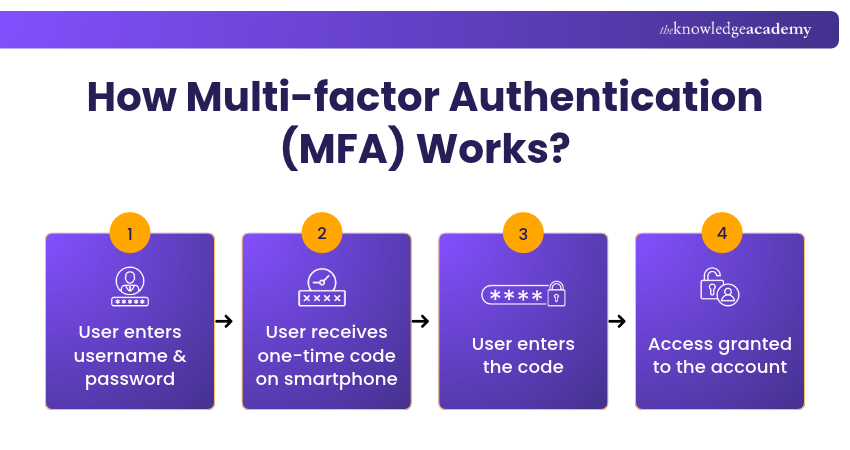
Explanation: Multi-factor Authentication (MFA) requires users to provide additional verification beyond a password. This reduces the likelihood that stolen credentials alone can be used to gain unauthorised access.
Here's how MFA works:
19) An IT Auditor discovers that former employees still have active system accounts. What is the PRIMARY risk?
a) Increased software performance
b) Unauthorised access to organisational information
c) Reduced network bandwidth
d) Delayed software updates
Answer: Option b) Unauthorised access to organisational information
Explanation: Active accounts belonging to former employees create opportunities for unauthorised access. Effective access management requires timely account deactivation and regular reviews to ensure permissions remain appropriate.
20) An organisation detects signs of possible unauthorised access to confidential information. What is the MOST appropriate initial response?
a) Immediately delete all affected files
b) Publicly announce the incident before confirming the details
c) Follow the incident response procedures to assess and contain the threat
d) Ignore the incident until the next scheduled audit
Answer: Option c) Follow the incident response procedures to assess and contain the threat
Explanation: Following established incident response procedures helps an organisation assess the situation, contain potential damage and preserve relevant evidence. The response should reflect the severity of the incident and applicable organisational and regulatory requirements.
Keep This in Mind
Success in the CISA exam depends on understanding auditing principles and applying them to practical situations. Focus on the reasoning behind each answer, revisit areas where you make mistakes and practise consistently across all five domains.
Unlock the skills needed to protect systems, networks, and data from cyber threats with Cyber Security Training – Join now!

The Knowledge Academy develops accessible learning content across Project Management, IT, Cybersecurity, Data Science, Business Analysis, HR, Accounting and Finance, Leadership and Health and Safety. Its resources combine subject research with clear explanations to help professionals build practical knowledge across a wide range of disciplines.
View Detail

 If you wish to make any changes to your course, please


