


 Top Rated Course

We may not have the course you’re looking for. If you enquire or give us a call on +34 932716793 and speak to our training experts, we may still be able to help with your training requirements.
What is Speed Reading? A Complete Guide
The Knowledge Academy 05 February 2026Have you ever wondered what Speed Reading is and how people manage to devour books at lightning speed? This blog discusses Speed Reading, its different types, and the advantages to readers. Continue reading below to learn several reading methods, strategies to improve reading speed, and advice for enhancing Speed Reading ability gradually.

Training Outcomes Within Your Budget!
We ensure quality, budget-alignment, and timely delivery by our expert instructors.
Table of Contents
Speed reading is a transformative skill that empowers you to absorb information swiftly without losing comprehension of the main ideas. But what exactly does speed reading involve, and how can it boost your information processing abilities?
At its core, speed reading is about improving reading efficiency through techniques like skimming, scanning, and using visual aids like pointers or guides to keep your attention focused. By training your brain to recognise patterns and process chunks of text faster, speed reading helps you stay engaged with the content while reducing the time spent on each page.
In this blog, we’ll delve into the fundamentals of speed reading, how it works, and practical tips for developing this skill to elevate your learning and productivity.
Table of Contents
1) What is Speed Reading?
2) Different Types of Reading
3) Steps to Learn Speed Reading
4) How to Improve Your Speed Reading?
5) Conclusion
What is Speed Reading?
Speed reading is an ability that enables individuals to rapidly comprehend written content. When individuals engage in Speed Reading, they are able to grasp extensive paragraphs and chunks of information rather than proceeding slowly through each phrase word by word.
Even though some people can quickly scan a page and grasp the main idea. Speed Reading facilitates readers to achieve a thorough understanding of the content without overlooking any details. Although most individuals read at a rate of 200-300 words per minute, Speed Readers can read at twice or even three times that speed.

Different Types of Reading
The main three types of reading are:

1) Textbooks
Initially, start by reading textbooks. As a scholar, you will have a deep understanding of this kind of reading. Textbooks frequently contain extensive portions of unnecessary text. Feel free to skip over these paragraphs or even whole sections without fear. Pay attention to the text in bold and prioritise that information over the rest for a quicker understanding.
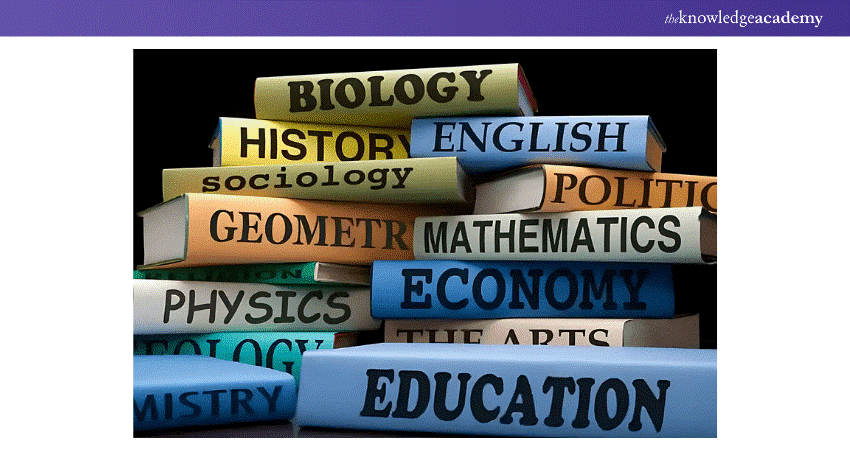
Previewing sections by scanning the chapter and reviewing section headings and bolded terms will prepare you to understand the key points. It might require a minute or two initially, but in the end, you should save time if done correctly.
Pause and recap your understanding after finishing a section or page. You can either say it aloud to yourself or write down a few key points. This significantly enhances the ability to remember and understand.
2) Books for Leisure
When it comes to reading for enjoyment, feel free to choose any book. If you wish to appreciate the subtleties of the author's language, then take your time. Nonetheless, if you simply desire to grasp the main idea, it is okay if your understanding decreases significantly.
The outcome greatly relies on the specific book and what you are aiming to gain from it. I take my time and read every word of certain books, while I skip sections of others. Most of the book's land in the middle ground.
3) Research
As a premed, med student, or resident, you will need to read numerous research articles, so it is important to approach them in a systematic manner. Carefully read the abstract at a slow pace to identify key points for better comprehension. When you are reading the entire article, pay attention to those specific key areas. Pay close attention to specific key areas of the article, this is where Critical Reading comes into play, enabling deeper understanding and analysis.
Review the summary and some opening paragraphs, glance through the methods and results sections for key highlights, and then thoroughly get insights into the discussion section.
Steps to Learn Speed Reading
The fundamental concept of Speed Reading centers around eliminating a process known as "subvocalisation" during reading. Subvocalisation is when you mentally pronounce each word individually, causing a decrease in reading speed.
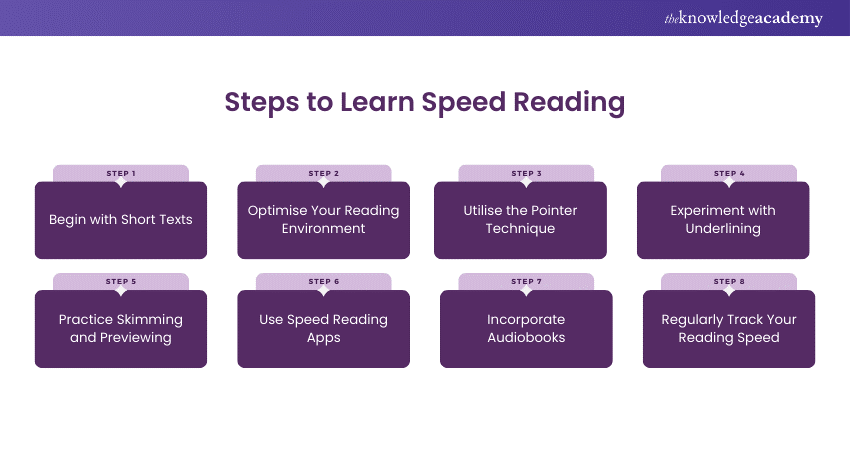
If you stop silently repeating words, you'll be able to read and write faster than when speaking. Follow these strategies to begin mastering the skill of Speed Reading:
1) Begin with Short Texts
Begin your Speed Reading journey by choosing a simple document or familiar text to practice on. Select a book or an uncomplicated piece on a topic you're already familiar with, and gradually move on to more difficult content at a more advanced reading level.
2) Optimise Your Reading Environment
When you start to learn Speed Reading, it can be easy to be distracted and significantly lose focus. Select a peaceful location with adequate lighting to minimise interruptions during practice. Being at ease enables you to concentrate on the words in front of you and their significance.
Select instrumental tracks without lyrics as your preferred Type of Music if listening to music assists in concentrating, to prevent your brain from handling multiple information sources concurrently.
3) Utilise the Pointer Technique
The method of using a pointer is a technique for starting to learn how to speed read by physically tracking the words as you read them. As you read, place a notecard under each line or move your finger along the page. This technique is alternatively referred to as meta guiding or hand pacing.
When reading on a screen, use the mouse pointer to follow along with the sentences in the document. This enables you to quickly link words with their meanings visually and be more purposeful in the way you absorb information, saving you from needing to backtrack and re-read text when you lose your focus.
4) Experiment with Underlining
If the pointer technique is not holding your attention, underline or highlight the word you are reading. This can assist you in gradually speeding up and focusing on the significance of every word. When employing the technique of underlining, intentionally begin at a slow pace and then gradually extend the duration spent on each line.
Gradually increasing the speed of your pen while highlighting can unconsciously lead to quicker reading. It’s just like controlling your breathing can help you determine your running pace.
5) Practice Skimming and Previewing
Another method for practicing Speed Reading involves deliberately scanning the page vertically, identifying recognised keywords and phrases in each line. Unlike other Speed-reading techniques, previewing does not necessitate reading every word. Key names, numbers, and recurring phrases should become more apparent with practice, allowing the reader to logically infer the content between these main words.
6) Use Speed Reading Apps
Technology can also help in the development of Speed Reading skills, either in conjunction with other techniques or independently. Mobile and web applications separate a portion of text and show individual words on the screen gradually, eventually increasing in speed. These applications assist in enhancing your brain's innate reading speed and restricting the time you dedicate to subvocalising.
7) Incorporate Audiobooks
Another way to enhance your Speed Reading skills is by listening to audiobooks. When you listen to audiobooks, you eliminate the option of subvocalisation by replacing it with another person's voice inside your mind. Attempt to read the text while simultaneously playing an audio recording of the information, keeping up with the same speed, which enhances your Reading Skills.
Certain audio programs enable you to increase your reading speed. This allows you to gradually practice reading at a faster pace as you keep pace with the narrator's voice accelerating over time.
8) Regularly Track Your Reading Speed
Regularly evaluate your reading speed to determine the most effective methods for you. There are multiple online platforms available for you to take a brief assessment, which can be utilised to monitor your advancement towards achieving your objective.
How to Improve Your Speed Reading?
Here are some steps to follow to improve your Speed Reading:
Turn Ideas into Stories Enhance Your Writing Potential with our Creative Writing CourseRegister Now!
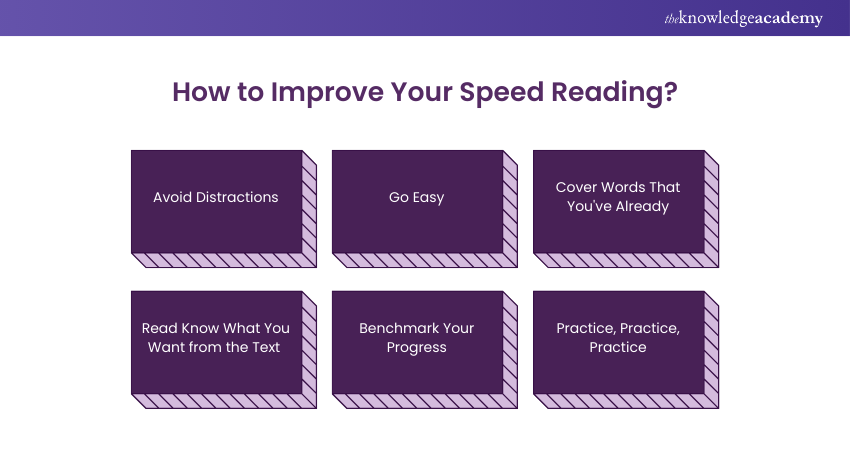
1) Avoid Distractions
Design a setting with minimal interruptions and distractions to enable complete focus on the words in front of you. The reading space should be free from external noise and interruptions.
2) Go Easy
Establish a setting with minimal interruptions and distractions to enable complete concentration on the text in front of you. Read a straightforward book or an easy online article to determine which method is most effective for you. Estimate how well you have retained or comprehended information, and time yourself to measure how much quicker you are at reading now.
3) Cover Words That You've Already
Cover the words that are already covered because this will assist in preventing your eyes from darting back to previous words, thus reducing the pace of your reading.
4) Read Know What You Want from the Text
Understand your expectations for the text. This is beneficial when employing the skimming technique, as it prepares you to focus when encountering pertinent words, sentences, or phrases. You can choose to decelerate or highlight these points by circling them, but otherwise, proceed swiftly across the page.
Get Proper knowledge of Punctuation and Correctness of Your Writings with our Proofreading Course Register Now!
5) Benchmark Your Progress
Benchmarking the progress will help to tell whether your practice is paying off or not. There are many free Speed Reading assessments online, which can be a good idea to increase and track progress.
6) Practice, Practice, Practice
Practice, practice, practice means that to efficiently enhance the Speed Reading skills, one must practice more and more to become good at it. The greater your practice, the more instinctive it will become. For those looking for structured methods, a Reading Strategies PDF can offer useful techniques to speed up the process.
Conclusion
Speed reading is a great technique to improve how efficiently you read, allowing you to go through more content in a shorter amount of time. By regularly practising, using the correct methods, and knowing the various types of reading, you can enhance both your speed and retention. Stay committed to monitoring your development and maintaining your concentration, and in no time, you will be able to read extremely fast.
Master your Editing and Writing Skills with our Writing and Editing Course Sign up Now!
Frequently Asked Questions
What is Reading Speed Influenced by?

The rate at which someone reads can be influenced by several factors such as the difficulty of the material, the reader's knowledge of the topic, and their level of focus. Easier content or well-known subjects result in quicker reading, whereas challenging material necessitates additional time.
Who Introduced Speed Reading?
Evelyn Nielsen Wood (January 8, 1909 – August 26, 1995) was a well-known American educator and businesswoman who gained fame for promoting Speed Reading, although she favored calling it "dynamic reading".
What are the Other Resources and Offers Provided by The Knowledge Academy?
The Knowledge Academy takes global learning to new heights, offering over 3,000+ online courses across 490+ locations in 190+ countries. This expansive reach ensures accessibility and convenience for learners worldwide.
Alongside our diverse Online Course Catalogue, encompassing 19 major categories, we go the extra mile by providing a plethora of free educational Online Resources like Blogs, eBooks, Interview Questions and Videos. Tailoring learning experiences further, professionals can unlock greater value through a wide range of special discounts, seasonal deals, and Exclusive Offers.
What is The Knowledge Pass, and How Does it Work?
The Knowledge Academy’s Knowledge Pass, a prepaid voucher, adds another layer of flexibility, allowing course bookings over a 12-month period. Join us on a journey where education knows no bounds.
What are the Related Courses and Blogs Provided by The Knowledge Academy?
The Knowledge Academy offers various Personal Development Courses, including the Content Writing and Practitioner Course, and the Creative Writing Course. These courses cater to different skill levels, providing comprehensive insights into Business Skills.
Our Business Skills Blogs cover a range of topics related to Journalism and Writing Courses, offering valuable resources, best practices, and industry insights. Whether you are a beginner or looking to advance your Business Management skills, The Knowledge Academy's diverse courses and informative blogs have got you covered .

The Knowledge Academy


Global Training Provider
The Knowledge Academy is a world-leading provider of professional training courses, offering globally recognised qualifications across a wide range of subjects. With expert trainers, up-to-date course material, and flexible learning options, we aim to empower professionals and organisations to achieve their goals through continuous learning.

Upcoming Business Skills Resources Batches & Dates
Date
 Speed Writing Course
Speed Writing Course
Fri 21st Aug 2026
Speed Writing Course
Fri 13th Nov 2026

 If you wish to make any changes to your course, please


