


 Top Rated Course

We may not have the course you’re looking for. If you enquire or give us a call on +34 932716793 and speak to our training experts, we may still be able to help with your training requirements.
What is Price Skimming? A Complete Overview
James Smith 04 February 2026Price Skimming is a pricing strategy where businesses launch new or innovative products at a high price to target early adopters and maximise initial revenue. As demand from premium buyers slows, prices are gradually reduced to reach more price-sensitive customers, expand market reach, and remain competitive as the market matures today!

Training Outcomes Within Your Budget!
We ensure quality, budget-alignment, and timely delivery by our expert instructors.
Table of Contents

Pricing plays a crucial role in the success of any new product, especially in competitive markets. One strategy that helps businesses maximise early revenue and manage market demand is Price Skimming. In this blog, we’ll provide a complete overview of What is Price Skimming, how it works, its advantages and disadvantages, and when businesses should use it to strategically position their products and boost profitability.
Table of Contents
1) What is Price Skimming?
2) How Price Skimming Works?
3) Advantages of Price Skimming
4) Disadvantages of Price Skimming
5) Example of Price Skimming
6) Four Signs Why Price Skimming Fits Business
7) What Data and Tools can be Used to Optimise a Price Skimming Strategy?
8) What Types of Businesses Use Price Skimming?
9) Conclusion
What is Price Skimming?
Price Skimming is a strategy where a company initially sets a high price for a new product, targeting customers who are eager and willing to pay a premium. Over time, as these early adopters are satisfied and competition increases, the company gradually lowers the price to attract more price-sensitive customers.
The term "Price Skimming" comes from the idea of "skimming" layers off the top, much like removing cream from milk. This approach contrasts with penetration pricing, which starts with a low price to quickly build a large customer base. Instead, Price Skimming aims to maximise early profits by leveraging high initial prices before adjusting to more competitive levels.

How Price Skimming Works?
Price Skimming is a strategic pricing approach used when launching a new product. Here's how it works:
a) Launch at a High Price: The product is launched into the market at a premium price to signal exclusivity, innovation or high value. This creates a strong first impression and targets consumers willing to pay more for early access.
b) Target Early Adopters: These customers prioritise being the first to own or experience a new product. They are typically less sensitive to price and more focused on the product’s features, status or innovation.
c) Gradual Price Reductions: Once early demand slows, the company slowly lowers the price to attract more budget-conscious customers. Each price drop opens the door to a new customer segment.
d) Expand to the Mass Market: As time progresses, the product becomes more accessible to a broader audience. The reduced price drives mainstream adoption, enabling the company to maximse both market share and overall revenue.
1) Ideal Conditions for Price Skimming
a) The product is new, unique, or highly innovative, with minimal direct competition.
b) The company enjoys strong brand recognition or loyalty, which supports higher pricing.
c) Competition is limited during the launch phase, allowing for a pricing advantage.
d) Early demand is strong, and there is a clear segment willing to pay a premium.
2) Steps to Successfully Apply Price Skimming
The pricing strategy must be precise and intelligent to implement Price Skimming, adhering to the pricing strategies, customer behaviour, and market timing. Here are the steps to follow to apply Price Skimming:
a) Analyse Customer Price Sensitivity: Determine market areas that are under price-sensitive, often early adopters who are willing to pay a premium to buy new or innovative products.
b) Calculate Cost and Profitability: fixed and variable costs, including R&D, production, and marketing, should be evaluated to make the initial high price offset the costs and generate a good margin.
c) Plan Gradual Price Reductions: Reduce prices gradually over a period in order to access a wider and more price-sensitive audience, although the product status should not be compromised.
d) Highlight Premium Value: Demonstrate the outstanding advantages, peculiarities of the product, and prove the superior price, which confirms quality, exclusiveness, and demand of interest to those buyers.
Advantages of Price Skimming
Price Skimming offers several strategic benefits, especially for businesses launching new or innovative products. Below are some key advantages of this approach:
1) Recover Sunk Costs Faster
Launching a product at a high price allows companies to quickly recoup research, development, and marketing expenses, making it ideal for sectors with significant upfront investments.
2) High Profit Margins
Early adopters are often willing to pay a premium, allowing the business to achieve higher profit margins before competitors enter the market or prices are reduced.
3) Quality Brand Perceptions
Launching with a premium price communicates exclusivity and high value, strengthening the brand’s reputation and positioning the product as a high-quality or luxury offering.
Disadvantages of Price Skimming
Price Skimming can be effective; it also comes with drawbacks that businesses should consider before using this strategy. Here are some common disadvantages:
1) Price Deterrence
High initial prices may deter potential customers, especially in price-sensitive markets. It can reduce early adoption and limit the initial customer base.
2) Limited Sales Volume
The high price can lead to fewer units sold during the early stages, slowing down overall market penetration and adoption.
3) Inefficient Long-term Strategy
Over time, competitors may offer similar features at lower prices. This makes Price Skimming less effective as a long-term strategy and may force the company to adjust quickly.
4) Consumer Loyalty
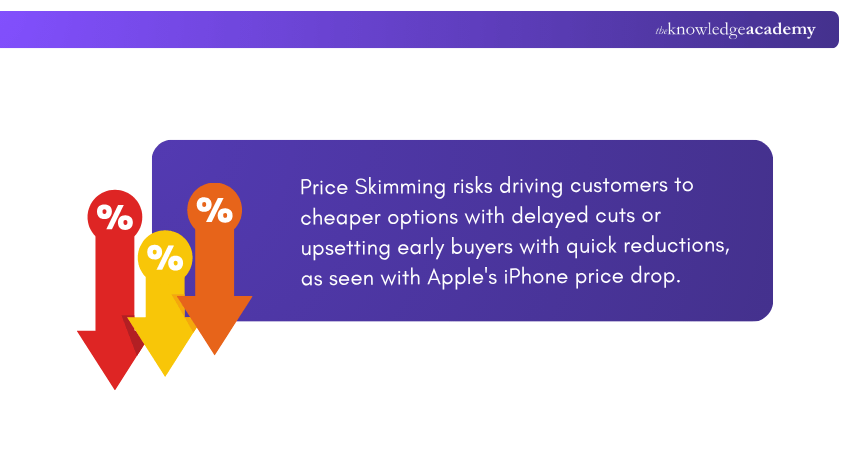
Customers who pay the initial high price may feel frustrated when the price drops later. This can hurt brand loyalty and lead to dissatisfaction or negative reviews.
Explore essential economic insights, market dynamics, and strategies to drive organisational success with our Economics For Managers Course- Join now!
Example of Price Skimming
After the initial demand at P1 is met, Company A lowers the price to P2. This follow-on pricing is aimed at attracting more price-sensitive customers who were previously unwilling to purchase at the higher price. It also acts as a strategic move to discourage competitors from entering the market by tightening profit margins. Through this two-tier pricing approach, the company extends its product’s market reach while maintaining profitability at different demand levels.
Here is an example of Price Skimming:
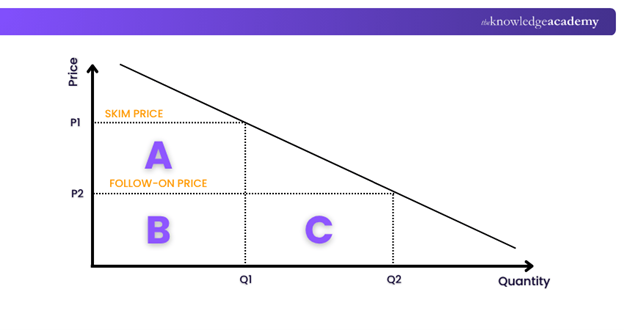
Key Elements:
1) P1 (Skim Price): The initial high price set when the product is first launched
2) P2 (Follow-On Price): The lower price set later to attract more customers
3) Q1 and Q2: Quantities sold at different price levels
4) A, B, C: Represent market segments or consumer groups
Explanation
1) Stage 1: Skim Price (P1)
a) The company starts with a high price (P1) to target early adopters who are less sensitive to price
b) The initial market captured is Area A (small quantity, high margin)
2) Stage 2: Price Reduction (P2)
a) Over time, the price drops to P2 (Follow-On Price) to attract more price-sensitive customers
b) This expands the market to Area B and C (more quantity, lower margin)
3) Consumer Segments:
a) A: Early adopters willing to pay the high skim price
b) B: Customers who join when the price drops
c) C: Customers who are even more price-sensitive join at later stages
Learn practical techniques to tackle challenges effectively in any business scenario with our Problem Solving Course- Sign up today!
Four Signs Why Price Skimming Fits Business
Before committing to a Price Skimming strategy, it's essential to evaluate your products and market conditions. Here are four signs that Price Skimming might be the right approach for your business:
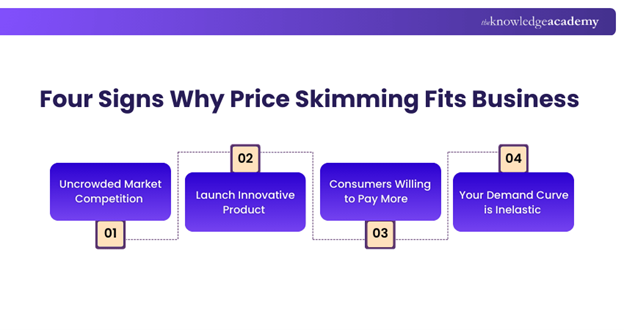
1) Uncrowded Market Competition
Price Skimming works best in markets with few competitors. If your industry isn't saturated, you can introduce new products at a high initial price. Ask yourself:
a) Is your product among the first of its kind?
b) What do similar brands offer?
c) How can you market your product to early adopters who are less sensitive to price?
2) Launch Innovative Product
If your product is perceived as innovative and indispensable, like those from Apple or Nike, Price Skimming can be effective. Consider:
a) What are your product’s unique features?
b) What makes it one-of-a-kind and the result of careful Research and Development (R&D)?
c) How can customers use it to make a significant difference in their lives?
d) How can you ensure its quality surpasses what's currently available?
e) What makes it difficult for competitors to replicate?
3) Consumers Willing to Pay More
Conduct market research to identify price-insensitive early adopters. Leverage their willingness to pay more:
a) Are segments of your customer base repeat buyers and loyal to your brand?
b) Do they perceive your brand as offering higher value than others?
c) Do they take pride in being the first to get the latest products?
d) Do they expect higher prices?
4) Your Demand Curve is Inelastic
If price changes don't significantly affect demand for your product, you have an inelastic demand curve. This means the need for your product remains steady regardless of price changes. Factors to consider include:
a) Products that take up a large part of a consumer's budget tend to have elastic demand
b) With few or no substitutes, demand is usually inelastic
c) Necessities like lifesaving drugs often have inelastic demand regardless of price changes
Boost leadership skills and team success with our expert-led Introduction to Management Courses - Join today!
What Data and Tools Can be Used to Optimise a Price Skimming Strategy?
To optimise a Price Skimming strategy, businesses need detailed pricing data, demand forecasts and insights into customer behaviour, including purchasing patterns and price sensitivity.
Tools such as predictive analytics software and CRM platforms help analyse these metrics, while pricing simulation tools can model the impact of price changes on profit margins. Market research tools provide competitive insights and identify segments willing to pay a premium, enabling companies to refine their strategy and maximise revenue.
What Types of Businesses Use Price Skimming?
Price Skimming is commonly used by businesses operating in industries where products involve high initial development costs and generate significant consumer interest. Technology companies such as Apple and Samsung frequently apply this strategy for the launch of new smartphones and other innovative devices.
High-end fashion brands and premium automobile manufacturers also employ Price Skimming to capitalise on early demand and reinforce the perception of quality and exclusivity.
Conclusion
Price Skimming is a powerful pricing strategy that allows businesses to maximise early profits, recover development costs quickly, and position their products as premium offerings. When applied strategically, it enables companies to reach early adopters, gradually expand to price-sensitive customers, and maintain a competitive edge. Understanding What is Price Skimming is key to making an effective tool for driving revenue and strengthening brand perception.
Ensure compliance, improve quality standards, and optimise supplier relationships with our Supplier Quality Management Training- Join today!
Frequently Asked Questions
Is Price Skimming Elastic or Inelastic?

Price Skimming typically targets inelastic demand. Early adopters are less sensitive to price changes and willing to pay a premium for new, innovative products. As prices decrease over time, the strategy then appeals to more price-sensitive consumers.
How Effective is Price Skimming?
Price Skimming is effective when used strategically. It maximises early profits, recovers costs quickly, builds a premium brand image, allows market segmentation, discourages early competition, and supports Product Lifecycle Management through gradual price adjustments.
What are the Other Resources and Offers Provided by The Knowledge Academy?
The Knowledge Academy takes global learning to new heights, offering over 3,000+ online courses across 490+ locations in 190+ countries. This expansive reach ensures accessibility and convenience for learners worldwide.
Alongside our diverse Online Course Catalogue, encompassing 19 major categories, we go the extra mile by providing a plethora of free educational Online Resources like Blogs, eBooks, Interview Questions and Videos. Tailoring learning experiences further, professionals can unlock greater value through a wide range of special discounts, seasonal deals, and Exclusive Offers.
What is The Knowledge Pass, and How Does it Work?
The Knowledge Academy’s Knowledge Pass, a prepaid voucher, adds another layer of flexibility, allowing course bookings over a 12-month period. Join us on a journey where education knows no bounds.
What are the Related Courses and Blogs Provided by The Knowledge Academy?
The Knowledge Academy offers various Management Courses, including the Management Training for New Managers Course, Costing and Pricing Training and the Introduction to Management Course. These courses cater to different skill levels, providing comprehensive insights into Top Budgeting Skills.
Our Business Skills Blogs cover a range of topics related to Management, offering valuable resources, best practices, and industry insights. Whether you are a beginner or looking to advance your Management skills, The Knowledge Academy's diverse courses and informative blogs have got you covered.

James Smith


Digital Marketing Manager and Trainer
James Smith is a digital marketing professional with over a decade of experience in SEO, content strategy, paid media and analytics. He has supported both SMEs and global brands in transforming their digital presence. James’s writing and training are rooted in results-driven tactics and the latest marketing trends.
View Detail
Upcoming Business Skills Resources Batches & Dates
Date
 Costing and Pricing Training
Costing and Pricing Training
Fri 31st Jul 2026
Costing and Pricing Training
Fri 23rd Oct 2026

 If you wish to make any changes to your course, please


