


 Top Rated Course

We may not have the course you’re looking for. If you enquire or give us a call on +34 932716793 and speak to our training experts, we may still be able to help with your training requirements.
What is a Mind Map | Meaning & Uses
The Knowledge Academy 05 May 2026A Mind Map is a visual tool for organising ideas, tasks, and concepts around a central topic, helping improve clarity, creativity, and structured thinking. It starts with one central idea and branches out into related topics, keywords, and sub-points, making it easier to see connections, remember information, and generate ideas.

Training Outcomes Within Your Budget!
We ensure quality, budget-alignment, and timely delivery by our expert instructors.
Table of Contents
Have you ever opened a notebook to plan something important and ended up with messy lists, arrows, or scattered notes? Our brains do not always have a linear way of thinking since they tend to jump between ideas and connections. That is exactly where it is essential to understand What is a Mind Map. Whether you are a learner, professional, or creator, this method helps to turn scattered thoughts into clear and cohesive ideas.
Effectively understanding What is a Mind Map can completely transform how you brainstorm, learn, plan projects, and solve problems. It shows your ideas as a visual network, making information easier to remember, process, and expand. In this blog, you will learn about Mind Mapping, how to create one, its core features, and more!
Table of Contents
1) What is Mind Mapping?
2) What are Mind Maps Used For?
3) How to Create a Mind Map?
4) Mind Mapping Tips and Techniques
5) Benefits of Mind Mapping
6) Conclusion
What is Mind Mapping?
Mind Mapping is a visual brainstorming technique used to organise information in a clear, structured, and connected way. It places one central idea at the core and builds related ideas around it in branching layers. Each branch represents a sub-topic, and smaller branches show supporting keywords or examples, making it easier to understand information at a glance.
Mind Mapping is widely used to generate ideas, explore topics, and break down complex problems into manageable parts. The approach reflects how the brain naturally links ideas, making it easier to identify relationships, improve understanding and build creative solutions.

What are Mind Maps Used For?
Mind Maps are used across various fields to help teams and individuals structure ideas, understand information, and approach tasks more clearly. Some of the common uses of Mind Map include:
1) Brainstorming and Ideation: Mind Maps encourage free-flowing idea generation, allowing thoughts to branch out naturally without any strict order.
2) Project Planning and Management: Mind Maps help to outline the project phase, design structure, timelines, and the overall project lifecycle.
3) Note-taking and Knowledge Management: Mind Maps simplify complex topics and improve understanding, recall, and documentation.
4) Creative Writing and Content Creation: Mind Maps are widely used by writers to organise story ideas, plot flow, themes, and character development.
5) Problem-solving and Decision-making: Mind Maps act as a strategic thinking tool to break down problems and explore possible solutions.
6) Personal Goal Setting: Mind Maps help people define tasks, track priorities, and plan clear, achievable steps to achieve their goals.
How to Create a Mind Map?
Learning how to create a Mind Map is a simple step-by-step process that helps you turn scattered ideas into a clear visual structure. Let’s look at the steps to help you build an effective Mind Map below:
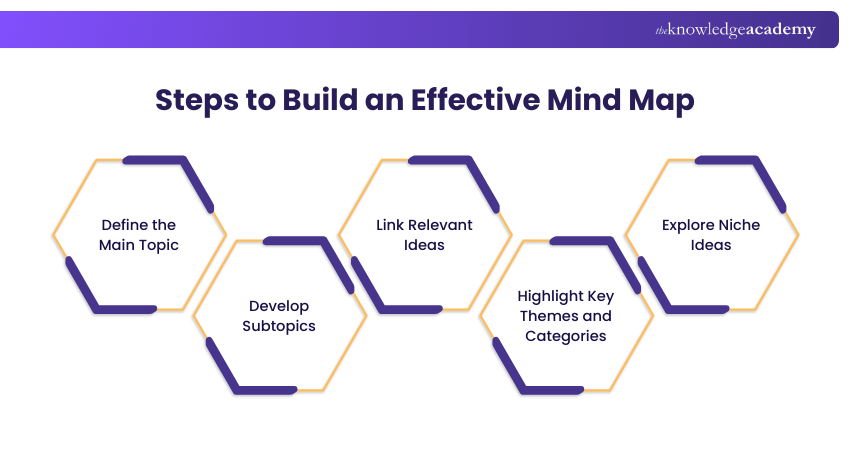
1) Define the Main Topic
Begin by writing the primary topic in the centre of your page or workspace. Keep it short and clear, such as a keyword or a brief phrase. You can also draw a small symbol or image to represent the idea and make it memorable.
2) Develop Subtopics
Next, add three to five main subtopics related to your central idea. Draw branches outward from the centre and label them with key themes. From each subtopic, continue adding smaller branches with related thoughts, examples, or supporting points. Quick associations are enough at this stage, as the goal is to capture ideas naturally.
3) Link Relevant Ideas
Proceed to link ideas that belong together using lines, shapes, or colour coding. This helps you identify patterns, overlaps, and relationships that may not be obvious otherwise. Group similar points under shared themes wherever possible.
4) Highlight Key Themes and Categories
Review all the branches and highlight the most relevant themes based on your goal. Then, reorganise if needed so the most important categories stand out clearly and your Mind Map moves in a focused direction.
5) Explore Niche Ideas
Finally, expand on the strongest branches by adding more detail. Include examples, supporting facts, action steps, or relevant next moves. This transforms your Mind Map from a simple brainstorming exercise into a practical planning and thinking framework.
Enhance your analytical and problem-solving skills with our Business Analyst Courses – Sign up today!
Mind Mapping Tips and Techniques
Mind Mapping is a powerful technique that can be enhanced with specific strategies and best practices. To make the most of your Mind Maps, consider these tips and strategies:
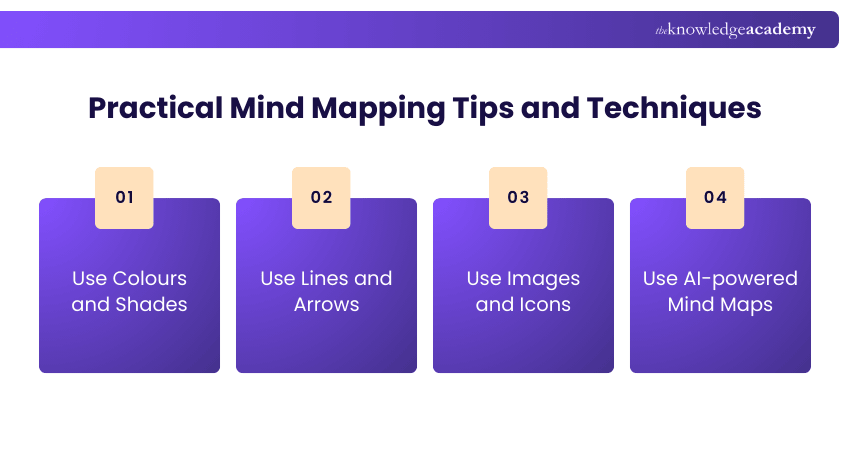
1) Colours and Shades
Apply a different colour to each main branch to separate sections clearly and briefly. For deeper levels, use lighter or darker shades of the same colour to show hierarchy. This colour grouping helps your brain recognise categories and relationships effectively.
2) Lines and Arrows
Use different styles of line to show the strength or type of connection between ideas. Thicker lines can show stronger links, while thinner lines can show weaker relationships. Arrows can indicate direction or cause and effect, along with a small legend to explain your line styles.
3) Images and Icons
Utilise small drawings, symbols, icons, or emojis to represent ideas visually. Images help explain abstract concepts faster than words and improve memory retention. Even incorporating simple sketches can make your Mind Map more engaging and easier to review.
4) AI-powered Mind Maps
Many modern Mind Mapping platforms include AI features that suggest related branches based on your central topic. This can be especially helpful when you feel stuck or want to explore additional perspectives. Treat AI suggestions as inspiration rather than final answers, refining and organising them with your own thinking to maintain originality and clarity.
Turn messy work into clear, optimised systems with Business Process Mapping Training now!
Benefits of Mind Mapping
There are various benefits Mind Mapping offers in comparison to traditional note-taking since it follows how the brain naturally connects ideas. Let’s look at some of the benefits below:
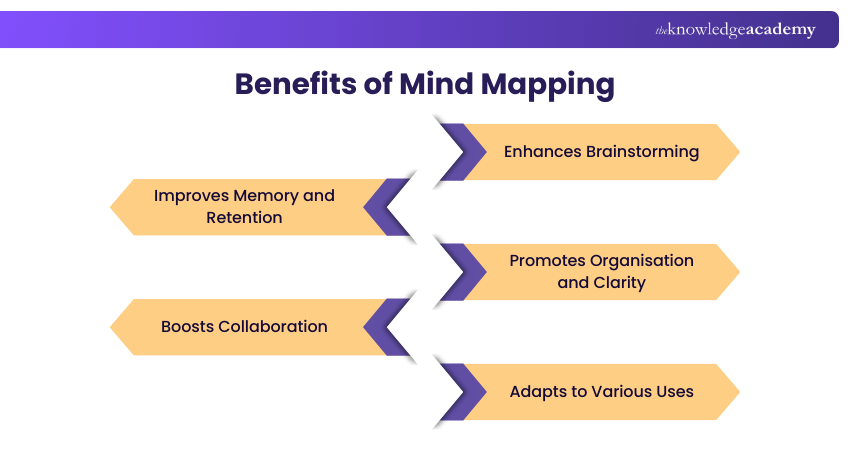
1) Enhances Brainstorming
Mind Maps support free-flow idea generation by letting thoughts branch naturally from a central concept. There is no pressure to think in a rigid and strict order, which reduces creative blocks and encourages more diverse and original ideas.
2) Improves Memory and Retention
Mind Maps match the brain’s associative memory style by linking ideas visually. Colours, shapes, and spatial layout create multiple memory cues, helping to understand complex topics and remember them for longer.
3) Promotes Organisation and Clarity
Mind Maps organise information into clear branches and levels without losing idea connections. This makes complex subjects easier to break down while keeping the overall picture visible and understandable.
4) Boosts Collaboration
Mind Maps give teams a shared visual structure for discussing and refining ideas. Different perspectives become easier to align, and teams can quickly identify gaps, overlaps, and conflicts during group thinking.
5) Adapts to Various Uses
Mind Maps are flexible and work for study, planning, writing, strategy building, and goal setting. They can be scaled for simple personal tasks or complex team projects without changing the core method.
Conclusion
Understanding What is a Mind Map gives you a powerful way to turn scattered thoughts into clear, connected ideas. Whether you are in the process of brainstorming, studying, or solving a problem, Mind Mapping helps you think creatively and organise information effectively. Using this visual thinking method becomes a go-to approach for facilitating clearer decisions, better ideas, and more structured outcomes.
Learn to turn data into smart business decisions with Business Analyst Fundamentals Training today!
Frequently Asked Questions
What is the Difference Between Mind Maps and Concept Maps?

Mind Maps and concept maps both show ideas using links, but they differ in their structure. Mind Maps are hierarchical, built around one central topic or theme with branching levels. In contrast, a concept map is non-hierarchical and shows connections between multiple ideas without a single centre.
What Tools Can I Use for Mind Mapping?
Mind Mapping can be done with a simple pen and paper, but digital tools make it faster and more flexible. Some of the popular tools include:
1) MindView
2) MindManager
3) Miro
These tools help individuals and teams build and share maps easily.
What are the Other Resources and Offers Provided by The Knowledge Academy?
The Knowledge Academy takes global learning to new heights, offering over 3,000 online courses across 490+ locations in 190+ countries. This expansive reach ensures accessibility and convenience for learners worldwide.
Alongside our diverse Online Course Catalogue, encompassing 19 major categories, we go the extra mile by providing a plethora of free educational Online Resources like Blogs, eBooks, Interview Questions and Videos. Tailoring learning experiences further, professionals can unlock greater value through a wide range of special discounts, seasonal deals, and Exclusive Offers.
What is The Knowledge Pass, and How Does it Work?
The Knowledge Academy’s Knowledge Pass, a prepaid voucher, adds another layer of flexibility, allowing course bookings over a 12-month period. Join us on a journey where education knows no bounds.
What are the Related Courses and Blogs Provided by The Knowledge Academy?
The Knowledge Academy offers various Business Analyst Course, including Mind Mapping Training, Business Process Mapping Training and Business Analyst Fundamentals Training. These courses cater to different skill levels, providing comprehensive insights into the Business Analysis Services.
Our Business Analysis Blogs cover a range of topics related to Mind Mapping, offering valuable resources, best practices, and industry insights. Whether you are a beginner or looking to advance your Mind Mapping skills, The Knowledge Academy's diverse courses and informative blogs have you covered.

The Knowledge Academy


Global Training Provider
The Knowledge Academy is a world-leading provider of professional training courses, offering globally recognised qualifications across a wide range of subjects. With expert trainers, up-to-date course material, and flexible learning options, we aim to empower professionals and organisations to achieve their goals through continuous learning.

Upcoming Business Analysis Resources Batches & Dates
Date
 Mind Mapping Training
Mind Mapping Training
Fri 31st Jul 2026
Mind Mapping Training
Fri 30th Oct 2026

 If you wish to make any changes to your course, please


