


 Top Rated Course

We may not have the course you’re looking for. If you enquire or give us a call on +34 932716793 and speak to our training experts, we may still be able to help with your training requirements.
How to Create a Cryptocurrency: A Complete Beginner’s Guide
The Knowledge Academy 04 March 2026Create a cryptocurrency by developing a new blockchain, adapting an existing one, or issuing a token on a platform, the simplest and least technical method. Tokens offer faster deployment and lower development costs. This makes cryptocurrency ideal for startups that are aiming to launch quickly and scale efficiently.

Training Outcomes Within Your Budget!
We ensure quality, budget-alignment, and timely delivery by our expert instructors.
Table of Contents

Creating your own cryptocurrency may seem daunting, but it is far more accessible than most people realise. With blockchain technology rapidly evolving, individuals and businesses are increasingly exploring custom digital currencies. Understanding the core steps can turn a complex concept into a structured, achievable process.
Whether you want to innovate, solve a specific problem, or build a new digital ecosystem, the journey begins with the right knowledge. This blog on How to Create a Cryptocurrency breaks down each stage clearly, helping you navigate development, security, and launch with confidence.
Table of Contents
1) A Brief Overview of the Basics of Cryptocurrency
2) How to Create a Cryptocurrency?
3) Pros and Cons of Making a Cryptocurrency
4) What to Know Before Making a Cryptocurrency
5) How Cryptocurrency Works?
6) How Much Does it Cost to Make a Cryptocurrency?
7) Conclusion
A Brief Overview of the Basics of Cryptocurrency
Cryptocurrency, or crypto, is a fully digital form of money that allows online and some physical transactions without carrying cash. Unlike government-issued currency, various companies issue cryptocurrencies.
Cryptos are fungible, meaning their value remains constant during trading, unlike non-fungible tokens (NFTs) whose worth varies. While largely unregulated, crypto gains and losses must be reported to HM Revenue and Customs for taxation.

How to Create a Cryptocurrency?
Now let’s look into How to Create a Cryptocurrency. Creating one might seem complex, but with the right approach, anyone can launch a digital currency. From defining your purpose to marketing your project, each step ensures your cryptocurrency is functional, secure, and appealing to users.
Here’s a detailed guide to help you bring your digital currency to life:
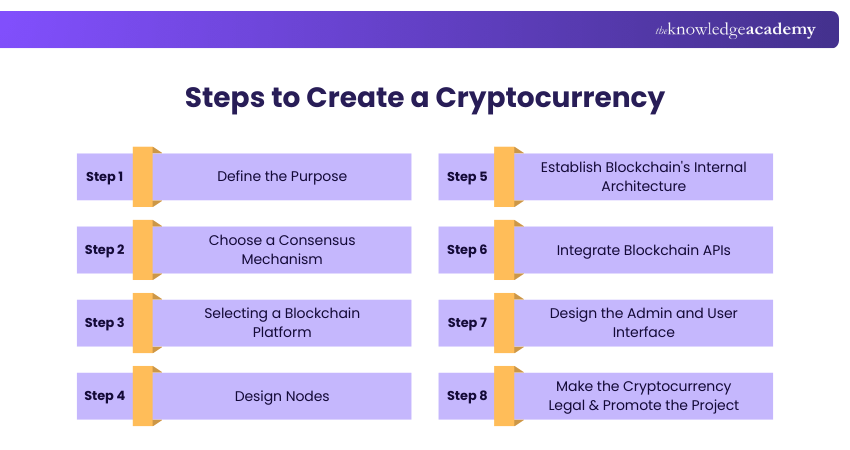
1) Step 1: Define the Purpose
One of the first steps towards making a cryptocurrency is that of establishing its purpose, determining the issue for solution, be it speedier transactions, reduced charges, or an innovative investment choice. Target audience and the possible types of use cases will help you to know that your crypto has practical use and relevance in the market. Also, design the economy and tokenomics in order to draw investors and users.
2) Step 2: Choose a Consensus Mechanism
The consensus mechanism ensures secure blockchain transactions without a central authority. Popular options include:
1) Proof of Work (PoW): Miners solve complex problems; secure but energy-intensive.
2) Proof of Stake (PoS): Validators are chosen based on coins staked; energy-efficient.
3) Delegated Proof of Stake (DPoS): Token holders vote for validators; fast and transparent.
4) Practical Byzantine Fault Tolerance (PBFT): Efficient, suitable for private blockchains.
Hybrid Mechanisms: Combine PoW and PoS to balance energy use, scalability, and security.
3) Step 3: Selecting a Blockchain Platform
1) The choice of platform impacts features, scalability, and ecosystem support. Popular platforms include:Ethereum: Strong for smart contracts and DApps.
2) OpenChain: Lightweight and flexible for custom projects.
3) NEM & EOS: Efficient transaction processing with smart contract support.
4) IBM Blockchain & Quorum: Enterprise-grade, secure solutions.
5) IOTA: Focused on IoT integration and scalability.
4) Step 4: Design Nodes
Nodes are essential to maintain and validate the blockchain. Consider:
1) Full Nodes: Store complete blockchain and validate transactions.
2) Light Nodes: Store minimal data for efficiency.
3) Centralized vs. Decentralized Nodes: Decentralization enhances security and resilience.
4) Configuration & Maintenance: Ensure hardware, software, and updates are optimal for smooth operations.
5) Step 5: Establish Blockchain's Internal Architecture
Define the internal architecture carefully, as changes post-launch are difficult. Key aspects include:
1) Permissions like Who can access, validate, and create blocks
2) Address format and cryptographic key management
3) Rules for issuing tokens and digital signatures
4) Data storage, transaction limits, and atomic swap support
5) Smart contracts for automation and enforcement of rules
6) Step 6: Integrate Blockchain APIs
APIs connect your blockchain with external systems for enhanced functionality:
1) Public APIs: Enable collaboration and third-party integration.
2) Private APIs: Maintain internal security.
3) Wallet APIs: Manage user funds safely.
4) Exchange APIs: Enable live trading.
5) Payment Gateway APIs: Expand adoption for merchants.
Proper API integration ensures a smooth, versatile cryptocurrency platform.
7) Step 7: Design the Admin and User Interface
A seamless interface improves user adoption and experience:
1) Front-End: HTML, CSS, JavaScript for intuitive design.
2) Back-End: Python, Java, C++ for secure transaction handling.
3) UX Design: Research, test, and optimise interfaces.
4) Security Measures: Encryption, multi-factor authentication, and safe coding practices.
A good UI/UX keeps users engaged and builds trust.
8) Step 8: Make the Cryptocurrency Legal & Promote the Project
Making your cryptocurrency legally compliant and promoting it are critical for success:
1) Legal Compliance: Adhere to local and international regulations, AML/KYC protocols, and tax obligations to avoid legal complications.
2) Promotion: Use social media, crypto forums, press releases, and community engagement to attract investors and build credibility.
Combining legal adherence with strategic marketing ensures your cryptocurrency reaches its audience safely and effectively.
Master the mechanics of Bitcoin and Bitcoin mining in our comprehensive Bitcoin and Cryptocurrency Course - Register now!
Pros and Cons of Making a Cryptocurrency
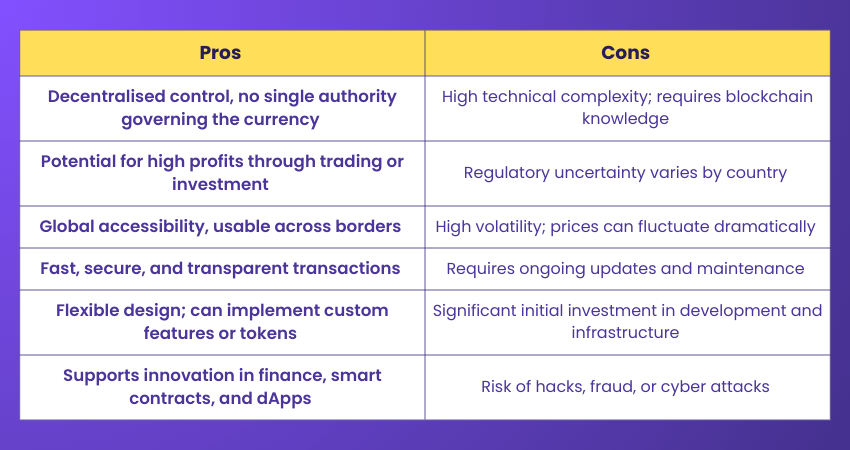
Now that you know How to Create a Cryptocurrency, let’s look into the negative and positive outcomes of making this digitalised coin. This table summarises the pros and cons of making a Cryptocurrency:
What to Know Before Making a Cryptocurrency
Even though anyone can make a Cryptocurrency, consider these points before creating your own:
1) Launching a successful coin requires significant investment. It takes time, money, marketing, programming skills, and long-term support.
2) Using a service or platform can make the creation process easier. But growing and maintaining the Crypto long after launch is far more demanding.
3) If you're doing it just out of curiosity or to learn, there’s less risk. Just be sure you’re not accidentally doing something that regulators could treat as an unregistered Initial Coin Offering (ICO).
4) Be aware of how crowded the field is. Lots of coins and tokens already exist. So unless you bring something uniquely valuable, it’s hard to stand out or achieve financial success.
Blockchain is a revolution in digital trust. Join it with our comprehensive Blockchain Course – Sign up now!
How Cryptocurrency Works?
Cryptocurrency is a kind of digital currency that leverages Cryptography for security. Here is a basic overview of how Cryptocurrency works:

1) Cryptocurrencies are based upon a technology called Blockchain which manages and records transactions. This technology maintains the integrity and order of transactions which makes this digital currency decentralised and secure.
2) Cryptocurrencies are created through a process called mining. It involves solving mathematical problems which in turn generate coins. There are brokers from whom the users can purchase the currencies and then store them to spend later. These currencies are stored in Cryptographic wallets.
3) After the currencies are generated, transaction takes place. These transactions are recorded in a public ledger. To maintain security, transactions need a two-factor authentication process.
4) These Cryptocurrencies are decentralised and are not managed by any governing bodies. It is controlled by decentralised network of computers or nodes.
5) Anonymity is maintained, since the value of the Cryptocurrencies are highly volatile. There are several factors which influence this value, such as market sentiment, supply and demand, technological advancements, secure and transparent voting system, etc.
How Much Does it Cost to Make a Cryptocurrency?
The cost of building a Cryptocurrency varies based on how much you choose to customise the token or coin. Highly customised coins established on native Blockchains are highly expensive to create, while launching a standardised token on the Ethereum platform can cost nothing through various apps.
Conclusion
The steps involved in How to Create a cryptocurrency is a structured process that blends technical planning, strategic design, and market positioning. By defining a clear purpose, building a secure blockchain framework, and ensuring legal compliance, you set the stage for a credible project. Effective promotion then helps your currency gain visibility and community trust. With the right steps, your digital asset can thrive in today’s competitive crypto landscape.
Navigate the world of trading and investment with ease by registering for our Investment and Trading Training – Join now!
Frequently Asked Questions
Is it Legal to Create a Cryptocurrency?

Cryptocurrencies these days are being considered legal tender in most countries. This includes trading them for products and services, mining, and other associated operations. However, it hasn’t been adopted in its entirety, countries like China still consider transactions in Cryptocurrencies an illegal affair.
Can I Create a Cryptocurrency Without Extensive Programming Knowledge?
You can create a Cryptocurrency without extensive Programming knowledge; however, you need a fair bit of knowledge to navigate this domain because you might face some limitations as it relies heavily on existing platforms and tools.
What are the Other Resources and Offers Provided by The Knowledge Academy?
The Knowledge Academy takes global learning to new heights, offering over 3,000+ online courses across 490+ locations in 190+ countries. This expansive reach ensures accessibility and convenience for learners worldwide.
Alongside our diverse Online Course Catalogue, encompassing 17 major categories, we go the extra mile by providing a plethora of free educational Online Resources like Blogs, eBooks, Interview Questions and Videos. Tailoring learning experiences further, professionals can unlock greater value through a wide range of special discounts, seasonal deals, and Exclusive Offers.
What is Knowledge pass and how does it work?
The Knowledge Academy’s Knowledge Pass, a prepaid voucher, adds another layer of flexibility, allowing course bookings over a 12-month period. Join us on a journey where education knows no bounds.
What are the Related Courses and Blogs Provided by The Knowledge Academy?
The Knowledge Academy offers various Investment and Trading Training, including Cryptocurrency Trading Training, Investment Management Masterclass, and Day Trading Course. These courses cater to different skill levels, providing comprehensive insights into NEFT.
Our Business Skills Blogs cover a range of topics related to Cryptocurrency, offering valuable resources, best practices, and industry insights. Whether you are a beginner or looking to advance your investment skills, The Knowledge Academy's diverse courses and informative blogs have you covered.

The Knowledge Academy


Global Training Provider
The Knowledge Academy is a world-leading provider of professional training courses, offering globally recognised qualifications across a wide range of subjects. With expert trainers, up-to-date course material, and flexible learning options, we aim to empower professionals and organisations to achieve their goals through continuous learning.

Upcoming Advanced Technology Resources Batches & Dates
Date
 Cryptocurrency Trading Training
Cryptocurrency Trading Training
Fri 7th Aug 2026
Cryptocurrency Trading Training
Fri 30th Oct 2026

 If you wish to make any changes to your course, please


