




We may not have the course you’re looking for. If you enquire or give us a call on +34 932716793 and speak to our training experts, we may still be able to help with your training requirements.
GDPR Principles: Key Rules for Protecting Personal Data
John Davies 14 July 2026The Seven GDPR Principles include lawfulness, fairness, transparency, purpose limitation, data minimisation, accuracy, storage limitation, and accountability. It ensures that individuals’ data is handled responsibly and securely. By adhering to these, organisations build trust, avoid legal risks, and promote ethical practices.
Home
 Resources
IT Security & Data Protection
GDPR Principles: Key Rules for Protecting Personal Data
Resources
IT Security & Data Protection
GDPR Principles: Key Rules for Protecting Personal Data
Resources
IT Security & Data Protection
GDPR Principles: Key Rules for Protecting Personal Data

Certified General Data Protection Regulation (GDPR) Foundation and Practitioner
 Top Rated Course
Top Rated Course
Exclusive 40% OFF
Training Outcomes Within Your Budget!
We ensure quality, budget-alignment, and timely delivery by our expert instructors.
Table of Contents

In the modern digital landscape, where information is transmitted at an unprecedented rate, it has become indispensable to ensure the security of individual data. Knowing the right methods for organisations to treat and protect the data will make trust and openness stronger. This blog will delve into GDPR Principles and their influence on good data practices.
Table of Contents
1) The Seven GDPR Principles
2) What is the Significance of GDPR Principles?
3) Examples of the Data Protection Principles in Action
4) How to Follow GDPR at Work?
5) What is the Checklist for the GDPR?
6) Conclusion
The Seven GDPR Principles
The seven Principles of the GDPR are fundamental guidelines for protecting personal data. Let's explore each in detail:
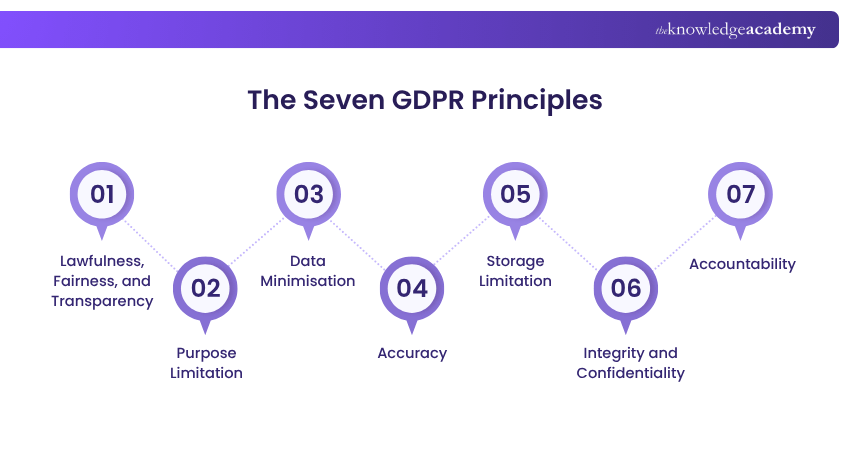
1) Lawfulness, Fairness, and Transparency
a) Lawful: From the very beginning, organisations are expected to handle and process personal data legally, and they must also adhere to the legal basis recognised by data protection regulations, such as consent, contract and legitimate interest.
b) Fair: Moreover, the data should be processed in a fair manner, which implies that people should not be deceived or disadvantaged with respect to their personal information.
Transparent: Moreover, transparency is a core principle in data protection, which means that persons must be well informed about the data, its purpose of use and the methods of safeguarding it, commonly through the provision of user-friendly privacy notices.
Data protection starts with you - Get Qualified in Certified Data Protection Officer (CDPO) today!

2) Purpose Limitation
Personal data should be gathered solely for particular, clear and lawful reasons and should not be utilized in ways that are not foreseen. The firm has to state distinctly the data collection reason and restrict the processing to that purpose. The data should not be used for other purposes later on unless the new use is both compatible and legal.
3) Data Minimisation
Personal data should only be collected when it is genuinely needed, not stored just because it might be useful later. The third GDPR principle emphasises avoiding unnecessary data hoarding and keeping information only when it serves a clear purpose. In simple terms, organisations must gather and process only the minimum data required to deliver a service.
4) Accuracy
This principle of the GDPR obliges businesses to ensure personal data is correct, full, and current. Data Controllers and Processors have to make a reasonable effort to spot and rectify or eliminate erroneous data. This is true when the precision of data has a direct impact on the person's rights or feelings.
5) Storage Limitation
According to GDPR Article 5(1)(e), personal information must not be stored for a longer period than is needed for its purpose, unless it is kept under public interest, scientific, historical, or statistical use with strict controls. After an organisation has no more use for the data, it should be completely wiped out. However, if the organisation must keep the data, then a specific retention period should be set, and reasons must be provided for it.
It's your responsibility to guard data like a pro – Start by joining our GDPR Training Today!
6) Integrity and Confidentiality
This tenet lays emphasis on the confidentiality and integrity of personal data as key factors in securing it. It imposes the obligation on the part of companies to take steps to make sure that the information is precise, not subject to unauthorised alterations, and that the risk of being accessed or disclosed is minimised. Furthermore, access is strictly limited to those with proper authorisation, which consequently lessens the likelihood of the data being misused or altered.
7) Accountability
It is the duty of the organizations to take control of their personal data handling and guarantee complete adherence to GDPR. This requires not only to meet legal obligations but also to demonstrate compliance through evidence. Accountability is a signal that data protection is actively controlled and not merely expected.Learn how to perform a personal data audit with our Data Protection Act Training (DPA 2018)-Join today!
What is the Significance of GDPR Principles?
The GDPR Principles are the core values that shape how organisations across the EU and globally should handle personal data. These principles are not just legal guidelines, but a blueprint for building responsible, transparent, and ethical data practices.
They serve as the foundation for protecting individuals and helping organisations maintain trust and compliance. Here are the prominent benefits of GDPR Principles:
Safeguarding Individual Rights
One of the most important roles of GDPR Principles is to protect the rights of individuals. People have the right to know what data is being collected, why it’s being collected, and how it’s being used. The principles ensure that personal data is not exploited or used unfairly. Individuals also have the right to correct, delete, or limit the use of their data.
Building Trust Between Businesses and Customers
Organisations follow GDPR Principles such as being transparent, fair, and accountable. Following them helps to build public confidence. Users are more likely to share their data with a business they know will handle it respectfully and securely. In today’s digital age, trust is a major competitive advantage.
Encouraging Responsible Data Practices
GDPR Principles require businesses to be intentional and thoughtful in their data handling. For example, you can only collect data that’s necessary and keep it accurate and up to date. Storing it for only as long as needed helps to keep it safe and secure. This results in more efficient systems, better data quality, and fewer risks.
Promoting Accountability and Good Governance
Under GDPR, it’s not enough to simply follow the rules that you must be able to prove compliance. This encourages companies to adopt better internal processes, conduct regular audits, train staff, and document everything. This accountability helps organisations stay organised, responsible, and ready to respond in case of an investigation or data breach.
Preventing Data Breaches and Penalties
By enforcing strong data security and privacy standards, GDPR Principles help reduce the risk of data breaches, loss, or unauthorised access. Following these principles can also help organisations avoid heavy fines.
They Set a Global Standard for Data Protection
Although GDPR is an EU regulation, its impact is global. Many countries and companies outside the EU have adopted similar standards or updated their own privacy laws to align with GDPR. These principles are shaping how the world approaches data privacy, setting a benchmark for digital responsibility.
Learn about the categorisation of personal data with our Personal Data Protection Bill Training - Join today!
Examples of the Data Protection Principles in Action
This section shows how GDPR principles work in real-life situations, helping you understand how organisations apply them in everyday data processing.
Example 1: E-Commerce Website
A digital retailer gathers solely the customer personal information that is essential for the handling of orders and the delivery of products. The store maintains the data only as long as is necessary, after which it either deletes or anonymises it securely. The details of the customer are kept under strong encryption and protected by access controls which ensure confidentiality and integrity.
Example 2: Healthcare Provider
The healthcare professional keeps patient data only for treatment and care purposes. Medical files are constantly being checked and modified to ensure they are precise and connected. After the retention time, the records are either safely archived or destroyed, with the exception of the records that are still required by law.
How to Follow GDPR at Work?
To follow GDPR at work, handle personal data lawfully, collect only what's necessary, and be transparent about its use. Keep data secure, up to date, and limit access to authorised staff. Always document your processes, respect individual rights, and report data breaches promptly. Regular staff training is essential.
What is the Checklist for the GDPR?
A GDPR checklist includes:
1) Identify what personal data you collect
2) Ensure you have a lawful basis
3) Update privacy policies
4) Get clear consent
5) Secure data properly
6) Respect individual rights
7) Keep records of processing
8) Train staff,
9) Have a breach response plan
Conclusion
It might be challenging to understand the GDPR Principles, and yet they are basically about securing and respecting everyone’s data. Whenever businesses apply them correctly, the result is an increase in trust and a decrease in risks. Just consider them as the superhero regulations for daily personal data protection!
Learn to reduce the risk of data breaches with our GDPR Awareness Training – Join today!
Frequently Asked Questions
How Does GDPR Manage International Data Transfers?

GDPR allows data transfers outside the EU only if the destination country has adequate data protection standards or if specific safeguards are in place. This ensures that personal data remains protected even when it moves across borders.
Does GDPR Specify Rules for Encrypting and Anonymising Personal Data?
GDPR doesn’t set specific rules for encryption or anonymisation but requires that personal data be protected. Using encryption and anonymisation is encouraged as they help secure data and comply with GDPR’s overall privacy requirements.

John Davies


Cyber Security Governance & Assurance Specialist
John Davies is a cybersecurity expert specialising in governance, risk management, and compliance. With over 15 years in the field, he has led enterprise-wide security programmes across finance, healthcare and public sector organisations. His content provides practical guidance on building secure environments, managing risk and aligning with regulatory frameworks.


 If you wish to make any changes to your course, please


