


 Top Rated Course

We may not have the course you’re looking for. If you enquire or give us a call on +34 932716793 and speak to our training experts, we may still be able to help with your training requirements.
Agile Project Management Techniques | Guide
David Evans 21 April 2026Agile Project Management Techniques include methods like Scrum, Kanban, Lean, DSDM, and Extreme Programming and focus on iterative development. It helps teams adapt to change, deliver value, and continuously improve processes based on feedback and project needs. It encourages regular stakeholder involvement and promotes transparency.

Training Outcomes Within Your Budget!
We ensure quality, budget-alignment, and timely delivery by our expert instructors.
Table of Contents

What if your next project could thrive on change instead of collapsing under it? In today’s fast-paced environment, static plans and rigid workflows just don’t cut it. The ability to adapt quickly isn’t a luxury anymore; it is a necessity. That’s where Agile Project Management is required!
It empowers teams to stay flexible, respond to change in real-time, and deliver results faster without sacrificing quality. Imagine a project workflow where goals evolve naturally, feedback is welcomed, and progress happens in visible steps. In this blog, we’ll walk you through Agile Project Management Techniques and how they work to maximise efficiency and success. Let’s dive in!
Table of Contents
1) What are Agile Project Management Techniques?
2) Key Agile Project Management Techniques and Methodologies
3) What are the Phases of Agile Project Management Methodology?
4) Benefits of Agile Project Management
5) What is the Most Common Agile Framework?
6) What is Scrum in Agile?
7) Conclusion
What are Agile Project Management Techniques?
Agile is a flexible and adaptive approach to managing projects. Instead of following a strict plan that never bends, Agile embraces change and allows you to adjust your path as needed. It's like having a superpower that helps you tackle unexpected twists and turns effortlessly.
In Agile, projects are broken down into small, bite-sized chunks called "Sprints." Each sprint is like a mini-race, where you and your team focus on completing specific tasks within a set timeframe. These sprints are like checkpoints along your project journey, allowing you to evaluate your progress, make improvements, and change direction if necessary.
Key Agile Project Management Techniques and Methodologies
Agile Project Management uses different methods to help teams work faster, stay flexible, and deliver better results. Each method has its own way of working. Let’s look at the most common Techniques of Agile Project Management:
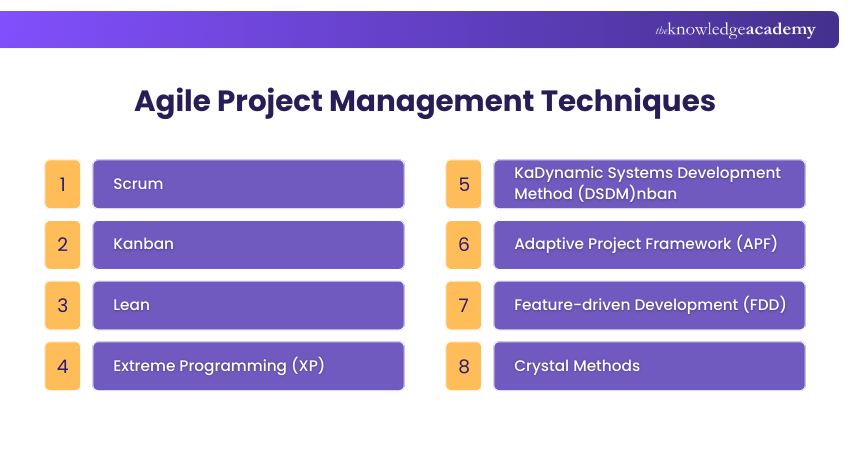
1) Scrum
Scrum is a widely used Agile methodology that focuses on teamwork, iterative development, and continuous improvement. It breaks the project into short, fixed time periods called sprints, usually lasting one to four weeks. Scrum helps teams deliver working parts of the project quickly and get regular feedback to improve over time.
a) Backlog: Backlog is a list of features, user stories, and tasks. The Product Owner is mainly responsible for managing and prioritising the backlog.
b) Sprint Planning: The team selects items from the backlog to work on during the start of each sprint. The Product Owner along with development team collaborate to define the scope of the sprint.
c) Daily Stand-up: The development team holds a brief daily meeting to discuss progress, challenges, and plans. It promotes transparency and identifies impediments.
d) Sprint Review: The team demonstrates the completed work to stakeholders at the end of the sprint. Feedback is collected to inform future work.
Unlock your potential and drive your career forward with our Scrum Certification – Register today!
2) Kanban
Kanban is a visual technique that helps teams manage their work better by showing tasks on a board. This board usually has columns like To Do, Doing, and Done, so everyone can see what is happening. This reduces overload, helps spot bottlenecks, and makes the workflow smoother. It is simple to use and improves overall efficiency and transparency.
a) Kanban Board: A visual board with columns representing different stages of work. For example, "To do", "In progress", and "Done". Work items are represented as cards that move through the columns.
b) Work in Progress (WIP) Limits: It is a set of columns that prevents overloading team members and highlights areas of congestion.
c) Pull System: Work is pulled into the system only when there is capacity, preventing excessive multitasking and reducing lead times.
d) Continuous Improvement: Teams regularly analyse the Kanban process to identify opportunities for improvement.
Enhance flow efficiency with Kanban principles for agile success with our Kanban Training – Explore now!
3) Lean
The Lean Agile process combines ideas from Lean manufacturing and Agile Project Management. It focuses on delivering value to customers quickly by removing anything that wastes time, money, or effort. Teams use Lean to streamline processes, cut out unnecessary steps, and improve how they work.
a) Eliminating Waste: Identify and eliminate non-value-adding activities, such as overproduction, excessive waiting and unnecessary processes.
b) Build Quality: Prioritise quality from the start to reduce defects and rework.
c) Deliver Fast: Aim for shorter development cycles to get working software to customers sooner.
d) Empower Teams: Give teams the autonomy to make decisions and improve processes.
Improve efficiency, reduce waste, and enhance customer value with our Lean Training – Join soon!
4) Extreme Programming (XP)
Extreme Programming (XP) is an Agile method used in Software Development that focuses on teamwork, simplicity, and quick feedback. It helps developers write better code with fewer errors by using practices like Test-driven Development (TDD) which involves writing tests before writing code. These practices help teams deliver high-quality software quickly.
a) Test-driven Development: Developers write tests before writing codes. This ensures that the code is functional and that changes do not break existing functionality.
b) Pair Programming: Two programmers work together on the same computer. This promotes knowledge sharing, code quality and reduces the likelihood of errors.
c) Continuous Integration: Code changes are integrated into a shared repository frequently. Automated tests are run to catch integration issues early.
d) Refactoring: Developers improve code quality by continuously restructuring and optimising the codebase.
5) Dynamic Systems Development Method (DSDM)
The Dynamic Systems Development Method (DSDM) is a complete Agile Project Management framework that leads teams through the entire project lifecycle. It focuses on continuous user involvement, frequent iterations, and clear communication to deliver real business value. It’s especially useful for projects that need strong planning and close collaboration with users.
a) Timeboxing: Projects are divided into fixed-time increments called timeboxes. Each timebox delivers a specific set of features.
b) Prioritisation: Requirements are prioritised, and the most important ones are addressed first.
c) Incremental Delivery: Deliveries are made incrementally, ensuring that the most critical functionality is available early in the project.
d) Iterative Development: The project progresses through a series of iterations, with each iteration building upon the previous one.
6) Adaptive Project Framework (APF)
Adaptive Project Framework fosters flexibility and value-driven Project Management. It prioritises customer needs, iterative development, and continuous refinement. APF adapts to changes, ensuring efficient resource utilisation and timely delivery. Key aspects of APF are:
a) Customer-centric Focus: APF places the customer's needs and expectations at the forefront, driving project decisions and ensuring the delivered product aligns with their requirements.
b) Iterative Progress: APF divides projects into iterative cycles, allowing for incremental progress and continuous refinement of project elements, leading to more accurate solutions.
c) Change Embrace: APF is designed to accommodate changes in project scope, requirements, and priorities, fostering adaptability and responsiveness to evolving conditions.
d) Stakeholder Collaboration: APF promotes active stakeholder involvement, enabling faster decisions and better alignment with evolving goals.
7) Feature-driven Development (FDD)
Feature-driven Development (FDD) is an Agile method that focuses on building features that users value most. It is best for large and complex projects where planning and structure are important. FDD combines good design with short, regular development cycles.
a) Feature-centric Planning: The project starts by identifying a list of client-valued features to be built.
b) Modelling: A high-level model of the system is created before development begins.
c) Short Iterations: Each feature is developed and delivered in a short, repeatable process.
d) Design and Build by Feature: Features go through design, development, and testing in small steps, making it easy to track progress and quality.
8) Crystal Methods
Crystal Methods are a family of Agile approaches that focus on people, communication, and adaptability. They are suitable for teams of different sizes and project criticalities, offering a customised process based on team needs rather than strict rules.
a) Team-based Approach: Each crystal method is chosen based on team size and project risk (e.g., Crystal Clear for small teams).
b) Communication-focused: Emphasises face-to-face communication, collaboration, and knowledge sharing.
c) Frequent Delivery: Encourages delivering working software frequently to get fast feedback.
d) Reflective Improvement: Teams regularly reflect on their work and adjust the process to improve performance and outcomes.
Master Agile planning and delivery techniques for real-world projects with our AgilePM® Foundation & Practitioner (AgilePM® V3) Course – Join now!
What are the Phases of Agile Project Management Methodology?
Agile Project Management follows a flexible and team-focused approach. Instead of one long planning cycle, Agile uses five repeating phases that help teams respond quickly to changes and deliver valuable results regularly. Below are the five key phases:

1) Envision Phase
The envision phase is the starting point of the Agile project. Here, the team works with stakeholders to define the project’s vision, goals, and scope. It sets the direction and outlines what success looks like.
2) Speculate Phase
In the speculate phase, the team outlines what needs to be done and plans how to do it. Instead of rigid planning, this phase promotes flexibility and welcomes change. This phase builds a strong base for iterative development while staying open to new ideas.
3) Explore Phase
The explore phase is about building and learning. Teams start executing the work planned in sprints and use customer input to guide development. This phase supports continuous improvement, fast delivery, and strong collaboration.
4) Adapt Phase
In the adapt phase, the team uses insights from earlier sprints to refine the process and improve outcomes. Flexibility is key here. This ongoing adjustment helps deliver a better product and supports team growth and learning.
5) Close Phase
The close phase wraps up the Agile project by ensuring all deliverables are completed and reviewed. It's also a time to reflect and improve. Even though Agile is iterative, this phase helps close the current cycle while preparing for future improvements.
Lay the foundation for successful Agile Project Management with our Agile Overview Training – Sign up anytime!
Benefits of Agile Project Management
Agile Project Management offers a wide range of benefits as follows:
1) Greater Flexibility: Agile allows teams to adapt quickly to changing requirements, customer feedback, and market conditions.
2) Faster Value Delivery: Projects are broken into smaller, manageable pieces, enabling quicker releases and continuous improvement.
3) Improved Collaboration: Encourages open communication and teamwork across cross-functional teams for better alignment and problem-solving.
4) Customer-centric Approach: Frequent iterations ensure the final product meets actual user needs and expectations.
5) Efficient Resource Allocation: Agile helps optimise time, effort, and budget through prioritisation and focused planning.
6) Early Risk Mitigation: Regular reviews and feedback loops allow teams to identify and resolve issues in the process.
7) Higher Quality Outcomes: Continuous testing and refinement lead to more polished, reliable, and valuable deliverables.
8) Competitive Advantage: Agile empowers organisations to innovate faster and stay ahead in dynamic, rapidly evolving industries.
What is the Most Common Agile Framework?
The most common Agile framework is Scrum. It is widely used across industries for its simplicity and effectiveness. Scrum roles include the Product Owner, who manages the backlog; the Scrum Master, who supports the team; and the Development Team, who do the work.
Scrum promotes transparency, teamwork, and continuous improvement. It is especially popular in Software Development but is now used in marketing, education, and many other fields to manage complex projects.
What is Scrum in Agile?
As an Agile Project Management framework, Scrum helps teams organise and manage work through structured roles, events, and practices. Here, the work is divided into short cycles called sprints. It will typically last for two to three weeks, with regular planning, review, and reflection sessions. Scrum’s principles of collaboration, adaptability, and transparency make it effective for any team aiming for continuous value delivery.
Conclusion
Agile Project Management is a powerful shift in how teams approach work, solve problems, and deliver value. By embracing flexibility, collaboration, and continuous improvement, Agile Project Management Techniques like Scrum, Kanban, and APF enable teams to stay aligned with customer needs and adapt to change with confidence. Start small, stay committed to learning, and empower your team to grow with every iteration.
Take the next step in your Agile journey with our Agile Training – Explore immediately!
Frequently Asked Questions
What is the Agile Method of Project Management?

Agile Project Management is a flexible, team-focused approach that breaks work into small tasks called iterations or sprints. It encourages regular feedback, quick adjustments, and close collaboration to deliver value to customers faster and improve project outcomes continuously.
How to Implement Agile in Project Management?
To implement Agile, form a cross-functional team, define project goals, and break work into sprints. Use tools like Scrum or Kanban, hold regular stand-ups, review progress often, and get feedback from users. Focus on delivering small, valuable results and improving with each cycle.
What are the Other Resources and Offers Provided by The Knowledge Academy?
The Knowledge Academy takes global learning to new heights, offering over 3,000 online courses across 490+ locations in 190+ countries. This expansive reach ensures accessibility and convenience for learners worldwide.
Alongside our diverse Online Course Catalogue, encompassing 17 major categories, we go the extra mile by providing a plethora of free educational Online Resources like Blogs, eBooks, Interview Questions and Videos. Tailoring learning experiences further, professionals can unlock greater value through a wide range of special discounts, seasonal deals, and Exclusive Offers.
What is The Knowledge Pass, and How Does it Work?
The Knowledge Academy’s Knowledge Pass, a prepaid voucher, adds another layer of flexibility, allowing course bookings over a 12-month period. Join us on a journey where education knows no bounds.
What are the Related Courses and Blogs Provided by The Knowledge Academy?
The Knowledge Academy offers various Agile Training, including Agile Project Management Foundation (AgilePM® V3) Course, AgilePM® Foundation & Practitioner (AgilePM® V3) Course and Agile for Teams Training. These courses cater to different skill levels, providing comprehensive insights into Business Transformation.
Our Project Management Blogs cover a range of topics related to Agile Project Management Techniques, offering valuable resources, best practices, and industry insights. Whether you are a beginner or looking to advance your Project Management skills, The Knowledge Academy's diverse courses and informative blogs have got you covered.

David Evans


Certified Project Trainer and Agile Delivery Expert
David Evans brings over a decade of hands-on experience in project delivery, Agile transformation, and team leadership. With a background in technology and business consulting, David has led cross-functional teams through Agile and Waterfall projects in both public and private sectors. He combines technical knowledge with practical insights to help readers navigate the challenges of modern project environments.

Upcoming Project Management Resources Batches & Dates
Date
 AgilePM® Foundation & Practitioner (AgilePM® v3)
AgilePM® Foundation & Practitioner (AgilePM® v3)
Mon 29th Jun 2026
AgilePM® Foundation & Practitioner (AgilePM® v3)
Mon 6th Jul 2026
AgilePM® Foundation & Practitioner (AgilePM® v3)
Mon 13th Jul 2026
AgilePM® Foundation & Practitioner (AgilePM® v3)
Mon 20th Jul 2026
AgilePM® Foundation & Practitioner (AgilePM® v3)
Mon 27th Jul 2026
AgilePM® Foundation & Practitioner (AgilePM® v3)
Mon 3rd Aug 2026
AgilePM® Foundation & Practitioner (AgilePM® v3)
Mon 10th Aug 2026
AgilePM® Foundation & Practitioner (AgilePM® v3)
Mon 17th Aug 2026
AgilePM® Foundation & Practitioner (AgilePM® v3)
Sat 22nd Aug 2026, Sun 23rd Aug 2026
AgilePM® Foundation & Practitioner (AgilePM® v3)
Mon 24th Aug 2026
AgilePM® Foundation & Practitioner (AgilePM® v3)
Tue 1st Sep 2026
AgilePM® Foundation & Practitioner (AgilePM® v3)
Mon 7th Sep 2026
AgilePM® Foundation & Practitioner (AgilePM® v3)
Mon 14th Sep 2026
AgilePM® Foundation & Practitioner (AgilePM® v3)
Mon 21st Sep 2026
AgilePM® Foundation & Practitioner (AgilePM® v3)
Mon 28th Sep 2026
AgilePM® Foundation & Practitioner (AgilePM® v3)
Mon 5th Oct 2026
AgilePM® Foundation & Practitioner (AgilePM® v3)
Sat 10th Oct 2026, Sun 11th Oct 2026
AgilePM® Foundation & Practitioner (AgilePM® v3)
Mon 12th Oct 2026
AgilePM® Foundation & Practitioner (AgilePM® v3)
Mon 19th Oct 2026
AgilePM® Foundation & Practitioner (AgilePM® v3)
Mon 26th Oct 2026
AgilePM® Foundation & Practitioner (AgilePM® v3)
Mon 2nd Nov 2026
AgilePM® Foundation & Practitioner (AgilePM® v3)
Mon 9th Nov 2026
AgilePM® Foundation & Practitioner (AgilePM® v3)
Mon 16th Nov 2026
AgilePM® Foundation & Practitioner (AgilePM® v3)
Mon 23rd Nov 2026
AgilePM® Foundation & Practitioner (AgilePM® v3)
Mon 30th Nov 2026
AgilePM® Foundation & Practitioner (AgilePM® v3)
Mon 7th Dec 2026
AgilePM® Foundation & Practitioner (AgilePM® v3)
Sat 12th Dec 2026, Sun 13th Dec 2026
AgilePM® Foundation & Practitioner (AgilePM® v3)
Mon 14th Dec 2026
AgilePM® Foundation & Practitioner (AgilePM® v3)
Mon 21st Dec 2026

 If you wish to make any changes to your course, please


