


 Top Rated Course

We may not have the course you’re looking for. If you enquire or give us a call on +44 1344 203 999 and speak to our training experts, we may still be able to help with your training requirements.
What is Strategic Marketing? Fundamentals Explained
James Smith 03 March 2026Strategic Marketing looks ahead, guiding how a brand grows by understanding customers, markets, and behaviour to make future-ready decisions. Through linking every single campaign to real business objectives, it produces an impact. Building up the relevancy of the brand allows the companies to be reliable during the market fluctuations.

Training Outcomes Within Your Budget!
We ensure quality, budget-alignment, and timely delivery by our expert instructors.
Table of Contents
In a situation where every brand is trying to stand out, the question that inevitably pops up is, What is Strategic Marketing? It is the path that leads companies to not only understand their customers but also meet their needs and create value knowingly. This thinking is the foundation of every unforgettable campaign, influencing brand personality and providing a brand with a voice that resonates.
This blog breaks down Strategic Marketing in a clear and practical way. It shows how perception is formed, trust is built, and relationships are sustained. You will explore the principles behind it and see how it can turn overlooked brands into one's people remember.
Table of Contents
1) Definition of Strategic Marketing
2) Importance of Strategic Marketing
3) The Strategic Marketing Process: 5 Stages
4) Key Components of Strategic Marketing
5) Benefits of Strategic Marketing
6) Examples of Successful Strategic Marketing
7) What Are The 5 C's of Strategic Marketing?
8) What Is The Main Goal of Strategic Marketing?
9) Conclusion
What is Strategic Marketing?
Strategic Marketing can be defined as the strategy of developing, communicating, and delivering value to customers. It does so while achieving organisational objectives. It involves developing a well-structured plan that connects market research, segmentation, targeting, and positioning. Additionally, Marketing Strategy Agencies play a key role in effectively allocating resources and shaping marketing efforts.
Unlike tactical or operational marketing, which focuses on short-term activities, Strategic Marketing takes a holistic and forward-looking approach to ensure sustainable success. By leveraging Market Research Tools and Platforms, this strategy is designed to capitalise on opportunities, mitigate risks, and stay ahead in an ever-changing marketplace.
Importance of Strategic Marketing
Strategic Marketing plays a crucial role in aligning an organisation’s objectives and necessities. Here are several benefits that businesses can derive from Strategic Marketing:
a) Market Penetration Made Simpler: By dissecting the market and grasping its current operational worth, a company can establish a solid base for its products.
b) Enhanced Accessibility: Through the prioritisation and analysis of the target audience, a business can forge connections with the appropriate demographic. Additionally, this marketing approach expands the consumer base by meticulously addressing the audience’s requirements.
c) Establishment of Enduring Objectives: Unlike traditional marketing, which gets lost in a sea of incessant product promotion, Strategic Marketing zeroes in on the target. It cultivates pertinent awareness via dedicated campaigns, thereby simplifying the process for companies to define and realise their ambitions.
d) Intelligent Resource Management: Resources such as time, finances, talent, and others can be squandered if not managed prudently. No enterprise can sustain itself over time without judicious resource allocation. Strategic Marketing Planning enables a company to achieve maximum results with minimal resource expenditure.
e) Sales Amplification: Ultimately, for any organisation, the end goal is to enhance profits and outpace competitors. Strategic Marketing accomplishes this by increasing the pool of potential customers.
The Strategic Marketing Process: 5 Stages
lets discuss the 5 processes of the strategic marketing process:
Stage 1: Situational Analysis (SWOT Analysis)
The foundation of a powerful strategy is always a clear vision. By assessing internal strong and weak points as well as external opportunities and threats the organisation gets to know its present position. By means of SWOT analysis, decision-makers gain a clearer picture of their surroundings, the risks are recognied sooner, and the possible outcomes are set out with more realism.
Stage 2: Market Research and Customer Analysis
At this point, assumptions are replaced by understanding. Companies delve into customer needs, how they act and what drives them while evaluating competitors and monitoring market direction. This knowledge discloses the people to be served, what their values are, and the changes in expectations, thus making it sure that the decision-making is based on evidence not on gut feeling.
Stage 3: Strategy Formulation and Positioning
With insight in place, direction is set. By means of insights, the organisations answer up to the problem of competition, point out the way to be different, and tell customers what to expect from them. A focused marketing strategy is formed that contains clear objectives, target segments, and a compelling value proposition, and it directs all future actions.
Stage 4: Implementation Planning (Marketing Mix)
At this point, strategy is no longer just a concept; it is happening. Every aspect of marketing product, pricing, promotion, and distribution—will be done according to the plans made. People involved, deadlines, and money are determined in such a way that the teams will be working with a clear goal in mind, and thus, every campaign will be in line with the main business objectives.
Stage 5: Performance Measurement and Optimisation
The final step in the process is learning. The tracking of outcomes is done by comparing them with significant criteria, which shows not only what is effective but also what requires improvement. The regular assessment permits the strategies to develop, thus making the marketing always relevant, effective, and in tune with the changing demands of both customers and market.
Key Components of Strategic Marketing
Having grasped the concept of Strategic Marketing, the next step is to uncover its essential parts. The components of Strategic Marketing are the essentials that determine the path for a business to succeed. Here are the principal components elaborated on:
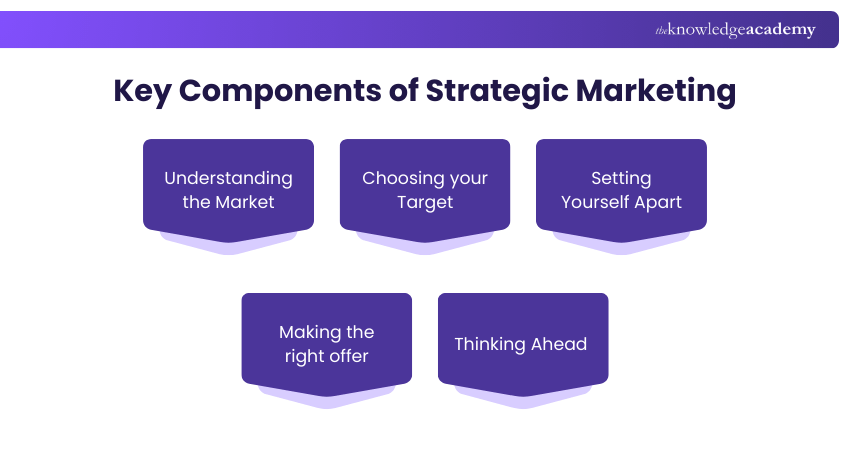
Understanding the Market
It is primarily a matter of recognising and comprehending the market that you are working in - knowing your possible customers, their demands, and their actions. It is all about getting to know the audience so that you can communicate with them effectively for the purpose of targeting.
Choosing your Target
Surely, not every person around you is a customer and it is fine! Marketing on a strategic base helps to select a certain group of people you want to contact – those who will have the greatest interest in your product.
Setting Yourself Apart
Picture yourself at a party, and you wish to be the center of attention. By showcasing differentiators, Strategic Marketing ensures your brand or product glows. Hence, people will not forget you in a particular way when they consider your offerings.
Making the right offer
Think of this like cooking – you need the right ingredients in the right amounts to make a delicious dish. In Strategic Marketing Management, this means finding the right mix of product features, pricing, where to sell, and how to talk about it.
Thinking Ahead
When a road trip is in your plans, you naturally want to be aware of your final destination and of the route that will take you there. Furthermore, Strategic Marketing is like a wonderful guide that shows you the road to the future and helps you along if the course changes.
Elevate your brand with powerful video storytelling. Join our Video Marketing Course today.
Benefits of Strategic Marketing
There are various benefits of Strategic Marketing that one should keep in mind before planning for your next marketing strategy. Let's have a detailed look at each one of them:
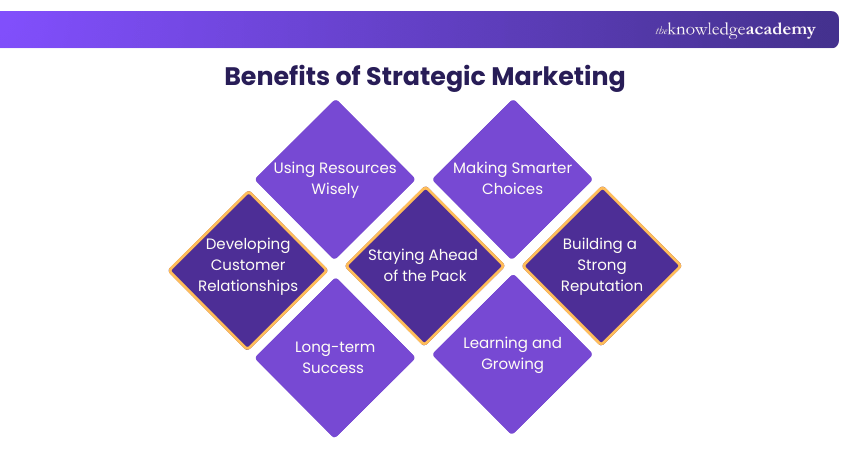
Using Resources Wisely
Imagine having a limited budget for a party. You'd want to spend it on things that really matter, right? A well-planned Video Marketing Strategy helps businesses use their money, time, and people in the smartest way possible, focusing on things that bring the best results.
Making Smarter Choices
Imagine possessing a magic crystal ball that reveals future events to you. Strategic Marketing may not be magic, but it is almost identical! It provides companies with crucial information regarding customers' wants, rivals, and market developments. This significantly simplifies and improves the accuracy of the whole decision-making process.
Developing Customer Relationships
All of us want friends who see us and think we are worth something just like Strategic Marketing does to companies through the gaining of a deep understanding of customers. It is almost the same as talking in their language, meeting their needs, and making them happy.
Staying Ahead of the Pack
Imagine you're in a race, and you know a shortcut that others don't. That's what Strategic Marketing does – it helps you stand out from your competitors by showing off your strengths and unique qualities, especially in a crowded market where the Red Ocean Strategy is at play. This way, you're not just in the race; you're leading it.
Building a Strong Reputation
Just like a good reputation makes you popular, Strategic Marketing helps build a reputation for your business. When you consistently deliver what you promise, people trust you more. This trust turns into a solid reputation that attracts even more customers.
Long-term Success
Think about planting a tree. You don't expect it to grow overnight, but with care and patience, it becomes strong and provides shade for years. Strategic Marketing is like nurturing a business for the long run. It focuses on gradual growth and stability rather than quick but temporary gains.
Learning and Growing
Like a student who's always learning, Strategic Marketing helps you understand what's happening around you. You learn from the market, your customers, and your own successes and mistakes. This means you keep getting better over time.
Examples of Successful Strategic Marketing
Strategic Marketing is the art of turning vision into reality, often making its mark through campaigns that resonate with consumers on a wider level. Let's explore a few remarkable instances where this marketing style propelled brands to new heights:style propelled brands to new heights:
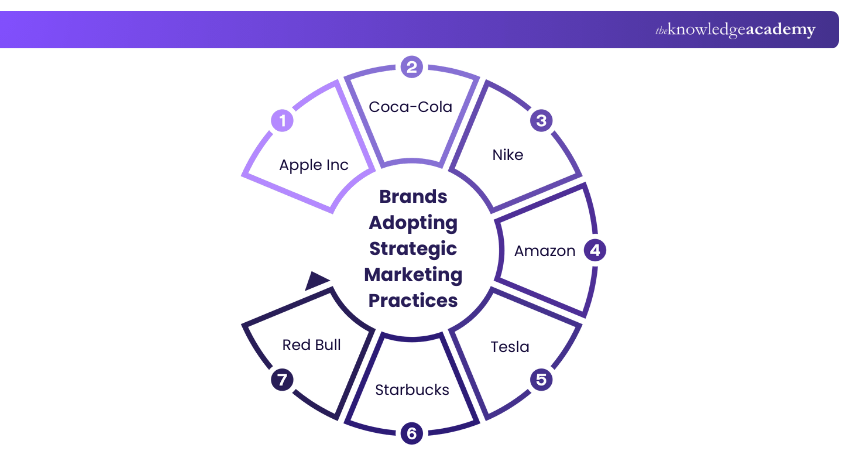
1) Apple Inc
Apple is a vital example of a company that has mastered Strategic Marketing Goals. From the launch of the iPod to the iPhone and beyond, Apple has consistently positioned itself as an innovative and premium brand.
The "Think Different" campaign sums up this ethos, emphasising uniqueness and breaking away from the norm. Apple's marketing focuses on simplicity, design, and user experience, creating a strong emotional connection with its audience.
2) Coca-Cola
Coca-Cola's Strategic Marketing journey has showcased adaptability in the face of changing consumer preferences. While maintaining its iconic image, Coca-Cola has shifted its marketing approach to align with health-conscious trends.
The "Share a Coke" campaign, which replaced its logo with popular names, encouraged personalisation and engagement. Also, the company has invested in promoting its lower-sugar and zero-calorie options to cater to health-conscious consumers. This strategic shift allowed Coca-Cola to retain its emotional connection with customers.
3) Nike
What is Strategic Marketing technique Nike adopted? It is centred around emotional branding and empowerment. The "Just Do It" campaign has become synonymous with the brand's identity, motivating individuals to push their limits. Nike has effectively positioned itself as more than just a sportswear company; it's a symbol of inspiration and achievement.
By partnering with athletes and celebrities, Nike positioned itself with success and determination. The brand's consistent messaging and focus on innovation have contributed to its enduring success.
Create, captivate, convert - Join our Content Marketing Course and elevate your marketing game!
4) Amazon
Amazon's Strategic Marketing revolves around customer-centricity and convenience. By focusing on offering a vast selection of products, quick delivery, and a seamless shopping experience, Amazon has placed itself as the go-to online marketplace.
The introduction of Amazon Prime, with its advantages like quick shipping and access to digital content, incentivised customer loyalty. Amazon's recommendation algorithms and personalised shopping suggestions further enhance the user experience, fostering a sense of trust and reliability.
5) Tesla
Tesla's Strategic Marketing stands out for its disruptive approach within the automotive industry. By positioning electric vehicles as not just eco-friendly choices but also high-performance and technologically advanced options, Tesla has challenged traditional perceptions.
The company's CEO, Elon Musk, plays a significant role in building the brand's aura and driving excitement. Tesla's strategic use of social media, especially Twitter, has kept enthusiasts engaged and invested in the brand's progress and innovations.
6) Starbucks
Starbucks has employed Strategic Marketing to create a global coffee culture and community. Using cosy store designs, consistent branding, and the customisation of orders, Starbucks offers more than just coffee; it offers an experience.
The company's seasonal promotions and loyalty program, the Starbucks Rewards, incentivise repeat business and drive customer engagement. Starbucks' focus on sustainability and ethical sourcing has also resonated with socially conscious consumers, further enhancing its brand reputation. Some customers, however, may also consider the difference between Coffee and Red Bull when choosing their preferred source of energy.
7) Red Bull
Red Bull's Strategic Marketing is synonymous with extreme sports and high energy. The company has managed to transcend the energy drink market by creating a lifestyle brand centred on adventure and excitement.
Red Bull's sponsorship of extreme sports events, such as the Red Bull Air Race and X Games, aligns perfectly with its brand identity. The "Red Bull Gives You Wings" slogan along with its association with daredevil stunts have positioned the brand as a symbol of limitless energy and enthusiasm.
What Are The 5 C's of Strategic Marketing?
The 5 C's represent a very stable and effective method for marketers to see the main factors that influence a company's success. They facilitate the assessment of both internal and external factors, thus making the strategies based on actual market insight. The five factors are:
1) The company itself is examined from within, looking at its capacities and imagined goals up to the strengths marking its brand name.
2) The customers direct their attention to the individuals who receive the service, their requirements, the level of their satisfaction, and the manner in which they come to a decision.
3) Competitors check out other companies in the space and how they interact with the same audience.
4) Collaborators would involve the strategic partners, suppliers and distribution channels that would bring value to the final product in the market.
5) The term climate, referred to as context at times, illustrates the broader circumstances like changes in regulations, socio-economic impacts, technological advancements, etc., that determine the performance of a particular business.
What Is the Main Goal of Strategic Marketing?
The primary purpose of strategic marketing is to coordinate all marketing activities to the top level of business objectives; thus, the company gets a continuous competitive edge and grows to be strong in the market for a long time.
This implies comprehending market opportunities, selecting the appropriate target groups , and establishing distinct value propositions that not only distinguish the brand but also facilitate the establishment of substantial customer connections
Moreover, the allocation of resources intelligently, data-informed decision-making, and adaptation to changes are some of the factors that strategic marketing concentrates on, thereby ensuring that the company stays pertinent and victorious in the long run.
Conclusion
We hope this blog has clarified what Strategic Marketing truly means and how it empowers brands to connect with audiences in meaningful ways. It is the forward-thinking approach that places a brand not only in the marketplace, but firmly in the thoughts and emotions of its customers. It helps businesses stay visible, relevant, and remembered in a world full of noise. Strategic Marketing gives brands direction, purpose, and a voice that feels human.
Discover the strategy behind buying decisions - join our Marketing Courses today and gain a competitive edge!
Frequently Asked Questions
How can I create a marketing strategy roadmap?

Define clear goals, study your market, and choose priority audiences and positioning. Map key initiatives into phases with timelines, owners, and milestones. A strong roadmap keeps teams aligned and adaptable as conditions change.
How to Evaluate a Marketing Strategy?
Evaluating a Marketing strategy involves analysing key metrics, including the Return on Investment (ROI), sales growth, customer feedback, and market share. It includes assessing how well the strategy aligns with business goals, and its effectiveness in reaching target markets.
What are the Other Resources and Offers Provided by The Knowledge Academy?
The Knowledge Academy takes global learning to new heights, offering over 3,000+ online courses across 490+ locations in 190+ countries. This expansive reach ensures accessibility and convenience for learners worldwide.
Alongside our diverse Online Course Catalogue, encompassing 19 major categories, we go the extra mile by providing a plethora of free educational Online Resources like Blogs, eBooks, Interview Questions and Videos. Tailoring learning experiences further, professionals can unlock greater value through a wide range of special discounts, seasonal deals, and Exclusive Offers.
What is The Knowledge Pass, and How Does it Work?
The Knowledge Academy’s Knowledge Pass, a prepaid voucher, adds another layer of flexibility, allowing course bookings over a 12-month period. Join us on a journey where education knows no bounds.
What are the Related Courses and Blogs Provided by The Knowledge Academy?
The Knowledge Academy offers various Marketing Courses, including the Strategic Marketing Course, Marketing Research Training, and Video Marketing Course. These courses cater to different skill levels, providing comprehensive insights into Advertising Campaign.
Our Digital Marketing Blogs cover a range of topics related to Strategic Marketing, offering valuable resources, best practices, and industry insights. Whether you are a beginner or looking to advance your Digital Marketing skills, The Knowledge Academy's diverse courses and informative blogs have got you covered.

James Smith


Digital Marketing Manager and Trainer
James Smith is a digital marketing professional with over a decade of experience in SEO, content strategy, paid media and analytics. He has supported both SMEs and global brands in transforming their digital presence. James’s writing and training are rooted in results-driven tactics and the latest marketing trends.
View Detail
Upcoming Digital Marketing Resources Batches & Dates
Date
 Digital Marketing Course
Digital Marketing Course
Fri 24th Apr 2026
Digital Marketing Course
Fri 17th Jul 2026
Digital Marketing Course
Fri 13th Nov 2026

 If you wish to make any changes to your course, please


