


 Top Rated Course

We may not have the course you’re looking for. If you enquire or give us a call on +44 1344 203 999 and speak to our training experts, we may still be able to help with your training requirements.
What Is Macro Photography? Complete Beginner Guide
The Knowledge Academy 15 July 2026Macro Photography captures extreme close-ups at 1:1 or higher, revealing tiny details using macro lenses, manual focus, stable setups, and soft lighting. It highlights textures that are often invisible to the naked eye, creating visually striking images. With the right techniques even, the small elements can create a powerful impact.

Training Outcomes Within Your Budget!
We ensure quality, budget-alignment, and timely delivery by our expert instructors.
Table of Contents
The most captivating details are often hidden in the smallest elements. Macro Photography allows you to explore a world that usually goes unnoticed. It reveals hidden details and creative possibilities in everyday subjects. Let’s examine the techniques and tools that bring these intricate subjects into clear focus.
Table of Contents
1) What is Macro Photography?
2) Why Shoot Macro?
3) Macro Photography for Beginners
4) Macro Photography Settings
5) Unleashing Creativity: Creative Macro Photography Ideas
6) Macro vs Micro Photography: Key Differences
7) What Makes Good Macro Photography?
8) Conclusion

What is Macro Photography?
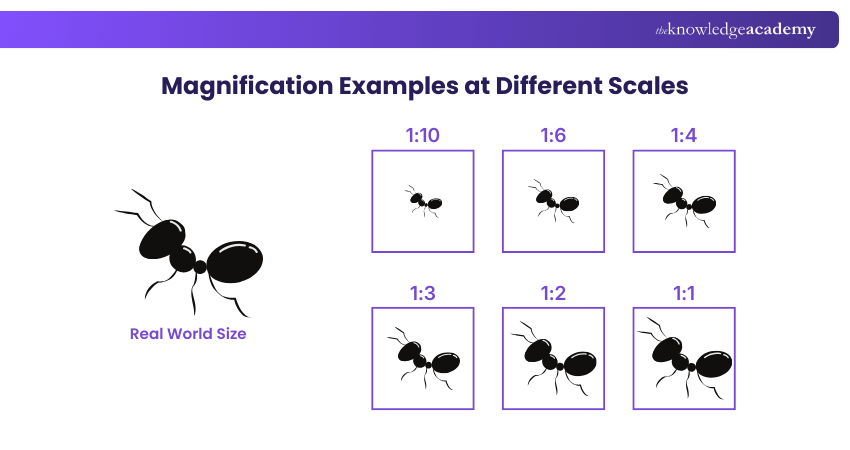
The art of macro photography consists in taking very close-up pictures of tiny things like little bugs and flowers in such a way that the details not visible to the human eye come out clearly. Usually, it requires shooting minuscule things at life-size crazy or even greater magnification so that they completely occupy the frame.
Beyond the Naked Eye: The Science of Magnification
Magnification helps you investigate a deeper world. Let’s understand various features that can help us do that:
a) Magnification Ratio: Typically, Macro Photography boasts a 1:1 magnification. However, specialised lenses allow for even greater magnification, showcasing minute details with precision.
b) Focus Distance: In Macro, subjects are usually captured from extremely close distances. Sometimes, these are mere centimetres away, revealing details often invisible to the naked eye.
c) Depth of Field: With such close proximity, the sharply focused area is incredibly narrow, meaning minute adjustments can shift the subject out of focus.
d) Lens Choices: Dedicated Macro lenses are preferred for this genre. However, Photographers also utilise extension tubes, reverse lens techniques, and close-up filters to achieve desired Macro effects.
e) Camera Settings: Using a smaller aperture (like f/16) provides a deeper depth of field, but demands adequate lighting due to reduced light intake.
f) Post-Processing: The shallow depth of field often necessitates focus stacking. This is a technique where images from varying focus distances merge to form a uniformly sharp composite
Common Subjects and Their Unique Characteristics
Here are a few common subjects that can help you gain better insights on Macro Photography.
a) Nature's Minutiae: Nature offers a plethora of Macro opportunities, from intricate bark patterns to the mesmerising interplay of light on morning dew atop spider webs.
b) Everyday Objects: Common objects, when viewed under Macro magnification, unveil intricate details, transforming mundane items into captivating subjects of art.
c) Artificial Miniatures: Utilising miniature figurines to craft stories becomes an art form in Macro Photography, breathing life into static scenes.
d) Texture and Patterns: Macro Photography highlights the beauty of patterns in everyday items, whether it's the delicate veins in leaves, wood grain, or even brush bristles.
e) Water Interactions: Water droplets, with their refractive properties, can act as minuscule magnifying glasses. They distort and enhance underlying details, resulting in striking imagery.
f) Life in Motion: Venturing beyond static subjects, Macro Photography can capture dynamic scenes. This includes hovering insects and the mesmerising dance of water droplets in motion.
Discover new passions, explore hobbies, and ignite interests with our diverse Hobbies & Interests Courses – Join now!
Why Shoot Macro?
Macro Photography allows you to capture fine details that are often overlooked by the naked eye. It reveals textures, patterns, and structures in subjects such as insects, flowers, and everyday objects, offering a completely new perspective.
It also encourages creativity and observation, helping photographers develop a deeper appreciation for detail and composition. By focusing on small subjects, you can create striking, unique images without needing complex setups or distant locations.
Macro Photography for Beginners
As budding photographers begin gaining experience in Macro Photography, they step into a fascinating world where even the smallest details matter. Mastering techniques and understanding equipment nuances are key to success in this field. For beginners, this journey can be both challenging and highly rewarding.
The Right Equipment: Lenses, Tubes, and More
Understanding your equipment is like understanding the essence. Let us have a look at some of the equipment right for you.
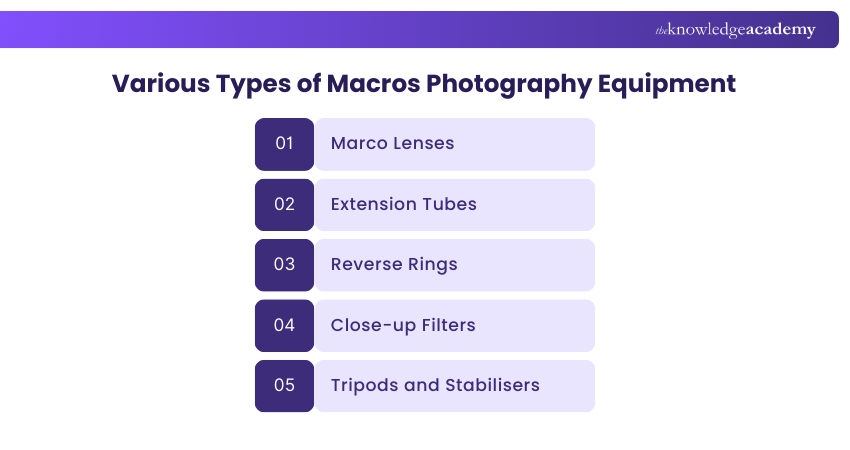
a) Macro Lenses: These lenses are optimised for close-up Photography. Unlike regular lenses, they can focus much closer, providing sharp, detailed images of tiny subjects. They're a significant investment but crucial for serious Macro enthusiasts.
b) Extension Tubes: If positioned between your camera body and lens, these tubes increase the distance between the lens and the sensor, enhancing magnification. They don't contain optics but can reduce the amount of light, so adjustments may be needed.
c) Reverse Rings: By attaching a lens in reverse, you alter its properties. This is a cost-effective technique, especially suitable for prime lenses. However, it's essential to ensure compatibility and protect the exposed rear element.
d) Close-up Filters: Acting as magnifying glasses, they attach to a lens's front. While they're a more affordable option, they might slightly reduce image quality, especially cheaper variants.
e) Tripods and Stabilisers: The closer the subject, the more noticeable any camera movement becomes. Tripods provide stability, and specialised Macro tripods offer adjustable arms to position the camera closer to subjects, facilitating precise shots.
Techniques for Sharper Images: Stability and Focus
Here something to enhance your stability and focus while you do Macro Photography.
a) Manual focus: Given the fine details in Macro, autofocus might not always be accurate. Manually adjusting focus provides greater control, allowing Photographers to pinpoint and highlight their subject's most compelling details.
b) Focus stacking: Due to the limited depth of field in Macro, parts of the subject might be out of focus. By taking multiple shots at different focus points and combining them in software, you can achieve an image that's sharp throughout.
c) Use of flash: Natural lighting might not always suffice, especially at higher magnifications. A flash can add required illumination, but diffusing it ensures the light isn't harsh and doesn't wash out the subject.
d) Remote shutter release: The shutter button introduces camera shake. Using a remote shutter or the camera's built-in timer minimises this risk, ensuring crisper images.
e) Shooting angles: A straight-on shot can look vastly different from a side or angled view. By experimenting, Photographers can discover unexpected and intriguing facets of their subjects.
Lighting the Tiny World: Natural vs. Artificial
Understanding the difference between natural and artificial is a key aspect to understand photography. Let us have a look at these pointers to understand it better:
a) Natural Light: Soft, even lighting, like that during the golden hours, can accentuate details without overpowering shadows. However, it's variable and might need modifiers to get it just right.
b) Reflectors: These tools are perfect for directing sunlight onto shaded subjects or softening strong sunlight. A simple reflector can significantly enhance image quality by providing balanced light.
c) LED Ring Lights: Circular lights that surround the lens, these ensure the subject is uniformly lit. They're especially helpful in shaded areas or indoors, but it's essential to adjust their intensity to avoid overexposure.
d) Flash Diffusers: Direct flash can be too harsh for delicate subjects. Diffusers scatter the flash's light, making it softer and more evenly distributed, preserving the subject's natural colours and textures.
Macro Photography Settings
Macro Photography settings require careful control of aperture, focus, and shooting mode to capture fine details with precision. Below are the steps to capture perfect Macro Photography. Using the right combination of these settings helps achieve sharp images, balanced exposure, and effective depth of field.
1) Set Your Camera to Aperture Priority or Manual Model
Using Aperture Priority or Manual mode gives you greater control over exposure and depth of field, which is essential in Macro Photography. These modes allow you to adjust settings precisely to capture fine details and maintain image clarity.
2) Carefully Choose Your Aperture for Perfect Depth of Field
Selecting the right aperture is crucial, as Macro Photography often has a very shallow depth of field. A smaller aperture helps bring more of the subject into focus, ensuring key details remain sharp and well-defined.
3) Use Manual Focusing for the Sharpest Results
Manual focusing provides better accuracy when working at close distances. It allows you to fine-tune focus on specific details, ensuring sharper and more controlled results compared to autofocus.
Unleashing Creativity: Creative Macro Photography Ideas
Macro Photography opens endless creative possibilities by transforming ordinary subjects into visually striking images. By experimenting with angles, lighting, and composition, photographers can capture unique perspectives and highlight intricate details that are often missed.
You can explore different textures, patterns, and colours in nature or everyday objects to create compelling visuals. Playing with background blur, reflections, and lighting techniques can further enhance creativity and produce distinctive macro shots.
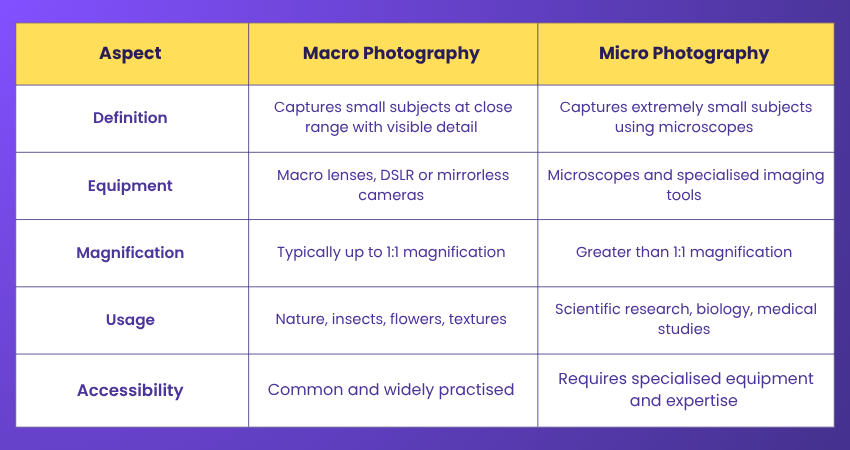
Macro vs Micro Photography: Key Differences
Macro and micro photography both focus on capturing small subjects, but they differ in technique, equipment, and level of magnification. Understanding these differences helps photographers choose the right approach for their creative and technical needs.
What Makes Good Macro Photography?
Good Macro Photography depends on the combination of sharp focus, controlled lighting, and strong composition. Through careful use of depth of field and framing, one can bring out very small details very clearly.
Conclusion
Macro Photography is a powerful way to reveal a world rich in hidden detail and creativity. With patience, practice, and the right techniques, even the smallest subjects can create a strong visual impact. It transforms how everyday scenes are seen through exploration and experimentation.
Build cinematic storytelling skills with our Filmmaking Course and bring creative film ideas to life!
Frequently Asked Questions
What is a Macro Lens Used for?

A macro lens is a special type of lens created for photographing very close to the subject. It allows the photographer to get big, detailed shots of tiny creatures like bugs and of flowers that show the textures that the regular lenses usually do not pick up.
Which Camera is Best for Macro Photography?
An excellent macro photography camera should possess traits such as focus stacking, high resolution, and exceptional close-up performance, which all come together to make mirrorless cameras the most sought after.

The Knowledge Academy


Global Training Provider
The Knowledge Academy is a world-leading provider of professional training courses, offering globally recognised qualifications across a wide range of subjects. With expert trainers, up-to-date course material, and flexible learning options, we aim to empower professionals and organisations to achieve their goals through continuous learning.


 If you wish to make any changes to your course, please


