


 Top Rated Course

We may not have the course you’re looking for. If you enquire or give us a call on +45 89870423 and speak to our training experts, we may still be able to help with your training requirements.
What is Revenue Forecasting: A Beginner’s Guide
The Knowledge Academy 23 December 2025Revenue Forecasting is the process of estimating a business’s future income based on historical data, market trends, and plans to aid budgeting and decisions. It helps companies to plan budgets, manage cash flow, set targets, and make smart investment decisions. It is a powerful tool to understand where a business is headed.

Training Outcomes Within Your Budget!
We ensure quality, budget-alignment, and timely delivery by our expert instructors.
Table of Contents
Related Courses
Have you ever wondered why some businesses are always prepared for the future while others struggle with a sudden income drop? Well, that is where the significance of What is Revenue Forecasting comes in. It helps businesses to prepare ahead and estimate the amount of money they can earn in a set timeframe.
It is a simple yet powerful tool for businesses, helping them to make informed decisions regarding spending, growth, and hiring. In this blog, you will learn about What is Revenue Forecasting, its importance, steps, and more comprehensively. So, if you are ready to begin planning with confidence, keep reading ahead!
Table of Contents
1) What is Revenue Forecasting?
2) Why is Revenue Forecasting Important?
3) Steps to Forecast Revenue
4) Revenue Forecasting Models
5) Challenges in Revenue Forecasting
6) Common Revenue Forecasting Mistakes to Avoid
7) Steps to Forecast Revenues Effectively
8) How to Improve Revenue Forecasting Accuracy?
9) What is the Difference Between Revenue Forecast and Actuals?
10) Conclusion
What is Revenue Forecasting?
Revenue Forecasting is the process of estimating how much money a business is likely to earn in the future. It means using past sales data, present performance, and market trends to predict future income. It works as a financial compass for businesses, helping them plan budgets, set targets, and decide cost allocation.
By having a set expectation of the future revenue, businesses can make better choices on hiring staff, launching products, and investing. Understanding What is Revenue Forecasting helps small companies to use limited resources effectively. For large companies, this helps to support big decisions, such as expansion. Also, it is helpful for leaders to identify potential growth opportunities and stay prepared for changes in the market.

Why is Revenue Forecasting Important?
Revenue Forecasting is important because it helps businesses to prepare ahead and make smart business decisions. This helps them to manage uncertainties effectively and support long-term growth. Let’s look at some of the key importance.
1) Planning Potential: It helps businesses plan better. When management likely knows how much revenue is coming in, they can decide where to spend, what to prioritise, and how much to invest in future projects.
2) Securing Investors: It shows investors that a business understands its future and makes decisions based on data. This helps to build trust and confidence when explaining the earning potential to key investors or stakeholders.
3) Preparing for Difficulty: It helps companies manage uncertain periods. If a drop in revenue is expected, they can act proactively by reducing costs or adjusting stock. This helps to protect cash flow and keep businesses stable.
Steps to Forecast Revenue
By examining historical performance, the current state of your business, and external factors, you can estimate future revenue. Forecasting revenue takes preparation and discipline. Here are some steps you can take to accomplish it.
1) Collect Accurate Financial Data
Data helps you gain an understanding of an organisation’s history. Balance sheets, income statements, and cash flow statements provide the base. To gather such information, you may rely on software that automatically monitors transactions, categorises expenses, and generates financial statements.
2) Define the Forecasting Time Frame
It is typical to have an annual revenue forecast in addition to some smaller increments. While forecasting revenue for the next few years can be helpful, more extended forecasts are naturally less certain.
3) Evaluate Internal Growth Factors
This starts with your products and services, including geographic expansions or new offerings. You must factor in capacity in production, logistics, staffing, etc. Strategy, such as major marketing campaigns or acquisitions, also plays a major role.
4) Consider External Influences
These factors (also known as drivers) can fuel or slow your business growth. They include seasonality, consumer demand, regulatory or legal changes, economic conditions, or significant local, national and global events.
5) Identify Constraints and Risks
For this, take into consideration how changes in business investment or consumer spending might affect the results. Also, think about whether limited labour, materials, or transport could reduce your capacity to have more accuracy in Revenue Forecasting.
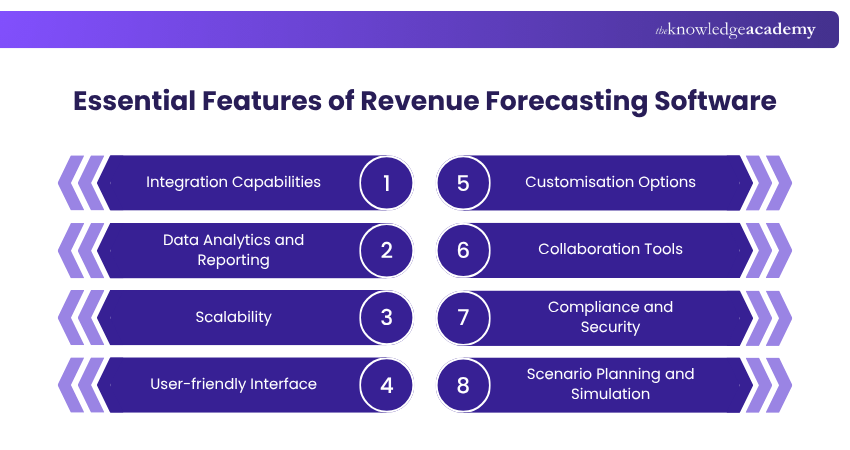
6) Utilise Forecasting Software
This could be anything from a spreadsheet to sophisticated financial forecasting software. Dedicated software can help consolidate the forecasting process, automate data gathering and analysis, and offer access to prebuilt forecasting models.
7) Select the Right Forecasting Method
With the data, assumptions, and tools in place, you can move on to choose which forecasting methods best fit your business model. Multiple potential forecasting methods are available, including time-series analysis, regression analysis, and financial modelling techniques.
8) Track and Adjust Your Forecast
You can set up dashboards to report on budget variances and revise the prediction based on actual revenue and changing economic conditions. Regular review of these updates helps to identify trends early, correct errors, and keep forecasts realistic.
Learn diverse global financial market dynamics efficiently and effectively with our Foreign Exchange Training – Register today!
Revenue Forecasting Models
Revenue Forecasting models help businesses estimate future earnings with greater accuracy. The most suitable model depends on the type of business and the quality of data available. To create a reliable forecast, companies study past sales, customer behaviour, market trends and seasonal patterns. The goal is to choose a method that provides clear and realistic insights.

1) Straight-line Method
This is the simplest model. It assumes that revenue will keep growing at the same steady rate as it has in the past. It gives a quick idea of future sales but may not be correct if the market changes suddenly.
2) Linear Regression
This method looks at how one thing affects another. For example, it checks if higher marketing spend leads to higher sales. If there is a clear link, it uses that pattern to predict future revenue. It works best when the relationship between factors stays steady.
3) Exponential Smoothing
This model uses past sales to predict future sales and gives more importance to recent results. It works well when recent trends matter, such as growing interest in a product. It might not be accurate if sales change too often.
4) ARIMA
AutoRegressive Integrated Moving Average (ARIMA) studies past sales trends over time and uses those patterns to forecast future revenue. It is effective with strong historical data, but is more technical to use.
5) Holt-winters Seasonal Method
This method works well for businesses that experience seasonal changes. For example, travel companies see higher sales in holiday seasons. This method studies past sales and seasonal trends to give a more accurate forecast.
Advantages of Revenue Forecasting
Revenue Forecasting offers businesses a wealth of benefits, enabling them to improve resource allocation and navigate the ever-changing market landscape with greater agility. The biggest advantages are highlighted below:
1) Forecasting business models can direct investments towards areas with the highest potential for growth and profitability, minimising wastage and maximising returns.
2) A Revenue Forecasting model plays a significant role in avoiding cash flow shortfalls and preventing unexpected financial surprises.
3) Revenue Forecasting enables you to set realistic sales targets for marketing campaigns and track the progress of the sales pipeline towards achieving them.
Challenges in Revenue Forecasting
Revenue Forecasting is not without its share of formidable challenges, as detailed below:
1) Acquiring precise and dependable historical data points is a significant hurdle in Revenue Forecasting. Data manipulation, human error, or external factors beyond a company’s control can undermine the accuracy of data sources.
2) Another challenge is the inherent unpredictability of external events. Changes in consumer preferences, technological advancements, economic fluctuations, and regulatory changes can profoundly impact revenue projections.
3) Human error is a constant threat in Revenue Forecasting. Manual data entry, computational errors, and subjective judgments can introduce inaccuracies that undermine the integrity of the Revenue Forecasting models.
4) The intricate nature of contemporary business models further amplifies the challenges of Revenue Forecasting. Modern businesses operate within interconnected markets, rendering accurate predictions of revenue streams increasingly difficult.
5) Ever-shifting customer behaviour poses a persistent challenge for Revenue Forecasting. Purchasing patterns, consumer preferences, and market trends are in perpetual flux, making it arduous for businesses to keep pace.
Gain practical insights through real-world case studies and hands-on simulations. Join our Investment Banking Training today!
Common Revenue Forecasting Mistakes to Avoid
A good Revenue Forecasting can go wrong due to commonly committed mistakes. Being aware of these errors helps businesses to have better clarity on What is Revenue Forecasting. Here is the list of key errors that businesses must be informed about.
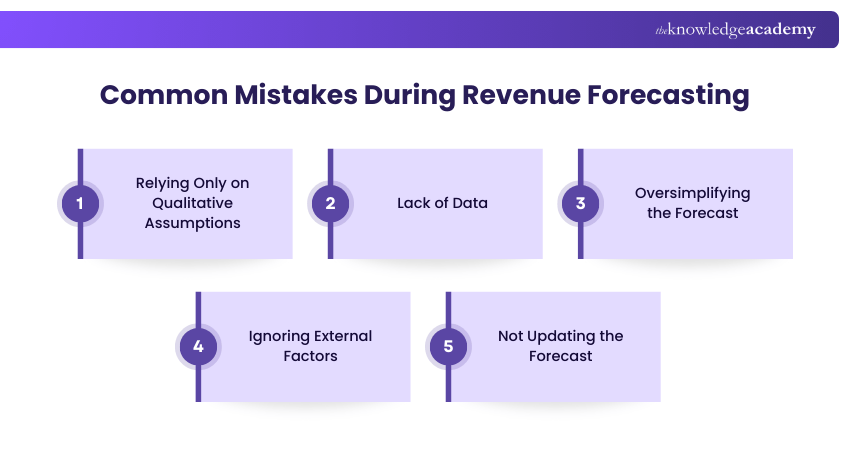
1) Relying Only on Qualitative Assumptions: Forecast must not be based solely on opinions or guesses. It can lead to unrealistic results. Utilise data on past sales and clear market trends to balance qualitative insights and quantitative data.
2) Lack of Data: New businesses often do not have sufficient historical data. If this is ignored, it can lead to weak Revenue Forecasting. They must use industry reports, market research, and competitor data to make informed predictions.
3) Oversimplifying the Forecast: It can be risky to make simple or straight-line projects. Since revenue is affected by many factors, such as market demand or pricing, ignoring these can lead to a misleading Forecast. By staying aware of this, unwanted results can be avoided.
4) Ignoring External Factors: A forecast must not ignore the outside world. Economic changes, new laws, technology shifts, or competitor actions affect revenue. It is essential to adjust your focus to these external factors to adjust your forecast.
Not Updating the Forecast: When a forecast is created, it is essential to review it. Otherwise, it becomes outdated. Regular updates by using data, real results, and changing external conditions help to keep Revenue Forecasting as accurate as possible.
Steps to Forecast Revenue Effectively
Forecasting Revenue means looking ahead and predicting how much money your business will bring in, using smart data and real-world insights. It helps you plan confidently, stay prepared, and grow with purpose.
How to do it:
1) Collect past sales and financial data
2) Choose a forecasting method (trend analysis, regression, top-down or bottom-up)
3) Review internal factors like pricing, marketing, and new products
4) Consider external influences such as the economy, market demand and competition
5) Create your forecast based on data and insights
6) Track actual results and adjust regularly
Build your expertise in growing wealth with the Investment Management Course – Register today!
How to Improve Revenue Forecasting Accuracy
For improving accuracy in Revenue Forecasting, it is important to use the right methods and correct information. Here are some practical ways to make your forecast more accurate and viable.
1) Use Historical Data
Look at past performances to identify patterns in your business revenue. By learning these trends, future projections are more realistic. Historical data can show you the:
a) Highs and lows of seasons
b) Impact due to economic changes
c) How customers responded
2) Use Market Research and Industry Insight
Do not be entirely reliant on internal data. Utilise data on external factors to understand trends, customer preferences, and changes in your field. It includes:
a) Market Research
b) Industry Report
c) Competitor Analysis
3) Use Technology, AI, and Machine Learning
Modern tools, such as AI and machine learning, can analyse large amounts of data efficiently. These tools help to understand market behaviour better. It can help to:
a) Track real-time changes
b) Show how different factors affect revenue
c) Improve accuracy in prediction
4) Regularly Review and Update Forecast
A forecast should not be created once. Conducting continuous review helps to keep the forecast aligned and realistic to support better decision-making. It should:
a) Compare actual results with your forecast
b) Update the data when conditions change
c) Adjust assumptions with more learning
5) Use Scenario Planning & Sensitivity Analysis
Testing how changes in demand, competition, or economic conditions affect revenue helps to prepare more effective plans. This keeps businesses prepared and flexible. It must create:
a) Best-case scenario (high demand and strong economy)
b) Worst-case scenario (low demand and tough economy)
c) Most likely to happen cases
What is the Difference Between Revenue Forecast and Actuals?
A Revenue Forecast is an estimate of how much money a business expects to earn in the future. Actual revenue is the real money the business has already earned. The main difference is that forecasts are predictions, while actual results are confirmed. Comparing both helps a business see how well it performed and improve future planning.
Conclusion
Understanding What is Revenue Forecasting helps businesses to plan ahead, use resources wisely, and stay ready for market changes. By studying past sales, trends, and customer behaviour, companies can make smarter financial decisions and stay competitive. With the right methods and regular tracking, Revenue Forecasting becomes a powerful tool for growth, stability, and long-term success.
Turbocharge your financial and investment skills with Investment and Trading Training today!
Frequently Asked Questions
What is the Best Method to Forecast Revenue?

Regression analysis, time series forecasting, and lead-driven forecasting are among the best methods to forecast revenue.
What are the Skills of Revenue Forecasting?
The skills required for Revenue Forecasting include:
a) Quantitative and Analytical Proficiency
b) Strategic Revenue Management
c) Technical Savvy with Revenue Systems
d) Financial Modelling
e) Data Visualisation
What are the Other Resources and Offers Provided by The Knowledge Academy?
The Knowledge Academy takes global learning to new heights, offering over 3,000+ online courses across 490+ locations in 190+ countries. This expansive reach ensures accessibility and convenience for learners worldwide.
Alongside our diverse Online Course Catalogue, encompassing 19 major categories, we go the extra mile by providing a plethora of free educational Online Resources like Blogs, eBooks, Interview Questions and Videos. Tailoring learning experiences further, professionals can unlock greater value through a wide range of special discounts, seasonal deals, and Exclusive Offers.
What is The Knowledge Pass, and How Does it Work?
The Knowledge Academy’s Knowledge Pass, a prepaid voucher, adds another layer of flexibility, allowing course bookings over a 12-month period. Join us on a journey where education knows no bounds.
What are the Related Courses and Blogs Provided by The Knowledge Academy?
The Knowledge Academy offers various Investment and Trading Courses, including the Revenue Management Training, Investment Banking Training, and the Investment Management Course. These courses cater to different skill levels, providing comprehensive insights into How to Invest in Gold.
Our Business Skills Blogs cover a range of topics related to Revenue Management, offering valuable resources, best practices, and industry insights. Whether you are a beginner or looking to advance your Revenue Management skills, The Knowledge Academy's diverse courses and informative blogs have got you covered.

The Knowledge Academy


Global Training Provider
The Knowledge Academy is a world-leading provider of professional training courses, offering globally recognised qualifications across a wide range of subjects. With expert trainers, up-to-date course material, and flexible learning options, we aim to empower professionals and organisations to achieve their goals through continuous learning.

Upcoming Business Skills Resources Batches & Dates
Date
 Revenue Management Training
Revenue Management Training
Fri 17th Jul 2026
Revenue Management Training
Fri 9th Oct 2026

 If you wish to make any changes to your course, please


