


 Top Rated Course

We may not have the course you’re looking for. If you enquire or give us a call on +45 89870423 and speak to our training experts, we may still be able to help with your training requirements.
ISO 27001 Certification Audit: Complete Step-by-Step Guide
Hailey Davis 13 July 2026An ISO 27001 Audit assesses an organisation’s ISMS to ensure compliance, reviewing policies, Annex A controls, and risk management processes. It also identifies gaps, recommends improvements, strengthens information security, helping organisations reduce risks, protect data, and maintain regulatory compliance.
Home
 Resources
IT Security & Data Protection
ISO 27001 Certification Audit: Complete Step-by-Step Guide
Resources
IT Security & Data Protection
ISO 27001 Certification Audit: Complete Step-by-Step Guide
Resources
IT Security & Data Protection
ISO 27001 Certification Audit: Complete Step-by-Step Guide

Training Outcomes Within Your Budget!
We ensure quality, budget-alignment, and timely delivery by our expert instructors.
Table of Contents
ISO 27001 Audits play a critical role in maintaining robust information security within organisations. By systematically reviewing an organisation’s Information Security Management System (ISMS), these audits ensure compliance with ISO 27001 standards, evaluate risk management practices, and verify the implementation of Annex A controls.
In this blog, we explore what an ISO 27001 Audit entails, its key objectives, types, processes, and the benefits it brings in safeguarding organisational data and maintaining regulatory compliance.
Table of Contents
1) What is ISO 27001 Audit?
2) Importance of ISO 27001 Audit
3) What are the Types of Audits?
4) Stages of the ISO 27001 Audit
5) How to Prepare for an ISO 27001 Audit?
6) Who Can Perform ISO 27001 Audits?
7) ISO 27001 Audit Checklist
8) How Often do I Need to Conduct an Audit?
9) How Much Does a 27001 Audit Cost?
10) Conclusion
What is ISO 27001 Audit?
An ISO 27001 Audit is a checklist to see if a company is following the rules and steps of the ISO 27001 standard. This standard helps businesses keep their information safe. The audit looks at how well a company protects its data and if it is doing what it promised in its security plan.

Importance of ISO 27001 Audit
Audits of ISO 27001 are essential to organisations in order to gain and retain certification by ensuring compliance with the international information security standards. They assist in proving the controls are working, risk management, and client or partners compliance.
Key Importance of ISO 27001 Audits:
1) Necessary to undergo the ISO 27001 process of certification.
2) Allow organisations to be associated with customers or partners that need ISO 27001 conformity.
3) Ensure continuity and certification by conducting regular audits.
4) Evaluate emerging risks and identify weaknesses as the organisation expands.
5) Soften data management and IT security activities by highlighting opportunities.
What are the Types of Audits?
There are two main types of Audits in ISO 27001: Internal Audit and External Audit. Both help make sure the company is keeping its data safe. Let's discuss in detail:
1) Internal Audit
An Internal Audit is done by someone inside the company or a hired person before the main audit. It helps find problems early and gives time to fix them. The goal is to check if the company is following its own security plan. It is like a practice check before the real one.
a) Done by the company’s own team or an outside helper
b) Helps find issues early and fix them
c) Prepares the company for the official audit
2) External Audit
An External Audit is done by a certification body. This is the official check to decide if the company gets ISO 27001 certified. The Auditor looks at systems, documents, and staff practices. If everything is correct, the company gets the certificate
a) Done by a certified external Auditor
b) Needed to get ISO 27001 certification
c) Confirms the company is keeping data safe properly
Learn how to conduct Internal Audits with our ISO 27001 Lead Implementer Course – Join today!
Stages of the ISO 27001 Audit
It is essential to know the steps of the ISO 27001 Audit among organisations that want to be certified. The certification would be segmented into two phases, and the successful passing of both phases would determine the attainment of ISO 27001 compliance. The two phases are:
1) Stage 1
Stage 1 is devoted to the review of the design and documentation of the ISMS that the organisation has in place to ensure that it is compliant with ISO 27001.
a) Audit of the Information security management system (ISMS) design in the organisation.
b) Establish risk level, security levels, and regulations or contract legalities.
c) Establish the scope of the audit, security objectives, and statement of applicability.
d) Document all the processes, procedures, policies, guidelines, and controls of the ISMS based on the ISO 27001/27002.
e) Prepare an analysis of risk, a risk treatment plan, and a gap analysis.
f) Auditor reviews documentation and reports findings and recommendations of the ISO 27001 audit.
g) The employees can require extra security training in order to comply with stage 1 requirements, after which they can change to stage 2.
2) Stage 2
Stage 2 confirms the presence of the ISMS that is successfully adopted and in operation within the organisation
a) Audited by a certifying body auditor to ensure that the ISMS is functioning effectively in practice
b) Auditor conducts an evidential field work and chooses information and data assets to verify that they are in accordance with process documentation
c) Key stakeholders, internal audit, and compliance teams interviews
d) Assessment of past audit reports and facts of remedies on the results of stage 1
e) Identifies after-certification plans, such as security knowledge training and an internal audit calendar
f) Successful completion results in ISO 27001 certification valid for three years
g) Annual surveillance audits are required to ensure ongoing compliance and that controls continue to operate effectively
Who Can Perform ISO 27001 Audits?
ISO 27001 Audits must be conducted by competent and experienced auditors who demonstrate a thorough understanding of the ISO 27001 standard. This knowledge is shown through formal education, certification, or practical experience validated by the certifying body.
Key Points:
a) Internal auditors must be independent from the ISMS stakeholders to avoid conflicts of interest.
b) Organisations without a dedicated audit team often hire trained contractors or auditing firms to support internal audits.
c) External audits, including certification, surveillance, and recertification, are performed by accredited auditors approved by certification bodies.
d) Many external auditors have completed ISO 27001 Lead Auditor training or equivalent certification.
e) Objective and knowledgeable auditors ensure accurate assessments, compliance, and identification of improvement opportunities.
Strengthen your organisation’s security from with our ISO 27001 Internal Auditor Training - Join today!
ISO 27001 Audit Checklist
A structured checklist ensures all key areas of your ISMS are reviewed for compliance before internal or certification audits. Confused what to check follow this below table:
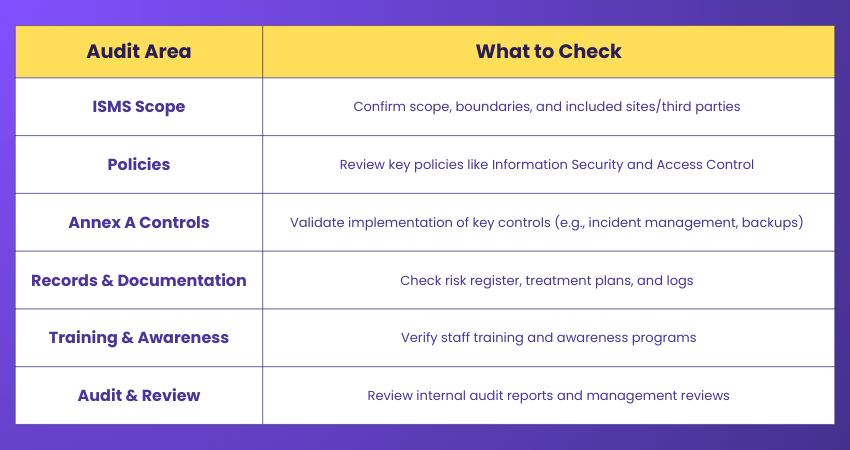
This checklist can be used for Internal Audit preparation, Stage 2 certification readiness and ongoing surveillance audits, helping teams stay organised and focused on key ISO 27001 requirements.
How to Prepare for an ISO 27001 Audit?
Getting ready for an ISO 27001 Audit involves a few steps that help your business show it meets the standard. These steps include:
1) Identify Key Processes to be Audited
Start by defining the scope of your Information Security Management System (ISMS). This means deciding which departments, locations, or services are included. Then, find out which processes are important to your ISMS — especially those that handle critical data or involve
high risks. Talk to process owners and other team members to better understand how these processes work and how they affect your information security.
a) Define the boundaries and scope of your ISMS
b) Focus on high-risk and business-critical processes
c) Speak with process owners and teams for more insights
2) Gather Required Documents
The ISO 27001 standard requires several documents that must be ready for the audit. These include your security policy, scope, risk assessment, and risk treatment plan. You’ll also need evidence of incident handling, backups, access control policies, and more. These documents prove that your business follows the required rules and has strong security practices.
a) Collect required documents like policies, plans, and logs
b) Keep risk assessments and treatment plans up to date
c) Ensure all audit-related documents are organised and accessible
3) Provide Training for Employees and Contractors
Make sure your team and any contractors are trained on your security policies and their responsibilities. Everyone should know how to follow the rules and understand why security is important. Regular training and updates will help your people stay aware and prepared, especially before an audit.
a) Train staff on their roles in information security
b) Provide updates on changes in policies and procedures
c) Ensure everyone understands their part in the ISMS
Learn auditing principles with our ISO 27001 Lead Auditor Course – Join today!
How Often do I Need to Conduct an Audit?
You should conduct an internal audit at least once a year. Some companies may do it more often, depending on risks or business needs. Regular audits help keep your information security system strong and up to date.
How Much Does a 27001 Audit Cost?
The cost of an ISO 27001 audit depends on your company’s size and complexity. On average, it can range from £5,000 to £20,000 for small to medium-sized companies. Larger organisations with more complex systems may pay £30,000 or more. Costs also include certification, training, and preparation work.
Conclusion
The ISO 27001 Audit helps companies keep their security compliance standards in check with the ISO guidelines. Regular Audits need to be conducted within companies by external certified bodies to retain their certifications. Considering the lengthy nature of the audit process, companies can proactively prepare themselves by training the teams regularly.
Learn to find security risks with our ISO 27001 Foundation Certification – Join today!
Frequently Asked Questions
What are the Common Non-conformities Found in ISO 27001 Audits?

Common non-conformities in ISO 27001 Audits include inadequate risk assessment documentation, missing or outdated policies, ineffective controls, lack of employee training, and non-compliance with required procedures.
What is an ISO 27001 Audit Checklist?
An ISO 27001 Audit Checklist is a tool used to ensure that an organisation’s Information Security Management System (ISMS) complies with ISO 27001 standards. It includes criteria for assessing risk management, policy adherence, and control effectiveness.

Hailey Davis


Compliance Officer
Hailey Davis is an ISO compliance expert with over 10 years of experience in audit, quality management systems (QMS), and regulatory compliance. She has worked with various industries, including manufacturing, healthcare, and technology, ensuring organisations achieve and maintain ISO certifications. Hailey’s content provides practical, actionable insights on navigating compliance challenges and improving business processes.
View Detail

 If you wish to make any changes to your course, please


