


 Top Rated Course

We may not have the course you’re looking for. If you enquire or give us a call on +45 89870423 and speak to our training experts, we may still be able to help with your training requirements.
The Future of Cryptocurrency: Trends, Predictions, and Insights
The Knowledge Academy 02 March 2026Future of Cryptocurrency points to mainstream adoption, clearer regulations, institutional growth, and real-world utility through Blockchain and tokenisation. Advancements in blockchain and wider global adoption are driving beyond speculation. This is creating new opportunities for investors, businesses, and users.

Training Outcomes Within Your Budget!
We ensure quality, budget-alignment, and timely delivery by our expert instructors.
Table of Contents

Cryptocurrencies have carved out a stellar niche for themselves in the digital revolution. It's a transformative innovation that opens a new realm of global commerce possibilities. Given this circumstance, the Future of Cryptocurrency beckons with promises of a transformed financial landscape. But what exactly might we experience in the times to come?
As more companies accept crypto payments, governments explore digital currencies and innovative technologies. In the coming years, cryptocurrencies will transform how banking operates, influence the economy, and shape financial decisions. In this blog, you will learn about the Future of Cryptocurrency, its predictions, and more. Keep reading ahead!
Table of Contents
1) Introduction to Cryptocurrency
2) What is the Future of Cryptocurrency?
3) Crypto Market Predictions
4) Why Cryptocurrency Could be the Future of Money?
5) Regulatory Factors Affecting the Future of Cryptocurrency
6) Is Crypto Taxable?
7) Conclusion
Introduction to Cryptocurrency
Cryptocurrency is a digital form of money, with well-known names, such as Bitcoin, Ethereum, and Litecoin. It utilises a powerful encryption to secure transactions and track ownership, turning it into a currency and virtual accounting system. For storing and accessing your digital coins, you require a Cryptocurrency wallet, which can be on a phone, computer, or cloud service.
It is important to note that Cryptocurrency comes with its own risk. The market is relatively new and highly volatile. Since it operates without banks or government regulations, it is often uninsured and harder to convert into traditional money. Additionally, cybersecurity threats and risks of losing wallet access can result in losing funds. By keeping these risks in mind, it helps users to explore the Cryptocurrency world safely and smartly.

What is the Future of Cryptocurrency?
The Future of Cryptocurrency remains a subject of intense debate, with opinions divided between enthusiasts and sceptics. Supporters expect a world where Cryptocurrencies replace traditional financial systems through Decentralised Finance (DeFi). They argue that digital currencies will cover everyday transactions, investments and online commerce.
On the other hand, critics question Cryptocurrency’s practicality and long-term stability. They argue that most Cryptocurrencies lack real-world use cases and remain way too volatile to function as reliable currencies. Concerns over regulatory scrutiny, fraud, and market manipulation further challenge their widespread adoption. Many believe that it may complement rather than completely replace traditional finance.
Crypto Market Predictions
From mainstream recognition to increased security measures, the future looks extremely promising for the Crypto market. Let's explore some interesting Cryptocurrency Trends and predictions that will shape the Future of Cryptocurrency:
1) Bitcoin Predictions
According to recent Data, the exchange rate for Bitcoin (BTC) in British Pounds (GBP) reached a low of £59,675 on April 9, 2025, and hit a high of £92,527.23 on October 6, 2025, with an average rate for the year of approximately £78,297.93. Some Analysts expect Bitcoin to break new records in the near future as more institutional investors enter the market and regulatory clarity improves.
Transform your finances with our expert Stock Trading Course – secure your spot now!
2) Mass Adoption and Mainstream Recognition
Cryptocurrencies gained significant momentum in 2023 as major financial institutions adopted digital assets. With more clarity and consistency in regulations across different regions, more traditional investors are joining the market. As the negative perception of Cryptocurrency fades away, there will be wider acceptance in everyday transactions. This shift will integrate digital assets into global financial systems.
3) Interoperability and Cross-chain Solutions
Blockchain interoperability will be a key point of focus in the near future as the Crypto space evolves into a more interconnected ecosystem. Cross-chain solutions and interoperability protocols will enable smooth communication and asset transfer between different Blockchain networks. Projects that aim to connect diverse Blockchains will gain popularity, assuring collaboration and innovation across the decentralised landscape.
4) Enhanced Security Measures
As the Crypto industry grows, so do the challenges of cybersecurity. We can anticipate a stronger emphasis on security measures within the Crypto space. Blockchain projects and exchanges will invest in solid security infrastructure, using advanced encryption techniques and decentralised storage solutions to protect user assets. The industry’s dedication to enhancing security will be essential in developing trust and confidence among users.
5) Decentralised Finance (DeFi) Maturation
The Decentralised (DeFi) space continues to drive innovation by offering financial services without traditional intermediaries. This means that soon, the ecosystem is expected to mature by solving key challenges around security, scalability, and user experience. Better infrastructure and interoperability between DeFi platforms will make financial access easier, encouraging traditional financial institutions to adapt to stay relevant.
Smarter tech is the key to smarter money. Dive into the digital revolution transforming banking, payments and investment with our FinTech Course - Sign up now!
Why Cryptocurrency Could be the Future of Money?
One optimistic future scenario is the possibility of regulators worldwide agreeing on a unified global framework for Cryptocurrency regulation. While it may seem unlikely today, an agreement could emerge over time as digital currencies reshape the financial world.

Currently, countries hold different positions on Cryptocurrency. Some, such as EL Salvador and the Central African Republic, have recognised Bitcoin as legal currency. While other countries, such as China, have banned Crypto transactions. Until Web3 wallets and other Blockchain tools become common, global regulatory alignment remains a challenge.
1) A Federal Opportunity
While global consensus on Crypto regulations remains distant, the United States is making notable progress at the federal level. The Biden administration has formed a specialised team to guide Crypto policy development, led by Treasury Secretary Janet Yellen and SEC Chairman Gary Gensler, who brings strong Blockchain expertise from his teachings at MIT.
Their leadership provides hope for practical, informed regulations that safeguard users while supporting innovation. Although Congress has proposed several Crypto bills, progress is slow and requires careful evaluation. Still, a clearer framework may soon emerge for investors, businesses, and financial institutions.
2) A Consumer-driven Trend
As governmental entities devise a legal framework and taxation system, Cryptocurrencies could become more prevalent in the digital wallets of US consumers. Bitcoin became a legal tender in a few countries; the US could do the same anytime soon.
Many retailers are likely to begin accepting payments in the form of Cryptocurrencies like Bitcoin, Litecoin, and Dogecoin, making investing in cryptocurrencies even more relevant. Increased use of Crypto should motivate regulatory agencies and politicians to act faster, and the Blockchain systems should also benefit from widespread usage.
3) Future Outlook
Investors dislike uncertainty, so even a very strict regulatory framework is likely to be a huge improvement over the lack of any regulation. Once legal regulations are established, we can expect the Crypto market to reach new levels.
Setting clear guidelines helps to protect consumers while encouraging responsible innovation from Crypto companies. Clarity on taxation, compliance, and security standards will enable businesses and institutional investors to confidently enter the market. This has the potential to make the Crypto ecosystem stable, transparent, and trustworthy.
Take the next step boldly in financial markets with the Forex Trading Course now!
Regulatory Factors Affecting the Future of Cryptocurrency
Crypto is also affected by the regulatory factors. You will learn about some of these factors in this section.
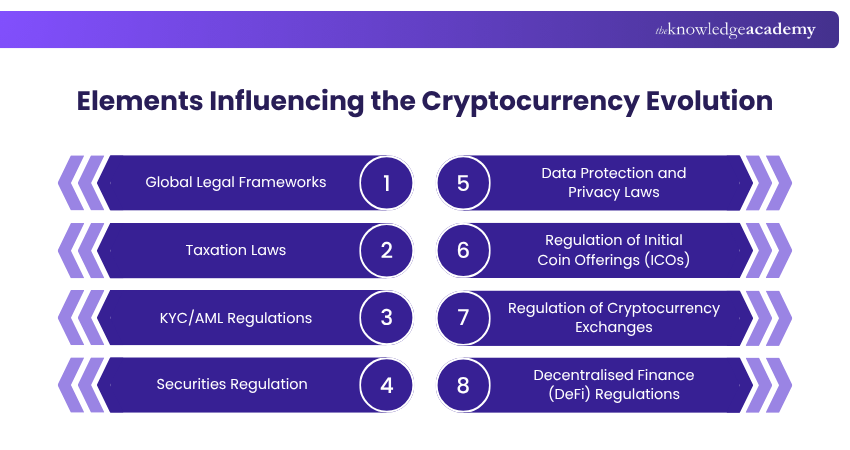
1) Global Legal Frameworks: The lack of a global legal framework for Cryptocurrencies makes it difficult for consistent regulation. Different countries have different rules, leading to uncertainty for investors and businesses.
2) Taxation Laws: The ways countries decide to tax Cryptocurrencies can significantly impact their use and growth. High tax rates may discourage people from using Cryptocurrencies, while low rates could encourage growth.
3) KYC/AML Regulations: Know Your Customer (KYC) and Anti-money Laundering (AML) regulations may become stricter to prevent illegal activities using Cryptocurrencies.
4) Securities Regulation: Some countries may classify certain Cryptocurrencies as securities. This would make them subject to specific regulatory guidelines. This classification could influence how these Cryptocurrencies are traded and used.
5) Data Protection and Privacy Laws: As Cryptocurrencies rely on the Blockchain, which records transactions, they could be affected by data protection and privacy laws. These laws can impact how transaction data is stored and used.
6) Regulation of Initial Coin Offerings (ICOs): ICOs are a common method of fundraising for new Cryptocurrencies. These regulations may impact how these offerings are conducted. This could affect the introduction of new Cryptocurrencies.
7) Consumer Protection: Governments are concerned about protecting consumers from potential scams and volatility in the Crypto market. Therefore, they may introduce regulations to safeguard the interests of consumers.
8) Regulation of Cryptocurrency Exchanges: Governments may decide to regulate Cryptocurrency exchanges more strictly to ensure they follow financial laws and provide adequate security to protect users' investments.
9) Decentralised Finance (DeFi) Regulations: DeFi is disrupting traditional financial services, and regulators may step in to control these services to protect consumers. This will also maintain the stability of the financial system.
10) Cryptocurrency Mining Regulations: Given the environmental impact of Cryptocurrency mining, some governments may regulate it to ensure compliance with environmental and energy usage laws, a key consideration highlighted in the Cryptocurrency Mining Guide. This could impact the production of Cryptocurrencies, especially proof-of-work ones like Bitcoin.
Join our comprehensive Day Trading Course and unlock your full trading potential – Join us now!
Cryptocurrency can be a high-risk and high-reward investment. Its value can fluctuate dramatically, leading to either potential gains or significant losses. Since Crypto assets are largely unregulated and vulnerable to fraud, investors must proceed cautiously and only invest what they can afford to lose.
Is Crypto Taxable?
Cryptocurrency is generally taxable in the U.S. The Internal Revenue Service (IRS) considers Crypto to be property. This means that selling, exchanging, spending, or disposing of Cryptocurrencies can result in a taxable event. Here are the key points to remember:
1) There’s no immediate tax liability when you buy and hold Cryptocurrency.
2) When you sell or exchange it for cash, goods, services or another Crypto, you may have a capital gain or loss.
3) If you earn Crypto via mining, staking or getting paid in Crypto, the income is taxable like ordinary income at the fair market value.
4) You must keep good records of these transactions because you’ll need to report them on your tax return.
Conclusion
The Future of Cryptocurrency is a blend of promise and uncertainty. It’s a constantly evolving ecosystem, fuelled by innovative technologies, regulatory challenges, and shifting market dynamics. As we navigate this complex landscape, it's clear that Cryptocurrencies hold the potential to redefine financial systems and offer unprecedented opportunities for global economic participation.
Elevate your trading game and secure your financial success – Join our Investment and Trading Training and unlock the secrets!
Frequently Asked Questions
What are the Career Opportunities in the Cryptocurrency Industry?

Career opportunities in the Cryptocurrency industry span across various sectors, such as:
1) Technical Roles: Blockchain Developer, Cybersecurity or Smart Contract Auditor
2) Finance Roles: Trader, Analyst, or Compliance Officer
3) Business Roles: Project Manager, Marketing, or Community Manager
Do I Need to Understand Blockchain Technology to Work in the Cryptocurrency Sector?
While understanding Blockchain Technology is advantageous, it's not mandatory for all roles in the Cryptocurrency sector. Positions in marketing, sales or administrative support may not require deep technical knowledge, though a basic understanding of Blockchain can be beneficial.
What are the Other Resources Provided by The Knowledge Academy?
The Knowledge Academy takes global learning to new heights, offering over 3,000+ online courses across 490+ locations in 190+ countries. This expansive reach ensures accessibility and convenience for learners worldwide.
Alongside our diverse Online Course Catalogue, encompassing 17 major categories, we go the extra mile by providing a plethora of free educational Online Resources like Blogs, eBooks, Interview Questions and Videos. Tailoring learning experiences further, professionals can unlock greater value through a wide range of special discounts, seasonal deals, and Exclusive Offers.
What is Knowledge Pass, and How Does it Work?
The Knowledge Academy’s Knowledge Pass, a prepaid voucher, adds another layer of flexibility, allowing course bookings over a 12-month period. Join us on a journey where education knows no bounds.
What are Related Courses and Blogs Provided by The Knowledge Academy?
The Knowledge Academy offers various Investment and Trading Courses, including Cryptocurrency Trading Training, Stock Trading Training, and the Day Trading Course. These courses cater to different skill levels, providing comprehensive insights into How to Invest in Gold.
Our Business Skills Blogs cover a range of topics related to Cryptocurrency, offering valuable resources, best practices, and industry insights. Whether you are a beginner or looking to advance your Cryptocurrency Trading skills, The Knowledge Academy's diverse courses and informative blogs have got you covered.

The Knowledge Academy


Global Training Provider
The Knowledge Academy is a world-leading provider of professional training courses, offering globally recognised qualifications across a wide range of subjects. With expert trainers, up-to-date course material, and flexible learning options, we aim to empower professionals and organisations to achieve their goals through continuous learning.

Upcoming Advanced Technology Resources Batches & Dates
Date
 Cryptocurrency Trading Training
Cryptocurrency Trading Training
Fri 7th Aug 2026
Cryptocurrency Trading Training
Fri 30th Oct 2026

 If you wish to make any changes to your course, please


