


 Top Rated Course


We may not have the course you’re looking for. If you enquire or give us a call on +45 89870423 and speak to our training experts, we may still be able to help with your training requirements.
Bookkeeping and Accounting | Differences Guide
Olivia Taylor 17 April 2026Bookkeeping records daily financial transactions, while accounting analyses them to provide reports, tax filings, and insights for business decisions. It ensures accuracy in records and supports compliance with financial rules. Together, they help businesses track performance and plan growth effectively.

Training Outcomes Within Your Budget!
We ensure quality, budget-alignment, and timely delivery by our expert instructors.
Table of Contents
Bookkeeping as well as accounting are indispensable in managing the finances of a business with precision. Although they are interrelated, they perform different functions in financial management. Let us see the differences between Bookkeeping and Accounting and the reasons why both are important.
Table of Contents
1) Bookkeeping vs. Accounting: An Overview
2) What Do Bookkeepers Do?
3) What Do Accountants Do?
4) Difference Between Bookkeeping vs Accounting
5) Education and Qualifications Required
6) Career Opportunities in Bookkeeping and Accounting
7) Salary Comparisons and Benefits: Bookkeeping and Accounting
8) When to Hire a Bookkeeper vs an Accountant?
9) How Can a Bookkeeper Become an Accountant?
10) Conclusion
Bookkeeping vs. Accounting: An Overview
Bookkeeping involves recording and organising all daily financial transactions to ensure records remain accurate and up to date. Accounting then uses this recorded data to analyse financial performance, prepare reports, and support business decision-making.
While bookkeeping focuses on capturing and maintaining financial data, accounting interprets that data to provide insights and guide strategy. Together, they offer a complete and clear picture of a company’s financial health.

What Do Bookkeepers Do?
Bookkeepers record and organise daily financial transactions to keep business records accurate and up to date. They manage ledgers, reconcile accounts, and track income and expenses to ensure all entries are correct and complete.
They also handle tasks such as processing invoices, recording payments, and maintaining financial documents for easy access. Their work supports accounting activities, helps maintain compliance, and ensures businesses have reliable data for reporting and decision-making.
Gain expertise to advance in finance, auditing, and business roles. Join our Accounting Course now!
What Do Accountants Do?
Accountants use the financial records prepared by bookkeepers to analyse a business’s financial position and performance. They prepare reports, ensure compliance with financial regulations, and support informed decision-making.
Their role includes tasks such as managing taxes, budgeting, and financial forecasting. By interpreting financial data, they provide valuable insights and guidance that help businesses plan effectively and achieve their goals.
Difference Between Bookkeeping vs Accounting
The following table shows the difference between Bookkeeping vs Accounting:
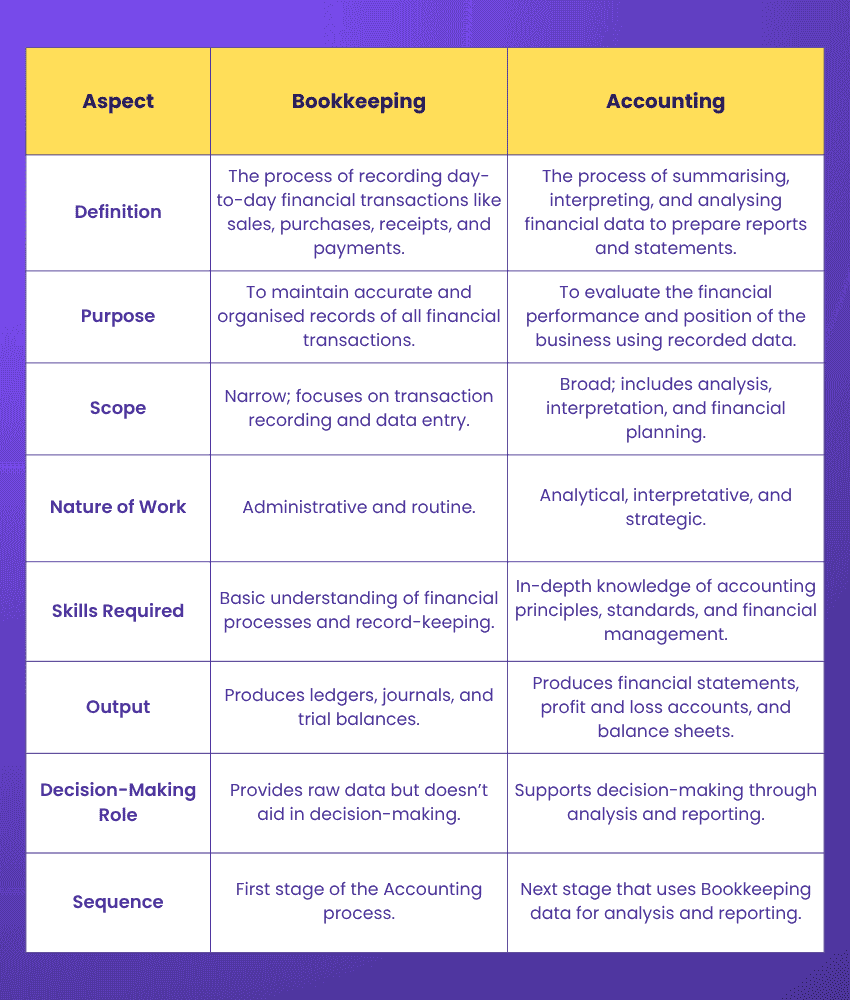
Here’s the main difference between Bookkeeping and Accounting explained:
1) Nature of Work: Bookkeeping focuses on recording daily business transactions such as sales, purchases, and receipts. Accounting, however, goes beyond recording. It analyses, interprets, and summarises financial data to provide meaningful insights into a business’s financial health.
2) Purpose: The main goal of Bookkeeping is to maintain accurate and organised financial records. Accounting uses this information to prepare reports, assess performance, and guide management decisions about budgeting, strategy, and investments.
3) Scope: Bookkeeping has a limited scope, covering only the systematic recording of financial data. Accounting is much broader, encompassing data analysis, interpretation, auditing, financial reporting, and planning for future growth.
4) Complexity and Skills Required: Bookkeeping requires basic financial knowledge, attention to detail, and familiarity with data entry systems. Accounting demands deeper expertise in financial management, tax laws, Accounting principles and analytical thinking.
5) Process Stage: Bookkeeping is the first step in the financial process. Bookkeepers maintain records that accountants later analyse. Accounting is the next stage, where recorded information is processed and interpreted to create reports and statements.
6) Output: Bookkeepers produce primary records such as journals, ledgers and trial balances. Accountants build upon these records to create complex reports like balance sheets, income statements and cash flow analyses used for strategic decision-making.
7) Decision-making Role: Bookkeeping provides the foundation for Financial Analysis but it doesn’t directly influence decision-making. Accounting transforms raw data into valuable insights to help businesses make informed operational and financial decisions.
8) Tools and Techniques: Bookkeeping relies on tools like spreadsheets or Accounting Software for record maintenance. Accounting employs advanced tools for data analysis, financial forecasting, and auditing to evaluate trends and ensure compliance.
Become the backbone of financial clarity and control with our Bookkeeper Course - Register now!
Education and Qualifications Required
Understanding the professional qualifications is essential for picking the right financial expertise for your business. Consider the following:
1) Bookkeeper Qualifications
Bookkeepers usually start with a high school diploma and training in Bookkeeping Software. Professional-level Bookkeepers often hold a certificate in Bookkeeping or an associate degree in Accounting, while advanced practitioners may earn a recognised Bookkeeping certification that varies by province. Most Bookkeepers gain between one and three years of practical experience to boost their accuracy and financial management skills.
2) Accountant Qualifications
Accountants typically start with a Bachelor’s degree in Accounting or a related discipline. Many also pursue specialised certifications in areas like Taxation, Forensic Accounting or Business Valuation. Accounting professionals usually accumulate two to five years of experience before advancing into advisory or strategic roles.
For businesses, this means that higher qualifications generally come with higher service fees but also deliver more in-depth expertise and comprehensive support. Choosing the right professional depends on the complexity of your financial needs and your budget.
Learn key financial regulations with our Accounting and Finance Policies Course – Join now!
Career Opportunities in Bookkeeping and Accounting
Bookkeeping and accounting create access to diverse accounting and compliance specialised positions. The following are the primary career opportunities that enable one to see how practitioners implement these skills in practice.
a) Bookkeeper: Bookkeepers deal with day-in, day-out financial records such as transactions, invoices, and account reconciliations. It is an accuracy and organisation-oriented position that appears as a gateway to the field of finance.
b) Accountant: Accountants analyse financial information to make reports, tax planning, and strategic planning. They usually need formal qualifications and can major in other aspects such as taxation or management accounting.
c) Auditor: Auditors review financial documents to make certain that they comply, are accurate, and are controlled effectively. They can be employed in organisations or as accountants in a firm.
d) Forensic Accountant: Forensic accountants look into financial information to unveil fraud and prosecute legal proceedings. Their practice consists of the integration of accounting, auditing, and investigative skills in different industries.
Salary Comparisons and Benefits: Bookkeeping and Accounting
When comparing salaries, accounting roles generally offer higher earning potential than bookkeeping positions. This is mainly because accountants have broader responsibilities, including financial analysis, reporting, and strategic planning, which often require advanced education and professional qualifications.
Bookkeepers typically earn lower salaries as their role focuses on recording and maintaining financial data. However, it remains a stable career option with steady demand, especially for small businesses that need accurate financial records on a daily basis.
Both careers offer valuable benefits. Bookkeeping provides an accessible entry into the finance field with opportunities to gain experience and grow into accounting roles. Accounting, on the other hand, offers stronger long-term career growth, higher earning potential, and opportunities to specialise in areas such as taxation, auditing, and financial planning.
When to Hire a Bookkeeper vs Accountant?
Every business needs support with managing money, whether it is small or growing. The choice between a bookkeeper and an accountant depends on the type and level of financial support you need.
Their roles are connected but serve different purposes. Here is how to decide:
Choose a Bookkeeper if:
1) You need help recording daily transactions such as sales, invoices, and payments
2) Your business operations are simple and require organised financial records
3) You are looking for a cost-effective way to manage routine financial tasks
Choose an Accountant if:
1) You need help analysing financial data and understanding business performance
2) Your finances are more complex, such as handling growth, tax planning, or compliance
3) You want expert advice for budgeting, forecasting, and long-term decisions
Choosing the right support ensures your financial records stay accurate while also helping you make better business decisions.
How Can a Bookkeeper Become an Accountant?
A Bookkeeper can become an Accountant by learning more about finance and getting extra qualifications. In the UK, this often means studying courses like ACCA or CIMA. These courses teach advanced skills such as tax rules, reporting, and financial planning. With study and practice, a Bookkeeper can move to the next level.
Getting real work experience is also very important. A Bookkeeper can start helping with tasks like checking reports or supporting audits. Over time, they will gain the skills needed to become a full Accountant. With the right training and effort, the career change is possible.
Learn AI-driven predictive analytics for financial forecasting with Certified Artificial Intelligence (AI) for Accountants Training – Join today!
Conclusion
When businesses recognise and comprehend the link between Bookkeeping and Accounting and the overall support of operations and strategy, they will be able to manage risks effectively and, as a result, make more informed decisions. This, in turn, will lead to the establishment of a stronger financial basis for the continuous growth of the business.
Frequently Asked Questions
What Can an Accountant do that a Bookkeeper Cannot?

Accountants can do more advanced jobs than Bookkeepers. They can file complicated tax returns, give tax advice, check a company’s full finances (called an audit), and help plan big business decisions. Bookkeepers cannot give tax advice or deal with tax problems for you.
What are the Three Types of Bookkeeping?
The three major types are:
1) Single-entry System: Ideal for small businesses, it records transactions like sales and expenses in one column.
2) Double-entry System: It records every transaction as both a debit and a credit.
3) Virtual Bookkeeping: It’s conducted remotely using Cloud-based software. It offers cost-effective Financial Management.
What are the Other Resources and Offers Provided by The Knowledge Academy?
The Knowledge Academy takes global learning to new heights, offering over 3,000+ online courses across 490+ locations in 190+ countries. This expansive reach ensures accessibility and convenience for learners worldwide.
Alongside our diverse Online Course Catalogue, encompassing 17 major categories, we go the extra mile by providing a plethora of free educational Online Resources like Blogs, eBooks, Interview Questions and Videos. Tailoring learning experiences further, professionals can unlock greater value through a wide range of special discounts, seasonal deals, and Exclusive Offers.
What is The Knowledge Pass, and How Does it Work?
The Knowledge Academy’s Knowledge Pass, a prepaid voucher, adds another layer of flexibility, allowing course bookings over a 12-month period. Join us on a journey where education knows no bounds.
What are the Related Courses and Blogs Provided by The Knowledge Academy?
The Knowledge Academy offers various Accounting Courses, including the Treasury Management Training Course, Capital Market Course, and Cash Flow Management Course. These courses cater to different skill levels, providing comprehensive insights into Accounting Software.
Our Accounting and Finance Blogs cover a range of topics related to Bookkeeping and Accounting, offering valuable resources, best practices, and industry insights. Whether you are a beginner or looking to advance your Accounting and Finance skills, The Knowledge Academy's diverse courses and informative blogs have got you covered.

Olivia Taylor


Chartered Accountant and Financial Training Specialist
Olivia Taylor is a qualified chartered accountant with over a decade of experience in financial management, auditing and corporate reporting. Having worked with leading firms in both the public and private sectors, Olivia brings clarity to complex financial topics. Her writing focuses on helping professionals build confidence in key areas of accounting, compliance and financial planning.
View Detail

 If you wish to make any changes to your course, please


