


 Top Rated Course

We may not have the course you’re looking for. If you enquire or give us a call on +49 8000101090 and speak to our training experts, we may still be able to help with your training requirements.
What is Agile Transformation and Why is it Important in Business?
David Evans 12 May 2026Agile Transformation is an organisation-wide shift to Agile ways of working that improves adaptability, collaboration, faster delivery and customer value today. It involves rethinking workflows, empowering teams, and fostering a culture of continuous learning, helping organisations to shift rapidly, reduce risks, and improve quality.

Training Outcomes Within Your Budget!
We ensure quality, budget-alignment, and timely delivery by our expert instructors.
Table of Contents

In a world where customer expectations constantly keep shifting, organisations need to effectively understand What is Agile Transformation. It helps to move from rigid and linear ways of working to a more adaptive, collaborative, and value-driven approach. It empowers teams to innovate quickly, respond to market changes and deliver outcomes that matter.
Measuring the impact of Agile Transformation is where the journey becomes meaningful. Monitoring key indicators, embracing feedback loops, and continually refining processes ensure businesses stay on course. In this blog, you will learn about What is Agile Transformation, its benefits, examples, and more!
Table of Contents
1) What is Agile Transformation?
2) Advantages of Agile Transformation
3) Challenges Faced While Implementing Agile Transformation
4) 6 Areas of Change in Agile Transformations
5) Agile Transformation Examples
6) What are the 4 Pillars of Agile Transformation?
7) What is the Roadmap for Agile Transformation?
8) Conclusion
What is Agile Transformation?
Agile Transformation is when your company changes how it works by following Agile ways of thinking. It is not just about using a new method. It is more about changing the whole culture of the business. This means how your people work together, how leaders lead, how decisions are made, and how products or services are delivered.
This is not at all a one-time change. It is a long-term journey where everyone in the organisation or company moves towards being faster, scalable, flexible, and more focused on what your customers really want.

Advantages of Agile Transformation
Knowing what is Agile Transformation will automatically drive you to check its advantages for making better choices. So, to aid you in this process, here are the advantages that comes with implementing Agile Transformation for your business or organisation:

1) Quality and Collaborative Improvisation
1) Encourages frequent quality testing, continuous feedback, and ongoing refinement
2) Quality improves gradually through small, manageable changes
3) Teams collaborate closely, share ideas, and solve problems faster
4) Fosters innovation and shared ownership among team members
5) Leads to continuous improvement in both process and products
2) Improved Productivity and Communication
1) Promotes daily stand-ups and strong cross-functional collaboration
2) Customer involvement ensures progress aligns with expectations
3) Reduces delays, distractions, and unnecessary meetings
4) Feedback loops keep everyone informed and focused
5) Streamlined communication channels minimise any misalignment
Upskill your knowledge of Agile to ensure a final solution that meets business needs with our Agile Overview Training – Register today!
3) Risk Reduction
1) Work is released in small parts, reducing risk of major failure
2) Issues are always identified and fixed at the earliest in every process
3) Agile Transformation avoids large upfront investments with little flexibility
4) Teams can easily respond to changes in scope or priorities
5) Transparency in Agile helps leadership identify risks before escalation
4) Enhanced Transparency and Better Customer Satisfaction
1) Agile tools (like boards/dashboards) make work visible across the organisation
2) Integrated tools show real-time status of cross-functional work
3) Expectations are managed proactively, reducing last-minute surprises
4) Customers and stakeholders are involved throughout the project
5) Customers feel heard and valued, increasing overall satisfaction
5) Quick Time to Deliverables
1) Short development cycles in Agile allows for frequent, fast releases
2) Enables quicker market testing and real-world feedback
3) Businesses can adapt faster to market changes or feedback
4) Delivery focuses on the highest-priority features first for maximum impact
5) Provides a strong competitive edge through speed and agility
Challenges Faced While Implementing Agile Transformation
The key to a successful change is to embrace the challenges that come your way. This explains that even implementing Agile Transformation has its own challenges. Let’s check what those challenges are to be prepared for.
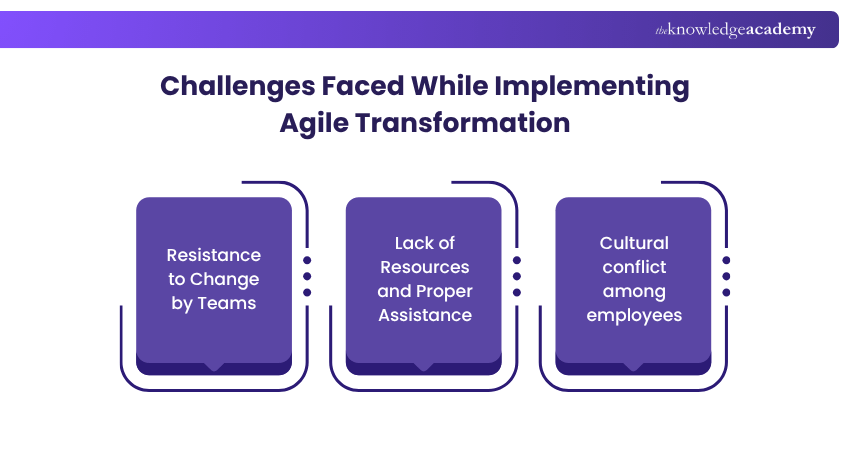
1) Resistance to Change by Teams
While implementing Agile Transformation, some team members or employees might not want to change the way they work. They may be used to the old methods and feel unsure or uncomfortable about Agile. This fear or doubt can make them avoid new processes, causing delays and frustration. Without support and proper understanding, it is hard for teams to fully accept and follow Agile practices.
Boost team performance and transform the way you work together by signing up for our Agile for Teams Training now!
2) Lack of Resources and Proper Assistance
Implementing Agile might result in some new technologies. So, it needs time, training, and experienced people to teach about it to each and every team. Without these, it is easy to get confused or make mistakes. If employees are not getting the help they need, they may use Agile in the wrong way, which can lead to poor results. Good support and proper assistance are important to make the transition smooth and successful.
3) Cultural conflict among employees
Agile works best in open and team-focused environments. But in some companies, employees are used to following strict rules. This can lead to misunderstandings or disagreements when trying to change. Switching to Agile will take a new set of concepts, procedures, responsibilities, and other things to change from the traditional methodology. If the company’s culture is struggling to match Agile’s values, it becomes harder to work together in a new way.
Learn the fundamentals and build a strong Agile foundation with Agile Project Management Foundation (AgilePM® V3) Course now!
6 Areas of Change in Agile Transformations
While adapting to Agile practices, it is essential for you to check for the six prominent areas that need to be changed. Here is a brief view of those six areas for you:
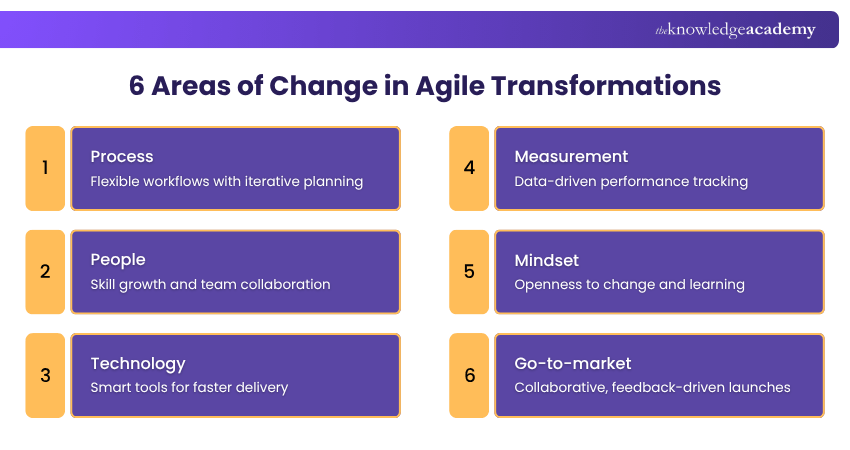
1) Process
Agile teams are not designed to follow strict steps. They work in short time blocks called sprints and change plans based on results. The goal is to stay flexible, fix problems early, and only make big changes when needed in situations like when goals or feedback change.
2) People
When teams are integrated with Agile, they need different skills to do their best at work. Employees should keep learning, try new things, and find better ways to work. Everyone plays a part in making the team better by being open to training, feedback, and new responsibilities.
3) Technology
You will use tools and software to work faster and smarter if you are implementing Agile for your business. Good tools help them stay on track, work together better, and fix problems quickly. New technology is used not just to be modern, but to make real progress in less time.
4) Measurement
With Agile, you can check how well your employees and customers are doing using simple data. They look at things like how fast they work, how much they finish, and how many customers they gain. These numbers help you to analyse what is working and what needs to be updated.
5) Mindset
Agile needs a new way of thinking. Every employee from your business or company needs to be open to change, willing to learn, and focus on what customers need. Instead of doing things the old way, they are expected to use helpful tools and ideas that improve how they work.
6) Go-to-market
Before launching new features, Agile teams plan together with product, marketing, and engineering teams. They listen to users for feedback, then use it to improve future updates. This makes launches smoother and ensures new changes are what customers really want.
Take your Agile skills to the next level with Agile Project Management Practitioner (AgilePM® V3) Course now!
Agile Transformation Examples
Real-world Agile Transformation show how organisations across industries have reinvented themselves to stay competitive. Let’s look at some to better understand What is Agile Transformation.
1) Spotify: Crafting a Culture of Continuous Improvement
As Spotify began to scale rapidly, traditional hierarchical management could not keep pace with its need for speed and innovation. This created the need for a model that allowed Spotify to grow without compromising agility.
Transformation:
Spotify introduced its famous “Squads, Tribes, Chapters, and Guilds” model. Here:
1) Squads operated as mini start-ups with end-to-end ownership.
2) Tribes, Chapters, and Guilds ensured alignment, shared learning, and cross-functional collaboration.
Outcome:
1) Enhanced autonomy: Teams could ship faster and make independent decisions.
2) Improved Collaboration: Cross-functional communication strengthened teamwork.
3) Sustained Innovation: Continuous improvement became a cultural norm.
2) ING: Banking on Agile
Dutch banking giant ING undertook Agile Transformation to compete in a rapidly evolving digital landscape. The organisation adopted Agile to deliver modern, customer-centric solutions and move away from traditional banking processes.
Transformation:
ING reorganised teams into small, cross-functional Squads, each responsible for specific customer journeys. This shift allowed the bank to focus on faster delivery and improved customer value.
Outcome:
1) Speed to Market: New features and updates were delivered much faster.
2) Customer-centricity: Frequent releases improved customer satisfaction.
3) Employee Engagement: Empowered teams reported greater motivation and ownership.
3) LEGO: Building Success Brick by Brick
In the early 2000s, LEGO faced declining sales and operational inefficiencies. To reclaim its position, the company adopted Agile Transformation that encouraged creativity, experimentation, and faster time-to-market.
Transformation:
LEGO adopted Agile methodologies within its product development teams, focusing on iterative development, rapid prototyping, and cross-functional collaboration. These changes allowed teams to act quickly on market trends and customer feedback.
Outcome:
1) Innovative Products: Successful lines, such as LEGO Friends, launched on schedule.
2) Market Responsiveness: Teams adapted faster to customer preferences.
3) Operational Efficiency: Waste was reduced through streamlined processes.
4) Microsoft: Transforming for the Cloud Era
As cloud computing exploded, Microsoft recognised the need to modernise its development process to remain competitive, especially against their evolving rivals.
Transformation:
Microsoft embraced Agile Transformation across the company, particularly in its Azure teams. They also adopted DevOps practices and implemented Continuous Integration/Continuous Delivery (CI/CD). These changes reduced development friction and accelerated delivery cycles.
Outcome:
1) Accelerated Development: Faster release cycles for new cloud services.
2) Improved Quality: Continuous testing enhanced software reliability.
3) Customer Focus: Rapid responses to customer needs and feedback.
5) Bosch: Innovating in the Industrial Sector
Global engineering leader Bosch faced the challenge of maintaining innovation across diverse product lines. Agile Transformation became essential for streamlining processes and enabling cross-team collaboration.
Transformation:
Bosch ran Agile pilot programs in select teams. After seeing promising results, they expanded Agile practices across departments, emphasising iterative development and cross-functional teamwork.
Outcome:
1) Enhanced Innovation: Improved ability to ideate and deliver new products.
2) Operational Efficiency: Reduced development cycles and smoother processes.
3) Employee Empowerment: Teams became more engaged, motivated, and productive.
Empower your team, train together, and grow faster with Agile for Teams Training today!
What are the 4 Pillars of Agile Transformation?
The four pillars of Agile Transformation arethe four core values insisted on during the process. Those four pillars are listed below:
1) Individuals and Interactions Over Processes and Tools
1) Employees and teamwork are more important than tools or rules
2) Strong teams solve problems faster and work more effectively
3) Good communication leads to better results and fewer delays
4) Tools should support, not replace, human connection
2) Responding to Change Over Following a Plan
1) Agile teams adapt to new ideas or feedback quickly as soon as they can
2) Plans are designed to help with the work and can be changed whenever required
3) Change is seen as a chance to improve, not a setback
4) Being flexible helps teams build better products faster
3) Customer Collaboration Over Contract Negotiation
1) Customers are involved throughout the project, not just at the start or the end
2) Regular feedback helps shape the product as it is built
3) Agile avoids rigid contracts by encouraging open communication
4) Leads to products that are more open to meet real user needs
4) Working Software Over Comprehensive Documentation
1) Agile values working on the products over long documents
2) User stories replace heavy paperwork, saving time
3) Teams start building quickly and adjust as they go
4) Focus is on delivering usable features, not perfect plans
What is the Roadmap for Agile Transformation?
The roadmap for Agile Transformation begins with assessing the readiness of your business by evaluating workflows, culture, and openness to change. Following this, you define a clear vision and set goals that align with the teams. Initially, begin with a small pilot to test Agile practices and offer proper training to support teams. As Agile matures, scale it across departments using suitable frameworks, ensuring alignment with the company’s structure and culture.
When Agile is implemented, it is essential to track progress using Agile metrics and regularly reflect on what is working well and what is deviating. Here, continuous improvement is key. This is why teams must consistently adapt and evolve based on the collected feedback, results, and changes in organisational needs.
Conclusion
Understanding What is Agile Transformation depicts how true success comes from embracing agility as a journey of learning, adapting, and improving. Building the right mindset, empowering teams, leveraging data, and refining processes can unlock faster delivery, greater innovation, and stronger customer value. Agile Transformation provides the flexibility, and the focus organisations need to thrive in a dynamic world.
Transform the way you work and unlock agility with Agile Training – Sign up today!
Frequently Asked Questions
How Long Does Agile Transformation Take?

Agile Transformation usually takes one to three years, depending on the size, structure, and how ready people are for change in a company. It is a long journey that needs ongoing learning and support.
How to Keep Agile Transformation on Track?
To keep Agile Transformation on track, you can try setting clear goals, measuring progress, and listening to feedback. Support your teams with training, good communication, and regular check-ins to stay focused and improve steadily.
What are the Other Resources and Offers Provided by The Knowledge Academy?
The Knowledge Academy takes global learning to new heights, offering over 3,000+ online courses across 490+ locations in 190+ countries. This expansive reach ensures accessibility and convenience for learners worldwide.
Alongside our diverse Online Course Catalogue, encompassing 17 major categories, we go the extra mile by providing a plethora of free educational Online Resources like Blogs, eBooks, Interview Questions and Videos. Tailoring learning experiences further, professionals can unlock greater value through a wide range of special discounts, seasonal deals, and Exclusive Offers.
What is The Knowledge Pass, and How Does it Work?
The Knowledge Academy’s Knowledge Pass, a prepaid voucher, adds another layer of flexibility, allowing course bookings over a 12-month period. Join us on a journey where education knows no bounds.
What are the Related Courses and Blogs Provided by The Knowledge Academy?
The Knowledge Academy offers various Agile Training, including the Agile Overview Course, Agile for Teams Course and AgilePM® Foundation & Practitioner (AgilePM® V3) Training. These courses cater to different skill levels, providing comprehensive insights into What is Project Risk Management.
Our Project Management Blogs cover a range of topics related to Agile Transformation, offering valuable resources, best practices, and industry insights. Whether you are a beginner or looking to advance your Project Management skills, The Knowledge Academy's diverse courses and informative blogs have got you covered.

David Evans


Certified Project Trainer and Agile Delivery Expert
David Evans brings over a decade of hands-on experience in project delivery, Agile transformation, and team leadership. With a background in technology and business consulting, David has led cross-functional teams through Agile and Waterfall projects in both public and private sectors. He combines technical knowledge with practical insights to help readers navigate the challenges of modern project environments.

Upcoming Project Management Resources Batches & Dates
Date
 Agile Project Management Foundation (AgilePM® v2)

 If you wish to make any changes to your course, please


