


 Top Rated Course

We may not have the course you’re looking for. If you enquire or give us a call on +49 8000101090 and speak to our training experts, we may still be able to help with your training requirements.
What is a Mortgage: Understanding Key Concepts
The Knowledge Academy 14 July 2026A Mortgage is a type of loan used to buy a home or refinance properties, where the borrower repays the amount with interest over an agreed time period. The lender provides the remaining property cost after the deposit is paid up front. Borrowers repay the Mortgage in monthly instalments with added interest over time.

Training Outcomes Within Your Budget!
We ensure quality, budget-alignment, and timely delivery by our expert instructors.
Table of Contents
Related Courses
Dreaming of owning a home but worried about the huge price tag? You’re not alone. For most people, buying a house outright isn’t possible, and that’s where a Mortgage steps in. It’s more than just a loan; it’s the bridge between renting and finally having a place you can call your own.
In this blog, we’ll answer What is a Mortgage, explain how it works, cover its main types, average Mortgage rates, repayment Mortgages, and negotiating rates. By the end, you’ll clearly understand Mortgages and know how to choose the right one for your needs.
Table of Contents
1) What is a Mortgage?
2) How Mortgages Work?
3) Types of Mortgages
4) What is a Repayment Mortgage?
5) How to Compare Mortgages?
6) How Many People Can be on a Mortgage?
7) Can You Negotiate Mortgage Rates?
8) Conclusion
What is a Mortgage?
A Mortgage is a type of loan used to help people buy a property, such as a house or flat. Since buying a home is expensive, borrowers usually pay a deposit up front and borrow the remaining amount from a bank or lender. The loan is secured against the property, which means that the lender can take ownership if the borrower fails to repay the Mortgage.
Mortgage repayments are usually made monthly over a long period, such as 20 to 30 years. Different types of Mortgage options are available, and the type chosen affects the interest rate, repayment method, and overall borrowing costs.

How Mortgages Work?
A Mortgage is more than just borrowing money to buy a home. It involves a few important steps, from choosing the right lender to paying back the loan over time. Here's a simple breakdown of how the Mortgage process works:
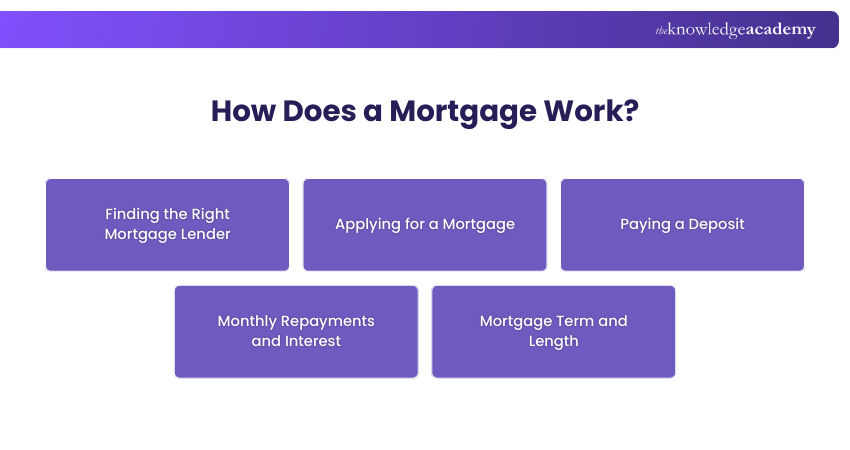
1) Finding the Right Mortgage Lender
Before applying for a Mortgage, borrowers should compare lenders, interest rates, repayment terms, and loan features to choose a suitable option.
a) Compare Mortgage interest rates from different lenders
b) Review repayment terms, loan features, and lender support
c) Choose a lender that offers clear guidance and suitable Mortgage options
2) Applying for a Mortgage
After selecting a lender, the borrower submits a Mortgage application. The lender reviews details like income, employment status, credit history, and expenses to check loan eligibility.
a) Submit documents such as payslips, bank statements, and identification proof
b) Complete the Mortgage application process with the lender
c) Wait for the lender to assess and approve the Mortgage loan
3) Paying a Deposit
A deposit is the amount you pay in advance when buying a home. It shows the lender you’re serious and helps lower the amount you need to borrow. Usually, the bigger the deposit, the better the Mortgage deal.
a) Most people pay at least 5% to 20% of the home's price
b) A larger deposit can lower your monthly payments
c) You need to save this money before applying
4) Mortgage Approval Process
The lender reviews the borrower’s financial and property details before approving the Mortgage and providing the loan terms and repayment conditions.
a) The lender checks affordability and repayment ability
b) Property valuation may take place during the approval process
c) Approved borrowers receive a Mortgage offer
5) Complete the Property Purchase
After Mortgage approval, the lender provides the funds to purchase the property, which then acts as security for the loan.
a) The lender transfers funds for the property purchase
b) Ownership of the property is completed legally
c) The property remains linked to the Mortgage until repayment ends
6) Monthly Repayments and Interest
Each month, you pay back part of the loan plus some interest. The interest is the extra money the lender charges for letting you borrow. Your monthly amount depends on how much you borrowed and the interest rate.
a) Payments include the loan amount and interest
b) Interest can be fixed or change over time
c) Always check how much you’ll pay monthly
7) Complete the Mortgage Repayment
Once all Mortgage payments are completed, the borrower fully owns the property. The lender’s legal claim over the property is removed, and the Mortgage is officially closed.
a) The final payment clears the Mortgage loan
b) The borrower gains full ownership of the property
c) The lender no longer holds security over the property
Become familiar with data collection, analysis techniques, and recapitulation. Join our Real Estate Risk Management Training today!
Types of Mortgages
There are different types of Mortgages available to suit different financial situations and preferences. Here are some common types:
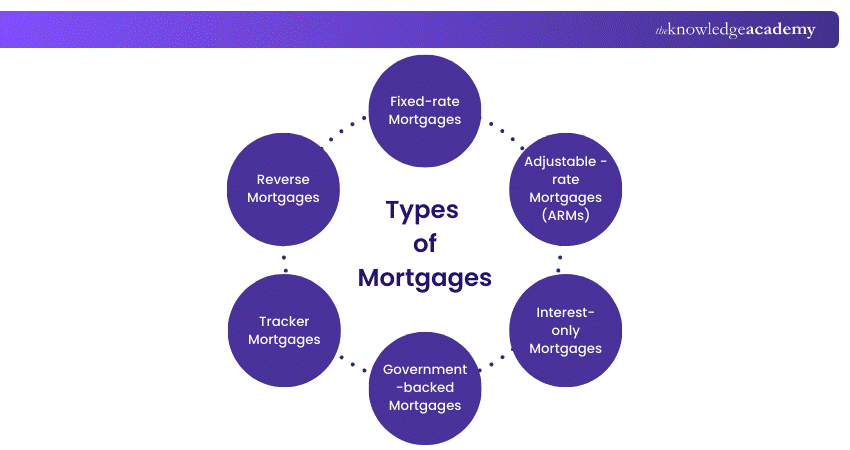
1) Fixed-rate Mortgages
A fixed-rate Mortgage means your interest rate stays the same for the whole loan period. Your monthly payment won’t change, which makes it easier to plan your budget. This type is good if you want stability and no surprises.
Example:
a) You pay £600 every month for 25 years
b) Useful when interest rates are low
c) Best for people who like steady payments
2) Adjustable-rate Mortgages (ARMs)
With an adjustable-rate Mortgage, the interest rate can go up or down over time. It often starts with a low rate, then changes based on the market. This type might save money at first but can become more expensive later.
Example:
a) 2.5% rate for the first 2 years, then it may rise
b) Good if you plan to move in a few years
c) Risky if interest rates go high
3) Interest-only Mortgages
In this type, you only pay the interest for the first few years. Later, you start paying both interest and the loan amount. This keeps payments low at the start but can be costly later on.
Example:
a) Pay only interest for 5 years, then full payments
b) Useful if your income will grow later
c) Not ideal for long-term home ownership
4) Tracker Mortgages
Tracker Mortgages follow the Bank of England’s base rate. If the base rate goes up or down, your interest rate changes too. It’s different from a fixed-rate because the payments can vary.
Example:
a) Your rate is 1% above the base rate
b) Good if base rates stay low
c) Payments can rise suddenly if the base rate increases
5) Reverse Mortgages
A reverse Mortgage lets older homeowners borrow money against their home’s value. You don’t make monthly payments; the money is paid back when you sell the house or pass away. It’s a way to get cash in retirement.
Example:
a) Borrow £40,000 while still living in your home
b) No monthly repayments needed during your lifetime
c) Usually for people aged 55 or older who own their home
What is a Repayment Mortgage?
A repayment Mortgage is the most common type of home loan. It is also called a capital and interest Mortgage. You pay money to the lender every month for a set number of years. Each payment goes toward the loan and the interest. If you pay on time each month, by the end of the term you will have fully paid off the loan and the interest, and the home will be yours.
Master income capitalisation, site analysis, and comparative sales techniques. Join our Real Estate Valuation and Appraisal Training today!
How to Compare Mortgages?
In the past, Mortgages mainly came from banks, credit unions, and savings and loan associations. Today, nonbank lenders such as Rocket Mortgage, Better, loanDepot, and SoFi are also important players in the Mortgage market. If you want to learn more about Mortgage options, it’s useful to explore different lenders and tools.
When searching for a Mortgage, using an online Mortgage calculator can be very helpful. It allows you to compare monthly payments based on the loan type, interest rate, and down payment. It can also show you how much property you can realistically afford.
Additional Costs in a Mortgage:
a) Mortgage payments often include more than the loan and interest
b) Lenders may set up an escrow account
c) Escrow covers property taxes, insurance, and other costs
d) These are added to your monthly Mortgage bill
How Many People Can be on a Mortgage?
The number of people who can be on a Mortgage depends on the lender and the Mortgage type. In most cases, up to four people can apply for a joint Mortgage together. Joint Mortgages are mainly used by couples, family members, friends, or business partners buying a property together.
Having multiple borrowers can increase borrowing power because lenders consider the combined income of all applicants. However, everyone listed on the Mortgage shares responsibility for making repayments on time and following the loan agreement.
Can You Negotiate Mortgage Rates?
Yes, Mortgage rates can often be negotiated. Lenders may give better rates based on your credit score, deposit size, or existing relationship with them. Comparing offers, improving your financial profile, or using a broker can help secure more favourable terms.
Conclusion
In essence understanding of What is a Mortgage is? It can help you make better decisions when buying a home. From types and rates to repayments and extra costs, knowing the basics allows you to plan wisely and avoid surprises. Mortgages make homeownership possible by spreading the cost over time and giving you confidence in your choices.
Gain expertise in assessing Mortgage products and market trends. Join our CeMAP Course (Level 1,2 And 3) today!
Frequently Asked Questions
Do I Need a Good Credit Score to Get a Mortgage?

Yes, you need a credit score to get a Mortgage, and having a higher score gives you better options. Lenders check your score to decide the risk and set your interest rate. You can still get a Mortgage with a lower score, often through government programmes. But it may mean higher interest or a bigger down payment.
What Happens if I Miss a Mortgage Payment?
If you miss a Mortgage payment, your lender will likely remind you and may add a late fee. One missed payment isn’t too serious if paid quickly, but repeated delays can hurt your credit score and make borrowing harder. If payments are missing for months, the lender may begin repossessing your home.

The Knowledge Academy


Global Training Provider
The Knowledge Academy is a world-leading provider of professional training courses, offering globally recognised qualifications across a wide range of subjects. With expert trainers, up-to-date course material, and flexible learning options, we aim to empower professionals and organisations to achieve their goals through continuous learning.


 If you wish to make any changes to your course, please


