


 Top Rated Course

We may not have the course you’re looking for. If you enquire or give us a call on +49 8000101090 and speak to our training experts, we may still be able to help with your training requirements.
What are Sprints in Project Management?
David Evans 28 May 2026Explore this blog to learn in detail about What are Sprints in Project Management and how they help streamline workflows. You will also learn how they help to deliver project results faster, and the processes involved in planning, executing, and reviewing Sprints. Read ahead to gain valuable insights and expertise!

Training Outcomes Within Your Budget!
We ensure quality, budget-alignment, and timely delivery by our expert instructors.
Table of Contents

Imagine managing a project as if it were a jigsaw puzzle. You have countless pieces, and your job is to assemble them to create a beautiful picture. But what if you could build the puzzle piece by piece, regularly checking your progress and adjusting as needed? This is where the concept of Sprints comes in. But do you truly know What are Sprints in Project Management?
Sprints represent time-bound work intervals within a project. Instead of attempting to handle the entire project at once, teams divide it into smaller segments. In this blog, we'll explore what are Sprints in Project Management, how they work, and why they're a game-changer in Project Management.
Table of Contents
1) What are Sprints?
2) Understanding Project Management Sprints
3) Benefits of Sprint-based Project Management
4) What are the Stages of Sprint?
5) How Long is a Sprint?
6) Sprint Tips That You Need to Follow
7) Conclusion
What are Sprints?
Sprints are essentially time-bound work periods in a project. Instead of trying to tackle everything all at once, teams break the project into smaller parts. It's like eating a big meal by taking small, manageable bites. During a Sprint, which usually lasts 2-4 weeks, the team focuses on completing specific tasks. The main objective is to finish these tasks and contribute something valuable to the project.
Think of Sprints as short-time labs in a race, which help teams maintain concentration, stay organised, and consistently demonstrate progress. This makes it easier to adapt to changes and ensure the project stays on course.
The Agile Framework
Agile is a framework that emphasises adaptability and collaboration in work, especially in areas like Software Development and Project Management. Instead of trying to plan everything from the start (which might not work if circumstances change), Agile divides work into smaller, manageable cycles. These cycles are called Sprints, during which portions of the project are completed, and plans are reevaluated.
The Agile approach values individual contributions and teamwork, tangible project progress, and cooperation with customers over rigid, predefined plans and strict processes. It's like constructing a building one step at a time, making sure each step is strong before moving on to the next. Agile and Sprints complement each other, ensuring that projects are both efficient and flexible.

Understanding Project Management Sprints
In Project Management, Sprints are a fundamental concept within the Agile framework. They facilitate the management of projects by breaking them into smaller, manageable pieces. Understanding Project Management Sprints involves recognising the importance of the following key components:
Time-boxed Iterations
Time-boxed iterations mean setting specific, fixed time periods for work. In the context of Sprints, a team commits to achieving a set of predefined tasks or goals within a short, rigid timeframe, typically lasting 2 to 4 weeks. This time constraint serves several purposes:
a) Focus: It keeps the team concentrated on the most important tasks at hand, reducing distractions and promoting productivity.
b) Predictability: Stakeholders can expect regular updates and progress reports at the end of each Sprint, making it easier to estimate when the project will be completed.
c) Adaptability: By working in short iterations, the team can quickly respond to changes, whether they are external (like shifts in client requirements) or internal (like recognising inefficiencies in their process).
d) Accountability: Team members have a clear understanding of what needs to be accomplished within the Sprint, creating a sense of responsibility and motivation to meet their commitments.
Cross-functional Teams:
In the context of Sprints, cross-functional teams refer to groups of individuals with various skills and expertise coming together to work on a project. This approach stands in contrast to traditional hierarchical teams where each member specialises in one area.
Cross-functional teams offer the following advantages:
a) Diverse Expertise: Different team members bring unique skills, viewpoints, and experiences to the project, ensuring that various aspects of the work are covered.
b) Effective Problem - solving: When issues or challenges arise during the Sprint, the team can quickly collaborate and utilise their varied skills to find solutions.
c) Reduced Bottlenecks: Cross-functional teams are less dependent on a single person or a particular skill, reducing the likelihood of bottlenecks when certain team members are unavailable.
Incremental Value Delivery:
Incremental value delivery is the concept of providing valuable and usable portions of a project at the end of each Sprint. Instead of waiting until the entire project is complete to deliver results, Sprints enable teams to showcase tangible progress after every time-boxed iteration, thereby increasing the value of the product at the time of delivery. Benefits of incremental value delivery include:
a) Early Feedback: Stakeholders get an early look at the project and can provide feedback, which can lead to valuable improvements.
b) Reduced Risk: By delivering value consistently, risks associated with large-scale project failures are minimised because issues can be identified and addressed early.
c) Client Satisfaction: Clients or end-users can start benefiting from the delivered increments sooner, leading to increased satisfaction.
Boost your career prospects with our Project Management Certification Course and gain industry-recognised skills today.
Benefits of Sprint-based Project Management
Sprint-based Project Management offers a range of significant advantages that can lead to more efficient, adaptive, and successful project outcomes. Let's delve into these benefits in detail:
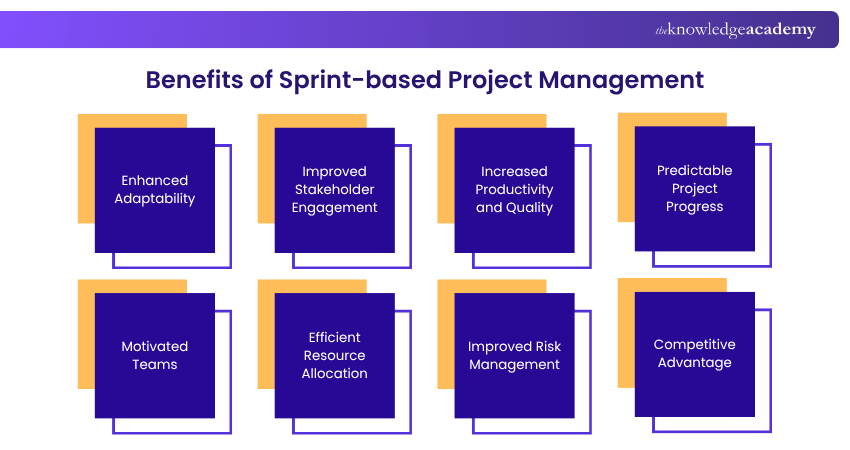
1) Enhanced Adaptability
Sprints allow teams to respond quickly to changing project requirements, market conditions, or client feedback. Something that isn't working or needs adjustment can be addressed in the next Sprint. By defining specific Sprint goals and priorities, it becomes easier to manage and control the project's scope. This reduces the risk of scope creep, where the project expands beyond its original boundaries.
2) Improved Stakeholder Engagement
Sprints facilitate constant interaction with Stakeholders. Regular reviews and discussions during and after each Sprint ensure that their feedback is incorporated into the project, increasing client satisfaction. Stakeholders and team members collaborate more closely in a Sprint-based approach, resulting in better decision-making and alignment with project goals.
3) Increased Productivity and Quality
In Sprint-based Project Management, testing and feedback are ongoing processes. This leads to early issue detection and rectification, ultimately improving the quality of the project. Sprints allow teams to concentrate their efforts on a limited set of tasks within a defined timeframe. This focused approach enhances productivity by minimising multitasking and maximising resource utilisation.
4) Predictable Project Progress
Sprints create measurable milestones at the end of each cycle. This predictability helps track project progress and estimate when it will be completed. Stakeholders gain a clearer understanding of how the project is progressing, reducing uncertainty and anxiety about the project's status.
5) Motivated Teams
Sprints provide teams with achievable short-term goals. This sense of accomplishment boosts team morale and motivation. Team members have a higher level of ownership and accountability for their work within a Sprint, as their contributions are clearly defined and measured.
6) Efficient Resource Allocation
With Sprint-based Project Management, it's easier to allocate resources efficiently. You can allocate the right people to the right tasks, ensuring that the project progresses smoothly. The incremental nature of Sprints enables better cost control, as you can measure spending against the delivered value in each Sprint.
7) Improved Risk Management
The regular review and retrospective processes in Sprints help in early issue detection and resolution, reducing the likelihood of major problems later in the project. Sprints allow teams to reassess and mitigate risks throughout the project rather than addressing risks in a single, potentially high-stakes phase.
8) Competitive advantage
Sprints enable faster delivery of project increments, allowing organisations to bring products or services to market quickly, which can be a significant competitive advantage. Organisations that embrace Sprint-based Project Management foster a culture of continuous improvement, making them more adaptable and competitive in dynamic markets.
Sprints are a key component of Agile Project Management, and to ensure their success, it's essential to follow best practices that promote efficiency, collaboration, and effective delivery. The role of a Technical Programme Manager in overseeing Agile sprints is vital to ensure technical requirements and resources are managed effectively throughout each sprint cycle.
Learn the basics behind successful projects with the Introduction To Project Management Course – Join now!
What are the Stages of Sprint?
Now, that you know What are Sprints in Project Management, let’s learn about the critical stages involved in managing these iterations. There are three major stages of a Sprint. These stages are as follows:
a) Sprint Planning: In this stage, both the development team and the owner of the product plan the upcoming Sprints in detail. They also select the items of the product which are in backlog. This backlog is then removed throughout Sprint's lifecycle.
b) The Daily Check: Every day for a few minutes, the Scrum Master conducts a meeting where they lead the meeting and discuss the various aspects of the project, highlight any achievements, discuss any immediate problem that needs to be tackled, etc.
c) Sprint Reviewing: In this stage, the team gathers after each Sprint is completed, to present the product to the Product Owner. In this Sprint review meeting, the key stakeholders are also involved, and the Product Owner, ensures that the backlogs which was identified in the planning stage has been completed, and if not, then the same must be taken care of in the next Sprint.
How Long is a Sprint?
The Sprint teams frequently finish their projects in two weeks, but there is no specific deadline. The timings are determined by the team's ability and the project's importance. It's possible that the sprint will take less time or possibly longer than planned.
A few helpful suggestions for improving Agile Project Management are as follows:
a) The Sprints shouldn't last longer than a month, according to the Scrum guide. If it takes more than a month, it is not a sprint.
b) Every sprint needs to be managed differently from one to the other. Providing a progression of iterative material is the aim of each sprint.
c) Since shortened Sprints come with higher pressure, they work effectively for high-performing teams.
d) Keep an eye on your team's working style and adjust the Sprint duration accordingly.
Learn to predict risks before they impact projects with the Project Risk Management Course – Join now!
Sprint Tips That You Need to Follow
To help you and your team work efficiently, we have prepared a table of Sprint tips where we have listed some do’s and don'ts. Let’s have a look at this table:
|
Do’s |
Don’ts |
|
You need to create an organised backlog containing all the requirements of the product. |
Try not to include too many backlogs, as it might hinder your team to complete them. |
|
Ensure that your team is aware of the Sprint goal. |
Do not overlook the technical issues or the quality inspection issues during the Sprint, as they can impact the overall process and, in turn, affect the Quality Inspector Salary, which is influenced by the quality control and inspection efficiency. |
|
Ensure that the Sprint velocity metric comprises of issues like team meetings and sick days. |
Never leave a task in Sprint with inadequate information, as it may confuse your team members. |
|
It is important that you employ the best Project Management tools. |
Always ensure that your team members have the working knowledge of a Project Management tool. Never implement a tool if they have no training in using it. |
Discover the fundamentals of a Project Management office with our Project Management Office Fundamentals Certification Course today!
Conclusion
We hope that from this blog, you have learnt about What are Sprints in Project Management. In this blog, we also discussed, how Project Management Sprints emerge as a dynamic force, greatly enhancing efficiency, adaptability, and Stakeholder engagement. They empower teams to deconstruct complex projects into manageable components, thereby fostering the incremental delivery of value.
Strengthen project governance and delivery to drive organised projects by joining the Project Management Office Fundamentals Certification today!
Frequently Asked Questions
How can Mastering Sprints Elevate my Project Management Career?

Mastering Sprints can elevate your Project Management career. It becomes easier for you to complete projects within a timeline, promotes better teamwork, and allows you to adapt to changing project needs.
What Certifications or Training can Enhance my Expertise in Project Management Sprints?
Project Management Sprint expertise can be improved with Agile Methodology training and certifications like Scrum Master or Professional Scrum Master (PSM). These give beneficial skills for successful execution.
What are the Other Resources and Offers Provided by The Knowledge Academy?
The Knowledge Academy takes global learning to new heights, offering over 3,000 online courses across 490+ locations in 190+ countries. This expansive reach ensures accessibility and convenience for learners worldwide.
Alongside our diverse Online Course Catalogue, encompassing 17 major categories, we go the extra mile by providing a plethora of free educational Online Resources like Blogs, eBooks, Interview Questions and Videos. Tailoring learning experiences further, professionals can unlock greater value through a wide range of special discounts, seasonal deals, and Exclusive Offers.
What is Knowledge Pass, and How Does it Work?
The Knowledge Academy’s Knowledge Pass, a prepaid voucher, adds another layer of flexibility, allowing course bookings over a 12-month period. Join us on a journey where education knows no bounds.
What are Related Courses and Blogs Provided by The Knowledge Academy?
The Knowledge Academy offers various Project Management Courses, including Project Management Certification , Project Management Office Fundamentals Certification, and Project Risk Management Course. These courses cater to different skill levels, providing comprehensive insights into Technical Programme Manager.
Our Project Management Blogs cover a range of topics related to Sprints in Project Management, offering valuable resources, best practices, and industry insights. Whether you are a beginner or looking to advance your Project Management skills, The Knowledge Academy's diverse courses and informative blogs have you covered.

David Evans


Certified Project Trainer and Agile Delivery Expert
David Evans brings over a decade of hands-on experience in project delivery, Agile transformation, and team leadership. With a background in technology and business consulting, David has led cross-functional teams through Agile and Waterfall projects in both public and private sectors. He combines technical knowledge with practical insights to help readers navigate the challenges of modern project environments.

Upcoming Project Management Resources Batches & Dates
Date
 Introduction to Project Management Course
Introduction to Project Management Course
Fri 12th Jun 2026
Introduction to Project Management Course
Fri 17th Jul 2026
Introduction to Project Management Course
Fri 14th Aug 2026
Introduction to Project Management Course
Fri 11th Sep 2026
Introduction to Project Management Course
Fri 16th Oct 2026
Introduction to Project Management Course
Fri 13th Nov 2026
Introduction to Project Management Course
Fri 18th Dec 2026

 If you wish to make any changes to your course, please


