


We may not have the course you’re looking for. If you enquire or give us a call on +49 8000101090 and speak to our training experts, we may still be able to help with your training requirements.
ITIL® Problem Management: A Complete Guide
ByVishnu SankarLast updated on: 21 October 2026
ITIL Problem Management focuses on reducing the likelihood and impact of incidents by identifying actual and potential causes, managing known errors and establishing workarounds. It helps IT teams investigate recurring or significant issues and support more reliable services.
In a Nutshell
1. ITIL Problem Management focuses on identifying underlying causes of IT incidents and reducing recurring disruptions.2. Proactive and Reactive Problem Management help organisations address potential problems and investigate existing issues.3. Problem Management activities include identifying problems, analysing root causes, managing known errors and implementing corrective actions.4. Problem Managers and Technical Teams coordinate investigations, develop solutions and document findings to improve service reliability.5. Effective Problem Management can reduce recurring disruptions, support service reliability and contribute to continual improvement.
Imagine dealing with the same IT disruption again and again, frustrating, right? That’s where ITIL Problem Management comes in. Instead of focusing only on restoring service, it investigates actual or potential causes of incidents and manages known errors and workarounds. This can help teams reduce recurring disruptions and improve service reliability.
In this blog, we will discuss what ITIL problem management is, processes, key roles, and benefits. Whether you’re in IT or just curious, this blog will help you understand how it works.
What Is ITIL® Problem Management?
ITIL Problem Management is an IT Service Management (ITSM) practice that helps organisations understand why IT incidents occur and take appropriate measures to prevent them from recurring. It involves examining incident patterns, investigating underlying causes, and identifying solutions that improve the stability and reliability of IT services.
Problem Management involves identifying and analysing actual or potential causes of incidents and managing problems throughout their lifecycle. Some important terms include:
a) Problem: A cause, or potential cause, of one or more incidents.
b) Known Error: A problem that has been analysed but has not yet been resolved.
c) Workaround: A solution that reduces or eliminates the impact of an incident or problem when a full resolution is not yet available.
d) Root Cause: The underlying cause identified through investigation that contributes to a problem or incident.
These definitions are foundational for understanding and executing problem management effectively.

Objectives of Problem Management in ITIL®
Problem Management aims to reduce the likelihood and impact of incidents by:
a) Identifying actual and potential causes of incidents
b) Investigating and managing problems throughout their lifecycle
c) Managing known errors and workarounds to reduce the impact of unresolved problems
Proactive and Reactive Approaches to Problem Management
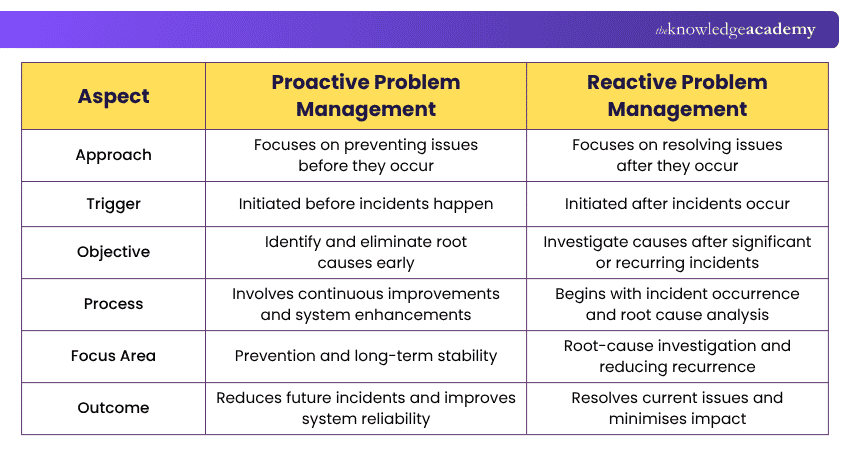
Organisations can benefit from the ITIL problem management process in two ways:
Proactive Problem Management
Proactive Problem Management looks for potential problems before they result in significant incidents. Teams may analyse incident trends, monitoring information, technical weaknesses and other sources to identify patterns or conditions that could affect services. Addressing these risks early can help reduce future disruptions and support service reliability.
a) Identifies risks and fixes them before they cause issues
b) Uses data from past incidents to prevent future problems
c) Helps reduce unexpected IT failures
d) Improves overall system stability and performance
Reactive Problem Management
Reactive Problem Management begins when incidents or other evidence indicate that an underlying problem needs investigation. Teams analyse available information, identify contributing causes, document known errors where appropriate and develop workarounds or corrective actions to reduce the likelihood or impact of recurrence.
a) Focuses on solving problems after they happen
b) Finds and fixes the root cause of incidents
c) Helps prevent the same issue from happening again
d) Improves IT service by reducing repeated failures
Pro Tip:
A problem that occurs only once can still deserve urgent investigation if its potential business impact is significant. Consider service criticality, financial consequences, and operational dependencies when deciding which problems require immediate attention.
Process Flow for ITIL® Problem Management
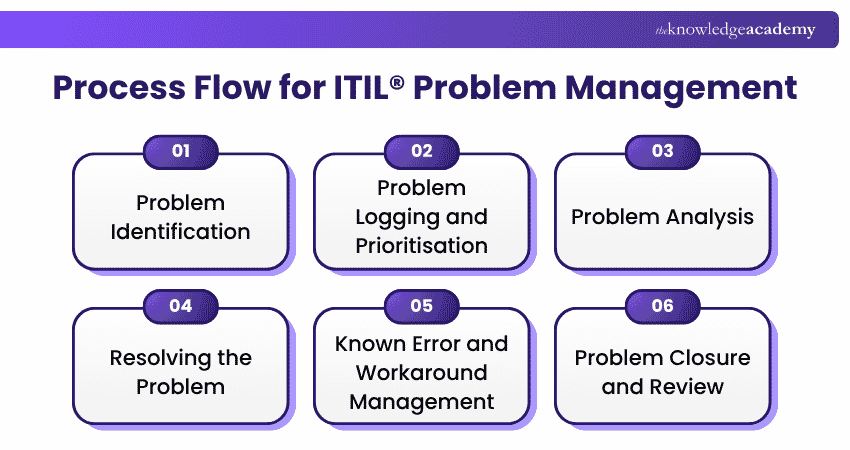
The first step of the ITIL problem management process starts with identifying the problem and concludes with the team taking preventive measures to avoid a similar problem in the future. Here's a complete breakdown of the ITIL problem management lifecycle stages:
Problem Identification
The first stage in ITIL problem management involves identifying and detecting problems that could affect IT services. The team aims to recognise issues early to manage, scrutinise, and eliminate potential threats. Incidents that recur or complaints from end-users often highlight these problems.
The team can check whether similar problems or incidents have occurred by reviewing relevant records and service data. Categorising identified problems helps teams assess their impact, urgency and likelihood of further incidents before deciding how they should be prioritised.
Problem Logging and Prioritisation
Once a problem is identified, IT teams create a problem record containing relevant information, such as the problem description, affected services, related incidents, timestamps, and available technical evidence. Maintaining accurate records supports investigation, communication and progress tracking.
a) Categorisation: Problems are categorised according to their nature, affected services or technical characteristics to support appropriate assignment and analysis.
b) Prioritisation: Problems are prioritised based on factors such as business impact, urgency and the likelihood of further incidents.
This approach helps teams allocate resources effectively and focus their investigations on problems that pose the greatest risk to service reliability.
Trainer's Insight:
A previously low-priority problem can become critical after a system upgrade, increased service demand or a change in business requirements. Periodically review unresolved problems to ensure their priority still reflects current operational risks
Problem Analysis
During problem analysis, teams investigate available evidence to understand the causes and contributing factors behind a problem. Techniques such as trend analysis, technical investigation and root-cause analysis can help identify why incidents are occurring and what actions may reduce their likelihood or impact.
The investigation may also identify related problems, workarounds or known errors that can help teams manage service disruption while longer-term corrective actions are considered.
Resolving the Problem
Resolving the problem is one of the most crucial stages of the actual work. You need to initiate the most appropriate solution once you have identified the root cause of the problem.
Once corrective actions have been implemented and verified, teams should update the problem record with the investigation findings, resolution details and any related knowledge. Before closure, they should confirm that the agreed closure criteria have been met and that any remaining risks or follow-up actions are understood.
Known Error and Workaround Management
When a problem has been analysed but remains unresolved, it can be documented as a known error. IT teams record the investigation findings and, where available, establish workarounds that help reduce the impact of related incidents while further corrective action is considered.
Maintaining known error records and documented workarounds enables support teams to respond more effectively to recurring incidents. It also supports knowledge sharing and helps minimise service disruption while corrective actions are being developed.
Problem Closure and Review
After corrective actions have been verified and the relevant closure criteria are satisfied, the problem record can be closed. IT teams document the investigation findings, resolution details and any lessons learned to maintain an accurate record of the problem.
Reviewing completed investigations helps organisations identify opportunities for improvement, strengthen knowledge sharing and refine their approach to preventing recurring incidents.
Build practical understanding of service lifecycles, relationships, and governance with the ITIL® 5 Service Certification – Join now!
Problem Management Roles and Responsibilities
Clear ownership and collaboration help Problem Management activities operate effectively. Organisations may assign responsibilities differently depending on their size and operating model, but common responsibilities can include coordinating the practice and providing technical expertise during investigations.
Problem Management Coordination
A person responsible for coordinating Problem Management may oversee problem records, investigations, priorities, known errors and communication across relevant teams. They help ensure that problems are handled consistently and that investigation findings, workarounds and corrective actions are documented.
Key Responsibilities:
a) Keeps track of all reported problems
b) Works with IT teams to find and fix root causes
c) Ensures solutions are documented for future reference
Technical and Subject Matter Experts
Technical and subject matter experts may support Problem Management investigations by analysing evidence, identifying contributing causes, testing potential corrective actions and documenting technical findings. The specialists involved can vary according to the product, service or technology affected.
Key Responsibilities:
a) Analyses data to find the cause of problems
b) Tests and applies fixes to prevent future issues
c) Shares knowledge to improve IT service quality
Understand governance, AI, automation, and DevOps in product-driven service delivery. Join for the ITIL® 5 Product Certification now.
Benefits of Problem Management in ITIL®
Effective problem management helps organisations improve service performance by addressing underlying causes rather than repeatedly dealing with the same disruptions. Its key benefits include:
a) Reduces Recurring Incidents: Identifying and addressing root causes decreases the likelihood of repeated service interruptions.
b) Improves Service Availability: Preventive actions and effective workarounds help organisations maintain more reliable IT services.
c) Supports Cost Efficiency: Addressing recurring problems can reduce repeated troubleshooting effort and avoid some associated support costs.
d) Supports Team Productivity: Reducing repeated disruptions can allow IT teams to spend more time on planned activities and service improvements.
e) Supports Knowledge Sharing: Documenting known errors, workarounds and resolutions helps support teams diagnose and address related incidents more effectively.

Vishnu Sankar is a Senior Content Writer with 5+ years of experience across content development, software development, web development and system administration. His technical background and professional training support his expertise in IT and Tech, while his extensive research and writing experience covers Project Management and Health and Safety.
View Detail

 If you wish to make any changes to your course, please


