


 Top Rated Course

We may not have the course you’re looking for. If you enquire or give us a call on +49 8000101090 and speak to our training experts, we may still be able to help with your training requirements.
What is Innovation Strategy: A Complete Guide
Benjamin Walker 25 February 2026An Innovation Strategy is a long-term plan that guides organisations to create and implement new products, services and processes for growth and advantage. It helps businesses align innovation with goals and respond to market change effectively. A clear strategy turns ideas into measurable results and lasting value.

Training Outcomes Within Your Budget!
We ensure quality, budget-alignment, and timely delivery by our expert instructors.
Table of Contents
Think about the last time you upgraded your phone, tried a new app, or noticed a brand suddenly doing something smarter or faster than before. That constant change you see around you is not random. It is innovation in action. But while great ideas can happen anywhere, the organisations that truly succeed are the ones that know how to turn ideas into real, lasting impact.
This is where understanding What is Innovation Strategy becomes essential. It helps organisations create, improve, and adapt in a fast-changing world. This blog explores the main types of Innovation Strategies and how organisations measure their success.
Table of Contents
1) What is Innovation Strategy?
2) Stages of Innovation Strategies
3) Types of Innovation Strategy
4) What are Some Examples of Successful Innovation Strategies?
5) How Can Organisations Measure Innovation Success?
6) Conclusion
What is Innovation Strategy?
Understanding What is Innovation Strategy, it can be described as specific managerial activities and plans used by organisations to develop and introduce new or improved value propositions. It involves discovering opportunities, conceptualising ideas, developing solutions, prototyping, implementing, and scaling them.
Leverage-based Innovation Strategies may emerge from the requirements of customers, changes within a market, developments in technology, social concerns or environmental factors. They also differ by scope and level and by the degree of newness and change they bring.

Stages of Innovation Strategies
What the innovation process overlooks is that it does not occur in a vacuum, it needs a defined process that develops a new idea and markets it. The following are the key stages of an Innovation Strategy:
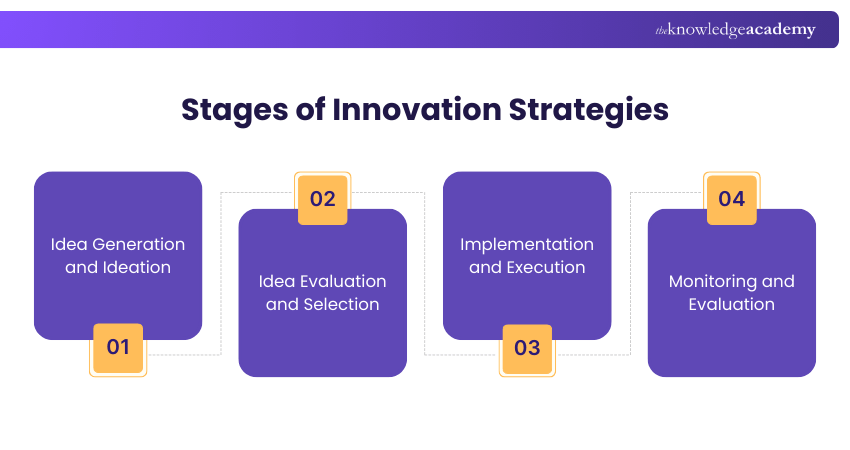
Idea Generation and Ideation
Ideation is the initial step of an innovation system. That is the one that assists firms in coming up with concepts for selling in the market and ways of finding other opportunities which may not be very risky.
There is innovation enabling companies to leverage new technologies for learning from Big Data what customer problems exist that you can solve. With such information, innovators will be able to seek ways of developing new ideas and plan how to implement the ideas in question.
The most important facet of this process is the feedback received from customers. A good idea requires a market of customers ready to witness an idea’s success, and not all ideas will have people willing to spend their money to access an idea. Using an Innovation Framework ensures that ideas are properly validated and refined based on customer approval, which helps define the feasibility of the ideas.
Idea Evaluation and Selection
Idea evaluation and selection is the set of processes used to determine how useful an idea is for further consideration. In this process, you evaluate the costs associated with an idea, the time it would take to get the product to market, potential profit, and other opportunities incidental to a business idea. This evaluation process is crucial whether you are assessing a completely new creation (Invention) or an improvement on an existing one (Innovation), clarifying the distinction between Innovation vs Invention in a business context.
The next step is to look at whether it seems like the product you are thinking about has a shot at being successful or not. After that it’s time to see if what you have in mind is similar to something that already exists. Is your new product a new unplanned creation, or is it a planned enhancement over current products? Will this set your company apart? Use all of this to identify the USP and decide if this will help.
Implementation and Execution
The implementation and execution phase is where the new idea is converted into an execution plan in order to put it to work. But this stage is more than building a product; it’s also about formulating a winning business model and searching for assistance to build your concept.
The first of these activities is new Product Development. To whom can you sell these materials or where can you find a partner to manufacture your product? What parts of your team should be involved in development?
When you get the right people, implementation is as simple as working from a plan. It is a managerial discipline encompassing the area of Project Management, resource management and processes as well as segmented improvement.
Monitoring and Evaluation
It is a rule of thumb that one is likely to get it wrong somewhere while creating a new paradigm within an industry. It will assist in managing those issues and adjusting the innovation process with the help of monitoring and evaluation.
This means the goal you have when monitoring a new project is to evaluate your performance. Is what you’re doing contributing toward making you reach your goal on release?
One of the ways to do this is through metrics. These numbers will indicate the success or otherwise of your business. To keep track of the release time, product progress, defects and the ROI in the longrun, record time. Hopefully, your metrics will show that you are reaching your goals, if this is not the case, then, it is time to rethink your strategy.
Learn how to transform business models to drive organisational success with our Business Model Innovation Training – Register today!
Types of Innovation Strategy
Innovation Strategies can be classified in many ways, but a common approach is to group them based on the level of novelty and change they introduce in technology and the market. Below are the four main Types of Innovation Strategy:
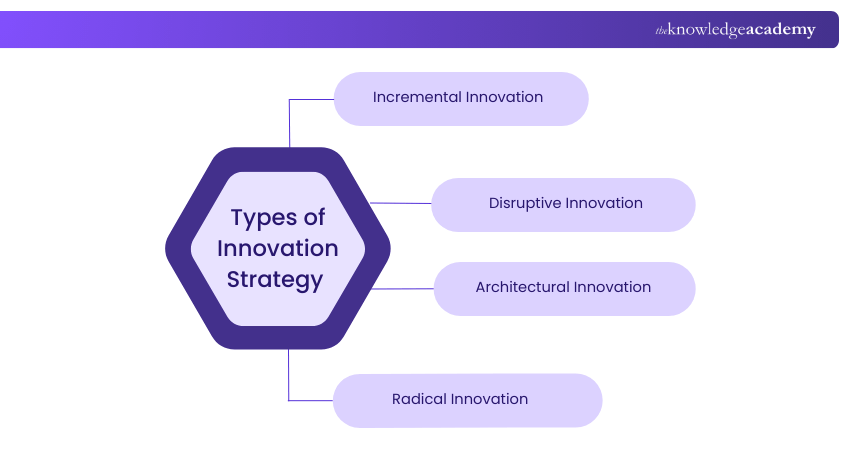
1) Incremental Innovation
Incremental Innovation is the most common and widely adopted type of Innovation. It involves making gradual improvements to an existing product, service, process, or Business Model while maintaining its core structure. These improvements may be small individually, but together they significantly enhance performance, usability, and Customer Satisfaction.
The main objective of Incremental Innovation is to improve efficiency, quality, and value by refining what already works and addressing existing customer needs in a consistent and measurable way.
Examples of Incremental Innovation Include:
a) Apple iPhone Improvements:
With each new iPhone release, Apple enhances familiar features like camera quality, processing speed, and user interface without changing the product fundamentally.
b) Gillette Razor Evolution:
Gillette has continuously refined its razor designs, progressing from single-blade to multi-blade systems to improve shaving comfort and precision.
c) Spotify Recommendation Enhancements:
Spotify regularly improves its recommendation algorithms to provide more personalised music suggestions, enhancing user experience over time.
2) Disruptive Innovation
Disruptive Innovation is less common but far more transformative. It introduces entirely new products, services, processes, or business models that differ significantly from existing ones. These innovations often create new markets, redefine customer expectations, or replace traditional solutions.
Disruptive Innovation typically delivers value to customers who are underserved or dissatisfied with existing options, often by providing simpler, more suitable, or more affordable alternatives.
Examples of Disruptive Innovation Include:
a) Netflix Streaming Services:
Netflix transformed entertainment by shifting consumers from physical DVD rentals and traditional broadcasting to on-demand digital streaming.
b) Uber Ridesharing Platform:
Uber changed urban transportation by connecting passengers directly with drivers through digital platforms, reducing reliance on traditional taxi systems.
c) Spotify Music Streaming:
Spotify replaced music ownership models with subscription-based streaming access, changing how people listen to and purchase music.
3) Architectural Innovation
Architectural Innovation involves rearranging or reconfiguring existing components or technologies to create new products, services, or business models without fundamentally changing the components themselves.
This approach delivers new value by combining existing elements in different ways, allowing organisations to expand into new markets or improve customer experience while relying on established knowledge and capabilities.
Examples of Architectural Innovation Include:
a) Smartwatches:
Smartwatches adapt smartphone technologies into wearable devices, offering new convenience without developing entirely new core technologies.
b) Peloton Home Fitness System:
Peloton combines exercise equipment, streaming technology, and online community engagement into a single integrated experience.
c) Canon Personal Copiers:
Canon redesigned large office photocopiers into compact personal machines suitable for individual users.
d) Hybrid Vehicles:
Hybrid cars integrate electric motors with traditional combustion engines to increase fuel efficiency and reduce emissions.
4) Radical Innovation
Radical Innovation involves the development of new technologies, products, services, or business models that create fundamental change. These innovations introduce breakthroughs that transform industries or generate entirely new markets.
The aim of Radical Innovation is to deliver revolutionary solutions to existing or emerging problems, often requiring significant research, investment, and technological advancement to create entirely new market possibilities.
Examples of Radical Innovation Include:
a) The Internet:
The Internet fundamentally transformed global communication, commerce, and information sharing, enabling entirely new industries.
b) Biotechnology and Gene Editing:
Advances such as Clustered Regularly Interspaced Short Palindromic Repeats (CRISPR) technology allow precise genetic modification, transforming medicine and agriculture.
c) Artificial Intelligence:
AI technologies like Machine Learning and Natural Language Processing are reshaping decision-making and automation across industries.
d) Blockchain Technology:
Blockchain enables decentralised digital systems and supports innovations such as Cryptocurrencies and secure data transactions.
Gain practical techniques to improve engagement, morale, and employee retention. Join our Staff Motivation Training now!
What are Some Examples of Successful Innovation Strategies?
Having explored various types of Innovations, let’s examine a few successful Innovation Strategy examples from well-known companies:
1) Amazon
Originally Amazon started as an internet retail store focusing on selling books. Originally, it developed into an all-encompassing hub that provides clients with an endless list of products. Amazon is still using these breakthroughs in technology to bring in variability within the online market.
The company has introduced a generation of streaming, audiobooks, eBooks, and many other value-added services for subscription and additional aesthetic value to its customers in order to boost customer satisfaction and customer retention.
2) Apple
The company is also known for its user-oriented design and quality products despite being a manufacturer of electronic gadgets. Thus, Apple does not create new types of products; it watches successes in some technological fields and improves existing products.
An example of a product with this model is the iPhone. Whereas Blackberry pioneered the birth of Smartphones in the world market, it was the innovations displayed by Apple in the design of this device and the easy interfaces that created a new era in the history of Smartphones and made iPhones a standard feature in most households across the world.
3) Startups and Entrepreneurs
Innovation is one of the core elements of startup and entrepreneurship systems. Here are some examples of companies that have disrupted industries with their innovative strategies:
a) Uber: Revolutionised the taxi service provision through the use of mobile applications through which lay people can become drivers.
b) Airbnb: Disrupted the entrenched industry of hotels and motels, and offered additional accommodation solutions, giving homeowners an opportunity to rent out their living space.
c) Netflix: Created changes in the entertainment services market, offering subscription-based services for streaming, instead of the monthly fee for live television.
d) Stripe: Revolutionised the payment industry by providing a solution to allow companies to adopt payment processing on their websites, thus enhancing the online payment process.
Elevate your team's creativity: Join our Managing Innovation Training today!
How Can Organisations Measure Innovation Success?
Measuring innovation success shows whether new ideas create real value. It is assessed using financial, operational, and organisational metrics. Below are the key metrics categories used to measure innovation success.
1) Financial and Impact Metrics
These measure the tangible business results of innovation, such as revenue from new products, Return on Innovation Investment (ROII), profitability, and cost savings from improved processes. They show whether innovation is delivering real value.
2) Pipeline and Process Metrics
These assess how efficiently ideas move from concept to launch. Metrics such as time-to-market, idea-to-implementation ratio, project progression speed, and kill rate indicate how effectively innovation is managed.
3) Input and Activity Metrics
These track the resources and effort invested in innovation, including R&D spending, idea generation, employee participation, and training. They reflect the level of organisational commitment to innovation.
4) Cultural and Strategic Metrics
These evaluate leadership focus and alignment with long-term goals. Management involvement, employee engagement, and strategic alignment show whether innovation is embedded in the organisation’s culture and direction.
Conclusion
Understanding What is Innovation Strategy helps organisations turn ideas into meaningful growth and long-term success. By choosing the right approach and measuring impact effectively, businesses can stay competitive, adapt to change, and create lasting value. Strong innovation is not just about ideas, but about delivering results that truly matter.
Enhance your leadership skills through interactive activities and real-world scenarios. Join our Leadership Courses now!
Frequently Asked Questions
What is The Best Innovation Strategy?

The best Innovation Strategy depends on a company's industry, goals, and risk tolerance. Proactive strategies suit tech leaders, while others may require caution. Successful companies often combine multiple strategies to stay innovative and meet diverse organisational needs.
Why do Businesses Need Innovation?
Businesses need Innovation to remain competitive, adapt to changing markets, and meet evolving customer demands. Innovation drives growth, improves efficiency, and creates value. It enables businesses to differentiate themselves, seize new opportunities, and achieve long-term success.
What are the Other Resources and Offers Provided by The Knowledge Academy?
The Knowledge Academy takes global learning to new heights, offering over 3,000+ online courses across 490+ locations in 190+ countries. This expansive reach ensures accessibility and convenience for learners worldwide.
Alongside our diverse Online Course Catalogue, encompassing 17 major categories, we go the extra mile by providing a plethora of free educational Online Resources like Blogs, eBooks, Interview Questions and Videos. Tailoring learning experiences further, professionals can unlock greater value through a wide range of special discounts, seasonal deals, and Exclusive Offers.
What is The Knowledge Pass, and How Does it Work?
The Knowledge Academy’s Knowledge Pass, a prepaid voucher, adds another layer of flexibility, allowing course bookings over a 12-month period. Join us on a journey where education knows no bounds.
What are Related Courses and Blogs Provided by The Knowledge Academy?
The Knowledge Academy offers various Leadership Courses, including the Managing Innovation Course, Staff Motivation Training, and the Business Model Innovation Training. These courses cater to different skill levels, providing comprehensive insights into Business Strategy.
Our Business Skills Blogs cover a range of topics related to Innovation Strategy, offering valuable resources, best practices, and industry insights. Whether you are a beginner or looking to advance your Business skills, The Knowledge Academy's diverse courses and informative blogs have got you covered.

Benjamin Walker


Leadership Development Coach and Management Consultant
Benjamin Walker is a leadership coach and business consultant with over 18 years of experience in guiding organisations through strategic growth and transformation. He specialises in developing leadership capabilities at all levels, from emerging managers to executive teams. Benjamin’s work focuses on practical leadership, team dynamics, and performance management.
View Detail
Upcoming Business Skills Resources Batches & Dates
Date
 Managing Innovation
Managing Innovation
Fri 3rd Jul 2026
Managing Innovation
Fri 4th Sep 2026
Managing Innovation
Fri 18th Dec 2026

 If you wish to make any changes to your course, please


