


 Top Rated Course

We may not have the course you’re looking for. If you enquire or give us a call on +49 8000101090 and speak to our training experts, we may still be able to help with your training requirements.
What Does a Business Consultant Do?
James Smith 09 February 2026A Business Consultant boosts performance by analysing operations, solving problems, and guiding strategy across finance, HR, and IT for better results. They provide expert advice to improve efficiency, reduce costs, and drive growth. By offering insights, they help organisations make smarter decisions and stay competitive.

Training Outcomes Within Your Budget!
We ensure quality, budget-alignment, and timely delivery by our expert instructors.
Table of Contents

Every organisation faces challenges at some point, whether it is falling profits, unclear goals or teams struggling to stay aligned. When progress slows and problems become difficult to solve, leaders often turn to a Business Consultant for expert advice and practical solutions. They help analyse issues, find opportunities, and guide companies toward better performance and sustainable growth.
In this blog, you will learn What Does a Business Consultant Do and what a Business Consultant role is. You will also explore the key skills, main types of Consultants, and the latest trends shaping the consulting industry.
Table of Contents
1) What is a Business Consultant?
2) What Does a Business Consultant Do?
3) How to Become a Business Consultant?
4) What Skills are Needed to be a Business Consultant?
5) Types of Business Consultants
6) Emerging Trends in the Consulting Industry
7) What are the Main Duties of a Consultant?
8) Conclusion
What is a Business Consultant?
A Business Consultant is an expert who helps organisations improve performance, solve problems, and achieve goals by offering professional advice and tailored solutions. They begin by analysing business operations, identifying challenges, and developing strategies to boost efficiency, profitability, and growth.
Business Consultants may also assist with implementing changes, training staff, and monitoring progress. Their objective, outside perspective and specialised knowledge help businesses overcome obstacles and stay competitive. Companies hire Consultants for short-term projects or ongoing support across areas like strategy, marketing, finance, or operations, making them valuable partners in driving business success.

What Does a Business Consultant Do?
A Business Consultant is hired to help organisations improve performance and increase profitability. Their responsibilities may differ by project, but they generally include tasks such as:
1) Analyse Business Operations
A Business Consultant begins by studying how the organisation works day-to-day. They assess workflows, finances, staff responsibilities, technology systems, and market performance to understand what is effective and where improvements are needed. This gives them a complete picture of the business’s current situation.
2) Identifies Problems and Opportunities
Through interviews, Data Analysis, research, and observation, Consultants identify key challenges that may be affecting performance. At the same time, they look for new opportunities that can help the business grow faster and operate more efficiently. They then prioritise the areas that require immediate attention.
3) Develops Tailored Strategies
Using the insights collected, Consultants develop strategies tailored to the company’s goals, size, and industry. These plans focus on boosting productivity, reducing costs, improving customer outcomes, and strengthening competitiveness. Each action step is aligned with the organisation’s long-term goals.
4) Assists with Implementation
Consultants support teams in applying the new strategies. This may include updating systems, introducing better processes, and guiding employees through change. Their involvement ensures that solutions are successfully implemented, not just recommended. This hands-on support helps the business achieve results more quickly and effectively.
5) Monitors and Adjusts
Performance is tracked using key metrics and progress reviews. If the outcomes are not as expected, Consultants refine the plan to achieve stronger results. This continuous monitoring helps the organisation stay on track toward its goals. It also ensures that improvements remain aligned with changing business needs.
6) Offers Specialised Expertise
Consultants bring valuable knowledge from different industries and projects that internal teams may not have. Their expertise in areas like digital transformation, financial planning, or HR enables companies to adopt up-to-date and effective practices. This specialised support helps businesses improve faster and stay competitive in the market.
7) Brings Objective Perspective
As external professionals, Consultants provide unbiased and fact-based advice. Their independent view helps leaders make smart decisions without being influenced by internal politics or personal opinions. This objective perspective supports fair, strategic choices that benefit the organisation’s long-term success.
Learn practical methods to analyse and enhance business operations effectively – Join our Business Process Improvement Training now!
How to Become a Business Consultant?
Here are the steps to become a Business Consultant:
Earn a Relevant Degree
Begin your journey with a Bachelor’s degree in fields like business administration, finance, management, marketing, or economics. This foundational education provides key knowledge in business operations, strategic thinking, and Financial Analysis.
Gain Practical Work Experience
Hands-on experience in real business environments is crucial. Working in roles like operations, marketing, HR, or finance helps you understand organisational challenges, build credibility, and develop practical problem-solving skills.
Develop Key Skills
Strong analytical thinking, effective communication, leadership, and decision-making are core to successful consulting. Sharpen your Project Management abilities and learn to navigate complex situations with confidence and clarity.
Consider Advanced Education
While not always required, pursuing an MBA or certifications like PMP, Lean Six Sigma, or industry-specific credentials can enhance your expertise and credibility. These qualifications signal your commitment to professional growth and specialised knowledge.
Choose a Specialisation
Consultants often thrive by focusing on a niche such as operations, marketing, IT, HR, or strategy. Specialising allows you to build deep expertise and stand out in a competitive field by solving complex challenges in a specific domain.
Network and Build Relationships
Networking is essential for discovering opportunities and growing your reputation. Attend industry events, join professional groups, and actively engage with peers and trainers to expand your influence and visibility.
Gain Consulting Experience
Start building experience through roles at consulting firms, freelance projects, or advisory work within companies. Each project helps you refine your consulting approach, build a portfolio, and earn client trust.
Stay Updated
The business world evolves quickly, so staying informed is critical. Continuously learn about new trends, technologies, tools, and industry shifts to offer relevant, forward-thinking advice to clients.
Learn the skills to manage teams with our Introduction to Management Course – Join today!
What Skills are Needed to be a Business Consultant?
To succeed in a Business Consultant role, you need a strong mix of technical expertise, analytical thinking, and people skills. Below are the essential Business Consultant requirements that help deliver value and manage their clients effectively:
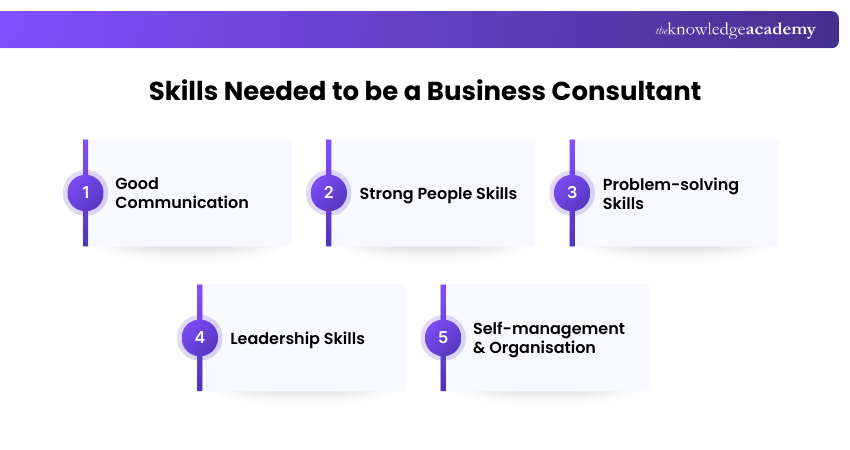
a) Good Communication:
You must clearly share ideas, explain strategies, and present insights in a way clients understand. Whether communicating in meetings or writing detailed reports, strong Communication helps build trust and make sure everyone is aligned with the proposed solutions.
b) Strong People Skills:
Consultants work closely with different clients and teams, so building positive relationships is crucial. Understanding workplace dynamics and gaining support for your ideas helps you create smoother collaboration and successful outcomes.
c) Problem-solving Skills:
Since consulting revolves around fixing business issues, you need to think creatively and evaluate multiple viewpoints. Identifying the root cause and finding practical solutions that align with client goals is key to improving performance and profitability.
d) Analytical Thinking:
Many consulting projects involve Analytical Thinking, analysing financial data, trends, and performance metrics. Being comfortable with numbers and tools like spreadsheets helps you uncover patterns, measure results, and forecast improvements for the business.
e) Leadership Skills:
Consultants lead to change, manage teams, and influence senior leaders, so strong Leadership skills are essential. Confidence, persuasion, and effective delegation help ensure their recommendations are implemented successfully.
f) Self-management & Organisation:
Consultants frequently balance multiple clients and demanding workloads. Being organised, managing time well, and handling administrative tasks independently allow you to maintain quality service across all projects.
Types of Business Consultants
Here are the Business Consultant types:
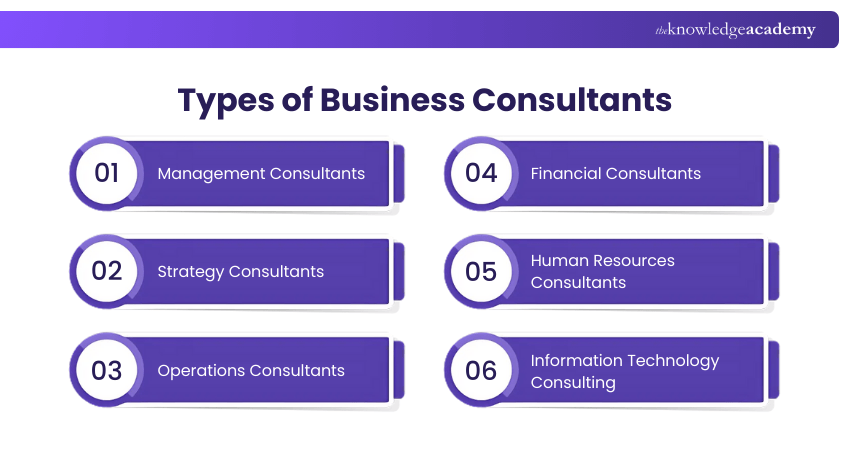
1) Management Consultants
They help companies create long-term plans and improve how they are managed. They work with senior leaders to align the company’s vision with its goals. Their job is to ensure resources are used effectively. They also help redesign structures or processes to boost overall performance and drive growth.
2) Strategy Consultants
A Strategy Consultant works with senior leaders to shape long-term business direction, focusing on areas like corporate strategy, growth opportunities, and competitive positioning. They mainly provide expert advice rather than handling day-to-day implementation.
3) Operations Consultants
These Consultants focus on improving daily operations. They look at supply chains, production processes, and other day-to-day activities. Their goal is to make the company run more efficiently. They often recommend new technologies or methods to boost productivity.
4) Financial Consultants
They advise companies on managing their money better. This includes Financial Planning, budgeting, and investment strategies. They help companies reduce costs and increase profits. Their expertise is crucial for making sound financial decisions.
5) Human Resources Consultants
These Consultants help manage the company’s workforce. They advise on recruitment, employee training, and Performance Management. Their aim is to enhance employee satisfaction and productivity. They also help develop policies and programmes to retain top talent.
6) Information Technology Consulting
These Consultants help businesses improve how they use technology. They assess current systems, find inefficiencies, and recommend digital tools to boost productivity. Their focus is on improving security, streamlining operations, and ensuring systems can grow with the business.
Learn how to create internal controls with our Business Process Improvement Training– Join today!
Emerging Trends in the Consulting Industry
The Consulting Industry is rapidly evolving as clients need faster results, stronger digital capabilities, and clear value delivery. Firms that embrace AI, data insights, and specialised skills are leading this shift.
Key Trends:
a) AI tools to automate tasks and improve efficiency
b) Higher demand for ESG, Cyber Security, and digital expertise
c) Outcome-focused services with measurable results
d) Hybrid consulting models for flexible client support
e) Data-driven insights guiding smarter decisions
f) Rising competition from boutique and PE-backed firms
What are the Main Duties of a Consultant?
A Business Consultant’s main duties include assessing client needs, offering expert advice, designing solutions, and helping implement improvements. They also evaluate results, provide training, and make sure the business stays on track toward its goals. Adaptability and in-depth industry knowledge are key to their success.
Conclusion
Business Consultants play a vital role in solving challenges, improving performance, and driving growth across industries. They offer expert guidance, strategic insights, and practical solutions tailored to each organisation’s needs. So, What Does a Business Consultant Do? They bridge gaps between goals and execution, empowering businesses to make informed decisions and obtain long-term success.
Learn the principles of Project Management with our Management Courses– Join today!
Frequently Asked Questions
Is Business Consulting Difficult?

Consulting for business can be demanding because one has to deal with problems and offer solutions to business entities. But still, it can be a very fulfilling occupation when the necessary skills and experience are applied.
Is There a Demand for Business Consultants?
Yes, there is a high demand for Business Consultants who will provide their expertise to help companies enhance their performance, strategies, and revenues. This demand is likely to continue as businesses confront new challenges and opportunities.
What are the Other Resources and Offers Provided by The Knowledge Academy?
The Knowledge Academy takes global learning to new heights, offering over 3,000+ online courses across 490+ locations in 190+ countries. This expansive reach ensures accessibility and convenience for learners worldwide.
Alongside our diverse Online Course Catalogue, encompassing 19 major categories, we go the extra mile by providing a plethora of free educational Online Resources like Blogs, eBooks, Interview Questions and Videos. Tailoring learning experiences further, professionals can unlock greater value through a wide range of special discounts, seasonal deals, and Exclusive Offers.
What is The Knowledge Pass, and How Does it Work?
The Knowledge Academy’s Knowledge Pass, a prepaid voucher, adds another layer of flexibility, allowing course bookings over a 12-month period. Join us on a journey where education knows no bounds.
What are the Related Courses and Blogs Provided by The Knowledge Academy?
The Knowledge Academy offers various Management Courses, including Consulting Skills Training, Costing and Pricing Training, and Conflict Management Training. These courses cater to different skill levels, providing comprehensive insights into Business Strategy.
Our Business Skills Blogs cover a range of topics related to Business Consulting, offering valuable resources, best practices, and industry insights. Whether you are a beginner or looking to advance your Business skills, The Knowledge Academy's diverse courses and informative blogs have got you covered.

James Smith


Digital Marketing Manager and Trainer
James Smith is a digital marketing professional with over a decade of experience in SEO, content strategy, paid media and analytics. He has supported both SMEs and global brands in transforming their digital presence. James’s writing and training are rooted in results-driven tactics and the latest marketing trends.
View Detail
Upcoming Business Skills Resources Batches & Dates
Date
 Consulting Skills Training
Consulting Skills Training
Fri 5th Jun 2026
Consulting Skills Training
Fri 25th Sep 2026
Consulting Skills Training
Fri 18th Dec 2026

 If you wish to make any changes to your course, please


