


 Top Rated Course

We may not have the course you’re looking for. If you enquire or give us a call on +49 8000101090 and speak to our training experts, we may still be able to help with your training requirements.
Bucket Sort Algorithm: How It Works and its Applications
The Knowledge Academy 23 February 2026Bucket sort separates data into buckets, sorts them individually, and merges them into a sorted list. It works best for datasets that are uniformly distributed. This blog explores the Bucket Sort Algorithm in detail, explaining its working principles, applications, and key concepts to help you master the algorithm.

Training Outcomes Within Your Budget!
We ensure quality, budget-alignment, and timely delivery by our expert instructors.
Table of Contents

If you want to visualise Bucket Sorting, think of it as sorting a messy pile of coins by simply dropping them into labelled jars. Essentially, this algorithm is great for handling large datasets, especially when values are uniformly distributed. Unlike traditional comparison-based sorting methods, Bucket Sort Algorithm groups elements into buckets, sorts them individually, and then merges them to produce a sorted array.
When applied to uniformly distributed data, Bucket Sort Algorithm delivers lightning-fast performance. This blog explores this concept in detail, highlighting its workings and applications. So read on and learn how it makes sorting as easy as tossing items in the right bins!
Table of Contents
1) What is a Bucket Sort Algorithm?
2) How Does Bucket Sort Work?
3) Complexity of Bucket Sort
4) Applications of Bucket Sort Algorithm
5) Variation of Bucket Sort Algorithm
6) Comparison of Bucket Sort with Other Sorting Algorithms
7) Advantages and Disadvantages of Bucket Sort
8) Why is Bucket Sort O(n+k)?
9) Conclusion
What is a Bucket Sort Algorithm?
The Bucket Sort Algorithm, also known as Bin Sort, is a sorting technique that distributes elements of an array into several groups or “buckets.” Each bucket holds a range of values, which are then sorted individually using another sorting algorithm or recursively using Bucket Sort itself.
The process involves four main steps:
1) Create empty buckets.
2) Distribute elements into these buckets based on their value.
3) Sort each non-empty bucket individually.
4) Merge all buckets back into a single sorted array.
This method is particularly effective when input data is uniformly distributed across a known range.

How Does Bucket Sort Work?
The Bucket Sort algorithm works by distributing elements into several groups (buckets), sorting each group individually, and then merging them back into a single sorted array. Here’s how the process unfolds step by step:
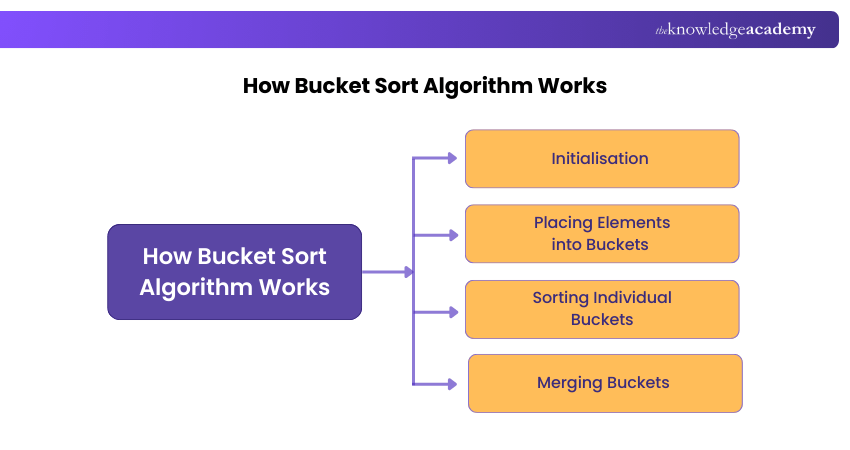
Initialisation
First, decide the number of buckets (k) based on the input data. Then, create ‘k’ empty buckets, each of which can be represented as a list or array. These buckets will temporarily hold the elements before sorting.
Placing Elements into Buckets
For each element, determine the correct bucket using a function or formula such as Bucket_index = value * k / (max_value + 1). Each element is then placed into its corresponding bucket based on this calculated index.
Sorting Individual Buckets
Once the elements are distributed, sort the contents of each non-empty bucket. You can use any sorting algorithm, but simple ones like insertion sort are efficient for smaller bucket sizes.
Merging Buckets
Finally, concatenate all buckets in order, maintaining the sequence of elements within each one. The result is a completely sorted array.
Example:
For the array [0.78, 0.17, 0.39, 0.26, 0.72, 0.94, 0.21, 0.12, 0.23, 0.68] with 10 buckets:
a) 0.78 goes into bucket 7, 0.17 into bucket 1, and so on.
b) Each bucket is then sorted individually.
c) Merging all buckets yields a final sorted array.
Note: The performance of Bucket Sort depends on how evenly the data is distributed. Uniformly distributed data allows it to approach linear time complexity. The sorting algorithm used within each bucket also influences efficiency.
Learn how to build robust web applications using Python and Django in our comprehensive Python Django Training - Sign up now!
Complexity of Bucket Sort
Bucket Sort Algorithm comes with two main complexity types, namely time complexity and space complexity. Let’s explore the two with examples:
1) Time Complexity
Factors affecting Time Complexity:
a) Distribution of Input Data: The efficiency of Bucket Sort largely depends on how the input data is distributed. If the data is uniformly distributed, Bucket Sort can be very efficient.
b) Number of Buckets (k): The choice of how many Buckets to use is crucial. Ideally, ‘k’ should be chosen such that the distribution of elements in the Buckets is as uniform as possible.
c) Sorting Algorithm for Buckets: The sorting algorithm for individual Buckets also influences the overall time complexity. Typically, insertion sort is used for its efficiency on small lists.
Time Complexity Analysis:
a) Best Case (O(n + k)): This occurs when the elements are uniformly distributed, and each Bucket gets one element. The sorting of each Bucket is O(1), as each Bucket contains only one element. Thus, the time complexity is linear regarding the number of elements, ‘n’, and the number of Buckets, ‘k’.
b) Average Case (O(n + n^2/k + k)): Typically, when elements are uniformly distributed, the average time complexity involves the time to insert elements into Buckets (O(n)), the time to sort all Buckets (O(n^2/k) if using insertion sort), and the time to merge the Buckets (O(k)).
c) Worst Case (O(n^2)): The worst case occurs when all elements are placed into a single Bucket. The overall performance becomes dependent on the sorting algorithm used for the Buckets. If insertion sort is used, the time complexity becomes O(n^2).
Practical code example
Consider an example in Python to illustrate Bucket Sort:
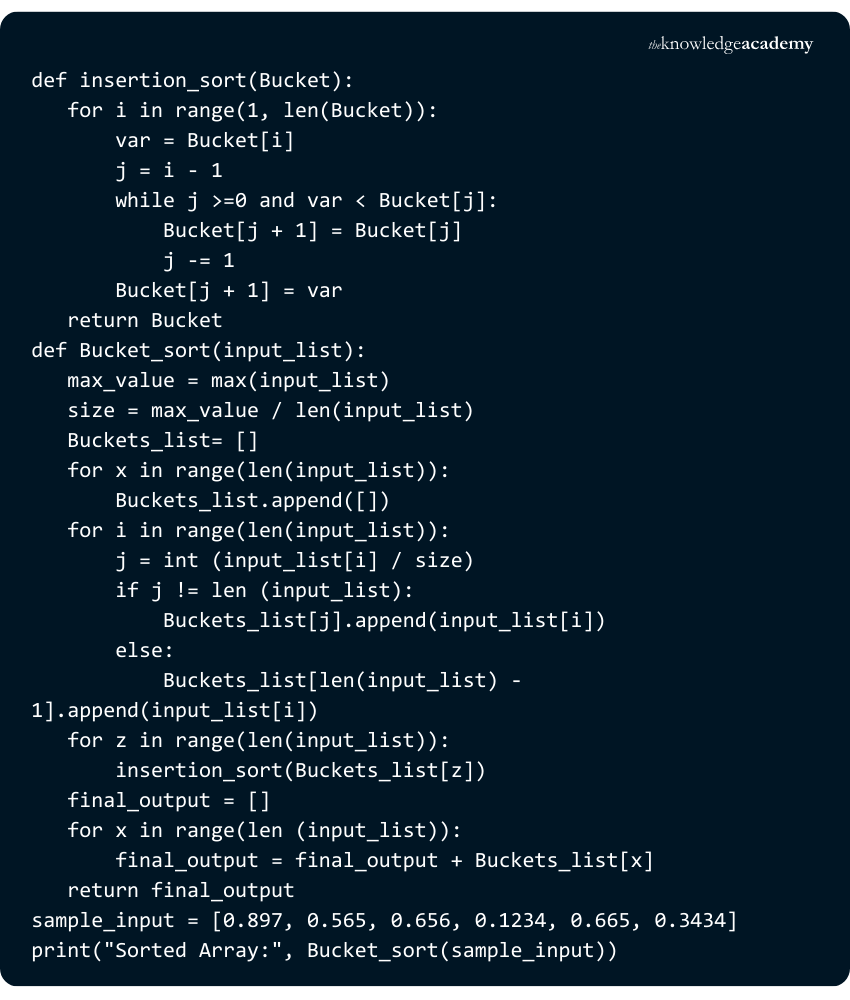
In this code, ‘insertion_sort’ is used for sorting individual Buckets, which are divided based on the range of the input elements.
Learn advanced data analysis and statistical techniques using R in our R Programming Course - Sign up now!
2) Space Complexity
Bucket Sort's space complexity is primarily influenced by the number of Buckets used and the space needed to store the input array.
a) Number of Buckets: The space required for the Buckets themselves is a key component. If you have ‘k’ Buckets, you need space to store these ‘k’ Buckets.
b) Size of input array: The space required to hold the input array elements in the Buckets is another factor. In the worst case, all elements might end up in a single Bucket.
Analysing Space Complexity:
The space complexity of Bucket Sort can be dissected as follows:
a) Space for Buckets: If there are ‘k’ Buckets, and each Bucket is an array or list, the space required is proportional to ‘k’.
b) Space for Elements: In the worst case, all ‘n’ elements of the input array could be in the same Bucket. Hence, the space required to store these elements is proportional to ‘n’.
c) Total space Complexity: Combining the above, the total space complexity of Bucket Sort is O(n + k), where ‘n’ represents the number of elements in the input array and ‘k’ represents the number of Buckets.
Practical Code Example:
Consider the Python code example from the previous explanation of Bucket Sort. In this case, the space complexity is determined by the space required for the ‘Buckets_list’ and the space required to hold the ‘input_list’.
Here's the same code with comments highlighting space allocation:
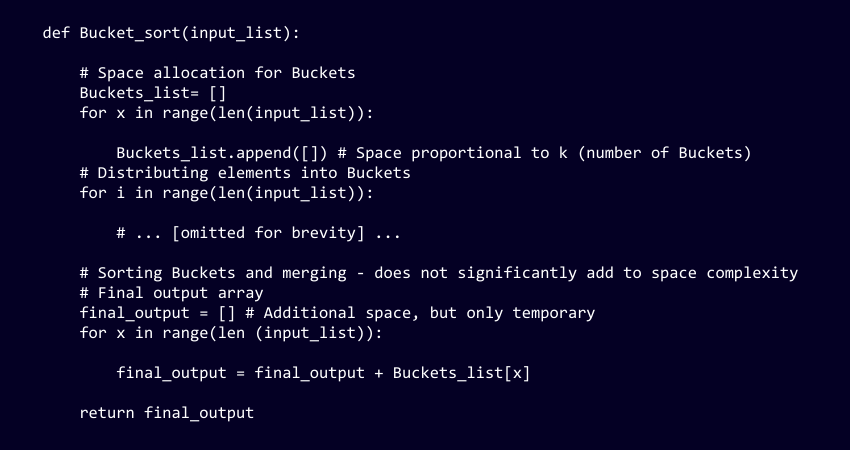
Key points in space complexity:
a) Proportionality to ‘n’ and ‘k’: The space complexity is proportional to the number of Buckets and elements.
b) In-place Sorting: Unlike other sorting algorithms (like merge sort), Bucket Sort does not sort in place; it requires additional space for Buckets.
c) Temporary Space: The space used for the final output array in the code is temporary and does not add to the overall space complexity, as it's just a reorganisation of the existing input.
Learn to leverage the simplicity and readability of Python with our comprehensive Python Course - Sign up now!
Applications of Bucket Sort Algorithm
Here are some key applications of the Bucket Sort Algorithm:

a) Sorting Large Datasets: Bucket Sort is ideal for sorting large datasets, especially when the data is uniformly distributed over a range. Its ability to distribute data into Buckets and sort them individually makes it efficient for handling vast amounts of data.
b) Decimal or Floating-point Sorting: It's particularly useful for sorting decimal or floating-point numbers that are uniformly distributed. Bucket Sort can manage the data more efficiently than comparison-based sorting algorithms.
c) Distributed Systems: In distributed systems, where data is spread across multiple machines, Bucket Sort can sort data locally in each machine (Bucket) before merging.
d) External Sorting: Bucket Sort can be an effective choice when dealing with data that doesn't fit into memory. It can sort chunks of data (Buckets) individually, which are then merged.
e) Graphics Rendering: Bucket Sort is used in graphics for depth sorting or the painter's algorithm, where objects are sorted based on depth before rendering.
Variation of Bucket Sort Algorithm
Here are the variations of Bucket Sort:
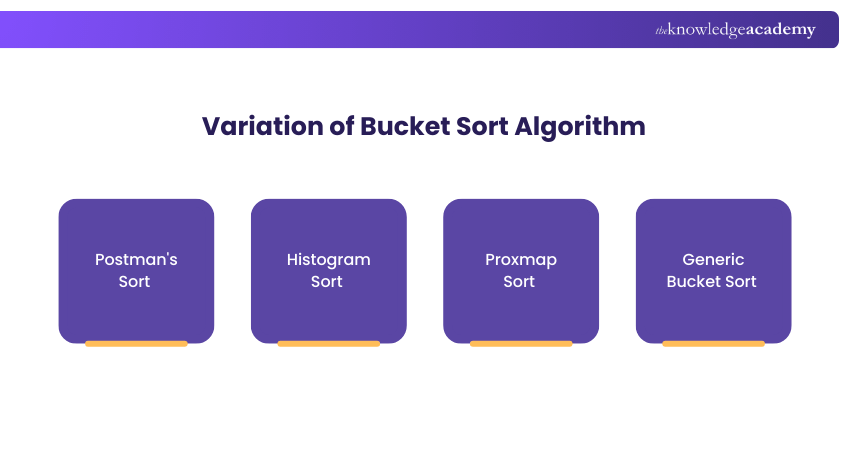
1) Postman's Sort
a) The algorithm sorts numbers from the most significant to the least significant digit.
b) Sorting numbers on multiple digits at a time significantly increases speed.
c) Postman’s Sort is a Bucket Sort variant that utilises a hierarchical structure of elements, typically described by a set of attributes.
d) Letter-sorting machines in post offices follow a similar approach:
i) Mail is first separated into domestic and international categories.
ii) Further sorted by state, province, or territory.
ii) Then sorted by the destination post office.
iv) Finally, sorted by routes, and so on.
2) Histogram Sort
a) A histogram is a rough representation of numerical data distribution.
b) The first step in creating a histogram is to bin (or bucket) the range of values:
c) This involves segmenting the entire range into intervals and determining how many values fall into each interval.
d) A variant of Bucket Sort, known as Histogram Sort or Counting Sort, follows a specific approach:
i) A first pass counts the number of elements in each bucket using a count array.
ii) The array values are then arranged into buckets using a series of exchanges.
iii) This method eliminates bucket storage overhead.
3) Proxmap Sort
a) ProxMap Sorting takes a unique approach, conceptually similar to hashing.
b) This method uses hashing with buckets, but the buckets have varying sizes.
c) ProxMapSort works similarly to Bucket Sort by dividing an array into subarrays using a "map key" function that maintains a partial ordering of keys.
d) While each key gets added to its subarray, insertion sort keeps that subarray sorted.
e) When ProxMapSort finishes, the entire array is in sorted order.
4) Generic Bucket Sort
a) The most common Bucket Sort variant processes n numeric inputs ranging from 0 to a maximum value M.
b) The value range is divided into n buckets, each of size M/n.
c) If Insertion Sort is used to sort each bucket, the algorithm achieves expected linear time complexity.
Advance your coding skills today with our diverse range of Programming Training. Join today!
Comparison of Bucket Sort with Other Sorting Algorithms
This table summarises the distinctions between the various sorting algorithms:

Advantages and Disadvantages of Bucket Sort
The Bucket Sort algorithm offers significant benefits for specific types of data, especially when dealing with uniformly distributed elements. However, it also has limitations that make it less suitable for certain datasets and applications.
Advantages of Bucket Sort
a) Fast for Uniformly Distributed Data: Performs efficiently when elements are evenly distributed across a known range.
b) Efficient for Floating-Point Numbers: Works well for sorting decimal or fractional values.
c) Can Leverage Other Sorting Algorithms: Each bucket can use fast sorting methods like Quick Sort or Merge Sort.
d) Parallelisable: Sorting individual buckets can be done concurrently for faster performance.
Disadvantages of Bucket Sort
a) Requires Extra Space: Needs additional memory for storing buckets.
b) Not Suitable for Large Range Inputs: Becomes less efficient with unevenly distributed data.
c) Complex Implementation: More complicated to implement compared to simpler algorithms like Insertion Sort.
Why is Bucket Sort O(n+k)?
Bucket Sort is O(n + k) because it distributes the input elements into a fixed number of buckets (k), and each bucket is sorted individually, usually with another sorting algorithm. The O(n) time complexity arises from distributing elements into buckets and then collecting them to form the sorted array.
Conclusion
In essence, the Bucket Sort Algorithm isn’t just another sorting method—it’s like organising a messy drawer into neat compartments, making everything easier to find. By breaking data into smaller buckets, it simplifies the process and boosts performance. While it’s not a one-size-fits-all solution, knowing when and how to use it can save you time and effort.
Master Swift Programming for iOS and macOS development in detail with our Swift Training – sign up now!
Frequently Asked Questions
What are Bubble Sort and Bucket Sort?

Bubble sort can be defined as a simple comparison-based algorithm that recursively steps through a list, compares adjacent elements, and interchanges them if they are in the wrong order. On the other hand, Bucket Sort distributes elements into multiple Buckets, sorts each Bucket individually, and then merges them, excelling with uniformly distributed data.
What Data Structures can be Used to Implement Buckets?
Buckets in the Bucket Sort algorithm can be implemented using data structures like arrays, linked lists, or dynamic lists. Arrays offer faster access, while linked lists provide flexibility for variable-sized buckets and easier insertion or deletion of elements.
What are the Other Resources and Offers Provided by The Knowledge Academy?
The Knowledge Academy takes global learning to new heights, offering over 3,000 online courses across 490+ locations in 190+ countries. This expansive reach ensures accessibility and convenience for learners worldwide.
Alongside our diverse Online Course Catalogue, encompassing 17 major categories, we go the extra mile by providing a plethora of free educational Online Resources like Blogs, eBooks, Interview Questions and Videos. Tailoring learning experiences further, professionals can unlock greater value through a wide range of special discounts, seasonal deals, and Exclusive Offers.
What is Knowledge Pass, and how Does it Work?
The Knowledge Academy’s Knowledge Pass, a prepaid voucher, adds another layer of flexibility, allowing course bookings over a 12-month period. Join us on a journey where education knows no bounds.
What are the Related Courses and Blogs Provided by The Knowledge Academy?
The Knowledge Academy offers various Programming Courses, including Data Structure and Algorithm Training, Basic Perl Training, and Ruby Programming Course. These courses cater to different skill levels, providing comprehensive insights into What is Dynamic Programming.
Our Programming & DevOps blogs covers a range of topics related to Data Structure and Algorithm, offering valuable resources, best practices, and industry insights. Whether you are a beginner or looking to advance your Programming skills, The Knowledge Academy's diverse courses and informative blogs have you covered.

The Knowledge Academy


Global Training Provider
The Knowledge Academy is a world-leading provider of professional training courses, offering globally recognised qualifications across a wide range of subjects. With expert trainers, up-to-date course material, and flexible learning options, we aim to empower professionals and organisations to achieve their goals through continuous learning.

Upcoming Programming & DevOps Resources Batches & Dates
Date
 Data Structure and Algorithm Training
Data Structure and Algorithm Training
Fri 28th Aug 2026
Data Structure and Algorithm Training
Fri 27th Nov 2026

 If you wish to make any changes to your course, please


