


 Top Rated Course

We may not have the course you’re looking for. If you enquire or give us a call on +49 8000101090 and speak to our training experts, we may still be able to help with your training requirements.
Black Box Testing: Overview, Types, and Techniques
Scarlett Adams 09 March 2026Black Box Testing examines software functionality without internal knowledge, focusing on input-output behaviour to find errors and validate performance. It is also known as specification-based testing. Key testing techniques include Equivalence Partitioning, Boundary Value Analysis, Decision Table Testing and State Transition Testing.

Training Outcomes Within Your Budget!
We ensure quality, budget-alignment, and timely delivery by our expert instructors.
Table of Contents

What if you could test software the same way a real User Experiences it, without ever looking at the code behind it? That is exactly what Black Box Testing is about. Like driving a car without opening the bonnet, it focuses purely on how the system behaves, not how it is built. Testers explore features, inputs, outputs and edge cases to ensure everything works as expected from the outside.
In this blog, you will discover what Black Box Testing is, the different types involved, and the key techniques used to make it effective. You will also see how this approach improves reliability, strengthens usability and builds confidence in modern software development and delivery. Let’s get started!
Table of Contents
1) What is Black Box Testing?
2) Features of Black Box Testing
3) Types of Black Box Testing
4) Black Box Functional Testing Techniques
5) Advantages of Black Box Testing
6) Disadvantages of Black Box Testing
7) Strategies for Successful Black Box Testing
8) Conclusion
What is Black Box Testing?
Black Box Testing is a software testing method that evaluates a system’s functionality without any knowledge of its internal structure or source code. Testers provide inputs and analyse the resulting outputs to understand how the system behaves. This helps them assess how it handles valid and invalid actions, response times, usability concerns, and overall reliability.
This approach is effective because it evaluates the system from an end-user perspective. Users care about results, not how the system is built, so testers focus on real-world scenarios to confirm that the software delivers the expected functionality accurately and consistently.

Features of Black Box Testing
Here are the most prominent features of Black Box Testing:
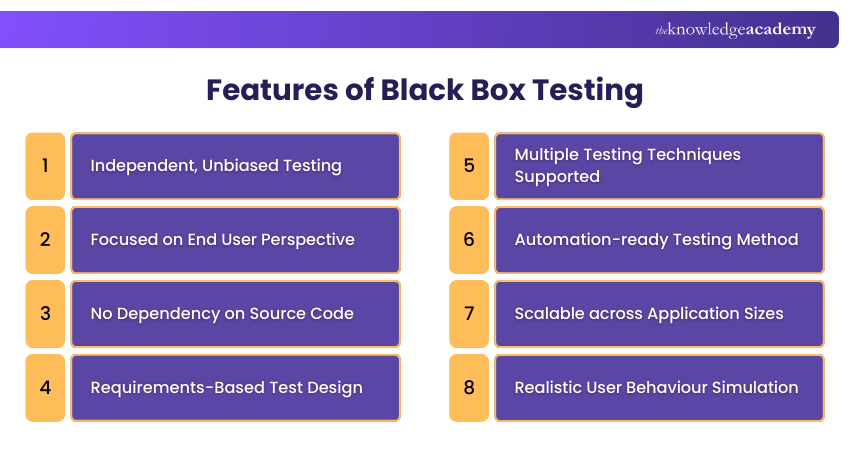
1) Independent Testing
Black Box Testing is carried out by Testers who are not part of the development team, supporting objective and unbiased evaluation. This separation helps identify issues that may be overlooked by Developers familiar with the system.
2) User Perspective
Testing is performed from an end-user viewpoint, ensuring the application aligns with user expectations and remains intuitive to use. It validates real-world usage scenarios and highlights practical usability challenges.
3) Code Ignorance
Testers do not view the underlying code or architecture, allowing them to concentrate solely on external behaviour and functionality. This encourages validation based on outcomes rather than implementation details.
4) Requirement-driven
Tests are designed around documented requirements, confirming the system meets defined specifications. This ensures all functional expectations are verified against agreed business needs.
5) Technique Variety
Black Box Testing supports techniques such as functional, usability, acceptance, and regression testing. This flexibility allows teams to address different quality aspects within a single testing approach.
6) Automation Friendly
It can be easily automated using testing tools, helping reduce manual effort and testing time. Automation also improves test consistency and supports frequent execution during development cycles.
7) Highly Scalable
The approach adapts well to applications of varying size and complexity. It can be applied to small modules as well as large, enterprise-level systems.
8) Realistic User Behaviour
Limited system knowledge ensures testing closely reflects real-world user behaviour. This makes the results more reliable when assessing overall user experience and system reliability.
Drive testing strategy, teams and outcomes with our Certified Software Testing Manager (CSTM) Course - Sign up today!
Types of Black Box Testing
Black Box Testing is commonly used across these three broad testing categories:
1) Functional Testing
This type focuses on verifying specific features or functions of the software. For instance, it checks whether users can successfully log in with valid credentials and are prevented from accessing the system with incorrect details. Functional testing may target critical features through smoke or sanity testing or examine interactions between major components via integration testing.
2) Non-functional Testing
Non-functional Black Box Testing assesses how well the software performs rather than what it does. Instead of validating whether an action works, it evaluates the quality of execution. Through this approach, Testers can determine whether the software is user-friendly, performs reliably under normal or peak loads, operates correctly across different devices, browsers and operating systems.
3) Regression Testing
Black Box Testing is also effective for identifying regressions introduced in new software versions. It ensures existing functionality and performance remain intact after updates or changes. Regression testing may highlight functional issues, such as features no longer working correctly, or non-functional problems, such as reduced performance or slower response times in the updated version.
Black Box Functional Testing Techniques
Several techniques are used to carry out black box functional testing, each designed to improve coverage while keeping testing efficient. Here are the key ones:
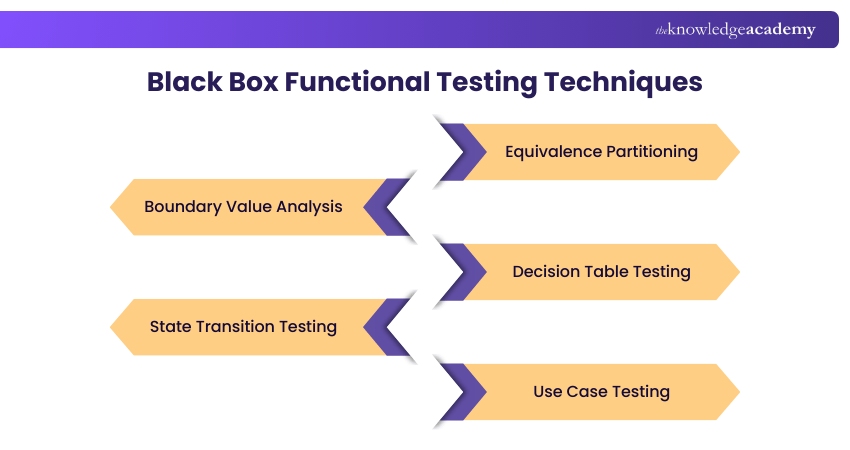
1) Equivalence Partitioning
Equivalence Partitioning, also called Equivalence Class Partitioning (ECP), divides the input data into groups that are expected to behave in the same way. The aim is to minimise the number of test cases while still achieving effective coverage of the application. The underlying idea is that if one value in a partition works correctly, all other values in that group should also behave as expected.
2) Boundary Value Analysis
Boundary Value Analysis (BVA) is based on the observation that defects are more likely to occur at the edges of input ranges rather than in the middle. Test cases are therefore created around minimum, maximum and boundary values. BVA is highly efficient because it uncovers common errors without testing every possible input combination.
3) Decision Table Testing
Decision Table Testing is used for systems with complex logic and multiple input combinations. It is particularly useful when different input conditions lead to different system behaviours. By representing conditions and outcomes in a table, this method ensures all meaningful combinations are tested.
4) State Transition Testing
State Transition Testing checks how a system behaves as it moves from one state to another in response to specific inputs. It is especially valuable when behaviour depends on previous actions or system states. State transition diagrams are used to map the states and transitions, helping verify correct behaviour across ordered events.
5) Use Case Testing
Use Case Testing derives test cases from defined use cases, which describe how users may interact with the system to achieve specific goals. This technique validates complete user workflows, ensuring that the system responds accurately across all realistic usage scenarios.
Our Mobile and Database Testing Training is the gateway to bug-free apps and strong databases - Sign up now!
Advantages of Black Box Testing
Here the benefits offered by Black Box Testing:
1) User-Focused
Black Box Testing is performed from an end-user’s perspective, ensuring the application behaves as expected in real-world scenarios. This approach helps identify usability gaps and functional issues that directly impact user experience.
2) Unbiased Assessment
Testers do not need any knowledge of internal code, allowing them to evaluate the system objectively. This independence increases the likelihood of detecting issues that Developers may overlook due to familiarity.
3) Simple Setup
Black Box Testing does not require an understanding of the internal architecture or programming logic. This makes it easy to initiate testing and enables Testers with diverse skill levels to participate.
4) Broad Coverage
It is effective for testing large and complex systems by validating overall functionality. This ensures multiple features, inputs, outputs, and user workflows are assessed efficiently.
Disadvantages of Black Box Testing
Black Box Testing is not without its drawbacks. These are the main ones you should keep in mind:
1) Limited Scope
Test case design depends heavily on clear and complete requirements. If specifications are unclear, certain system areas may remain untested.
2) Inefficient Debugging
Identifying the root cause of defects is difficult without visibility into the internal code. This can slow down troubleshooting and resolution of issues.
3) Redundant Testing
Testers may unknowingly repeat similar test cases due to lack of internal insight. This can lead to duplicated effort and inefficient use of testing time.
4) Missed Logic
Internal workflows, logic paths and conditions may not be fully validated. As a result, hidden defects can remain undetected despite correct external behaviour.
Ensure advanced insights through smarter testing. Register for our ISTQB Advanced Level Test Analyst Course now!
Strategies for Successful Black Box Testing
Here are some proven strategies and best practices to ensure your Black Box Testing is effective and delivers reliable results:
1) Gain a Clear Understanding of Requirements
1) Gain a clear and complete understanding of system requirements, including functionality, data handling and security expectations.
2) Use requirement knowledge to design accurate and meaningful test cases.
3) Identify potential risk areas within the application early.
4) Focus testing efforts on high-impact or error-prone functionalities.
5) Improve overall testing effectiveness by aligning tests closely with defined requirements.

2) Focus on High-impact Test Cases
1) Identify and rank test cases based on their impact and importance.
2) Focus first on critical application areas and core functionalities.
3) Prioritise features that are most important to end users.
4) Ensure essential functions are thoroughly tested before release.
5) Manage time and resources effectively by addressing high-priority tests early.
3) Incorporate a Variety of Input Scenarios
1) Leverage diverse input data to uncover hidden defects and unexpected behaviour.
2) Test the system using a wide range of input values and scenarios.
3) Include both valid and invalid inputs to assess system robustness.
4) Observe how the application responds to unexpected or incorrect data.
5) Ensure consistent and reliable behaviour across varied input conditions.
4) Work Collaboratively with Developers
1) Work closely with the development teams to ensure proper Black Box Testing.
2) Collaborate to gain a shared understanding of system requirements and expected behaviour.
3) Coordinate on creating accurate test cases.
4) Use rapid feedback from Developers to address issues and refine tests quickly.
5) Leverage Developer insights to identify critical application areas and prioritise testing efforts.
Conclusion
Black Box Testing brings much-needed clarity to software quality by focusing on outcomes rather than the code. By exploring its overview, types and techniques, it becomes clear how this approach mirrors real user behaviour. It strengthens reliability and ensures that the applications deliver consistent, dependable experiences.
Master the art of software quality assurance, one test at a time. Sign up for our Software Testing Courses now!
Frequently Asked Questions
Which Tool is Used for Black Box Testing?

Several tools support Black Box Testing, including:
1) Selenium for web applications
2) Appium for mobile testing
3) QTP for functional testing
4) JMeter for performance testing
These tools help Testers validate functionality and system behaviour without accessing internal code.
How to Automate Black Box Testing?
Black Box Testing can be automated by:
1) Identifying repeatable test cases
2) Selecting suitable automation tools
3) Creating test scripts based on expected inputs and outputs
4) Executing them regularly
What are the Other Resources and Offers Provided by The Knowledge Academy?
The Knowledge Academy takes global learning to new heights, offering over 3,000+ online courses across 490+ locations in 190+ countries. This expansive reach ensures accessibility and convenience for learners worldwide.
Alongside our diverse Online Course Catalogue, encompassing 17 major categories, we go the extra mile by providing a plethora of free educational Online Resources like Blogs, eBooks, Interview Questions and Videos. Tailoring learning experiences further, professionals can unlock greater value through a wide range of special discounts, seasonal deals, and Exclusive Offers.
What is The Knowledge Pass, and How Does it Work?
The Knowledge Academy’s Knowledge Pass, a prepaid voucher, adds another layer of flexibility, allowing course bookings over a 12-month period. Join us on a journey where education knows no bounds.
What are the Related Courses and Blogs Provided by The Knowledge Academy?
The Knowledge Academy offers various Software Testing Courses, including the ISTQB Software Testing Foundation Course, Certified Software Testing Professional (CSTP) Course and the Certified Software Testing Manager Training. These courses cater to different skill levels, providing comprehensive insights into Web Application Testing.
Our Business Analysis Blogs cover a range of topics related to Black Box Testing, offering valuable resources, best practices, and industry insights. Whether you are a beginner or looking to advance your Software Testing skills, The Knowledge Academy's diverse courses and informative blogs have got you covered.
Upcoming Business Analysis Resources Batches & Dates
Date
 ISTQB Software Testing Foundation
ISTQB Software Testing Foundation
Mon 30th Mar 2026
ISTQB Software Testing Foundation
Mon 13th Apr 2026
ISTQB Software Testing Foundation
Mon 27th Apr 2026
ISTQB Software Testing Foundation
Mon 11th May 2026
ISTQB Software Testing Foundation
Tue 26th May 2026
ISTQB Software Testing Foundation
Mon 8th Jun 2026
ISTQB Software Testing Foundation
Mon 6th Jul 2026
ISTQB Software Testing Foundation
Mon 3rd Aug 2026
ISTQB Software Testing Foundation
Tue 1st Sep 2026
ISTQB Software Testing Foundation
Mon 14th Sep 2026
ISTQB Software Testing Foundation
Mon 28th Sep 2026
ISTQB Software Testing Foundation
Mon 12th Oct 2026
ISTQB Software Testing Foundation
Mon 26th Oct 2026
ISTQB Software Testing Foundation
Mon 9th Nov 2026
ISTQB Software Testing Foundation
Mon 23rd Nov 2026
ISTQB Software Testing Foundation
Mon 7th Dec 2026
ISTQB Software Testing Foundation
Mon 21st Dec 2026

 If you wish to make any changes to your course, please


