


 Top Rated Course


We may not have the course you’re looking for. If you enquire or give us a call on +357 26030221 and speak to our training experts, we may still be able to help with your training requirements.
What is Resilience and Why is it Important Today?
The Knowledge Academy 16 February 2026Resilience is the ability to adapt to change, recover from challenges, and grow stronger by learning from difficult experiences over time. It helps individuals stay focused under pressure and respond positively to setbacks. Strong resilience actively supports long-term personal wellbeing and meaningful personal growth.

Training Outcomes Within Your Budget!
We ensure quality, budget-alignment, and timely delivery by our expert instructors.
Table of Contents
Life is one that is fraught with challenges, changes, and twists. But did you ever ask yourself What is Resilience and why is it important? This power of resilience is your ability to come back better, always be in a good mood, and use misfortunes to improve yourself. In this blog, we shall discuss how to create it, why it is essential, and how to succeed in life during good and bad times.
Table of Contents
1) What is Resilience?
2) Importance of Resilience
3) Types of Resilience
4) 6 Signs of Resilience in Life
5) Various Examples of Resilient Behaviours
6) How to Build Resilience?
7) What Are the 7 ‘Cs' of Resilience?
8) Top 10 Resilience Skills
9) Common Myths About Resilience
10) Conclusion
What is Resilience?
Resilience is the capacity to get back swiftly from challenges, barriers, or major life changes while maintaining mental health and well-being. It involves not only surviving but also flourishing in the face of adversity. Resilient individuals, much like the concept of Resilient Distributed Datasets, exhibit emotional strength, mental stamina, and a positive outlook, which enables them to effectively navigate life's ups and downs.
Emotional regulation skills, self-awareness, and the ability to maintain a balanced perspective are all important components of Resilience, frequently explored through Resilience Interview Questions. Resilience enables people to face challenges with courage and confidence by developing healthy coping mechanisms, strong social support systems, and an open-minded attitude toward change. people to face challenges with courage and confidence by developing healthy coping mechanisms, strong social support systems, and an open-minded attitude toward change.
Importance of Resilience
The importance of Resilience cannot be overstated; it is the key to navigating challenges and emerging stronger, no matter the circumstances. The following points highlight the importance of resilience:
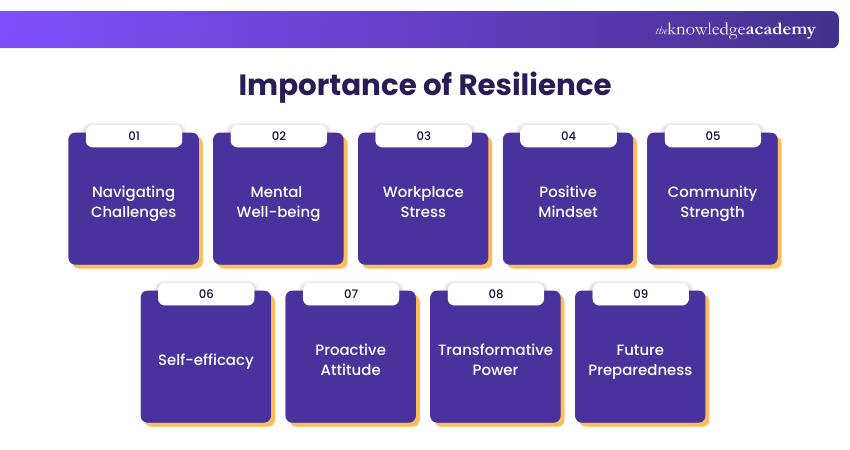
a) Navigating Challenges: Empowers people to face and overcome obstacles, setbacks, and uncertainty with strength and adaptability.
b) Mental Well-being: Promotes emotional stability and continuous motivation.
c) Workplace Stress: Prepares people to deal with workplace stress and adapt to changing conditions.
d) Positive Mindset: Promotes positive thinking, problem-solving, and determination.
e) Community Strength: Helps communities to weather crises more effectively, demonstrating collective strength.
f) Self-efficacy: Nurtures a sense of self-efficacy and confidence in personal development.
g) Proactive Attitude: Encourages a proactive and optimistic attitude towards life's challenges.
h) Transformative Power: Shapes individuals and communities to not only endure hardships but also emerge stronger and more resourceful.
i) Future Preparedness: Better equips individuals and communities for future challenges.
Unlock your peak productivity with Attention Management Training - - Sharpen your focus and supercharge your success! your focus and supercharge your success!
Types of Resilience
Resilience, a multidimensional trait, manifests in various forms, each addressing different aspects of an individual's or community's ability to adapt, overcome challenges, and thrive in the face of adversity. Let's delve into the four key types of Resilience.
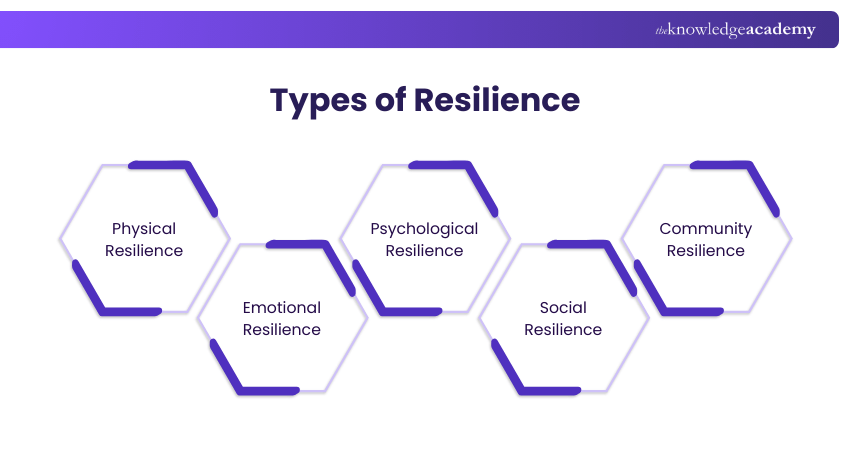
1) Physical Resilience
a) Physical Resilience is the body’s ability to endure and recover from physical challenges, illnesses, or injuries.
b) It focuses on maintaining overall health, strength, and vitality.
c) Key contributors to physical Resilience include Regular exercise, a balanced diet, adequate rest, and healthy lifestyle choices.
d) Strengthening physical Resilience enhances the ability to withstand health challenges.
e) Physical Resilience promotes overall well-being and vitality.
2) Emotional Resilience
a) Emotional Resilience is the ability to manage and recover from emotional challenges.
b) It involves recognising, understanding, and navigating one’s own emotions effectively.
c) Includes the capacity to empathise with others’ emotions.
d) Emotionally resilient individuals maintain balance during setbacks, disappointments, and conflicts.
e) Acknowledging and regulating emotions builds the strength to handle emotional complexities.
f) Emotional Resilience supports overall well-being amidst life’s challenges.
3) Psychological Resilience
a) Psychological Resilience simply means the ability to stand up face, manage and overcome life challenges.
b) It encompasses learning to develop Resilience, meaning making, and construction of successive ways of overcoming difficulties.
c) Having high psychological capital means a person learns how to cope with stress, trauma, or an extraordinary event.
d) They include problem solving, self-awareness and personal growth.
e) Cognitive behavior therapy, mindfulness, and constructing social support systems are all part of RESILIENCE.
f) Psychological Resilience is the ability of people to assertively approach and address all tasks and goals that come their way.
4) Social Resilience
a) Social resilience is the ability of groups or communities to adapt and recover from adversity
b) It relies on strong social bonds and supportive relationships
c) A resilient social network provides moral and emotional support during challenges
d) Communities with high social resilience coordinate and rebuild effectively after crises
e) Examples include neighbourhoods uniting after natural disasters or major disruptions
5) Community Resilience
a) Community Resilience focuses on a community's ability to withstand and recover from adversities, disasters, or disruptions.
b) It emphasises effective collaboration, communication, and resource utilisation within the community.
c) Key factors influencing community Resilience include social cohesion, disaster preparedness, and supportive community structures.
d) Community Resilience requires active community engagement, inclusive decision-making, fostering a sense of unity and shared responsibility.
Enhance your Emotional Intelligence skills with our Emotional Intelligence Training and excel!
6 Signs of Resilience in Life
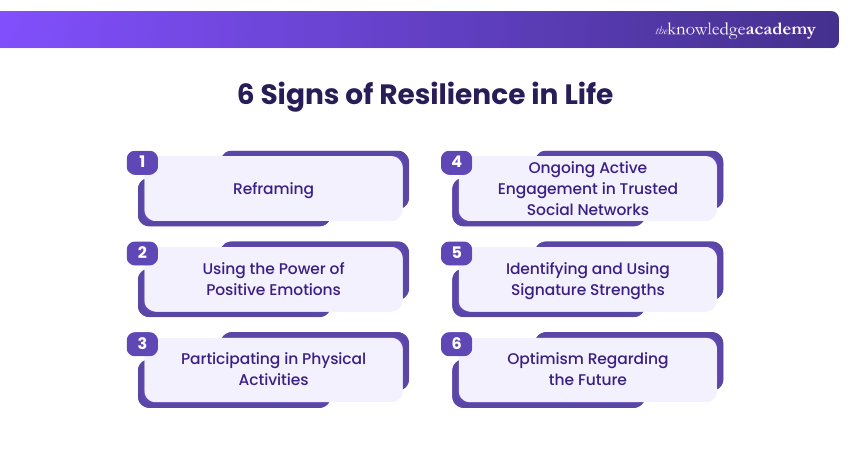
Resilience research recognises each of the following as both facilitators and indicators of Resilience in individuals:
a) Adaptability: Resilient individuals demonstrate high adaptability, embracing change and adjusting their mindset to navigate new circumstances. They view challenges as opportunities for learning and growth, fostering flexibility in their approach to life's uncertainties.
b) Positive Outlook: Maintaining a positive outlook in challenging situations is a hallmark of Resilience. Resilient individuals focus on solutions rather than dwelling on problems, cultivating optimism that acts as a driving force to overcome setbacks and persevere through difficulties.
c) Problem-solving Skills: Resilience involves effective problem-solving. Individuals with resilient behaviours approach challenges analytically, breaking down complex issues into manageable components. This proactive problem-solving mindset enables them to find solutions and take constructive action.
d) Self-reflection: Resilient individuals self-reflect, gaining insight into their emotions, thoughts, and behaviours. This reflective practice enhances self-awareness, allowing them to understand their reactions to adversity better and positively adjust their coping strategies.
e) Social Support Utilisation: Seeking and leveraging social support is a resilient behaviour. Resilient individuals recognise the importance of connections and actively seek support from friends, family, or community networks. Building and maintaining strong social ties contribute significantly to emotional well-being during challenging times.
f) Emotional Regulation: Resilient individuals exhibit effective emotional regulation, acknowledging and managing their emotions constructively. They avoid being overwhelmed by negative emotions, employing strategies like mindfulness, deep breathing, or other relaxation techniques to maintain emotional balance.
g) Maintaining a Sense of Purpose: Resilient behaviours often involve maintaining a sense of purpose and direction in life. This overarching goal provides motivation and Resilience during challenging times, serving as a guiding force that helps individuals navigate difficulties with determination and focus.
h) Coping Through Creativity: Creativity is a powerful form of Resilience. Engaging in creative pursuits, such as art, writing, or music, allows individuals to express emotions, find solace, and channel their energy into constructive outlets during challenging periods.
Unlock your full potential with our Personal Development Training and become the best version of yourself today.
Various Examples of Resilient Behaviours
Resilient behaviours encompass a range of responses and coping strategies that individuals exhibit in the face of adversity. These behaviours enable individuals to navigate challenges and contribute to personal growth and emotional well-being. Here are various examples of resilient behaviours:
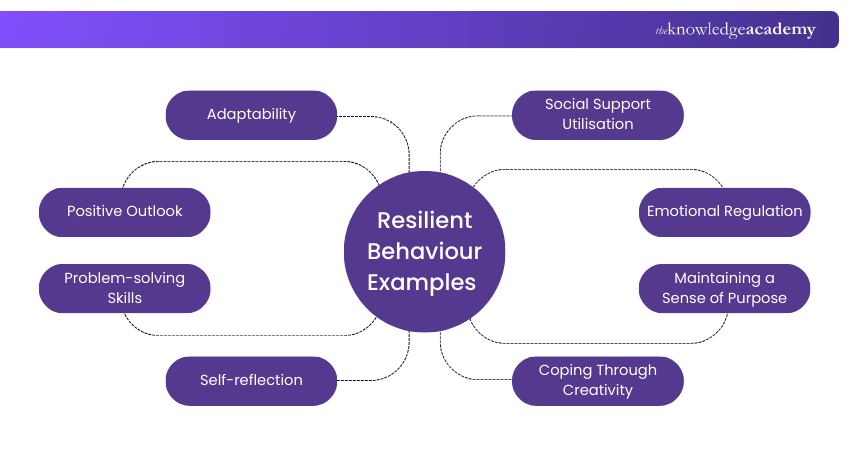
a) Adaptability: Resilient individuals who experience change learn to adapt because they see obstacles as chances to develop themselves.
b) Positive Outlook: Their solution-focused optimism enables them to overcome obstacles that result in their success.
c) Problem-solving Skills: They create a plan to handle difficulties by dividing the problem into smaller parts, which they will handle through their work.
d) Self-reflection: They use thought and emotional examination to achieve better self-understanding and the capacity to deal with different situations.
e) Social Support Utilisation: They use their strength as emotional protection by getting support from other people whom they choose to spend time with.
f) Emotional Regulation: They handle tough emotions by using healthy methods, which help them maintain emotional equilibrium.
g) Maintaining a Sense of Purpose: People who possess a strong purpose keep their focus and determination during difficult times.
h) Coping Through Creativity: They use artistic activities, which include art and writing, to handle their feelings and achieve efficient emotional management.
Unlock peace of mind and boost productivity with our Stress Management Training – join us today to regain control over your life!
How to Build Resilience
Building resilience involves intentional practices which help you develop strength for dealing with stress and handling life challenges. Positive psychology divides these strategies into different groups which help people maintain mental health and develop long-term resilience.
Positive Psychology Intervention
1) Active Interventions
Active interventions require you to do physical activities while you decrease your unhealthy habits which simultaneously build your ability to handle stress together with adverse situations. People who exercise regularly show increased mental and physical durability.
2) Calming Interventions
Calming interventions use mindfulness together with deep breathing and relaxed breathing techniques which include mindful walking and yoga to support emotional control while decreasing stress reactions. The techniques will help you maintain stability throughout challenging times.
3) Identity Interventions
Identity interventions teach you to recognise your personal strengths which you should apply more frequently because this practice will increase your self-assurance and vitality while you manage your difficulties. The evaluation tools which include values and strengths assessments help individuals achieve their personal development objectives.
4) Optimising Interventions
Optimising interventions require you to define your ideal identity while you choose your life objectives which should match your fundamental values because this process will create hope together with optimism and purpose which will help you withstand stress.
What Are the 7 ‘Cs' of Resilience?
The 7 'Cs' of Resilience are a framework designed to help individuals, especially young people, develop Resilience. This concept was developed by Dr. Kenneth Ginsburg, a Paediatrician specialising in adolescent medicine. The 7 'Cs' include:
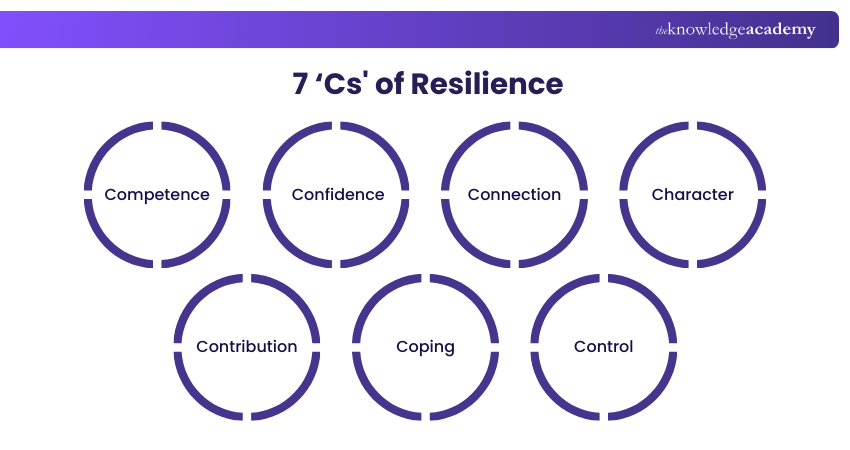
a) Competence: Resilience develops through the combination of various skills together with a mindset that encourages personal development which people achieve by learning and facing difficult situations.
b) Confidence: Confidence empowers resilience by strengthening self-belief in oneself and considering challenges as opportunities for growth.
c) Connection: Supportive relationships help people build resilience through their capacity to deliver both empathetic support and different viewpoints and practical methods for dealing with stress.
d) Character: Strong ethics and integrity create resilience by helping people make honest, empathetic decisions in challenging situations. Self-reflection and acting in line with personal values help sustain resilience despite obstacles.
e) Contribution: People who have a clear purpose together with the desire to create positive changes in the world show higher levels of resilience. The process of making important contributions to others brings back both focus and energy to tackle upcoming difficulties.
f) Coping: Coping strategies serve as essential elements that enable people to develop resilience through their ability to handle stress and overcome challenges. The activities of exercise, mindfulness, writing, counselling, and soothing activities work together to enhance both emotional and mental strength.
g) Control: Resilience increases when people concentrate on their controllable elements while letting go of everything that lies beyond their control. The process of taking ownership for our decisions and actions enables us to face obstacles with greater assurance.
Achieve your dreams with our Motivation and Goal Setting Training – Register now and succeed!
Top 10 Resilience Skills
Resilience is not merely an inherent trait; it's a set of skills that can be cultivated and honed over time. These skills empower individuals to navigate challenges, bounce back from setbacks, and thrive amidst adversity. Here are the top eight Resilience skills that contribute to building a robust and adaptable mindset:
a) Positive Thinking: The positive mindset enables people to view challenges as chances for growth while they work on finding solutions to their problems. The outlook creates an atmosphere which produces optimism and leads to positive reactions when people face setbacks.
b) Emotional Regulation: Emotionally resilient individuals recognise and manage their emotions, allowing them to handle stress, cope with disappointment, and stay balanced during difficult situations.
c) Adaptability: The ability to adapt to new situations serves as a fundamental component of resilience because it enables people to handle unexpected changes. The process enables teams to create innovative solutions while they navigate through unpredictable circumstances.
d) Problem-solving: Resilient individuals approach problem-solving challenges through their ability to break down problems into smaller components. The skills that they possess enable them to develop successful results while keeping their work under control.
e) Self-compassion: Self-compassion requires people to show themselves kindness during their difficult moments. Resilient individuals accept their imperfections, learn from mistakes, and avoid harsh self‑criticism.
f) Social Connection: Strong social connections support resilience by offering encouragement, belonging, and emotional support. People who face challenging times can turn to their friends and family and community members for support.
g) Mindfulness and Relaxation: Resilient individuals manage stress through mindfulness and relaxation which leads to better mental health. The practice of mindfulness helps people stay aware of their current surroundings while it decreases their anxiety and regret.
h) Goal Setting: Setting achievable objectives helps people develop resilience skills because it gives them a clear purpose and a defined path to follow. The process of dividing major challenges into smaller tasks allows people to advance their work while they deal with their various hurdles.
i) Effective Communication: Effective communication means clearly and assertively expressing your needs and feelings while also actively listening to others.
j) Effective Copying Strategies: The process of stress management becomes more effective through the use of healthy coping strategies which include positive self-talk, visualisation, exercise, goal setting, social support, mindfulness, and relaxation techniques.
Unlock peace of mind and boost productivity with our Stress Management Course – Join us today to regain control over your life!
Common Myths About Resilience
People frequently misunderstand resilience, but the process of debunking its myths will reveal its authentic definition, which describes how people overcome difficulties to adapt and develop.
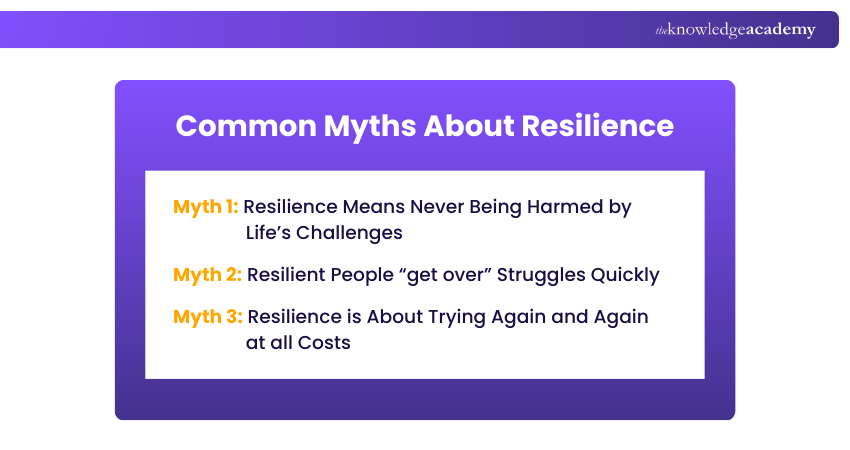
a) Myth 1: Resilience Means Never Being Harmed by Life’s Challenges.
True resilience provides people with protection against their upcoming challenges. The process of dealing with difficult situations requires people to confront their challenges while they maintain their progress.
b) Myth 2: Resilient People “get over” Struggles Quickly.
People face difficult times in different ways. He may be silent for a month, but he has been thinking about the incident every day.
c) Myth 3: Resilience is About Trying Again and Again at all Costs.
The essential quality of resilience does not depend on persistent behavior. The process requires one to identify when their current method fails and to start searching for alternative solutions.
These myths present false information, which prevents people from understanding the true nature of resilience, such as maintaining flexible abilities to handle the disorderly aspects of life while developing skills through both success and failure.
Conclusion
Learning What is Resilience indicates that it is not about avoiding difficulty, but learning how to adapt and grow through it. By building the right skills, mindset, and support systems, resilience becomes a strength anyone can develop. With consistent effort, challenges can become opportunities for lasting personal growth.
Upgrade your academic skills and writing precision with Academic Writing Course today!
Frequently Asked Questions
What is the Difference Between Resilience and Mental Toughness?

The definition of resilience describes how people can quickly overcome their challenges. Mental toughness provides people with two benefits: self-assurance and an active, optimistic outlook that helps them achieve success during difficult times. Theoutperformer.co.
How Does Resilience Help in Career Growth?
The ability to recover from setbacks enables you to handle changing situations while acquiring necessary skills which will help you remain employed. The program equips you to handle obstacles which will allow you to advance your career through better self-presentation and upcoming prospects.
What are the Other Resources and Offers Provided by The Knowledge Academy?
The Knowledge Academy takes global learning to new heights, offering over 3,000+ online courses across 490+ locations in 190+ countries. This expansive reach ensures accessibility and convenience for learners worldwide.
Alongside our diverse Online Course Catalogue, encompassing 19 major categories, we go the extra mile by providing a plethora of free educational Online Resources like Blogs, eBooks, Interview Questions and Videos. Tailoring learning experiences further, professionals can unlock greater value through a wide range of special discounts, seasonal deals, and Exclusive Offers.
What is The Knowledge Pass, and How Does it Work?
The Knowledge Academy’s Knowledge Pass, a prepaid voucher, adds another layer of flexibility, allowing course bookings over a 12-month period. Join us on a journey where education knows no bounds.
What are the Related Courses and Blogs Provided by The Knowledge Academy?
The Knowledge Academy offers various Personal Development Courses, including the Time Management Training, Attention Management Training, and Dealing With Difficult People Course. These courses cater to different skill levels, providing comprehensive insights into Anger Management.
Our Business Skills Blogs cover a range of topics related to What is Resilience, offering valuable resources, best practices, and industry insights. Whether you are a beginner or looking to advance your Business skills, The Knowledge Academy's diverse courses and informative blogs have got you covered.

The Knowledge Academy


Global Training Provider
The Knowledge Academy is a world-leading provider of professional training courses, offering globally recognised qualifications across a wide range of subjects. With expert trainers, up-to-date course material, and flexible learning options, we aim to empower professionals and organisations to achieve their goals through continuous learning.


 If you wish to make any changes to your course, please


