


 Top Rated Course

We may not have the course you’re looking for. If you enquire or give us a call on +357 26030221 and speak to our training experts, we may still be able to help with your training requirements.
Definition of Done Scrum Meaning Criteria and Importance
The Knowledge Academy 03 April 2026Definition of Done in Scrum: A key Agile concept ensuring work is truly complete. Discover its importance and benefits and learn how to apply it within your team. This shared understanding helps Scrum teams deliver high-quality increments, avoid misunderstandings, and maintain consistent standards across sprints.

Training Outcomes Within Your Budget!
We ensure quality, budget-alignment, and timely delivery by our expert instructors.
Table of Contents

Have you ever finished a task only to realise that it wasn't really done? In Scrum, the Definition of Done (DoD) clears up any such confusing annoyances. It's the standard that ensures every piece of work meets agreed-upon quality levels before being called complete. Without this clarity, teams can drift, deadlines slip away, and quality suffers. However, with a strong DoD in place, every sprint ends in predictable and reliable success. This blog offers a full overview of the Definition of Done in Scrum, why it matters and how it supports Agile success. So read on, keep your team sharp, and keep your projects flying high!
Table of Contents
1) What is the Definition of Done?
2) Steps to Creating a Definition of Done
3) Why is the Definition of Done Important?
4) Definition of Done (DoD) Examples
5) Conclusion
What is the Definition of Done?
The Definition of Done (DoD) in Scrum is a clear and shared agreement within the Scrum Team on what it means for a product backlog item to be complete. It includes all necessary activities such as coding, testing, documentation, and review that must be finished before work can be considered.
Having a well-defined DoD in Scrum ensures that all team members follow the same quality standards and nothing is left incomplete. It promotes transparency, reduces misunderstandings, and ensures each increment is truly usable and potentially releasable at the end of the Sprint.

Steps to Creating a Definition of Done
Follow these key steps to build a clear, practical, and team-aligned Definition of Done for your Scrum project.

1) Work With the Right Team
Creating a Definition of Done starts with involving the right people. Include product owners, Scrum masters, developers, testers, product managers, sponsors, and other key stakeholders. Each team member contributes valuable insights from their area of expertise, helping to ensure the DoD is practical, inclusive, and aligned with the project’s goals.
Missing out on the right voices can lead to gaps in the criteria, which may affect product quality. A well-rounded team helps create a shared understanding of what “done” means, making sure that everyone involved is on the same page from the start.
2) Establish the Criteria
The next step is defining the specific criteria that indicate when work is truly complete. These should be clear, measurable, and focused on delivering customer value. For example, instead of stating “All code tested,” a better approach is “All code thoroughly tested via unit, integration, and end-to-end tests.”
It’s important that these criteria are both realistic and relevant to the goals of the product. The DoD should reflect not just technical standards but also end-user needs, such as documentation being easy to understand and up to date for customer use.
3) Build a Completion Checklist
Whether for a major feature or a small bug fix, turning your Definition of Done into a checklist ensures consistency. A completion checklist helps team members verify that all essential tasks, like writing tests, updating documentation, or peer reviews which are completed before marking work as done.
Even for smaller assignments, this checklist can maintain a standard of quality across all deliverables. It also serves as a guide to prevent critical steps from being overlooked, helping the team produce reliable, ready-to-release work.
4) Assign Acceptance Criteria to User Stories
While the Definition of Done applies to the overall increment, acceptance criteria apply to individual user stories. These criteria define what needs to be true for a story to be accepted by the customer, such as how a feature should behave or appear to users.
Acceptance criteria are often detailed and tailored to each story. For example, for a search function, the criteria might include where the search field is placed and what happens when the search button is clicked. These helps ensure features work as intended and meet customer expectations.
5) Revise and Update the DoD
The Definition of Done is not fixed. As teams uncover bugs or face challenges, the DoD should evolve to address new quality standards and prevent recurring issues. Regularly reviewing and updating the DoD ensures it stays aligned with team learnings and project needs.
Use sprint reviews or backlog refinement sessions as opportunities to revisit the DoD. Encouraging team input and adjusting the criteria as required helps the DoD remain realistic, comprehensive, and relevant throughout the project lifecycle.
Simplify sprint planning and backlog grooming with our Scrum for Teams Course today!
Why is the Definition of Done Important?
A DoD is important for delivering a quality product that customers want because it clarifies when an item can be marked ready to be included in a product increment. A well-crafted DoD delivers the following benefits:
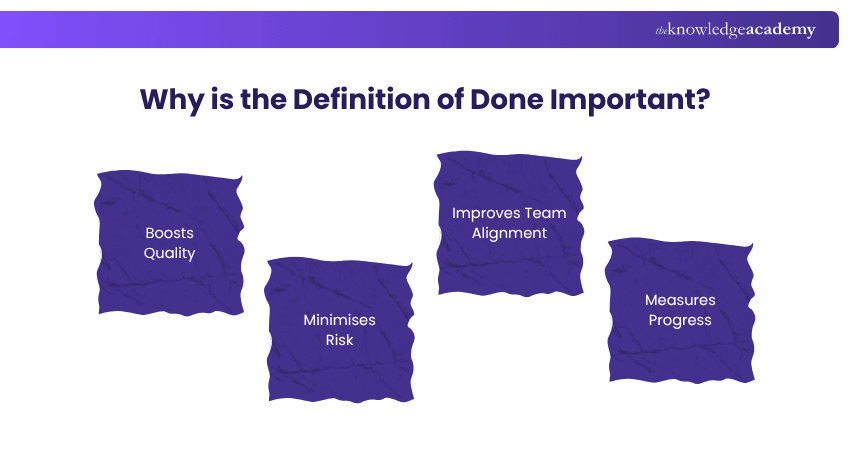
Boosts Quality
a) The DoD ensures every deliverable meets a set quality standard before completion.
b) It defines what the finished work looks like by covering code quality, design specifications, performance metrics, etc.
c) The DoD prevents any progression of work that does not meet necessary standards.
d) It elevates the overall quality of the final product.
Minimises Risk
a) Incorporating Risk Management into the Definition of Done reduces potential issues before they become serious problems.
b) Early risk identification safeguards the project from delays and cost overruns.
c) Following the DoD reduces the risk of rework by clearly defining completion criteria.
d) Clear criteria help you ensure that quality is maintained at every project stage.
Embrace Scrum and keep up the spirit of agility in every project you do! Sign up for our Managing Agile Projects with Scrum Course now!
Improves Team Alignment
a) The DoD acts as a foundational communication tool for teams and stakeholders.
b) It aligns everyone to a common understanding of project goals and standards.
c) By clarifying expectations, DOD reduces the number of interpretations of tasks and quality.
d) A shared definition of “done” helps teams stay focused on customer requirements.

Measures Progress
a) A clear Definition of Done helps your team track the number of product increments meeting the "done" criteria.
b) Scrum metrics, such as velocity, measure how many completed increments a person delivers in a set timeframe.
c) A well-defined DoD makes it easier to measure project progress accurately.
d) Predefined completion criteria help project managers and teams track advancements more reliably.
e) As a result, it enables transparent and straightforward status updates to stakeholders.
Sign up for our Certified Artificial Intelligence for Scrum Master Training now!
Definition of Done (DoD) Examples
In Scrum, the Definition of Done is a crucial agreement within the Scrum Team that outlines what it means for a product backlog item or increment to be considered complete. It ensures that every piece of work meets the agreed-upon standards before it can be released or presented as done. A strong DoD helps maintain transparency, improve quality, and align team expectations throughout the Sprint.
Below are some typical examples of DoD items used by Scrum teams:
1) Code is written, peer-reviewed, and merged into the main branch: Ensures collaboration and code quality.
2) All unit, integration, and end-to-end tests are passed: Validates that the feature works correctly and does not break existing functionality.
3) Code is deployed to the staging or testing environment: The increment is available for final validation in a controlled setting.
4) All necessary documentation is complete and updated: Includes technical, user, and release documentation as needed.
5) Work is reviewed and accepted by the Product Owner: Confirms that the feature meets functional expectations.
6) No critical bugs remain open: Ensures the increment is stable and ready for release.
7) Security, compliance, and performance checks are completed: Confirms the work meets organisational and regulatory standards.
What are the Three Purposes of the Definition of Done?
The Definition of Done ensures consistent quality, creates a shared understanding of completion, and helps deliver potentially shippable increments. It aligns team expectations, reduces rework, and supports transparency across the development lifecycle.
Who is Responsible for Creating the Definition of Done?
The Scrum Team as a whole is responsible for creating the Definition of Done. This includes developers, the Product Owner, and the Scrum Master, all of whom collaborate to ensure the DoD reflects shared standards and expectations.
Conclusion
The Definition of Done in Scrum is more than just a checklist; it's a foundational principle that ensures all team members have a clear and shared understanding of what it means for work to be truly complete. This understanding is crucial for maintaining high quality standards and efficiency throughout the project lifecycle. Following this practice can significantly enhance the success and sustainability of projects across any domain.
Showcase your leadership and eye for detail in the field of Product Development! Sign up for our Scrum Product Owner Certification now!
Frequently Asked Questions
Who is Responsible for Creating the DOD in Scrum?

Typically, a DoD is created by the development team, led by the Scrum Master. However, they must seek input from testers, product owners and other stakeholders.
What is the Difference Between the Definition of Done and Acceptance Criteria?
The DoD is a set of high-level criteria to determine if a product increment is complete and is applicable to all product increments. Conversely, acceptance criteria are low-level conditions applicable only to specific user stories or features. It defines whether a user story is acceptable to a customer.
What are the Other Resources and Offers Provided by The Knowledge Academy?
The Knowledge Academy takes global learning to new heights, offering over 3,000 online courses across 490+ locations in 190+ countries. This expansive reach ensures accessibility and convenience for learners worldwide.
Alongside our diverse Online Course Catalogue, encompassing 19 major categories, we go the extra mile by providing a plethora of free educational Online Resources like Blogs, eBooks, Interview Questions and Videos. Tailoring learning experiences further, professionals can unlock greater value through a wide range of special discounts, seasonal deals, and Exclusive Offers.
What is the Knowledge Pass, and how Does it Work?
The Knowledge Academy’s Knowledge Pass, a prepaid voucher, adds another layer of flexibility, allowing course bookings over a 12-month period. Join us on a journey where education knows no bounds.
What are the Related Courses and Blogs Provided by The Knowledge Academy?
The Knowledge Academy offers various Scrum Certification Training, including Scrum Master Certification Course, Scrum Product Owner Training and Scrum Developer Training. These courses cater to different skill levels, providing comprehensive insights into Agile Project Management With Scrum.
Our Project Management Blogs cover a range of topics related to Scrum, offering valuable resources, best practices, and industry insights. Whether you are a beginner or looking to advance your Project Management skills, The Knowledge Academy's diverse courses and informative blogs have you covered.

The Knowledge Academy


Global Training Provider
The Knowledge Academy is a world-leading provider of professional training courses, offering globally recognised qualifications across a wide range of subjects. With expert trainers, up-to-date course material, and flexible learning options, we aim to empower professionals and organisations to achieve their goals through continuous learning.

Upcoming Project Management Resources Batches & Dates
Date
 Scrum Master Certification
Scrum Master Certification
Thu 25th Jun 2026
Scrum Master Certification
Thu 9th Jul 2026
Scrum Master Certification
Thu 23rd Jul 2026
Scrum Master Certification
Thu 6th Aug 2026
Scrum Master Certification
Thu 20th Aug 2026
Scrum Master Certification
Thu 3rd Sep 2026
Scrum Master Certification
Thu 17th Sep 2026
Scrum Master Certification
Thu 1st Oct 2026
Scrum Master Certification
Thu 15th Oct 2026
Scrum Master Certification
Thu 29th Oct 2026
Scrum Master Certification
Thu 12th Nov 2026
Scrum Master Certification
Thu 26th Nov 2026
Scrum Master Certification
Thu 10th Dec 2026
Scrum Master Certification
Wed 23rd Dec 2026

 If you wish to make any changes to your course, please


