


 Top Rated Course


We may not have the course you’re looking for. If you enquire or give us a call on +357 26030221 and speak to our training experts, we may still be able to help with your training requirements.
Data Journalism Explained: Definition, Process, and Tools
The Knowledge Academy 02 March 2026Data journalism uses data analysis and digital tools to uncover insights and explain complex news stories through clear charts and interactive visuals. It brings depth, accuracy and transparency to reporting, helping audiences understand what is happening, why it matters, and how it affects them directly.

Training Outcomes Within Your Budget!
We ensure quality, budget-alignment, and timely delivery by our expert instructors.
Table of Contents

From public spending to social trends, the world is recorded in numbers. These figures hold meaning, but only when they are examined and explained. Data Journalism uncovers these stories, turning information into insight and helping readers see the truth behind the headlines.
In this blog, we cover the definition of Data Journalism, its process, key tools, and its role in modern reporting. You will gain a clear understanding of how data is used to uncover stories, support evidence-based reporting, and reshape the way news is created and shared.
Table of Contents
1) What is Data Journalism?
2)Why is Data Journalism important?
3) Key Elements of Data Journalism
4) Process of Data Journalism
5) Data Journalism vs Traditional Journalism
6) Essential Skills for Data Journalism
7) Benefits of Data Journalism
8) Impact of Data Journalism
9) Challenges in Data Journalism
10) Tools Used in Data Journalism
11) Future of Data Journalism
Conclusion
What is Data Journalism?
Data Journalism is a new form of reporting that integrates some of the traditional journalistic methods with data analysis to allow reporting of stories to be discovered, verified and explained using numbers. It transforms raw datasets into meaningful narratives, helping audiences understand complex issues through evidence-backed storytelling and visual clarity.
At its core, Data Journalism involves collecting, cleaning, analysing and interpreting large volumes of information to uncover patterns, trends and insights that may not be visible through conventional reporting. The approach is common to various industries such as sports, politics, health and economics where statistics show more information behind the scenes of events and performance.
Journalists working with data rely on tools such as spreadsheets, statistical software, and visualisation platforms to turn complex figures into accessible formats like charts, maps, and interactive graphics. These visuals make information easier to grasp, allowing readers to explore stories rather than simply consume them.
In a digital world shaped by constant data generation, Data Journalism plays a vital role in transparency and accountability. It allows journalists to cut through the information clutter, confirm claims with evidence and deliver reports that are interesting and credible. However, basing narratives on data makes journalism more accurate, significant and close to contemporary audience.

Why is Data Journalism important?
Data Journalism plays a key role in pushing scientific findings into the spotlight of a story, so that they can be consumed in the form of a static images, interactive functionalities or other types of analysis within a breaking news story.
The media world is transforming, with traditional outlets no longer enjoying exclusive control over information dissemination. Days of depending on the printing press to get news are long gone. Nowadays, news is produced on the spot by a wide variety of sources, traversing an extensive web of social networks and it is subject to ranking, commenting, and in many instances, rejecting.
This highlights the importance of Data Journalism. The capacity to collect, filter and present information that one cannot perceive directly is becoming valuable. In today's global economy, every sip of orange juice or cup of coffee involves unseen connections. Data is the language of this complex system, in which seemingly insignificant pieces of information can be of great value when perceived through the appropriate prism. Data Journalism, thus, cannot be substituted in the process of uncovering the intricacies of our globalized world.
Key Elements of Data Journalism
Data Journalism is shaped by a set of essential elements that help turn raw information into clear, meaningful stories. All the elements facilitate the process of data to insight in order to make sure that figures become stories that people are able to comprehend and believe.
1) Data Collection and Sourcing: All stories based on data have to start with quality information. The sources used by journalists include data on public records, surveys, official reports, databases, and open data portals. The validity of such sources has a direct impact on the validity of the finished story.
2) Data Cleaning and Organisation: The majority of data comes in a imperfect form. It can contain values that are missing, errors or duplicate. Organising and cleaning the data makes sure that the data is consistent and prepared to be used. This is a process that makes disorganized information organized.
3) Analysis and Interpretation: Journalists process data with the help of spreadsheets and simple statistics. This procedure assists in revealing the trends, patterns, and odd outcomes. It is where the concealed histories start uncovering.
4) Visualisation and Presentation: Complex information is simplified using Charts, maps and infographics. Visuals enable readers to observe relationships, comparisons and changes visually making it easier to understand and read through.
5) Narrative and Context: Numbers alone do not explain meaning. Journalistic writing includes background, relevance and the human view. This framing demonstrates the importance of the data and its impact on actual individuals.
6) Interactivity and Reader Engagement: There are numerous data stories where the readers can interact with the information by themselves. Interactive tools like filters and maps assist the audience to identify with the data and develop trust in what they observe.
When combined, these factors enable journalists to discover significant stories, deliver information in an understandable way and provide accurate, engaging, and relevant reporting in a world dominated by data.
Process of Data Journalism
Get the data
Journalists gather information based on the public records, requests, leaks, web scraping, or documents. When there is no useful dataset, they construct it on the basis of available sources.
Understand the nature of the data
This step will include determining who prepared the data, how it was prepared, and what it describes, and its limitations and completeness.
Verify the data
Data is checked for accuracy and authenticity by cross-referencing with other sources, consulting experts, and contacting named individuals or organisations.
Document and safeguard the data
Every procedure and modification is documented, original documents are maintained, and access is monitored in order to safeguard confidential information.
Analyse the data for insights
Journalists investigate patterns, trends and anomalies through understandable and repeatable means to establish significant stories.
Plan for publication
The last step involves fact-checking, writing, legal considerations and the decision of how one can best display the data with text, graphics or an interactive version.
Data Journalism vs Traditional Journalism
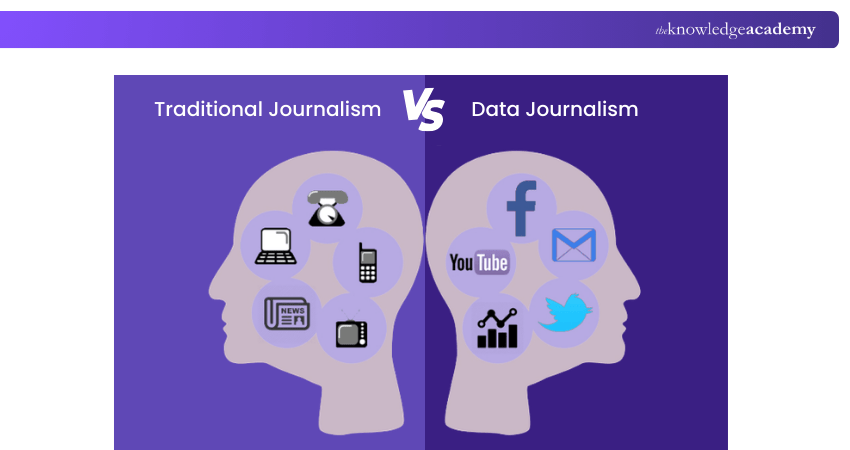
The Traditional Journalism deals with the reporting of events based on interviews, observations, and first-hand observations. It is extremely based on human sources, statements, and narrative writing to clarify what and why it has occurred. The power of this strategy is the power of narrative, the environment, and emotion.
Data Journalism on the other hand is led by the evidence in numbers. It does not usually start with an event or a quote but rather with a dataset. The journalists examine patterns, trends, and inconsistencies to reveal the stories that can not be noticed by observation alone. The plot is constructed based on the facts disclosed through data.
Whereas Traditional Journalism provides answers to questions by people, Data Journalism provides answers to questions by providing evidence. A traditional political narrative may be based on speeches and interviews, but a data-driven one could examine voting behaviour, expenditure trends or demographics to tell a more in-depth story.
Essential Skills for Data Journalism
Data Journalism is a combination of critical thought and solid reporting principles. Journalists require a combination of technical, creative and ethical skills to transform the complex datasets into narratives that not only inform but also have an impact.
Statistical Literacy
Good knowledge of statistics will enable journalists to recognize patterns, test assumptions, and misleading conclusions. It makes sure that the process of data interpretation is correct and the insights are supported by evidence and not guesses.
Data Visualisation
The visual skills enable presentation of complex information using charts, maps, and interactive graphics to make the information clear. Efficient visualisation allows the viewers to learn about trends and associations at a glance, and data becomes more familiar and enjoyable.
Programming Skills
Basic knowledge of languages such as Python, R, or SQL supports data collection, cleaning, and analysis. These skills enable journalists to work efficiently with large datasets and uncover stories that manual methods cannot reach.
Storytelling Ability
Data alone does not create impact. Journalists must shape findings into clear narratives that explain why the data matters and how it affects people. Strong storytelling turns numbers into meaningful stories.
Interdisciplinary Communication
Data projects often involve collaboration with designers, analysts, and developers. Effective Communication across disciplines ensures that insights are accurate, visuals are effective, and the final story remains coherent.
Ethics and Accuracy
Working with data requires careful handling of sensitive information, awareness of bias, and transparency about sources. Accuracy and ethical judgement protect credibility and ensure responsible reporting.
Together, these skills enable data journalists to investigate deeply, communicate clearly, and produce reporting that is both reliable and impactful.
Elevate your communication skills with our comprehensive Report Writing Training.
Benefits of Data Journalism
Data Journalism offers clear advantages for both news organisations and audiences. By grounding stories in evidence and presenting information visually, it strengthens trust, engagement, and public understanding.
Increased Credibility
Using verified data adds weight to reporting. When stories are supported by clear evidence, audiences can see where conclusions come from, making journalism more transparent and trustworthy.
Better Engagement
Interactive charts, maps, and tools invite readers to explore information themselves. This active involvement makes stories easier to understand, more memorable, and more likely to be shared.
Empowered Citizens
Accessible data helps people understand complex social, political, and economic issues. By providing clarity and context, journalists enable readers to make informed decisions and participate confidently in public life.
Expanded Reach
Data-driven stories often cross language and cultural boundaries. Visuals and universal statistics allow stories to resonate with wider audiences, helping journalism travel across regions and platforms.
Impact of Data Journalism
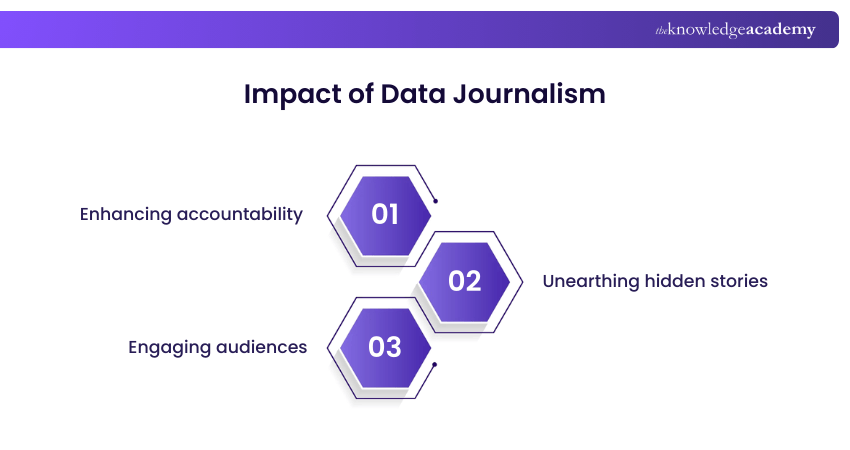
In an era where information overload and misinformation are constant challenges, Data Journalism emerges as a beacon of insight and accountability. The impact of Data Journalism goes beyond traditional reporting methods, offering a transformative approach that wields the power of data analysis to illuminate stories and shape public discourse.
Enhancing accountability
One of the most profound impacts of Data Journalism is its ability to enhance accountability. By diving into datasets and scrutinising information, Data Journalists can uncover patterns of corruption, inefficiency, and misconduct. Hard evidence presented through data-driven stories leaves little room for denial or evasion. Whether it's revealing disparities in public spending or exposing political scandals, Data Journalism serves as a powerful tool for holding institutions and individuals accountable, promoting transparency and instigating positive change.
Unearthing hidden stories
Data Journalism possesses a unique ability to unearth hidden stories that may elude traditional reporting. By analysing vast datasets, journalists can identify trends and phenomena that remain unnoticed in day-to-day news coverage. Whether it's tracking the impact of climate change through temperature records or revealing socio-economic disparities through demographic data, Data Journalism amplifies voices and narratives that might otherwise be overshadowed.
Engaging audiences
The visual impact of Data Journalism cannot be understated. Infographics, interactive visualisations, and data-driven storytelling captivate audiences in ways that raw data alone cannot achieve. By transforming complex datasets into digestible visuals, Data Journalism enables readers to understand and connect with the information on a personal level. Engaging visuals enhances comprehension and resonates with a broader spectrum of readers, ensuring that the stories told through data have a lasting impact.
The impact of Data Journalism transcends conventional reporting methods, ushering in a new era of accountability, discovery, and engagement. As Data Journalism continues to evolve, its potential to reshape public discourse, empower citizens, and challenge the status quo remains a testament to its enduring importance in the realm of modern journalism.
Transform your listening into precision: Join our Audio Transcription Masterclass today!
Challenges in Data Journalism
While Data Journalism offers powerful advantages, it also presents practical and ethical challenges. Addressing these barriers is essential to ensure accuracy, responsibility, and long-term sustainability.
Data Quality and Reliability
Poor-quality data leads to weak reporting. Journalists must examine sources carefully, check for bias, and understand limitations. Transparency about where data comes from and how it is used is critical for maintaining trust.
Privacy and Ethics
Working with data involves responsibility. Sensitive information must be protected, and individuals should not be harmed by exposure. Anonymising data and considering social impact are essential parts of ethical reporting.
Technical Skills Gap
Many journalists lack training in analysis, coding, or visual design. As data-driven reporting grows, newsrooms must invest in skill development to meet the demand for statistical, technical, and visual literacy.
Resource Constraints
Smaller organisations often face limits in time, staff, and tools. These challenges can be addressed by using open-source platforms, collaborating with universities or nonprofits, and focusing on smaller but meaningful data projects.
Despite these challenges, Data Journalism continues to grow. With the right tools, training, and ethical awareness, these barriers can be overcome, enabling stronger and more responsible reporting.
Tools Used in Data Journalism
1) Data Analytics Platforms: These tools help journalists explore large datasets, identify trends, and convert raw figures into meaningful insights that guide reporting.
2) Database Management Systems: Used to store, organise, and retrieve vast volumes of information, these systems make complex and long-term investigations manageable.
3) Data Visualisation Software: Tools such as Tableau and Power BI turn numbers into charts, maps, and dashboards, making complex information easier for audiences to understand.
4) Programming Languages: Python and R support data cleaning, automation, and advanced analysis, enabling journalists to work efficiently with large or messy datasets.
5) Content Management Systems with Embedded Analytics: These platforms integrate data and visuals directly into articles, allowing data-driven stories to be published and updated seamlessly.
Future of Data Journalism
1) Automation and AI: Intelligent tools will help journalists scan vast datasets, detect patterns, and generate basic reports, freeing time for deeper investigation, context, and storytelling.
2) Real-Time Data Reporting: Live dashboards for elections, emergencies, and global events will become standard, meeting audience expectations for instant, continuous updates.
3) Collaboration and Open Data: Cross-border and cross-discipline reporting will grow, supported by open datasets that enable richer stories and more democratic access to information.
4) Personalised News Experiences: Data-driven systems will tailor stories to readers locations and interests, presenting the same facts through relevant perspectives without compromising accuracy.
5) Immersive Data Storytelling: Technologies such as augmented and virtual reality will allow audiences to explore data in three-dimensional spaces, turning information into experiences.
While tools and formats will evolve, the purpose remains constant to inform the public, reveal truth, and hold power to account.
Unleash your storytelling potential with our Journalism Course today!
Conclusion
Data Journalism reflects how modern reporting adapts to a world shaped by constant information. By combining evidence with narrative, it transforms numbers into stories that explain reality with clarity and purpose. As this field continues to grow, journalists must balance technical capability with responsibility, ensuring accuracy, fairness, and context remain central. In an age of information overload, Data Journalism does more than inform. It builds understanding, strengthens trust, and helps create a society that can question, interpret, and engage with the world more confidently.
Elevate your skills with our comprehensive Personal Development Courses today!
Frequently Asked Questions
What Ethical Issues are Involved in Data Journalism?

Ethical issues in Data Journalism include protecting personal privacy, ensuring accuracy, and avoiding misuse or misinterpretation of data. Journalists must be transparent about sources, recognise bias in datasets, and present information responsibly to prevent harm or misleading conclusions.
What is Investigative Data Journalism?
Investigative Data Journalism uses data to uncover hidden patterns, wrongdoing, or systemic issues that are not immediately visible through traditional reporting. It involves analysing large or complex datasets to reveal evidence of corruption, inequality, or abuse, turning numbers into proof-led stories that hold power to account.
What are the Other Resources and Offers Provided by The Knowledge Academy?
The Knowledge Academy takes global learning to new heights, offering over 3,000+ online courses across 490+ locations in 190+ countries. This expansive reach ensures accessibility and convenience for learners worldwide.
Alongside our diverse Online Course Catalogue, encompassing 17 major categories, we go the extra mile by providing a plethora of free educational Online Resources like Blogs, eBooks, Interview Questions and Videos. Tailoring learning experiences further, professionals can unlock greater value through a wide range of special discounts, seasonal deals, and Exclusive Offers.
What is The Knowledge Pass, and How Does it Work?
The Knowledge Academy’s Knowledge Pass, a prepaid voucher, adds another layer of flexibility, allowing course bookings over a 12-month period. Join us on a journey where education knows no bounds.
What are related courses and blogs provided by The Knowledge Academy?
The Knowledge Academy offers various Personal Development Courses, including Journalism Course, Creative Writing Course and Customer Experience Training. These courses cater to different skill levels, providing comprehensive insights into Strategic Planning.
Our Business Skills Blogs cover a range of topics related to Earned Value Management, offering valuable resources, best practices, and industry insights. Whether you are a beginner or looking to advance your Project Management skills, The Knowledge Academy's diverse courses and informative blogs have got you covered.

The Knowledge Academy


Global Training Provider
The Knowledge Academy is a world-leading provider of professional training courses, offering globally recognised qualifications across a wide range of subjects. With expert trainers, up-to-date course material, and flexible learning options, we aim to empower professionals and organisations to achieve their goals through continuous learning.


 If you wish to make any changes to your course, please


