


 Top Rated Course

We may not have the course you’re looking for. If you enquire or give us a call on +44 1344 203999 and speak to our training experts, we may still be able to help with your training requirements.
What is Test Case? Types, Features, and Best Practices
Richard Harris 21 April 2026A Test Case is when you validate that a system or feature works as expected in the world of software testing. It’s a detailed set of steps that testers follow to check whether an application behaves correctly or not. It typically includes information such as test data, preconditions, the steps to execute, and the expected results.
Training Outcomes Within Your Budget!
We ensure quality, budget-alignment, and timely delivery by our expert instructors.
Table of Contents
Related Courses

Test Cases might seem small, just a few steps and checks but their impact is huge. They ensure that your app does what it’s supposed to every single time. It’s the checklist that keeps bugs in check, the guide for consistent testing, and the proof that quality matters.
In this blog, you can explore What is Test Cases and it supports everything from daily builds to major launches. You’ll discover different types, must-have features, and smart best practices to make your testing more efficient and effective. So, if you’re ready to turn tiny steps into high-quality software, let’s dive into the art of writing Test Cases that matter.
Table of Contents
1) What is a Test Case?
2) Why Test Cases are Important?
3) Test Cases Features
4) Types of Test Cases
5) Components of Test Case
6) Key Requirements for Writing an Effective Test Case
7) Benefits of Writing High-quality Test Cases
8) Best Practices to Write Test Cases
9) Example of Test Case
10) Test Cases vs Test Scenario
11) Conclusion
What is a Test Case?
A Test Case is a specific set of conditions, inputs, actions, and expected results designed to verify whether a particular part of a software application works correctly. It acts like a checklist for testers, guiding them step-by-step through the process of validating features, functions, and behaviours of the software.
Each Test Case is written to test one aspect, whether it’s logging in, calculating a discount, or displaying an error message. It acts like a checklist for testers, guiding them step-by-step through the process of validating features, functions, and behaviours of the software.

Why Test Cases are Important?
Test Cases may seem difficult to write, but they’re vital. Why? The reason is they ensure consistency, accuracy, and traceability in software testing. Without them, tests can become unstructured, repetitive, or worse; skipped altogether.
Here’s why Test Cases matter:
a) They help identify bugs early which saves time and money
b) Test Cases ensure test coverage, so nothing critical is missed
c) Provides a clear testing roadmap, especially for new team member
d) Improve communication between testers, developers, and stakeholders
e) Serves as documentation for future reference or audits
Test Cases Features
Test Cases share some common traits that make them both practical and powerful. Let’s explore the key features:
Regular Updates
Software evolves constantly, which means Test Cases need to evolve too. Regularly updating Test Cases ensures they stay aligned with current system behaviour. Outdated Test Cases are not just useless, but they can lead to incorrect testing results.
Clustered Data
Test Cases should use clustered or structured test data to represent various real-world scenarios. This ensures more thorough testing and helps uncover issues that may not surface with simple default inputs.
Interdependent Elements
In complex systems, Test Cases are often interconnected. One test might feed into another, and understanding those dependencies helps in planning efficient test execution and debugging when failures occur.
Dual Usage
A well-written Test Case serves a dual purpose; it guides testers and provides documentation. It helps in training new testers, preparing reports, and justifying decisions to stakeholders.
Tired of clicking the same tests over and over? Let Selenium do it for you with our Selenium Testing Framework Training now!
Types of Test Cases
Depending on the purpose, there are several types of Test Cases. Each focus on different aspects of the software. Below are the most common and important types of Test Cases used in modern software testing:
Functionality
Functionality is one of the core types of test cases in software testing. It focuses on checking whether a system or application performs its intended functions correctly, according to the requirements. It checks if the system behaves as expected.
Example: For form Submission, check form accepts input and displays success message.
Use case: Used during system testing, integration testing, or acceptance testing
Unit
Unit tests focus on individual pieces of code usually specific functions or methods. These are typically written by developers during the coding phase and are often automated.
Example: Testing a “calculate Total ()” function in an e-commerce app to ensure it returns the correct price.
Use Case: Helps catch bugs early during development, reducing the risk of errors later.
Performance
These Test Cases examine how well the software performs under different conditions. They test for speed, responsiveness, and stability.
Example: Testing how long it takes for a page to load under heavy traffic.
Use Case: Essential for applications that must support many users at once, such as online banking or e-commerce platforms.
User Interface
UI Test Cases verify that elements on the screen are displayed correctly and function as intended. This includes layouts, buttons, colours, fonts, and navigation.
Example: Checking if a “Submit” button is clickable and styled correctly on all screen sizes.
Use Case: Important for ensuring consistent and accessible User Experiences (UX).
Integration
These Test Cases verify that different modules or systems interact correctly. Integration testing ensures that when two or more units work together, the result is smooth and bug-free.
Example: Testing whether user data entered on a website is correctly saved in the database.
Use Case: Ideal for multi-module systems where interconnectivity is key.
Security
Security Test Cases check for vulnerabilities and ensure data protection. They focus on authentication, authorisation, encryption, and secure data storage.
Example: Testing if the system locks a user out after multiple failed login attempts.
Use Case: Critical for systems that handle sensitive data, such as finance, healthcare, or personal information.
Database
These Test Cases validate the back-end; specifically how data is stored, updated, and retrieved from the database.
Example: Testing if deleting a user from the front end removes their data from the database.
Use Case: Ensures data integrity, performance, and correct query handling.
Give your career a serious upgrade — Learn Selenium Immersion with C# Course today!
Regression Testing
Whenever code is updated, there’s a risk of accidentally breaking something that used to work. Regression Test Cases are designed to retest existing functionalities to ensure new changes haven’t introduced bugs.
Example: After adding a new payment method, retesting the original checkout process to confirm it still works.
Use Case: Essential for agile teams and projects with frequent releases.
User Acceptance
These are created from the end user’s perspective to ensure the system meets business requirements. UAT is typically the final step before deployment.
Example: A user tests if they can complete a full purchase journey from product selection to confirmation email.
Use Case: Conducted by business users or clients before sign-off and going live.
Usability
Usability Test Cases focus on the user experience. They check how easy, intuitive, and satisfying the application is to use.
Example: Testing how many steps a user takes to complete a task and whether they find it easy.
Use Case: Useful for improving customer satisfaction, app adoption, and overall User Experience (UX) design.
Components of Test Case
A good Test Case includes several clear and consistent components:
a) Test Case ID: A unique identifier for tracking
b) Test Description: A short summary of what’s being tested
c) Preconditions: What needs to be set up before running the test
d) Test Steps: Detailed instructions to perform the test
e) Test Data: Specific inputs used during testing
f) Expected Result: The outcome you expect if everything works
g) Actual Result: What happened (added after execution)
h) Status: Pass, Fail, or Blocked
i) Comments: Notes, screenshots, or observations
Key Requirements for Writing an Effective Test Case
Creating effective Test Cases takes more than technical knowledge. It’s about clarity, precision, and structure.
Here are some key requirements:
a) Be clear and concise and use simple language and avoid ambiguity
b) Keep it reusable and design Test Cases that can be reused for similar scenarios
c) Focus on one goal per Test Case and try not to mix multiple tests into one
d) Include all necessary details, such as Preconditions, data, and steps
e) Stick to a consistent format along with reviewing and sharing easier
f) Peer review Test Cases to catch flaws or gaps
g) Trace link Test Case requirements to ensure coverage
You already know testing-now make it faster with ours Selenium WebDriver with Python Training today!
Benefits and Challenges of High-quality Test Cases
Some of the pros of Test Cases are clear communication between QA, developers, and stakeholders. It promotes faster onboarding for new testers. Reduces rework, saving time and costs. You can do better documentation for audits or knowledge transfer. Quality Test Cases don’t just improve software but improve teams, processes, and customer trust.
Despite their value, writing and managing Test Cases comes with its own set of challenges, such as Unclear Requirements and poor communication. Other challenges are time Pressure, testing Issues and incomplete Documentation
Lack of historical test data or traceability makes it hard to see what’s already been tested. These leads to redundant or missed tests.

Best Practices to Write Test Cases
To get the most out of your testing process, follow these best practices:
a) Start early: Write Test Cases as soon as requirements are ready
b) Collaborate: Get input from developers and product owners
c) Use Templates: Standardised formats keep things organised
d) Automate Where Possible: Especially for repetitive or regression tests
e) Review And Revise: Test Cases should evolve with the product
f) Keep It User-focused: Think like the end user
g) Document Outcomes: Record what passed, what failed, and why
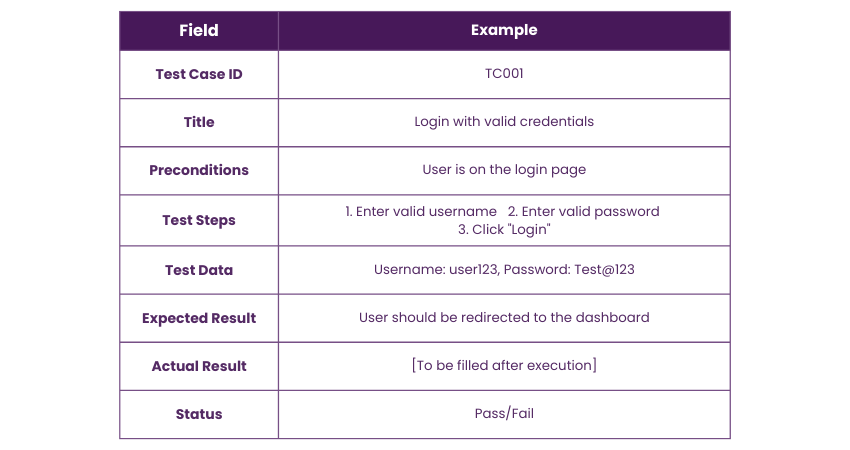
Example of Test Case
Let us understand Test Cases better with the below example:
Test Cases vs Test Scenario
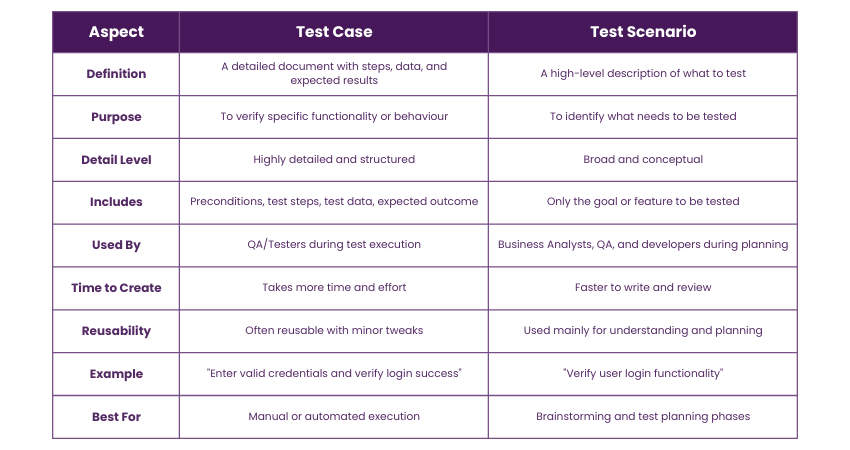
It’s easy to confuse a Test Case with a test scenario but they’re not the same. A Test Case is detailed and includes exact steps, data, and expected results whereas, a test scenario is high-level and outlines what to test, not how to test it.
Conclusion
Test Cases are the foundation of reliable, structured, and scalable testing. They turn complex systems into manageable parts and give testers the clarity they need to ensure software quality. In 2025’s fast-paced development world, high-quality Test Cases aren’t just helpful but essential.
Whether you’re a tester, developer, or team lead, understanding how to write, manage, and optimise Test Cases can elevate your projects and your team. With the right practices, tools, and mindset, your testing can go from reactive to proactive.
Frequently Asked Questions
What Is the Purpose of a Test Case?

The purpose of a Test Case is to check if a part of the software works as expected. It gives clear steps, input, and expected results so testers can find bugs, confirm features, and ensure quality. Test Cases help make testing repeatable, reliable, and easy to track.
What are Requirements in Test Cases?
Requirements in Test Cases are the specific features that the software is supposed to have. They guide what the Test Case should check. Testers use these requirements to make sure each part of the software does what it’s meant to do, based on what the client or project asked for.
What are the Other Resources and Offers Provided by The Knowledge Academy?
The Knowledge Academy takes global learning to new heights, offering over 3,000+ online courses across 490+ locations in 190+ countries. This expansive reach ensures accessibility and convenience for learners worldwide.
Alongside our diverse Online Course Catalogue, encompassing 17 major categories, we go the extra mile by providing a plethora of free educational Online Resources like Blogs, eBooks, Interview Questions and Videos. Tailoring learning experiences further, professionals can unlock greater value through a wide range of special discounts, seasonal deals, and Exclusive Offers.
What is The Knowledge Pass, and How Does it Work?
The Knowledge Academy’s Knowledge Pass, a prepaid voucher, adds another layer of flexibility, allowing course bookings over a 12-month period. Join us on a journey where education knows no bounds.
What are the Related Courses and Blogs Provided by The Knowledge Academy?
The Knowledge Academy offers various Selenium Training , including the Selenium WebDriver with Python Training, Selenium Immersion with C# and the Selenium Testing Framework Training. These courses cater to different skill levels, providing comprehensive insights into Web Browser.
Our Programming & DevOps Blogs cover a range of topics related to Test Case, offering valuable resources, best practices, and industry insights. Whether you are a beginner or looking to advance your programming skills, The Knowledge Academy's diverse courses and informative blogs have got you covered.

Richard Harris


Senior Full Stack Developer and Technology Educator
Richard Harris is a highly experienced full-stack developer with deep expertise in both frontend and backend technologies. Over his 12-year career, he has built scalable web applications for startups, enterprises and government organisations. Richard’s writing combines technical depth with clear explanations, ideal for developers looking to grow in modern frameworks and tools.

Upcoming Batches & Dates
Date


 If you wish to make any changes to your course, please


