


 Top Rated Course

We may not have the course you’re looking for. If you enquire or give us a call on +44 1344 203999 and speak to our training experts, we may still be able to help with your training requirements.
What is Digital Marketing? Types, Benefits & Strategy
James Smith 09 April 2026Digital Marketing uses online channels like websites, social media, and search engines to promote products, boost brand awareness, and drive traffic. It enables businesses to reach targeted audiences with personalised content and measurable results. By analysing data and user behaviour, marketers can refine their strategies.

Training Outcomes Within Your Budget!
We ensure quality, budget-alignment, and timely delivery by our expert instructors.
Table of Contents
Picture this: you’ve got something amazing to share. So, instead of shouting into the void, why not learn What is Digital Marketing? This will hand you the mic and point you to the crowd already listening. It’s smart, fast, and always evolving. From catchy posts to clever ads, it’s how brands stay in the spotlight.
Therefore, get started into learning What is Digital Marketing. Starting from this moment itself, you will get to know all about it. Added knowledge on its types, how it operates, and everything will be included. This will be super helpful for you, especially if you are new in this field. Get started now!
Table of Contents
1) What is Digital Marketing?
2) How Digital Marketing Works?
3) Why is Digital Marketing Important?
4) Types of Digital Marketing
5) Benefits of Digital Marketing
6) How to Create a Digital Marketing Strategy?
7) What is the Easiest Type of Digital Marketing?
8) What are the 7 Cs of Digital Marketing?
9) Conclusion
What is Digital Marketing?
Digital Marketing promotes various brands using the magic of the internet. It reaches people through various mediums. This can include websites, social media, and emails. It can also mean search engines. The goal is to grab attention, spark interest, and drive action. It’s flexible, fast, and focused on real results. Additionally, it also helps businesses speak directly to the right audience. Every click, share, and search tell a story.
How Digital Marketing Works?
Now that you have understood about Digital Marketing, it’s time you explore its workings too. So, go through the points below to know on how it operates:
a) Setting Clear Goals: Every campaign is known to start with a purpose. This can mean more sales, or traffic. It can also mean a great level of awareness.
b) Knowing the Audience: Marketers study habits, interests, and behaviour extensively. All of this is good as to reach the right crowd.
c) Choosing the Right Channels: Different platforms are known to suit a lot of different messages. This can mean social media, email, or search.
d) Creating Strong Content: Words, images, and videos are effectively crafted to grab attention. It also helps in building trust.
e) Using Targeted Ads: Paid promotions are shown to the people who are most likely to respond. This means that the advertisements can be targeted solely to them.
f) Tracking Performance: Every action is measured to see what is working and what is not. This hints that the performance is tracked properly.
g) Adjusting Strategies: Tactics are tweaked based on data to improve results over time. All of this hints at adjusting strategies on a large scale.
h) Building Customer Loyalty: Ongoing engagement keeps people coming back. This also helps in spreads the word.
Why is Digital Marketing Important?
Any form of Marketing has always been very important. However, Digital Marketing is more important than anything else. Explore why from these points given below:
a) Reaches More People: It connects with users across different locations. It also connects with people from various time zones. This means that there is no barrier with regard to reaching more people.
b) Targets the Right Audience: It delivers messages to people who are most likely to care. This means that the right audience is targeted through this.
c) Cost-effective Approach: It offers value without needing a huge budget. This makes it the best as a budget-friendly option is always attractive.
d) Tracks Real-time Results: It shows how campaigns perform as they run. This helps you to gain a lot of knowledge on what is happening.
e) Boosts Brand Visibility: Digital Marketing puts your business in front of more eyes. This, in the long run, is very helpful. Eventually, it makes the brand more popular.
f) Builds Stronger Relationships: It keeps customers engaged through ongoing interaction. This helps in bringing a stronger relationship.
g) Improves Customer Insights: It reveals what people like, want, and do online. This is good as tracking all of it sharpens customer insights.
h) Adapts Quickly to Trends: It responds fast to changes in user behaviour. This is good as a brand that acts fast, impresses fast!
i) Supports Business Growth: It also helps in driving the traffic, leads, and loyal customers. This, overall, supports business growth.
Learn how to make goals a reality through our Inducting and Retaining for Success Training – Join now!
Types of Digital Marketing
There are many types of Digital Marketing and each of it has its own uniqueness. This is why you should know its various types. These are given below:

1) Search Engine Optimisation (SEO)
SEO is known to improve your website’s visibility in search results. All of this is done by using keywords and content. It focuses on gaining organic traffic without paying for ads. This involves on-page optimisation, link building, and technical improvements.
SEO helps your pages rank higher. This occurs especially when users search for related topics. This takes time. However, the results are long-lasting and steady. So, in the long run, relying on SEO is not a bad decision.
2) Search Engine Marketing (SEM)
SEM promotes your website by paying for placements in search engine listings. It includes tools like Google Ads and keyword bidding. This method provides instant visibility for targeted searches.
It works especially well for reaching users ready to take action. Budgets can be managed and adjusted based on campaign results. This is why SEM is the best of all the types of Digital Marketing. It truly is reliable.
3) Content Marketing
Content marketing involves sharing a lot of useful material. This is done especially to let people know and soon, attract an audience. It includes various types of blogs, videos, and infographics. Through all of this, the main aim manifests in itself.
This is to build trust before encouraging a purchase. It also increases the time users spend on your site. Tip of the day! Good content supports your SEO. It also helps to establish authority. Therefore, do the content marketing well.
4) Pay-per-click (PPC)
PPC advertising lets you display paid ads on various platforms. The payment from it is only processed if a consumer chooses to click on it. These ads appear in every user’s search results. It also comes up on websites. It also comes up across social media.
PPC is ideal for promoting time-sensitive offers or campaigns. By implementing this, you can control costs. This can be done by setting your budget. There is nothing to worry as the results are measurable and can be adjusted real quick.
5) Social Media Marketing
Social media marketing uses various platforms. This can include Facebook, Instagram, or LinkedIn to reach users. It builds brand visibility where people are already active. You can run both free posts and paid promotions.
It encourages engagement through various ways. This can include comments, shares, and likes. This helps make your brand feel very relatable. It also contributes in making it way more approachable.
6) Affiliate Marketing
Affiliate marketing rewards others for promoting your product or service. Through this, affiliates earn a commission for each sale they generate. This form of marketing is good as it is known to be a low-risk way. Especially, in terms of expanding your audience.
This strategy is known to work very well. Especially, with regard to bloggers, influencers, and content creators. The best part is that for this type of marketing you only pay for actual results. This marks it up as the most cost-efficient way.
7) Email Marketing
Email marketing sends newsletters, promotions, and updates straight to people's inboxes. It creates a direct line between you and your audience. Campaigns can be personalised and targeted for better results.
It’s great for nurturing leads and encouraging repeat visits. Performance is tracked through open and click-through rates. So, by all forms, email marketing is very trustworthy. It can truly reach people even if they go to the other corner of the world.
8) Video Marketing
Video marketing uses visual content to tell stories or explain products. It makes complex ideas easier to understand. Videos can be shared on websites, YouTube, or social platforms. Common formats include tutorials, testimonials, and product demos.
The Importance of Video Marketing is evident in its ability to boost engagement and help your brand stand out. The best part of video marketing is that it is very interesting. You can tailor it properly according to what your consumer wants. This means that it is very effective.
9) Marketing Automation
Marketing automation uses software to handle repetitive tasks like email follow-ups. It saves time and ensures consistency across campaigns. This approach often covers emails, social media, and website activity.
It helps bring in leads through the sales funnel. Built-in analytics also make performance tracking easier. Additionally, all of this means that marketing automation is very much active in form. Utilising it can bring in good results.
10) Mobile Marketing
Mobile marketing targets users on smartphones and tablets. It includes app notifications, SMS campaigns, and mobile-friendly websites. This method reaches people wherever they are. It’s useful for location-based offers and fast communication.
Mobile content must be responsive and quick to load. It must be instant. A pro tip would be to make it very catchy. If the message is catchy it will attract people rapidly. This will be very good overall for the firm.
11) Text Messaging
Text messaging sends short updates, offers, or reminders directly to users' phones. It’s quick, direct, and often sees high open rates. Ideal for limited-time deals or appointment reminders. It works well for local businesses or service providers.
Messages must be brief and clear to keep users engaged. No number of long messages are ever entertained by readers. This is why you must make sure that your message is concise. It should be such that the main message must stand out instantly.
12) Influencer Marketing
Influencer marketing partners with individuals who have loyal followings online. These creators promote your product in a personal, relatable way. It helps build trust through someone the audience already admires.
It is known to work best on platforms like Instagram, TikTok, or YouTube. Choosing the right influencer is key for authentic results. This is because they can market your product very beautifully. A personal touch is also added by some of them.
13) Native Advertising
Native advertising blends paid content into the platform’s natural format. It appears as part of blogs, articles, or social feeds. The aim is to promote without disrupting the user experience. It feels less intrusive than traditional ads.
Strong storytelling makes native ads more effective. Ever saw an advertisement and the next moment you felt attracted to it? That’s where native storytelling was put into practice. So, to gain the best results, you can try this out.
14) Marketing Automation
Marketing automation uses tools to schedule and manage campaigns across channels. It reduces manual work and keeps your outreach consistent. Great for email series, lead nurturing, or abandoned cart follow-ups.
It also tracks how users interact with your content. Insights from automation tools help refine future strategies. This is why you must take in the services of marketing automation. For sure, it will help you gain a lot of consumers.
Boost your Digital Marketing skills with this Influencer Marketing Course – Register now!
Benefits of Digital Marketing
Digital Marketing has many benefits associated to it. Knowing them will be extremely beneficial for you. Therefore, explore some of these merits given below:
1) Cost-effective
Digital marketing lets you promote your brand without spending a fortune. Small businesses can compete with larger ones using smart strategies. Campaigns can be scaled based on budget. You only pay for what you use, making it flexible and affordable.
2) Reach a Large Demographic
You can connect with people across countries, cities, and communities. Online platforms break down barriers of location and time. Whether it's a global campaign or a local one, your reach expands fast. More eyes on your content means more chances to grow.
3) Results are Measurable
You can see exactly what works and what doesn’t. Every click, view, or share is tracked in real time. This helps you fine-tune your strategy without guessing. Data takes the lead, guiding future campaigns toward better outcomes.
4) Easier Personalisation for Customers
Messages can be tailored based on user interests and behaviours. From names in emails to content recommendations, it feels more personal. Customers are more likely to engage when they feel understood. This builds trust and stronger brand loyalty.
5) Opportunity to Engage with Customers at Various Stages
You can connect with people whether they're just browsing or ready to buy. Content can pave the path to them step by step through the journey. Social posts, emails, and ads work together to support this process. It’s all about meeting them where they are.
6) Easy and Convenient Conversions
From clicking an ad to making a purchase, the path is smooth. Digital tools reduce friction and speed up decisions. A clear call-to-action or a fast-loading page makes a big difference. Every step is designed to turn interest into action.
Gain knowledge about marketing and financial metrics with our Data-driven Marketing Course – Join today!
How to Create a Digital Marketing Strategy?
Creating a good Digital Marketing strategy is very important. This is why you should read the below given points here. Explore the ways!
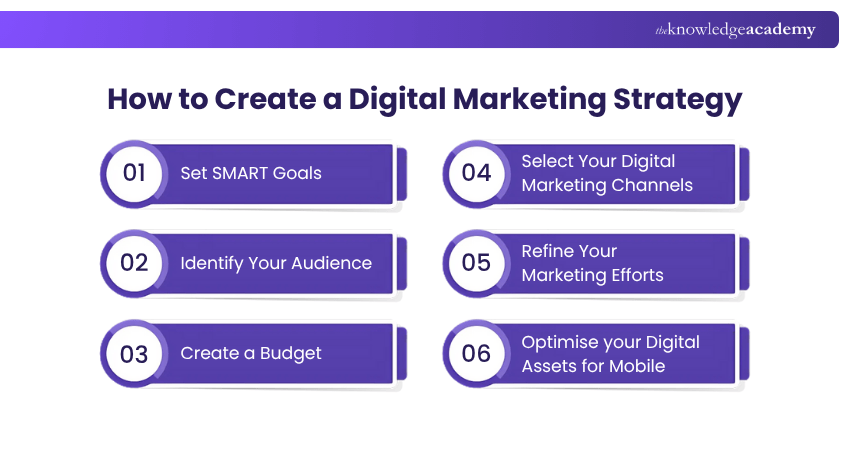
1) Set SMART Goals
Start with goals that are Specific, Measurable, Achievable, Relevant, and Time-bound. Clear objectives help you stay on track and measure progress. Whether it's gaining followers or boosting sales, define what success looks like. This makes every effort more intentional.
2) Identify Your Audience
Know who you’re speaking to before you begin. Learn about their interests, habits, and online behaviour. The better you understand them, the easier it is to create messages that stick. This step sets the tone for everything that follows.
3) Create a Budget
Decide how much you’re willing to spend and where. A clear budget helps you avoid overspending and prioritise the most effective tools. Allocate funds across content, ads, and software wisely. Staying within budget keeps your plan sustainable.
4) Select Your Digital Marketing Channels
Pick platforms that match your audience’s preferences. You don’t need to be on every platform. Focus on where your audience spends the most time. Choose from social media, email, search engines, or video platforms. Each one serves a different purpose and audience.
5) Refine Your Marketing Efforts
Keep testing and adjusting your strategy as you go. Look at the data to see what is working and where to improve. Try new ideas when needed to stay fresh. Regular changes based on feedback lead to better results.
6) Optimise your Digital Assets for Mobile
Make sure your website, emails, and content run smoothly on phones and tablets. Most people browse on mobile, so your site should load quickly and be easy to use. A clean layout keeps users engaged. Good mobile design also boosts your visibility in search engines.
What is the Easiest Type of Digital Marketing?
The easiest type of Digital Marketing for beginners is social media marketing. It’s simple to start, doesn’t require advanced tools, and lets you reach people quickly through posts, stories, and ads. Platforms like Instagram and Facebook offer built-in features to help you step by step.
What are the 7 Cs of Digital Marketing?
The 7 Cs of Digital Marketing are Customer, Content, Context, Community, Convenience, Cohesion, and Conversion. Together, they help brands understand their audience, deliver value, build trust, ensure consistency, and drive action across digital channels.
Conclusion
So, by now, you must have understood why you need to learn What is Digital Marketing. By all means, it has become a vital part of modern business success. It helps brands connect with the right people, at the right time. All of this is done by using smart strategies and tools. Thus, a strong digital presence can open doors.
Looking for guidance in creating visually appealing product content for E-commerce excellence? Sign up for our Product Content for E-Commerce Training now!
Frequently Asked Questions
What are the Four Pillars of Digital Marketing?

The four pillars are Content, Communication, Community, and Commerce. They help create valuable content, engage users, build trust, and drive sales online. These pillars form the foundation of a successful digital presence. When used together, they ensure your brand stays relevant, consistent, and customer focused.
What are the Five PS of Digital Marketing?
The 5 Ps of Digital Marketing are Product, Price, Place, Promotion, and People. These elements help shape a brand’s strategy by focusing on what is offered, how it’s priced, where it’s sold, how it’s promoted, and who it’s for. Together, they bring in smart, audience-focused marketing decisions.
What are the Other Resources and Offers Provided by The Knowledge Academy?
The Knowledge Academy takes global learning to new heights, offering over 3,000 online courses across 490+ locations in 190+ countries. This expansive reach ensures accessibility and convenience for learners worldwide.
Alongside our diverse Online Course Catalogue, encompassing 17 major categories, we go the extra mile by providing a plethora of free educational Online Resources like Blogs, eBooks, Interview Questions and Videos. Tailoring learning experiences further, professionals can unlock greater value through a wide range of special discounts, seasonal deals, and Exclusive Offers.
What is The Knowledge Pass, and How Does it Work?
The Knowledge Academy’s Knowledge Pass, a prepaid voucher, adds another layer of flexibility, allowing course bookings over a 12-month period. Join us on a journey where education knows no bounds.
What are the Related Courses and Blogs Provided by The Knowledge Academy?
The Knowledge Academy offers various Digital Marketing Courses, including the Social Media Marketing Course and the Copywriting Course. These courses cater to different skill levels, providing comprehensive insights into Digital Marketing Campaign.
Our Digital Marketing Blogs cover a range of topics related to Digital Marketing, offering valuable resources, best practices, and industry insights. Whether you are a beginner or looking to advance your Digital Marketing skills, The Knowledge Academy's diverse courses and informative blogs have got you covered.

James Smith


Digital Marketing Manager and Trainer
James Smith is a digital marketing professional with over a decade of experience in SEO, content strategy, paid media and analytics. He has supported both SMEs and global brands in transforming their digital presence. James’s writing and training are rooted in results-driven tactics and the latest marketing trends.
View Detail
Upcoming Digital Marketing Resources Batches & Dates
Date
 Digital Marketing Course
Digital Marketing Course
Fri 10th Jul 2026
Digital Marketing Course
Fri 13th Nov 2026

 If you wish to make any changes to your course, please


