


 Top Rated Course


We may not have the course you’re looking for. If you enquire or give us a call on +44 1344 203999 and speak to our training experts, we may still be able to help with your training requirements.
What is a Trial Balance: Types and How it Works
Olivia Taylor 21 April 2026A Trial Balance is an internal report that lists all ledger balances to verify that total debits equal total credits before preparing financial statements. It helps prepare final accounts, detect arithmetic errors, and support accurate financial reporting. Businesses use it to ensure the accuracy of their bookkeeping records.

Training Outcomes Within Your Budget!
We ensure quality, budget-alignment, and timely delivery by our expert instructors.
Table of Contents
How do businesses make sure every financial transaction has been recorded correctly? With dozens, sometimes hundreds, of entries flowing through the books each month, even a small mistake can disrupt the accuracy of financial reports.
This is where a Trial Balance becomes essential. It acts as a crucial checkpoint, verifying that total debits and credits are equal before financial statements are prepared. In this blog, we will explore What is a Trial Balance, its types, and how it works to maintain accurate financial records. Let's get started!
Table of Contents
1) What is Trial Balance?
2) What's the Role of a Trial Balance in Accounting?
3) How a Trial Balance Works?
4) Types of Trial Balance
5) Benefits of Using a Trial Balance
6) Drawbacks of Using a Trial Balance
7) Trial Balance Example
8) Trial Balance vs Balance Sheet
9) Conclusion
What is Trial Balance?
A Trial Balance is a bookkeeping statement prepared at the end of an accounting period to check the mathematical accuracy of ledger accounts. It lists all account balances, including assets, liabilities, equity, income, and expenses, in two columns, such as debit and credit.
Its main purpose is to ensure that the total of all debits equals the total of all credits, acting as an important internal control tool in the accounting process. Once the figures match, the Trial Balance becomes the foundation for preparing final accounts and financial statements such as the income statement and balance sheet.

What's the Role of a Trial Balance in Accounting?
A Trial Balance serves as a vital account checkpoint, confirming that there are balanced and error-free books. Here are the key roles in the Trial Balance in Accounting:
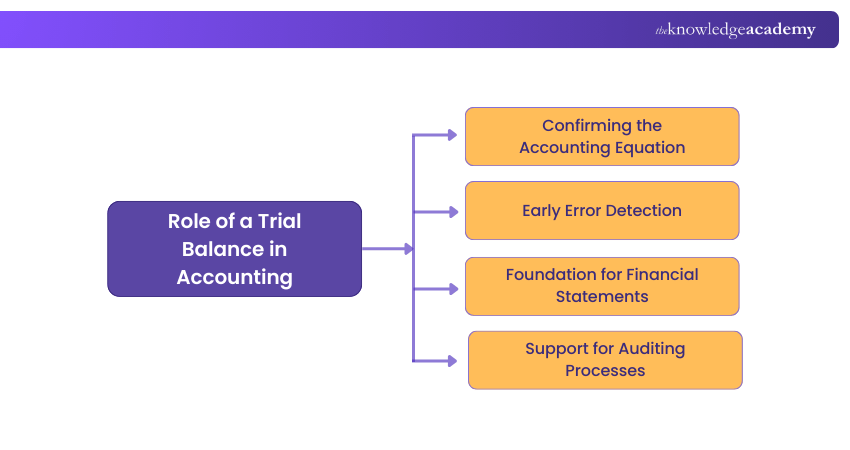
1) Confirming the Accounting Equation: It ensures that every debit entry has a corresponding credit entry, confirming the maintenance of the basic accounting equation.
2) Early Error Detection: It acts as an early error detection tool by identifying ledger discrepancies, allowing corrections before further financial reporting.
3) Foundation for Financial Statements: It lays the groundwork for detailed financial statement preparation, such as the balance sheet and Cash Flow Statement.
4) Support for Auditing Processes: It provides Auditors and Accountants with the confidence of mathematically accurate recorded transactions, streamlining the audit process.
How a Trial Balance Works?
Understanding the inner workings of a Trial Balance is essential for grasping how businesses maintain accurate financial records. Here is the step-by-step working of a Trial Balance:
1) Record Transactions: All business transactions are initially recorded in the accounting system and posted to individual ledger accounts, each tracking debits and credits for that specific category.
2) Extract Account Balances: At the reporting period’s end, the closing balances from each ledger account are gathered, representing the net debits or credits total in each account.
3) Prepare the Worksheet: The balances extracted are then organised into a worksheet with two columns, one for debit balances and one for credit balances, to clearly display each side’s total.
4) Add and Compare Totals: The debit and credit columns’s totals are separately calculated. The key check here is that the total debits should equal the total credits, confirming that the basic accounting equation holds true.
5) Identify and Correct Errors: If there is a mismatch in the total, this signals possible errors such as mis-recorded entries or omissions. Accountants then review and perform discrepancy correction to ensure the accuracy of the financial records before proceeding with further financial analysis and reporting.
Manage cash inflows and outflows with our Cash Flow Management Course – Join now!
Types of Trial Balance
In the accounting cycle, a Trial Balance can be prepared at different stages depending on the purpose and timing. Based on this, types of Trial Balance have been created, and each type serves a specific role in ensuring accuracy.
Now that you know What is a Trial Balance, let’s check the three main types are explained below:
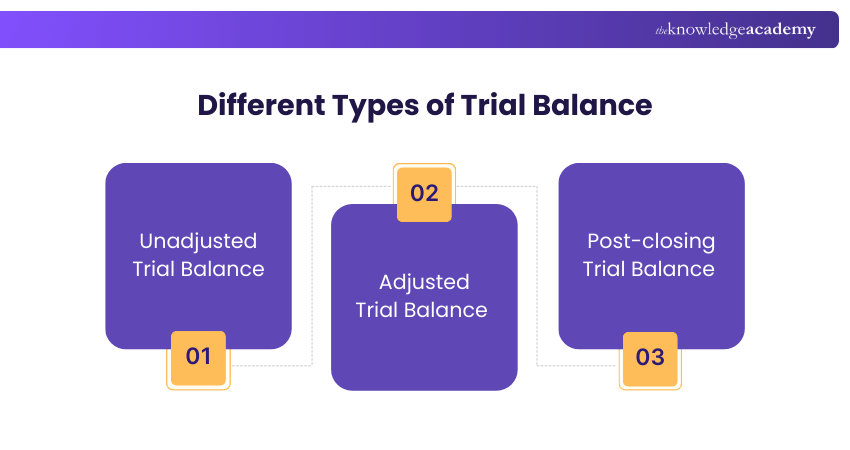
1) Unadjusted Trial Balance
An Unadjusted Trial Balance is a primary record, and it is prepared before any end-of-period adjustments are made. It lists all ledger account balances after transactions have been recorded but before adjusting entries such as accruals, depreciation, or prepaid expenses are applied.
Its main purpose is to check whether total debits equal total credits at the initial stage. However, because adjustments have not yet been recorded, the figures may not accurately reflect the true financial position of the business.
2) Adjusted Trial Balance
An Adjusted Trial Balance is prepared after all necessary adjusting entries have been recorded. These changes ensure that revenues and expenses are recognised in the correct accounting period, following the accrual concept.
This version presents more accurate and updated account balances. It is used directly to prepare the income statement and balance sheet.
3) Post-closing Trial Balance
A Post-closing Trial Balance is created after closing entries have been made. Closing entries transfer balances from temporary accounts, such as revenues and expenses, to permanent accounts like retained earnings.
At this stage, only permanent accounts (assets, liabilities, and equity) appear in the trial balance. It ensures that the books are properly closed and ready for the next accounting period.
Learn advanced data reconciliation techniques with our Bookkeeper Course- Register today!
Benefits of Using a Trial Balance
Using a Trial Balance offers several benefits that help maintain accurate and efficient accounting records. Here are some key advantages:
1) Error Detection: It helps identify bookkeeping mistakes by ensuring the equivalency of total debits and credits.
2) Financial Statement Preparation: A complete Trial Balance is the foundation of an accurate financial statement.
3) Improved Accuracy: Regular Trial Balance compilation reinforces proper record-keeping and increases the overall financial data reliability.
4) Facilitates Auditing: It simplifies the audit process by providing a clear ledger balance overview, allowing Auditors to quickly verify the recorded transactional accuracy.
5) Streamlines Adjustments: A Trial Balance aids in adjustments that need identification before accounts are finalised, ensuring the correctness of all transactions in the right period.
Transform quantitative insights with Accounting and Financial Statement Analysis Training – Sign up today!
Drawbacks of Using a Trial Balance
Using a Trial Balance has its limitations and may not catch every error or issue in the accounting process. Here are some key drawbacks:
1) Limited Error Detection: A Trial Balance only confirms that debits equal credits; it cannot detect errors like omitted entries or misclassifications where both sides are equally wrong.
2) Does not Verify Transaction Accuracy: It does not ensure that individual transactions are recorded correctly, as errors of commission (posting to the wrong account) might still result in a balanced Trial Balance.
3) Inability to Detect Fraud: Since the Trial Balance only performs mathematical accuracy checking, it may not reveal fraudulent activities or the record’s intentional misstatements.
4) Time-consuming for Large Volumes: For businesses with a high transactional volume, Trial Balance compilation and verification can be labour-intensive and may require additional automated systems for enhanced accuracy.
Trial Balance Example
To understand how a Trial Balance works, let’s look at a simple example. Imagine a business records its transactions for the month and posts them to various ledger accounts. At the end of the accounting period, it prepares a Trial Balance to ensure that total debits equal total credits.
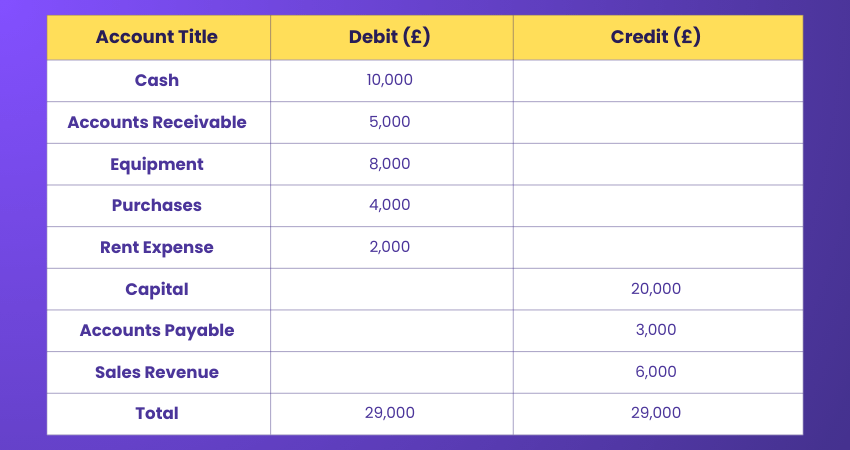
In this example, the total debits (£29,000) equal the total credits (£29,000), confirming that the books are arithmetically balanced. However, even when totals match, businesses must still review records carefully, as certain types of errors may not be detected by the Trial Balance alone.
Trial Balance vs Balance Sheet
Although both documents are prepared during the accounting process, a Trial Balance and a Balance Sheet serve very different purposes. A Trial Balance ensures that the books are mathematically correct. It does not show profit, loss, or net worth directly.
A Balance Sheet, on the other hand, presents the company’s financial position at a specific date, highlighting what the business owns (assets) and owes (liabilities), along with shareholders’ equity. Below is a detailed difference between Trail Balance and balance sheet:
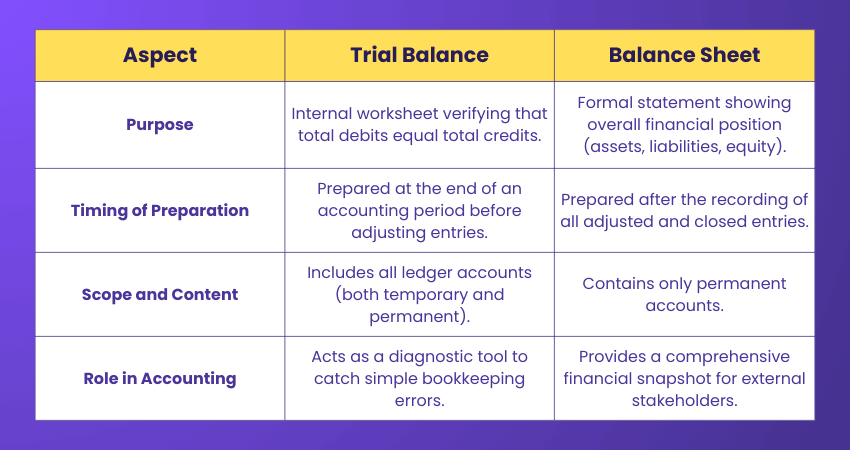
1) Purpose
a) Trial Balance: It serves as an internal worksheet used for total debits equal to total credits verification, ensuring the mathematical correctness of bookkeeping entries.
b) Balance Sheet: It is a formal financial statement that shows the company’s overall financial position through assets, liabilities, and equity listing.
2) Timing of Preparation
a) Trial Balance: Typically prepared at the accounting period’s end before there are any adjusted entries, serving as a preliminary check.
b) Balance Sheet: Prepared after recording all adjusting and closing entries, providing a final financial status snapshot on a specific date.
3) Scope and Content
a) Trial Balance: Includes all ledger account balances (both temporary and permanent) to ensure the proper recording of every transaction.
b) Balance Sheet: Contains only permanent accounts, such as assets, liabilities, and equity, to present the business's financial health.
4) Role in the Accounting Process
a) Trial Balance: A diagnostic tool that catches simple accounting record errors. This makes it easier to draft accurate financial statements later.
b) Balance Sheet: Provides a comprehensive report for external users (like Investors and Creditors) to evaluate the company’s financial stability and performance.
Conclusion
A Trial Balance may seem like a simple internal report, but it plays a vital role in maintaining accuracy within the accounting process. By ensuring that total debits and credits are equal, it helps businesses detect calculation errors early and build confidence in their financial records. A clear understanding of What is a Trial Balance forms the backbone of reliable financial reporting and sound bookkeeping practices.
Join our Accounts Payable and Receivable Training to optimise invoice and cash processing!
Frequently Asked Questions
What Are the Three Rules of Trial Balance?

The three rules of Trial Balance are: (1) Assets and expenses are recorded as Debits; (2) Liabilities and income are recorded as Credits; (3) Total Debits must equal total Credits. These principles, rooted in double-entry accounting, ensure consistency and accurate financial records.
What Happens If the Trial Balance Doesn’t Balance?
If the Trial Balance doesn’t match, that means there is an error in the Accounting process. It's better to rectify the error immediately to prevent any substantial flaws later on.
What are the Other Resources and Offers Provided by The Knowledge Academy?
The Knowledge Academy takes global learning to new heights, offering over 3,000+ online courses across 490+ locations in 190+ countries. This expansive reach ensures accessibility and convenience for learners worldwide.
Alongside our diverse Online Course Catalogue, encompassing 17 major categories, we go the extra mile by providing a plethora of free educational Online Resources like Blogs, eBooks, Interview Questions and Videos. Tailoring learning experiences further, professionals can unlock greater value through a wide range of special discounts, seasonal deals, and Exclusive Offers.
What is The Knowledge Pass, and How Does it Work?
The Knowledge Academy’s Knowledge Pass, a prepaid voucher, adds another layer of flexibility, allowing course bookings over a 12-month period. Join us on a journey where education knows no bounds.
What are the Related Courses and Blogs Provided by The Knowledge Academy?
The Knowledge Academy offers various Accounting Courses, including the Accounting Course, Accounting and Finance Policies Course, and the Accounting and Financial Statement Analysis Training. These courses cater to different skill levels, providing comprehensive insights into Double-entry Bookkeeping.
Our Accounting and Finance Blogs cover a range of topics related to Trial Balance, offering valuable resources, best practices, and industry insights. Whether you are a beginner or looking to advance your accounting skills, The Knowledge Academy's diverse courses and informative blogs have got you covered.

Olivia Taylor


Chartered Accountant and Financial Training Specialist
Olivia Taylor is a qualified chartered accountant with over a decade of experience in financial management, auditing and corporate reporting. Having worked with leading firms in both the public and private sectors, Olivia brings clarity to complex financial topics. Her writing focuses on helping professionals build confidence in key areas of accounting, compliance and financial planning.
View Detail

 If you wish to make any changes to your course, please


