


 Top Rated Course

We may not have the course you’re looking for. If you enquire or give us a call on +44 1344 203999 and speak to our training experts, we may still be able to help with your training requirements.
SEO vs PPC: Key Differences, Benefits, and Strategies
The Knowledge Academy 20 April 2026The two methods address various objectives and business schedules. A significant number of businesses use SEO and PPC to attain consistent growth and immediate, quantifiable marketing outcomes. Together, SEO builds long-term visibility, while PPC drives instant traffic, creating a balanced strategy that improves reach and conversions.

Training Outcomes Within Your Budget!
We ensure quality, budget-alignment, and timely delivery by our expert instructors.
Table of Contents
In today's digital world, businesses are always seeking ways to enhance their web presence and attract more customers. Two of the most popular techniques are SEO and PPC. But how do you decide which is best for your business? In this blog, we dive into "SEO vs PPC," breaking down their key differences and unique advantages.
Whether you're aiming for long-term growth or immediate results, understanding these strategies can help you make informed decisions. Get ready to unlock the secrets of these strategies and discover how they can work together to supercharge your online presence!
Table of Contents
1) What is SEO?
2) What is PPC?
3) Key Differences Between SEO and PPC
4) How To Use SEO And PPC Together?
5) What Is The Difference Between SEO SEM and PPC?
6) Which Is Better For Your Business In 2026 PPC or SEO?
7) Conclusion
What is SEO?
SEO is an acronym for Search Engine Optimisation which is a fundamental aspect of Digital Marketing that focuses on improving the website’s visibility and ranking in Search Engine Results Pages (SERPs). It involves implementing various strategies and techniques to enhance the website’s relevance and authority in the eyes of search engines.
SEO aims to optimise the website’s structure, content, and other elements to align with the algorithms used by Google, Bing, and Yahoo. By doing so, SEO targets to increase the website’s organic (non-paid) traffic by appearing higher in the search results for relevant queries. However, considering the advantages and disadvantages of SEO is crucial to ensure long-term success and avoid potential pitfalls like over-optimization.

Benefits of SEO
SEO offers several advantages that help businesses build visibility, trust, and steady website traffic over time.
1) Builds Organic Traffic: SEO makes your site seem natural with the search engine and attracts visitors actively seeking information, goods or services. This natural traffic is more applicable and tends to create greater engagement and higher conversion potential in the long run.
2) Long Term Cost Effective: In comparison to the paid advertising, SEO does not make you pay each time someone clicks. Although this will need constant effort in the beginning, it will be more cost effective in the long run where you will have your pages attracting visitors without having to spend on advertisements constantly.
3) Enhances Credibility And Trust: Organic websites are usually perceived to be more trustworthy to users. Your content is more genuine without a sponsored label in the search results; this will aid in gaining confidence and trust with potential customers.
Drawbacks of SEO
Following are the drawbacks of SEO
1) Slow To Deliver Results: SEO takes time to show impact. Reaching the first page, and especially the top positions, often requires months of consistent effort rather than quick wins.
2) High Keyword Competition: The established websites already target many valuable search terms. The competition on these keywords may be tough and small or new sites may find it more difficult to be visible.
3) Frequent Algorithm Changes: Search engines regularly update how they rank content. These alterations may have an impact on the performance unexpectedly, and constant adjustments have to be made to retain the rankings.Take your SEO to the next level! Download the Semantic SEO Guide now and start applying advanced semantic SEO techniques for superior search performance.
What is PPC?
PPC, which stands for Pay-Per-Click, is a digital advertising model. Here, advertisers must pay a fee each time their ad is clicked. It is a form of online advertising that aims to drive the target traffic to a website or landing page.
Unlike organic Search Results, achieved through SEO efforts, it allows advertisers to place ads directly on SERPs, social media platforms, or other websites. Advertisers bid on specific keywords or target audience demographics, and their ads are displayed to users who enter relevant search queries or meet the specified criteria.
Benefits of PPC
Benefits of PPC are listed below:
1) Provides Real-time Visibility: PPC enables your business to be visible in the search results in just a short time. With this kind of bid, your link is displayed to the person immediately, and you get attention and clicks without having to wait until the ranking improves.
2) Targets The Right Audience: Under PPC, you have an opportunity to target individuals who are seeking products or services similar to yours. With the help of proper keywords, your advertisements will target people who have a higher probability of being interested in what you have to offer.
3) Secures Top Search Positions: PPC ads are displayed above organic listings on search engine results pages. This prime placement increases visibility and ensures your website is seen before competing organic results.
Drawbacks of PPC
Following are the drawbacks of PPC:
1) Can Become Costly Over Time: PPC may deliver fast visibility, but it can be expensive as a long-term approach. Costs can increase rapidly since you pay per click and particularly in competitive industries.
2) Results Are Not Guaranteed: There is no guarantee that your advertisements will be present all the time. Others can outbid you on the same keywords and organic results are still preferred by many users and this may restrict returns.
3) Short Lived Visibility: PPC visibility will only run as long as your budget. After you cease to make payments, your advertisements will not be displayed in search results anymore, and traffic will decline nearly right away.
Learn how to run PPC campaigns with our Pay Per Click (PPC) Training – Join today!
Key Differences Between SEO and PPC
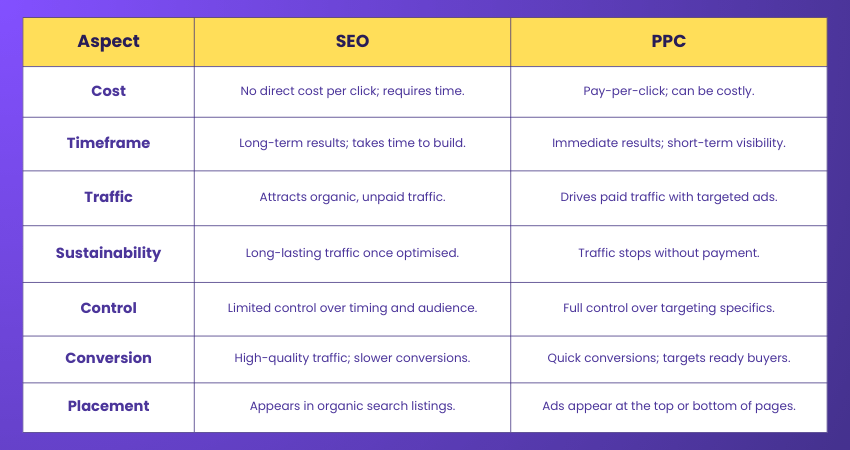
Here is the key differences SEO vs PPC:
1) Cost
With SEO, you're working to improve your website's ranking in search results without paying directly for clicks. It requires time and effort to optimise your site, but once it's done well, it doesn’t cost extra for traffic.
On the other hand, with PPC, you pay each time someone clicks on your ad. This means you can get quick visibility, but it can become expensive, especially if many people click on your ads.
2) Timeframe
Building SEO takes time. You might not see results immediately, but once your site ranks well, it can keep attracting visitors over time. On the other hand, PPC provides instant results. Once you start a campaign, your ads can appear immediately, but they only stay visible as long as you're paying for them.
3) Traffic
SEO aims to attract people naturally by having your site appear in regular search results. It focuses on getting visitors through unpaid search engine rankings.
In contrast, PPC drives traffic by showing your ads to people. It focuses on paid search results, where your ads appear based on specific keywords.
4) Sustainability
Once you’ve optimised your site, it can continue to draw in visitors without ongoing costs. The results are more lasting, even if you pause your efforts. On the other hand, PPC brings traffic as long as you keep paying for ads. Once you stop paying, the traffic stops immediately.
5) Control
With SEO, you optimise your site to rank for relevant searches. You don’t have control over when it appears, but you work on making your site more attractive to search engines.
In contrast, PPC gives you control over who sees your ads. You can target specific audiences, locations, and times, making it easier to reach the right people.
6) Conversion
SEO brings in organic traffic that might take time to convert, but these visitors are often looking for information or solutions. This leads to high-quality traffic.
On the other hand, PPC can drive quick conversions by targeting people who are ready to take action. It’s effective for attracting buyers looking for specific products or services.
7) Placement
SEO results show up in the organic search listings, typically below the ads. These are the standard search results that users trust for information.
In contrast, PPC ads appear at the top or bottom of search results pages. They are marked as ads and are shown prominently to attract clicks.
How to Use SEO And PPC Together?
SEO and PPC are most effective as complementary tools and not as rival tools. When used together, they assist the businesses reach more traffic, produce qualified leads, and make constant sales. SEO develops the long-term presence whereas PPC injects immediacy and accuracy, developing a balanced strategy towards growth.
1) Support SEO Content with Paid Ads
Organic content can be given a start with paid advertisements. With the use of PPC to promote informative pages, you are able to view the user behavior, their conversion, and their next read. This understanding assists in refining the paid and organic strategies. When analysing SEO vs PPC performance for specific pages, businesses can identify which topics deserve long-term organic focus and which benefit from paid promotion.
2) Use PPC Insights to Improve Organic Click Rates
PPC information will show the most clicked headlines and keywords. This understanding could be utilized in the title tags and page headings of SEO, so that organic results are more attractive and relevant to search results. Studying SEO vs PPC click-through trends also helps refine meta descriptions and headlines to maximise overall visibility.
3) Retarget Organic Visitors With PPC
Paid advertisements are an option of re engaging visitors who access your site via organic search. Retargeting helps you to present relevant advertisements to users who have already expressed interest, which enhances the possibility of conversions.
4) Strengthen SEO Pages With Clear Calls to Action
SEO content is usually targeted at visibility whereas PPC is targeted at action. With organic pages, adding clear and relevant calls to action may turn traffic into leads and sales using what works well in paid campaigns.
5) Generate Organic Content on Competitor Ad Terms
Competitor ads indicate valuable search terms. Although you can bid on them, you can also generate high quality organic content on the same topics, and you will be able to attract traffic without having to spend on ads constantly. This strategic approach strengthens your position in the ongoing SEO vs PPC landscape by combining visibility with cost efficiency.
What Is the Difference Between SEO SEM and PPC?
The major difference between SEO SEM and PPC are listed below:
1) SEO aims at enhancing your site to be ranked in search engines in a natural manner. SEO gives rise to organic traffic and does not need payment per individual click. It is based on the content quality, relevancy, and web site optimisation.
2) SEM is a wider term that is used to refer to paid techniques to make an appearance in search engines. It encompasses techniques that imply advertisement in order to occupy high rankings in search results.
3) PPC is a certain form of paid advertising within SEM. In PPC, the search engine or platform gets paid by the advertisers each time a person clicks on their advertisement. This model is fast to see but requires continuous expenditure on ads to keep the traffic.
Which Is Better for Your Business In 2026 PPC Or SEO?
In 2026, selecting between PPC and SEO would be based on what your business requires the most at the moment. SEO is more applicable to businesses that are more interested in creating long term presence, credibility and constant organic traffic. It helps to sustain growth and still provide value even during the slowdown in active spending.
PPC, however, are effective in those business cases where a business requires fast exposure, instant leads or instantaneous outcomes of a particular campaign. It gives excellent power of targeting and message but needs sustained budget to keep it visible.
For most businesses in 2026, the smarter choice is not PPC or SEO alone, but a combination of both. Using PPC for speed and insights, alongside SEO for long term stability, creates a balanced and resilient digital marketing strategy.
Conclusion
Both SEO and PPC are valuable strategies in Digital Marketing, each with its strengths and weaknesses. SEO is ideal for building long-term, sustainable traffic and is more cost-effective over time, while PPC offers quick results and precise targeting. When considering "PPC vs SEO," think about your goals, budget, and timeline to decide which is best for you. Creating a Landing Page that complements both strategies can amplify your results, helping you maximise your reach and achieve your marketing objectives.
Learn the skills to analyse data-driven metrics with our Web Analytics Course – Join today!
Frequently Asked Questions
How does SEO Impact PPC?

SEO and PPC both work to improve your online marketing strategy. When your website ranks in organic search results through SEO, it can increase your brand's credibility, which can positively impact your PPC campaigns.
How is Ranking Different When Comparing PPC and SEO?
With PPC, your ads appear at the top or bottom of search results pages immediately, but you pay for each click. SEO focuses on improving your website's organic ranking. While PPC provides instant visibility, SEO builds long-term authority.
What are the Other Resources and Offers Provided by The Knowledge Academy?
The Knowledge Academy takes global learning to new heights, offering over 3,000+ online courses across 490+ locations in 190+ countries. This expansive reach ensures accessibility and convenience for learners worldwide.
Alongside our diverse Online Course Catalogue, encompassing 17 major categories, we go the extra mile by providing a plethora of free educational Online Resources like Blogs, eBooks, Interview Questions and Videos. Tailoring learning experiences further, professionals can unlock greater value through a wide range of special discounts, seasonal deals, and Exclusive Offers.
What is The Knowledge Pass, and How Does it Work?
The Knowledge Academy’s Knowledge Pass, a prepaid voucher, adds another layer of flexibility, allowing course bookings over a 12-month period. Join us on a journey where education knows no bounds.
What are Related Courses and Blogs Provided by The Knowledge Academy?
The Knowledge Academy offers various Marketing Courses, including the Pay Per Click (PPC) Course, Web Analytics Course, and Conversion Rate Optimisation Course. These courses cater to different skill levels, providing comprehensive insights into Marketing Campaign.
Our Digital Marketing Blogs cover a range of topics related to Search Engine Optimisation, offering valuable resources, best practices, and industry insights. Whether you are a beginner or looking to advance your SEO skills, The Knowledge Academy's diverse courses and informative blogs have got you covered.

The Knowledge Academy


Global Training Provider
The Knowledge Academy is a world-leading provider of professional training courses, offering globally recognised qualifications across a wide range of subjects. With expert trainers, up-to-date course material, and flexible learning options, we aim to empower professionals and organisations to achieve their goals through continuous learning.

Upcoming Digital Marketing Resources Batches & Dates
Date
 Pay Per Click (PPC) Training
Pay Per Click (PPC) Training
Fri 10th Jul 2026
Pay Per Click (PPC) Training
Fri 18th Sep 2026

 If you wish to make any changes to your course, please


