


 Top Rated Course

We may not have the course you’re looking for. If you enquire or give us a call on +44 1344 203999 and speak to our training experts, we may still be able to help with your training requirements.
What is Planning Poker: A Complete Guide to Agile Estimation
David Evans 25 February 2026Planning Poker is a consensus-based agile estimation method where teams use numbered cards to estimate effort, discuss gaps, and align on a final value overall. This helps teams to discuss needs, share opinions, and reveal estimates. It removes bias, fosters open conversations, and leads to clear conversations and decisions.

Training Outcomes Within Your Budget!
We ensure quality, budget-alignment, and timely delivery by our expert instructors.
Table of Contents
Estimating tasks in Agile projects often leads to uncertainty. If one person thinks a feature will take hours to complete, another believes it will take days. Communication becomes longer, assumptions are unclear, and teams are unsure. If you have been part of such a team experience, then you understand the challenge of making fair and accurate estimates.
This is where Poker Planning comes in to provide a smarter way forward. It builds a simple, collaborative space where everyone can share their views, make accurate project planning, and reveal estimates together. In this blog, you will learn What is Poker Planning, how it works, its benefits, its goals and more. So, keep reading to learn more!
Table of Contents
1) What is Planning Poker?
2) How Does Planning Poker Work?
3) Benefits of Planning Poker
4) Drawbacks of Planning Poker
5) When Do Teams Use Planning Poker?
6) Planning Poker Origin
7) Who Participates in Planning Poker?
8) What is the Goal of Planning Poker?
9) Conclusion
What is Planning Poker?
Planning Poker is a widely utilised Agile estimation technique that helps teams to estimate the effort required for user stories or features. It converts estimation into an engaging and collaborative activity, where team members have equal say. This enables teams to agree on a realistic estimate instead of relying on one person’s opinion.
A Planning Poker session begins when the Product Owner explains a user story, and each estimator is given a deck of cards. After the discussion is over and doubts are clear, everyone selects a card and reveals it together. If values match, that becomes the estimate; if not, the team discusses the differences and votes again until they reach a consensus.

How Does Planning Poker Work?
Planning Poker brings together stakeholders from various departments within the organisation to reach a consensus on the estimated effort required for several backlog initiatives. In an Agile software organisation, stakeholders can include a Product Owner, Developers, User Experience (UX) Designers, QA Testers, and Product Managers, among others.
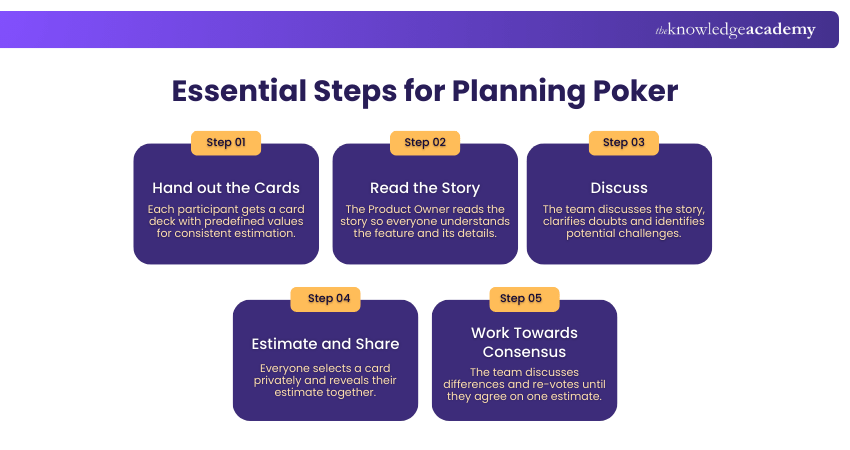
a) Step 1: Hand out the Cards
Participants receive identical decks of cards (or chips), each featuring a different number. A common sequence involves doubling each number: 1, 2, 4, 8, 16, 32, 64. Mike Cohn of Mountain Goat Software, who popularised Planning Poker for Agile development, recommends the sequence 0, 1, 2, 3, 5, 8, 13, 20, 40, and 100.
Such decks feature strategic number intervals to assist participants in reaching a consensus estimate for each story. Providing too many options, such as each number from 1 to 50, would make the process inefficient.
b) Step 2: Read the Story
In this step, the Product Owner, or possibly a Product Manager, reads each story aloud to the group. This ensures everyone hears the same description and understands the features from the perspective of the customer. Here, it includes explaining the acceptance criteria, business value, key details, and any dependencies.
c) Step 3: Discuss
Once everyone has heard the story, the group discusses it. Participants describe how they envision tackling the work, how many estimated individuals would be involved, which skill sets will be required, and any obstacles they foresee slowing progress. The group also uses this time to ask questions about the story.
d) Step 4: Estimate and Share
After everyone has shared their viewpoints and questions are clarified, each participant selects a card. This selection reflects their estimate of the story’s effort. When everyone is ready, the team reveals their cards, with higher values indicating a belief that the story will be more difficult or time-consuming.
e) Step 5: Work Towards Consensus
If every participant reveals the same card, the value becomes the consensus estimate and moves to the next story. If card values differ, the team continues to provide their reasoning for the estimates they provided. After the discussion, everyone reconsiders their choice, selects a card again, and reveals together until agreement is reached.
Advance your Agile Skills with the AgilePM® Foundation & Practitioner Course (AgilePM® v3) - Join today!
Benefits of Planning Poker
The primary benefit of Planning Poker is that it leads to more accurate team estimates. Accurate estimates are crucial for the sprint planning process, as they provide both your team and stakeholders with a realistic timeline for task completion. Here are a few additional ways Planning Poker can benefit your Agile team:
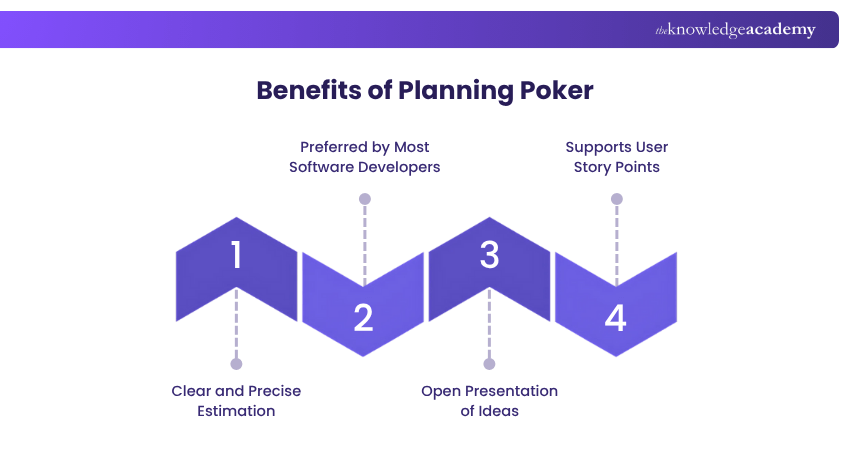
Planning Poker is a popular estimation technique that helps teams improve accuracy, encourage collaboration, and uncover hidden challenges early. Its key benefits include:
1) Clear Relative Estimation: Planning Poker helps teams estimate tasks by comparing them with each other. This builds a useful reference point for future projects, especially when dealing with unfamiliar work.
2) Equal and Inclusive Participation: Every team member has a chance to contribute, regardless of experience. This encourages open discussion and allows new perspectives to surface.
3) Better Requirement Clarity: When team members explain their estimates, it often reveals missing details or unclear requirements. These discussions help identify gaps before development begins.
4) Encourages Open Idea Sharing: The format creates a safe space for fostering honest and open discussion. This allows diverse perspectives to flow and lead to deeper insights and more accurate estimates.
Build a solid foundation on Agile fundamentals with Agile Project Management Foundation Course (AgilePM® v3) - Register today!
Drawbacks of Planning Poker
Here is a list describing the drawbacks of Planning Poker that are important to understand:
1) False Sense of Confidence: Reaching a consensus can sometimes give the team a false sense of confidence. They might still lack crucial information, leading to inaccurate estimates.
2) Influence of Dominant Voices: A dominant person in the group can unduly influence other participants. If not managed carefully, this can result in estimates driven by force of will rather than true consensus.
3) Optimism Bias in Groups: Research indicates that group estimates tend to be more optimistic than those made by individuals in isolation. Consequently, the discussion phase of a Planning Poker meeting can lead to the team convincing itself that it can achieve more in less time than is actually feasible.
When Do Teams Use Planning Poker?
Planning Poker is used whenever teams need to estimate product backlog items. This makes it essential to understand What is Poker Planning in Agile projects. It is valuable at the beginning of a project, when the initial backlog is created. This enables teams to understand the scope, size, and complexity of the upcoming work.
Planning Poker is also used when new backlogs appear during the project. Also, ongoing estimation occurs during product backlog refinement. During the refinement phase, the team reviews new stories, clarifies each detail, and uses Planning Poker to update or create estimates.
Planning Poker Origin
The origin of Planning Poker goes back to the technique known as Wideband Delphi, developed by RAND Corporation for estimating complex tasks. In 2002, software entrepreneur James Grenning polished the idea and adapted it for Agile teams, giving it the name Planning Poker.
After a few years, in 2005, Mike Cohn of Mountain Goat Software popularised the method through his book “Agile Estimating and Planning.” This helped Planning Poker turn into one of the widely used estimation practices in the domain of Agile development today.
Who Participates in Planning Poker?
Planning Poker involves the entire Agile team, including Product Owners, Testers, Developers, and other relevant stakeholders. Everyone collaborates to estimate the effort required for completing user stories, ensuring diverse perspectives.
What is the Goal of Planning Poker?
The goal of Planning Poker is to produce accurate, team-driven estimates by encouraging discussion, knowledge sharing, and consensus. It helps Agile teams assess task complexity collaboratively, identify uncertainties early, and align on realistic expectations for sprint planning.
Conclusion
Planning Poker turns estimation into a clear, collaborative, and confidence-building process. Understanding What is Poker Planning, helps Agile teams to make smarter decisions, bring out hidden details, and create a shared ownership of the upcoming work. This makes estimation sessions effective, fair, and engaging.
Learn how to build strong Agile practices with professional Agile Training today!
Frequently Asked Questions
Is Scrum Poker and Poker Planning the Same?

Yes, Scrum Poker and Planning Poker refer to the same estimation technique used in Agile Development. It involves team members using numbered cards to estimate the effort required for user stories. The process promotes discussion, consensus, and more accurate, collaborative task estimation.
What is the Fibonacci Sequence in Planning Poker?
The Fibonacci sequence (e.g., 1, 2, 3, 5, 8, etc.) helps estimate tasks by highlighting relative differences in size. Larger gaps between numbers reduce over-analysis.
What are the Other Resources and Offers Provided by The Knowledge Academy?
The Knowledge Academy takes global learning to new heights, offering over 3,000+ online courses across 490+ locations in 190+ countries. This expansive reach ensures accessibility and convenience for learners worldwide.
Alongside our diverse Online Course Catalogue, encompassing 17 major categories, we go the extra mile by providing a plethora of free educational Online Resources like Blogs, eBooks, Interview Questions and Videos. Tailoring learning experiences further, professionals can unlock greater value through a wide range of special discounts, seasonal deals, and Exclusive Offers.
What is The Knowledge Pass, and How Does it Work?
The Knowledge Academy’s Knowledge Pass, a prepaid voucher, adds another layer of flexibility, allowing course bookings over a 12-month period. Join us on a journey where education knows no bounds.
What are the Related Courses and Blogs Provided by The Knowledge Academy?
The Knowledge Academy offers various Agile Trainings, including the Agile Project Management Foundation & Practitioner (AgilePM®) Course, Agile Project Management Foundation (AgilePM®) Course, and Agile Project Management Practitioner (AgilePM®) Training. These courses cater to different skill levels, providing comprehensive insights into Scrum Case Studies.
Our Project Management Blogs cover a range of topics related to Planning Poker, offering valuable resources, best practices, and industry insights. Whether you are a beginner or looking to advance your Poker Planning skills, The Knowledge Academy's diverse courses and informative blogs have got you covered.

David Evans


Certified Project Trainer and Agile Delivery Expert
David Evans brings over a decade of hands-on experience in project delivery, Agile transformation, and team leadership. With a background in technology and business consulting, David has led cross-functional teams through Agile and Waterfall projects in both public and private sectors. He combines technical knowledge with practical insights to help readers navigate the challenges of modern project environments.

Upcoming Project Management Resources Batches & Dates
Date
 AgilePM® Foundation & Practitioner (AgilePM® v2)

 If you wish to make any changes to your course, please


