


 Top Rated Course

We may not have the course you’re looking for. If you enquire or give us a call on +44 1344 203999 and speak to our training experts, we may still be able to help with your training requirements.
What Is a Minimum Viable Product (MVP)? A Beginner’s Guide
Richard Harris 03 April 2026Minimum Viable Product (MVP) is the simplest product version released quickly to test market demand, feedback, and validate ideas with minimal effort and resources. Created with minimal time and resources, it helps teams identify user needs, reduce development risks, and refine features before a full-scale launch.

Training Outcomes Within Your Budget!
We ensure quality, budget-alignment, and timely delivery by our expert instructors.
Table of Contents
Every successful product begins with a simple idea but turning that idea into something people actually use takes the right approach. Businesses today focus on testing concepts early, gathering feedback quickly, and refining solutions before committing major time and money.
This is where a Minimum Viable Product comes in, helping teams launch faster while learning what customers truly need. By starting small and improving strategically, companies can reduce risk and build smarter. Let’s explore how this approach works and why it matters.
Table of Contents
1) Defining Minimum Viable Product (MVP)
2) Purpose of Minimum Viable Product
3) How to Define a Minimum Viable Product?
4) Benefits of Minimum Viable Product
5) Types of Minimum Viable Product
6) Steps to Build a Minimum Viable Product
7) Five Examples of the Minimum Viable Product?
8) Conclusion
Defining Minimum Viable Product (MVP)
Minimal Viable Product (MVP) is a prototype of a product that contains the bare minimum functionality required to perform and fulfil the minimal user requirements. It is launched fast enough to allow businesses to test the primary concept in the real market and receive responses of actual users rather than be guided by assumptions.
Instead of building a fully developed solution from the beginning, organisations release a simplified but functional product to validate demand and understand customer behaviour. The feedback collected at this stage helps teams refine features, reduce development costs, minimise risks, and improve the product through future iterations.
Purpose of Minimum Viable Product
The concept of Minimum Viable Product was introduced by Eric Ries as a concept of his Lean Startup methodology. It describes the purpose of an MVP as an early version or stage of a product that enables an organisation to collect the validated learning about the customer with the least effort in a maximum amount. The objective of an organisation to release MVP is to launch the product in the market as soon as possible, test a product idea with real users before investing a huge amount, and understand what can resonate with the organisation’s target market.
How to Define a Minimum Viable Product?
It is very important to know when the MVP is completely ready to release to the market. Here are the following strategies to follow.
Ensure That Your Planned MVP Matches With Organisation Objective
Before considering the features to build, the very first step is to build your MVP. It ensures that the product will align with the organisation’s strategic objectives. Additionally, you must know what purpose this MVP will provide. Let's take an example- will it keep the new target audience engaged in a new market adjacent to the existing product? If this is one of your organisation's goals, then this MVP approach might be viable.
Start to Identify Certain Issues to Improve Your Persona
As in the first step, you have ensured your product matches the organisation's objective; you can begin to think of specific solutions that you can provide to the target audience through your product. You might present these solutions in users' epics, stories or features. But remember one thing that does not represent the overall vision of the product, only the subgroup of that vision. You have to be strategic while deciding which limited feature or functionality to incorporate in your MVP. You can make these decisions based on various factors such as user research, competitive analysis, how fast you can iterate on certain functionalities when you get user feedback and relative costs for the implementation of several users' epics and stories.
Transform Your MVP Functionality Into a Plan
Now that you’ve considered the strategic components above and decided on the limited functionality you want for your MVP, it’s time to summarise this into an action plan for expansion. It’s very important to remember that the V in MVP—means the product must be viable. That means it must enable your consumers to complete tasks or projects and deliver a high-quality user experience. An MVP can't be a user interface with multiple half-built features and tools. It is a working product that your organisation should be able to sell.
Learn the concepts of logging and configuration with our Microsoft BI Training Course now!
Benefits of Minimum Viable Product
A Minimum Viable Product offers several advantages that help businesses validate ideas, save resources, and deliver products more efficiently. Here are some key benefits:
1) Focus on key functionalities: An MVP helps concentrate on the core purpose of the product. It prevents unnecessary features from diverting attention, allowing you to test the main idea quickly and cost-effectively while ensuring that your solution targets the real problem.
2) Save time and money: Developing a full product requires heavy investment and long timelines. With an MVP, you can launch faster using fewer resources, test market response early, and make informed decisions before committing to large-scale development.
3) Better understanding of user’s requirements: An MVP allows real users to interact with your product and share valuable feedback. This first-hand input provides more accurate insights than assumptions or analytics, helping refine features that align with actual user needs.
4) Clear user interface: Keeping the initial product simple ensures a clean and intuitive design. With fewer features, users can easily navigate and engage with the product, making it easier to evaluate how additional features might enhance the experience.
5) Iterative improvement: An MVP supports continuous development through user feedback. By analysing data and responses, you can update and improve your product over time, ensuring it stays relevant and effectively meets user expectations.
6) Reduced waste: Launching a full product without validation risks wasting time, money, and effort. An MVP helps avoid unnecessary development by focusing only on what users truly need and value.
7) Risk mitigation: Testing your idea through an MVP reduces business risk. It helps determine whether your concept has real market demand before investing heavily, ensuring your efforts are directed toward a product with true potential for success.
Types of Minimum Viable Product
There are various types of Minimum Viable Products. Which type of MVP you can use depends on the product's nature, your objective, available resources and the level of authentication you need.

1) Single-Feature MVP: This type of MVP focuses on developing and launching the product with a single-core feature and functionality. It enables you to test the viability of a product idea by delivering the essential components.
2) Concierge MVP: In this type of MVP, the product’s core functionality is manually performed by a human behind the scenes. It provides a personalised experience to the users while testing the concept.
3) Wizard of Oz MVP: This MVP is just similar to the single concierge MVP. It gives you the appearance of a completely automated product, but certain functions are manually executed by the team.
4) Landing Page MVP: In this type of MVP, you build a landing page or a website that describes the product's value rather than building the whole product. Users can sign up and express interest, and this ultimately helps in collecting user data.
5) Explainer Video MVP: This type of MVP is a short video that showcases the product's value and, prepositions and functionality without actually building the product. It can be used to gather feedback and generate interest.
Learn the difference between mapping and modelling with Flowchart Mapping Training now!
Steps to build a Minimum Viable Product
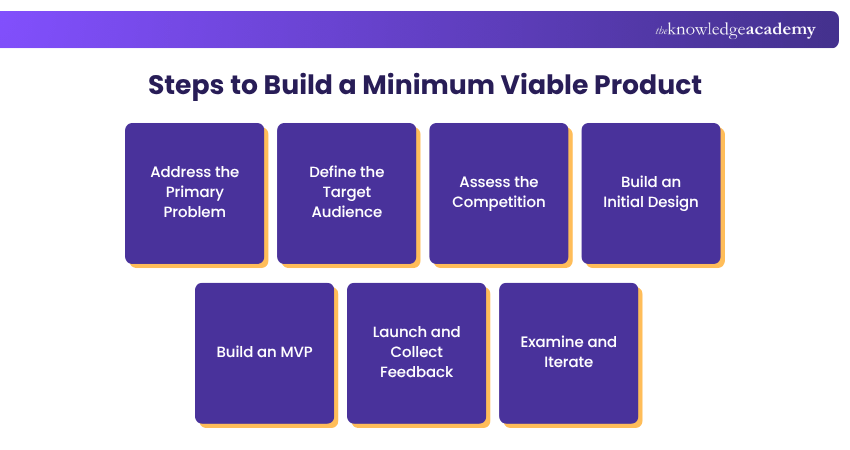
There are various key steps to building a successful Minimum Viable Product (MVP) that assist in creating a functional version of the product while reducing the resources and time investment. Here are the following steps that you need to follow to build an MVP.
There are various key steps to building a successful Minimum Viable Product (MVP) that assist in creating a functional version of the product while reducing the resources and time investment. Here are the following steps that you need to follow to build an MVP.
1) Address the Primary Problem: In the first step, you need to address the primary issues of the product and aim to solve them. It may be as easy as questioning why the product is required. Your solutions should be the foundation to determine the features and functionality of the product to focus on.
2) Define the Target Audience: It is essential to address your target audience and analyse their pain point, preferences and behaviours. In this step, you need to create a comprehensive user persona explaining who will purchase your product without giving it a second thought. Getting familiar with your target audience's lifestyles helps in figuring out whether your product meets their expectations or not.
3) Assess the Competition: Examine competitive products and those contiguous to your industry. Understanding what they got right and what they require to improve can assist you in defining the functionality of your MVP. Check out their customer reviews, market share and articles from the blogger and press. Understanding the competition’s strengths and weaknesses can help you find what your product requires to prevail against them.
4) Build an Initial Design: This step generally involves technical architects, business analysts, and UX/UI designers. Firstly, business analysts explain in detail what the MVP should look like. The architects take that narrative and determine the tech stack required; this may need them to make a proof of concept. Then, the designers create functioning prototypes, a product style guide, and a visual design for the MVP.
5) Build an MVP: Now that your team has gained so much knowledge from the previous steps, your development team is all set to build and test Minimum Viable Product. Based on its complexity, your MVP can take a few days to various months to develop and test.
6) Launch and Collect Feedback: In this step, you need to gather feedback. So, try to make it as simple as possible for your target audience to share their views, thoughts and suggestions. Based on the type of product and audience, you can do interviews, surveys and other efforts like this to collect overall user feedback.
7) Examine and Iterate: Remember that the purpose of an MVP is to test predictions, validate ideas, and collect user feedback. Thus, each step should be accomplished to understand real-world usage and make educated decisions for the product’s future direction.
As you explore the feedback, don’t just see what they don't like about the MVP but also see what they like and where they see gaps in implementation and functionality. Utilise this information to enhance the next version of the product.
5 Examples of the Minimum Viable Product?
Most of the successful firms started with the simple version of a product to exude the demand and acquire knowledge on the users and then add more features and services.
1) Airbnb
The founders initially placed their own apartment on the Internet with simple photos and descriptions. Premature reservations brought about the concept of short-term rentals of houses.
2) Foursquare
When Foursquare was launched, it supported location check-ins and basic rewards only. Additional features came later when there was more uptake of the product by users.
3) Amazon
Amazon had been an online bookstore that sold books online. This success saw it venture into other product lines.
4) Uber
Uber was first launched to enable people to hire the services of a limited number of riders within a single city. The service has since been extended to new destinations and rides.
5) Spotify
Spotify started as a simple music streaming platform that had small content. It added larger libraries and personalisation when the demand increased.
Conclusion
Launching small helps businesses learn quickly, adapt to user needs, and refine their ideas before heavy investment. By applying a Minimum Viable Product approach, organisations can reduce risk and build solutions that grow stronger over time.
Check out our Business Objects Reporting Course now!
Frequently Asked Questions
What is the Difference Between MVP and MVE?

An MVP (Minimum Viable Product) focuses on testing a product’s core functionality to validate its market potential. An MVE (Minimum Viable Experience) goes further, ensuring users have a complete, valuable experience that reflects the product’s intended purpose.
What is MVP in SDLC?
In the Software Development Life Cycle (SDLC), an MVP represents the first functional version of a product built with essential features. It allows teams to test assumptions, gather feedback, and refine the final product through iterative development.
What are the Other Resources and Offers Provided by The Knowledge Academy?
The Knowledge Academy takes global learning to new heights, offering over 3,000+ online courses across 490+ locations in 190+ countries. This expansive reach ensures accessibility and convenience for learners worldwide.
Alongside our diverse Online Course Catalogue, encompassing 17 major categories, we go the extra mile by providing a plethora of free educational Online Resources like Blogs, eBooks, Interview Questions and Videos. Tailoring learning experiences further, professionals can unlock greater value through a wide range of special discounts, seasonal deals, and Exclusive Offers.
What is The Knowledge Pass, and How Does it Work?
The Knowledge Academy’s Knowledge Pass, a prepaid voucher, adds another layer of flexibility, allowing course bookings over a 12-month period. Join us on a journey where education knows no bounds.
What are the Related Courses and Blogs Provided by The Knowledge Academy?
The Knowledge Academy offers various Business Intelligence Reporting Courses, including Business Intelligence Analyst Course, Microsoft Power BI Course, and Tableau Desktop Training. These courses cater to different skill levels, providing comprehensive insights into Minitab vs Excel.
Our Office Applications Blogs cover a range of topics related to Minimum Viable Product, offering valuable resources, best practices, and industry insights. Whether you are a beginner or looking to advance your Data Analysis skills, The Knowledge Academy's diverse courses and informative blogs have got you covered.

Richard Harris


Senior Full Stack Developer and Technology Educator
Richard Harris is a highly experienced full-stack developer with deep expertise in both frontend and backend technologies. Over his 12-year career, he has built scalable web applications for startups, enterprises and government organisations. Richard’s writing combines technical depth with clear explanations, ideal for developers looking to grow in modern frameworks and tools.

Upcoming Office Applications Resources Batches & Dates
Date
 Microsoft Power BI Course
Microsoft Power BI Course
Fri 4th Sep 2026
Microsoft Power BI Course
Fri 2nd Oct 2026

 If you wish to make any changes to your course, please


