


 Top Rated Course

We may not have the course you’re looking for. If you enquire or give us a call on +44 1344 203999 and speak to our training experts, we may still be able to help with your training requirements.
Top Nine IT Service Management Metrics to Measure Success
The Knowledge Academy 10 February 2026IT Service Management Metrics are used to evaluate the effectiveness, efficiency, and quality of IT Services provided within an organisation. These metrics help monitor service delivery, detect issues early, and enhance satisfaction. Key ITSM metrics include response time, resolution rate, SLA, and change success.

Training Outcomes Within Your Budget!
We ensure quality, budget-alignment, and timely delivery by our expert instructors.
Table of Contents

How do you know if your IT Services are truly delivering value? After all, simply keeping systems running isn’t enough in the lightning-fast world of Information Technology. This is where IT Service Management Metrics comes in. These metrics help you track performance, spot inefficiencies, and improve service quality.
In this blog we’ll dive into the top nine IT Service Management Metrics that every organisation must track, from cost per ticket to change success rate. So read on and help your team move from constant troubleshooting to seamless service!
Table of Contents
1) IT Service Management Metrics
2) The Importance of ITSM Metrics
3) The Role of ITSM Tools
4) What are the Four Dimensions of IT Service Management?
5) What are ITSM Benchmarks?
6) Conclusion
IT Service Management Metrics
Effective ITSM relies on various metrics to ensure that services are delivered and meet user expectations. The ITSM Framework helps organisations structure and manage these metrics. Here, we discuss nine metrics for IT Service Management that help organisations improve their IT Services:
1) Cost per Ticket
It defines the average spendings to solve one ticket. This is important because it provides insight into the IT service desk finances. This further helps organisations determine areas which they can cut costs without have to negatively impact the quality of the services. If the cost per ticket is high, then this may mean that it is time to train the technicians better or get better ITSM Tools.
For example, if the total cost of handling 100 tickets is £5000, the cost per ticket is £50.
2) First Contact Resolution Rate (FCR)
FCR is the percentage of tickets resolved in the first contact with the user. Higher FCR means that the IT service desk provides fast solutions to the incidents, hence improving users’ satisfaction. There are ways of enhancing FCR such as getting better service training to workers, creating more robust knowledge bases and more effective ticket routing systems.
For example, if 80 out of 100 tickets are resolved on the first contact, the FCR rate is 80%.
3) User Satisfaction
It is a metric that measures how satisfied users are with the IT services they receive. This can be measured via surveys and feedback forms. High user satisfaction is a sign that the IT service desk is meeting user needs effectively.
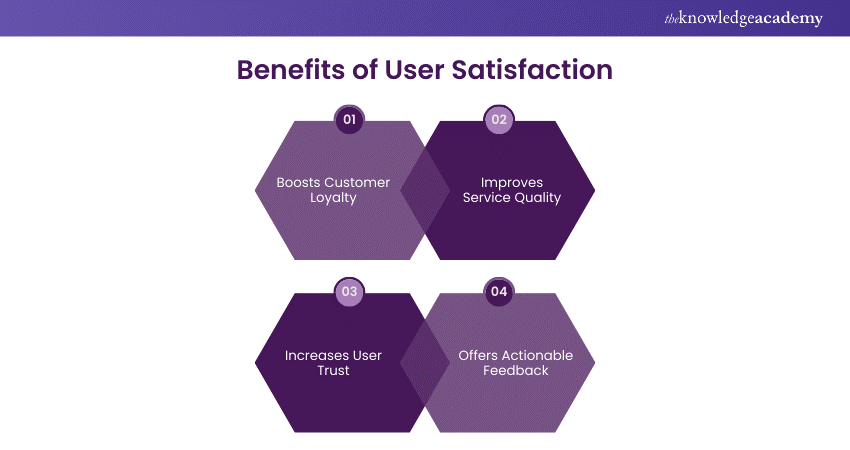
To improve this metric, organisations can focus on providing effective solutions, maintaining clear communication, and ensuring a user-friendly support experience.
For example, if 90 out of 100 users rate their experience as satisfactory, the user satisfaction rate is 90%.
4) Net Promoter Score (NPS)
It measures the likelihood of users recommending IT services to others. It's calculated based on user responses to the question, “How likely are you to recommend our IT services to a colleague?” A high NPS indicates strong user loyalty and satisfaction. To boost NPS, IT service desks should focus on resolving issues instantly.
For example, if 70 users are promoters, 20 are passives, and 10 are detractors, the NPS is 60.
Master IT Asset Management for better cost-efficiency and compliance in our ITIL® 4 Specialist: IT Asset Management Training - Sign up now!
5) Average First Response Time
It measures the average time taken for the IT service desk to respond to a user’s initial request. This metric is important because users expect quick acknowledgment of their issues. Reducing the first response time can improve user satisfaction in the IT service desk.

Strategies to improve this metric include automating initial responses and ensuring adequate staffing during peak times.
For example, if the total response time for 100 tickets is 500 minutes, the average first response time is 5 minutes.
Boost the efficiency of your team with our Certified Agile IT Service Manager (CAITSM) - Join today!
6) Average Resolution Time (ART)
Average Resolution Time (ART) measures the average time taken to resolve a ticket from the moment it is logged. This helps in understanding the efficiency of the IT service desk in resolving issues. A lower ART indicates faster resolution of issues, leading to higher user satisfaction.
To reduce ART, organisations can streamline their processes, provide better training to technicians, and use more efficient tools.
For example, if the total resolution time for 100 tickets is 1000 minutes, the ART is 10 minutes.
7) Resolution SLA Percent
Resolution SLA Percent measures the percentage of tickets solved within the agreed Service Level Agreement (SLA) timeframes. Meeting SLA targets is crucial for maintaining user trust.
To improve this metric, IT service desks should monitor SLA compliance regularly, identify bottlenecks, and take corrective actions to ensure timely resolution of tickets.
For example, if 90 out of 100 tickets are resolved within the SLA, the resolution SLA percent is 90%.
8) Mean Time to Resolve (MTTR)
It refers to the average time that it takes to solve an incident once it has been logged. This metric is similar to the ART but confined to incidents only. A lower MTTR means that the IT service desk brings efficiency by solving incidents with a shorter response time.
To achieve better MTTR, enhancements can be made in the management processes, training of technicians, and employing technological aid.
For example, if the total time to resolve 50 incidents is 500 minutes, the MTTR is 10 minutes.
9) Change Success Rate
It measures the percentage of changes that are successfully implemented without causing incidents, problems, or service disruptions. This metric is important for assessing the effectiveness of the Change Management process.

A high change success rate indicates that changes are well-planned. To improve this metric, organisations should follow best practices in Change Management. They should conduct thorough testing before implementation and ensure clear communication with all stakeholders.
For example, if 95 out of 100 changes are successful, the change success rate is 95%.
Understand how to align IT Services with business goals in our Certified IT Service Manager (CITSM) Certification - Sign up now!
The Importance of ITSM Metrics
Tracking metrics is vital for efficient ITSM for numerous reasons:
1) Finding Areas to Improve: Tracking metrics helps you identify weak spots in ITSM processes. This allows for better efficiency, cost savings and improved customer satisfaction.
2) Measuring Progress: Comparing data over time shows how ITSM is improving and highlights those areas that need more work.
3) Showing ITSM’s Value: These metrics help prove to leadership and stakeholders how ITSM can support business goals. This provides strong justification for resources and investments.
4) Predicting Issues: Spotting trends in data can reveal potential problems early on. This helps you prevent downtime and customer impact.
5) Making Better Decisions: Using real data instead of guesses ensures that ITSM decisions are well-informed and effective.
6) Aligning with Business Goals: Setting measurable targets ensures that ITSM services support overall business objectives and track performance effectively.
The Role of ITSM Tools
Using the right ITSM tool makes tracking performance easier. Modern ITSM systems provide dashboards, automate reports, and provide real-time insights. Remember the following points regarding ITSM tools:
1) A good ITSM platform must easily connect with existing systems for minimal disruptions.
2) It must be flexible enough to adapt to business needs and be scalable enough to support future growth without major modifications.
3) The platform must provide real-time data and insights to help teams make quick decisions.
4) A user-friendly interface and adaptable features make sure that employees can use the system without extensive training.
5) The tool must track key performance metrics, offering valuable insights into the efficiency of IT Service and improvement areas.
6) By analysing performance data, the platform must help refine IT processes and elevate overall Service Management.
7) It should identify recurring problems, allowing IT teams to address issues before they become major disruptions.
8) The platform must help improve response times and allocate resources effectively to increase productivity and reduce downtime.
Explore various techniques to improve organisational efficiency with our ITIL® 4 Specialist: Plan, Implement and Control Training - Sign up now!
What are the Four Dimensions of IT Service Management?
The four dimensions include:
1) Organisations and people
2) Information and technology
3) Partners and suppliers
4) Value streams and processes
What are ITSM Benchmarks?
Remember the following ITSM benchmarks:
1) Reducing call wait times and responding to tickets faster can positively impact your entire business.
2) Providing a great customer experience at your help desk can set you apart from competitors. In industries with many choices, customer satisfaction plays a key role in success.
Conclusion
Tracking the right IT Service Management Metrics is the key to continuous improvement for your organisation. By timely measuring performance, efficiency and customer satisfaction, you can optimise your IT Services and stay ahead of challenges. It's about focusing on data-driven insights to refine the processes, improve User Experience (UX) and User Interface (UI) for drive long-term IT success.
Learn best practices in IT Service Management with our ITIL® 4 Foundation Certification – Sign up today!
Frequently Asked Questions
How to Measure ITSM Success?

The success of an IT Service Management team can be measured by tracking a few key metrics:
a) Average first response time
b) Customer Satisfaction (CSAT)
c) Average resolution time
d) Average first assign time
e) First Contact Resolution (FCR)
f) Resolution SLA percentage
g) First response SLA percentage
What are the Goals of ITSM Performance?
The main goals of IT Service Management are to deliver IT Services smoothly, keep customers happy by meeting their expectations, and improve processes to boost efficiency while cutting costs.
What are the Other Resources and Offers Provided by The Knowledge Academy?
The Knowledge Academy takes global learning to new heights, offering over 3,000+ online courses across 490+ locations in 190+ countries. This expansive reach ensures accessibility and convenience for learners worldwide.
Alongside our diverse Online Course Catalogue, encompassing 19 major categories, we go the extra mile by providing a plethora of free educational Online Resources like Blogs, eBooks, Interview Questions and Videos. Tailoring learning experiences further, professionals can unlock greater value through a wide range of special discounts, seasonal deals, and Exclusive Offers.
What is The Knowledge Pass, and How Does it Work?
The Knowledge Academy’s Knowledge Pass, a prepaid voucher, adds another layer of flexibility, allowing course bookings over a 12-month period. Join us on a journey where education knows no bounds.
What are Related Courses and Blogs Provided by The Knowledge Academy?
The Knowledge Academy offers various Agile IT Service Management Training, including the Certified Agile IT Service Manager (CAITSM) Course and Certified IT Service Manager (CITSM) Certification. These courses cater to different skill levels, providing comprehensive insights into 10 Benefits of IT Service Management (ITSM).
Our IT Service Management Blogs cover a range of topics related to IT Service Management, offering valuable resources, best practices, and industry insights. Whether you are a beginner or looking to advance your IT Service Management knowledge, The Knowledge Academy's diverse courses and informative blogs have got you covered.

The Knowledge Academy


Global Training Provider
The Knowledge Academy is a world-leading provider of professional training courses, offering globally recognised qualifications across a wide range of subjects. With expert trainers, up-to-date course material, and flexible learning options, we aim to empower professionals and organisations to achieve their goals through continuous learning.

Upcoming IT Service Management Resources Batches & Dates
Date
 Certified Agile IT Service Manager (CAITSM)
Certified Agile IT Service Manager (CAITSM)
Thu 9th Jul 2026
Certified Agile IT Service Manager (CAITSM)
Thu 5th Nov 2026

 If you wish to make any changes to your course, please


