


 Top Rated Course

We may not have the course you’re looking for. If you enquire or give us a call on +44 1344 203999 and speak to our training experts, we may still be able to help with your training requirements.
14 Key Facilitation Skills to Improve Team Performance
The Knowledge Academy 03 March 2026Facilitation skills help groups reach shared goals through clear communication, active listening, good time management and effective handling of group dynamics. These skills create a clear structure and keep discussions focused and productive. They also encourage wider participation and support smoother decision-making across the group.

Training Outcomes Within Your Budget!
We ensure quality, budget-alignment, and timely delivery by our expert instructors.
Table of Contents

When ideas are all over the place and some people do not get a chance to speak, meetings can quickly get off track. However, with proper technique, an expert facilitator can transform the chaos into understanding and teamwork. This blog is going to be about the great importance of strong Facilitation Skills in making discussions fruitful and guiding groups towards significant results.
Table of Contents
1) What are Facilitation Skills?
2) Why are Facilitation Skills Important?
3)14 Essential Facilitation Skills
4) What Challenges do Facilitators Commonly Face?
5) What is the Difference Between a Facilitator and a Moderator?
6) Conclusion
What are Facilitation Skills?
Facilitation Skills blend competencies and soft skills to design and guide group processes effectively. These skills shine when planning and leading collaborative efforts like workshops. For more on workshops, check out our guide. Facilitation often involves using activities, tools, and methods in workshops.
Seasoned facilitators build a toolkit of proven processes and templates. Behind-the-scenes (BTS), facilitation includes preparing and designing meetings, events, and activities, shaping agendas to help groups achieve their goals. Various software tools assist facilitators in delivering great sessions, and Facilitation books are invaluable for exploring new techniques and tools that can enhance a facilitator's toolkit.
Why are Facilitation Skills Important?
Strong Facilitation Skills help teams communicate, collaborate, and achieve better results. Whether you're leading a meeting, running a workshop, or managing a project, knowing how to guide discussions and keep things on track makes all the difference. Here’s why these skills matter:
a) Improves Communication: Helps people express ideas clearly and listen actively.
b) Encourages Collaboration: Creates an open space where everyone’s input is valued.
c) Boosts Problem-solving: Guides teams in brainstorming and finding creative solutions.
d) Keeps Meetings Productive: Ensures discussions stay focused and time is used effectively.
e) Strengthens Teamwork: Builds trust and engagement, making teams work better together.
f) Manages Conflict Smoothly: Helps navigate disagreements and find common ground.
g) Increases Efficiency: Speeds up decision-making and keeps projects moving forward.
h) Develops Leadership Skills: Enhances your ability to motivate and manage teams effectively.
14 Essential Facilitation Skills
Here is a descriptive list of the various Facilitation Skills that make a good Facilitator:

1) Active Listening Skills
For fruitful discussions to happen, it is a must to have all interlocutors feel that their opinions are really taken into account; hence, active listening is an essential skill for a facilitator. The application of such methods as paraphrasing, summarising, and positive reinforcement, among other things, supports the acknowledgement of participants and strengthens the voices of those who speak less.
2) Communication
A competent facilitator combines attentive listening with talk that is clear and brief. They convey their notions in a manner that is comprehended by all without taking over the conversation. By making their contributions targeted and allowing others to talk, they make it possible that every opinion is listened to, and the conversation remains useful.
3) Time Management
Effective facilitators recognise when discussions become circular and stall progress. They use strategies like summarising key points or refocusing the group to steer the conversation back on track. By redirecting thoughtfully and reading group dynamics, they keep discussions productive and purposeful.
4) Conflict Resolution
The proficient mediator is impartial and guarantees that all opinions get the same consideration while leading to common comprehension. They predict disputes in advance and implement preventive measures that are non-violent. Their aim at all times is to foster an environment for dialogue that is positive and respectful among all the parties concerned.
5) Adaptability
A skilled facilitator remains flexible and modifies his/her tactics immediately when the group's behaviour changes suddenly. He/she employs active listening, empathy, and fast problem-solving to perceive the mood and react appropriately. This adaptability allows them to lead the group without hitches, even in difficult or rapidly changing environments.
Start your SCADA Training today and enhance your industrial control skills.
6) Maintaining High Energy Levels
A powerful facilitator is someone who always has high energy to keep the group involved, innovative, and efficient. They monitor the mood in the room, notice when the energy goes down, and switch between different speeds and activities to give the participants a new boost of energy. They create a dynamic, cooperative atmosphere where goals are faster to reach by getting to know the different types of people.
7) Impartiality
Facilitators who are fair to all parties involved demonstrate that they are aware of their biases and treat every idea equally. They make it possible for all the people involved to express their thoughts, not only the ones who speak loudly. They continue to keep the process under control instead of affecting the content.
8) Group Dynamics Management
The best mediators are the ones who recognise the various personality types present in the group and change their method accordingly. They apply strategies that allow each person to take part in the discussion in a worthwhile way. If disturbances happen, they step in very skillfully so as to maintain a fair and fruitful conversation.
9) Decision-making
Facilitators provide easy-to-understand decision-making structures that allow different groups to assess alternatives in a rational manner. They apply participation methods to make sure all members take part in the process. If necessary, they will lead the group to agreement or assist them in comprehending and approving the ultimate decision.
10) Self-awareness
Strong facilitators are always conscious of the group’s progress as well as their own impact on the conversation. They run the risk of inadvertently supporting one side and obstructing progress if they do not have this self-awareness. Recognising their strengths and weaknesses, they keep neutral and manage the group more efficiently.
11) Questioning Techniques
Facilitators employ open-ended questions with the intention of obtaining complete and thorough answers. Clarifying questions sometimes reveal deeper insights and also helps to elucidate the points. Participants are encouraged to think about their own thoughts and behaviours through reflective questions, which ultimately leads to significant self-awareness.
Register for our Industry Training and stay ahead of the curve and thrive in your industry!
12) Cultural Sensitivity
It is acknowledged and appreciated by successful facilitators that there are cultural differences in the way people communicate and behave. They modify their methods to make sure that the conversations are perceived as inclusive and culturally suitable. They value different views, and thus, they build a venue where all the participants feel honoured and understood.
13) Technology Proficiency
The facilitators must have a good grasp of virtual meeting platforms and, at the same time, be able to manipulate the tools, such as breakout rooms or polls, in an effective manner. Tools for digital collaboration allow the team to easily share their ideas and work in an integrated manner. A quick fixing of the technical issues helps to keep the sessions going smoothly without interruption.
14) Emotional Intelligence
Facilitators are able to identify and control not only their feelings but also those of the group in order to maintain a smooth flow of conversation. They exhibit empathy through recognition of emotions and by comprehending the various points of view. Through the establishment of trust and connection, they facilitate a secure environment where participants are at ease with disclosing their thoughts and feelings.
What Challenges do Facilitators Commonly Face?
Many difficulties challenge the facilitator in relation to how sessions will be managed, how the group will engage and get involved, and how overall goals will be achieved.
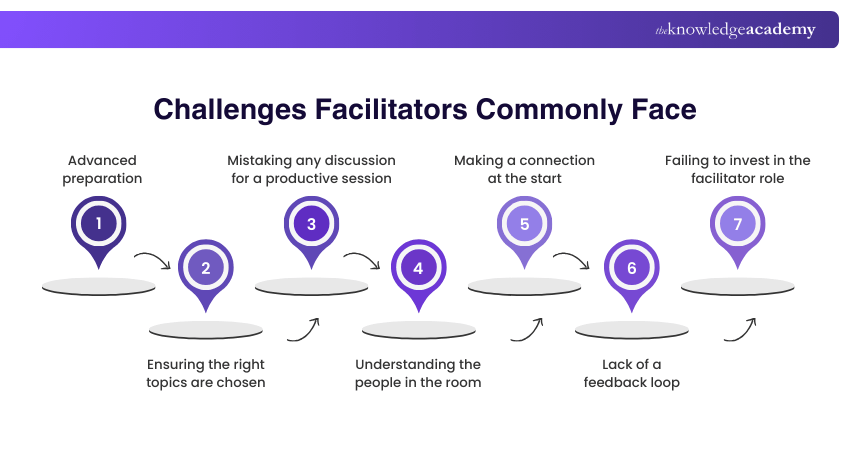
a) Advanced preparation: A facilitator may easily exceed the time allocated for preparation and still get the feeling of being under-prepared.
b) Ensuring the right topics are chosen: The facilitators must make sure that the topic is aligned with the real needs of the group and not just by guessing.
c) Mistaking any discussion for a productive session: Holding a discussion just for its own sake can lead to an unproductive facilitation session.
d) Understanding the people in the room: If one does not know the participants’ motivations, roles, and dynamics, it becomes difficult to guide the session successfully.
e) Making a connection at the start: The lack of early engagement with the participants through introductions or ice-breakers will weaken the trust and the energy of the group.
f) Lack of a feedback loop: Facilitators can lose the opportunity of learning and can also fail to make the necessary adjustments if there is no structured debriefing or review.
g) Failing to invest in the facilitator role: The diminishing of the effectiveness of the facilitator over time by treating facilitation as a skill that is needed once rather than as a discipline that requires continuous training disperses the effectiveness.
Optimise operations, cut costs, and lead with confidence – Join our Facilities Management Course.
What is the Difference Between a Facilitator and a Moderator?
Facilitators and moderators function differently; the bullet points show how their respective responsibilities and scopes differ.
The Facilitator: Facilitators guide groups through structured processes that help them collaborate effectively, stay focused, and reach shared outcomes without influencing the content or direction of the decision.
a) Process-oriented: Organises a formal agenda that leads the whole group towards a common goal.
b) Self-conscious: Observes their own feelings and remains emotionally stable during the whole meeting.
c) Trust-maker: Provides a comfortable atmosphere where the participants feel they are respected and have the right to speak.
d) Impartial: Is not interested in the result, and, at the same time, supports all opinions equally.
e) Socially Perceptive: Understands the interaction between the group and manages the energy to keep the focus on the constructive.
f) Goal-oriented: Always directs the group to the objectives that they have agreed upon and helps them in achieving a consensus.
g) Understanding: Perceives the speaker's feelings, spots conflicts quickly, and brings back the focus to those who have lost it.
h) Perceptive: Relates the replies of the participants to the process and brings out the thinking that is both creative and purposeful.
The Moderator: Moderators are in charge of the discussions and manage them by controlling the conversation flow, making sure the agenda remains on track and that the participants are involved with the main topic.
a) Topic-focused: Directs discussion around a specific subject or theme.
b) Time-keeper: Manages pacing, structure, and transitions during the session.
c) Conversation Controller: Guides who speak when and ensure orderly participation.
d) Content-oriented: Concentrates on what is being said rather than how the group interacts.
e) Clarifier: Asks questions to highlight key points and maintain relevance.
f) Balanced: Ensures all viewpoints are heard without allowing any one voice to dominate.
g) Agenda-driven: Keeps the discussion aligned with the planned flow or event structure.
h) Presenter-like: Acts as a host who connects speakers, segments, and audience engagement.
Conclusion
The ability to facilitate effectively is not just about regulating discussions but also about opening up the possibility for real cooperation and movement forward. Elevating your Facilitation Skills is going to make it easier for the group to perform at a higher level, but it will also change the communication and problem-solving patterns of the people involved.Build systems that last.
Sign up for our Reliability Engineering Training today and enhance performance!
Frequently Asked Questions
What are the Three Basic Principles of Facilitation?

Facilitation is guided by three core principles: neutrality, inclusivity, and adaptability. Neutrality ensures the facilitator remains unbiased, inclusivity encourages active participation from all members, and adaptability allows adjustments to meet the group’s evolving needs and dynamics.
What is the Difference Between Facilitation and Mediation?
Facilitation refers to a neutral third party leading the design and process of the group's communication to deal with the problem, while mediation aims at the settlement of a dispute between the parties.
What are the Other Resources and Offers Provided by The Knowledge Academy?
The Knowledge Academy takes global learning to new heights, offering over 3,000+ online courses across 490+ locations in 190+ countries. This expansive reach ensures accessibility and convenience for learners worldwide.
Alongside our diverse Online Course Catalogue, encompassing 17 major categories, we go the extra mile by providing a plethora of free educational Online Resources like Blogs, eBooks, Interview Questions and Videos. Tailoring learning experiences further, professionals can unlock greater value through a wide range of special discounts, seasonal deals, and Exclusive Offers.
What is The Knowledge Pass, and How Does it Work?
The Knowledge Academy’s Knowledge Pass, a prepaid voucher, adds another layer of flexibility, allowing course bookings over a 12-month period. Join us on a journey where education knows no bounds.
What are the Related Courses and Blogs Provided by The Knowledge Academy?
The Knowledge Academy offers various Industry Training, including the Facilities Management Training, Product Management Training, and Reliability Engineering Training. These courses cater to different skill levels, providing comprehensive insights into Facilities Management.
Our Business Skills Blogs cover a range of topics related to Facilitation Skills, offering valuable resources, best practices, and industry insights. Whether you are a beginner or looking to advance your Business Skills, The Knowledge Academy's diverse courses and informative blogs have got you covered.

The Knowledge Academy


Global Training Provider
The Knowledge Academy is a world-leading provider of professional training courses, offering globally recognised qualifications across a wide range of subjects. With expert trainers, up-to-date course material, and flexible learning options, we aim to empower professionals and organisations to achieve their goals through continuous learning.

Upcoming Business Skills Resources Batches & Dates
Date
 Facilitation Skills Training
Facilitation Skills Training
Fri 24th Jul 2026
Facilitation Skills Training
Fri 9th Oct 2026

 If you wish to make any changes to your course, please


