


 Top Rated Course

We may not have the course you’re looking for. If you enquire or give us a call on +44 1344 203999 and speak to our training experts, we may still be able to help with your training requirements.
What is AI Optimisation? Importance, Benefits, and Use Cases
Lily Turner 06 June 2026AI Optimisation improves system performance, efficiency, and accuracy. Understand why it is important for smarter decisions, automation, and business growth. It focuses on refining Artificial Intelligence (AI) models, processes, and systems to enhance adaptability, reduce errors, and support scalable, real-world applications.

Training Outcomes Within Your Budget!
We ensure quality, budget-alignment, and timely delivery by our expert instructors.
Table of Contents
Think about the last time a recommendation felt spot on, or a process worked faster than expected. Behind these seamless experiences is Artificial Intelligence (AI) working quietly in the background. However, simply using AI is not enough. Systems need to be refined to handle real-world demands, and that is where AI Optimisation plays a crucial role in improving how effectively these technologies perform.
By fine-tuning models, streamlining workflows, and making better use of resources, it helps organisations achieve consistent and practical results. In this blog, you will learn about What is AI Optimisation, its importance, components, benefits, and more. Let’s begin!
Table of Contents
1) What is AI Optimisation (AIO)?
2) Why is AI Optimisation Important?
3) Components of Artificial Intelligence Optimisation
4) How Does AI Optimisation Work?
5) Use Cases for AI Optimisation
6) What are the Benefits of AI Optimisation?
7) What are the Challenges of AI Optimisation?
8) Future Trends in Artificial Intelligence Optimisation
9) Conclusion
What is AI Optimisation (AIO)?
AI Optimisation refers to the use of Artificial Intelligence (AI) to improve performance, efficiency, and effectiveness across systems and processes. It focuses on refining AI models, enhancing data usage, and ensuring better outcomes. AIO covers multiple ways AI can be applied to optimise business and technological operations.
AI Optimisation can be grouped into three key areas. AI model optimisation improves the speed, accuracy, and efficiency of AI systems. AI process optimisation enhances and automates workflows. AI-driven optimisation focuses on improving specific strategies, such as digital experiences and content performance.

Why is AI Optimisation Important?
AI Optimisation is important because adopting AI is no longer enough to stay competitive. As organisations rely on AI for decision-making, automation, and customer interactions, the quality and performance of these systems directly influence outcomes. Without optimisation, AI models may produce slower, less accurate, or inconsistent results leading to reduced effectiveness.
By focusing on AI Optimisation, businesses can ensure their systems remain efficient, responsive, and aligned with evolving user expectations. It helps organisations adapt to change, improve performance over time, and make better use of AI across different functions. This enhances operational outcomes as well as supports long-term growth and innovation.
Components of Artificial Intelligence Optimisation
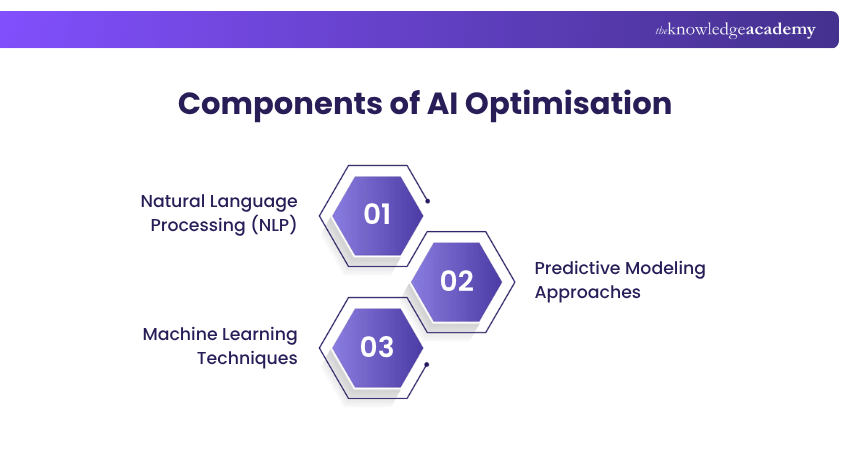
AI Optimisation is built on a set of core components that enable systems to understand data, learn from it, and make informed decisions. These components work together to enhance system performance, adaptability, and accuracy in real-world scenarios. Let’s explore them below:
1) Natural Language Processing (NLP)
Natural Language Processing enables AI systems to understand, interpret, and generate human language. It combines computational linguistics with Machine Learning (ML) to analyse text and speech. This capability allows systems to interact naturally with users, extract meaningful insights, and improve communication across digital platforms.
2) Predictive Modeling Approaches
Predictive modelling uses statistical techniques and Machine Learning to forecast future outcomes based on historical data. It helps organisations identify trends, anticipate risks, and make proactive decisions. By analysing patterns and probabilities, predictive models reduce uncertainty and support more strategic planning.
3) Machine Learning Techniques
Machine Learning (ML) allows AI systems to identify patterns in data and improve their performance. Learning from historical data allow these systems to make more accurate predictions and continuously refine their outputs as new data becomes available.
Build smarter products and power product decisions with AI automation by joining the AI Automation Course For Product Management – Sign up now!
How Does AI Optimisation Work?
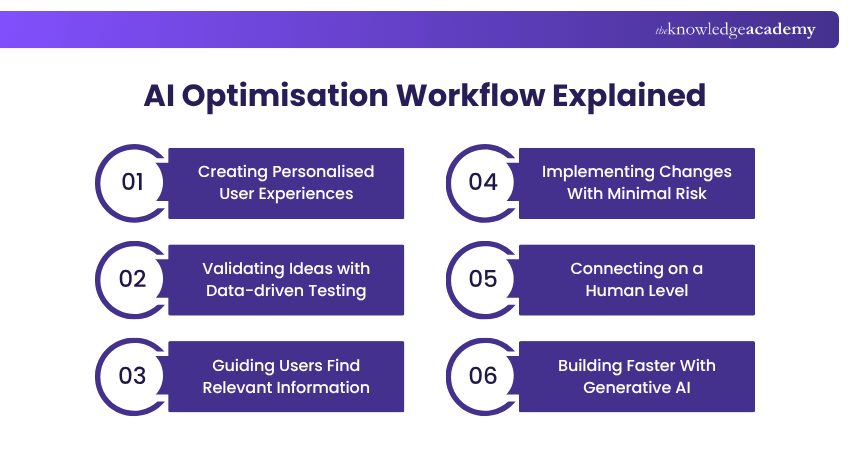
AI Optimisation functions as a connected system of intelligent capabilities that continuously analyse data, learn from user behaviour, and improve outcomes in real time. It combines automation, analytics, and adaptive learning to enhance both user experience and business performance. Let’s explore how it works:
1) Creating Personalised User Experiences
AI Optimisation uses behavioural data, preferences, and interaction patterns to create personalised experiences for each user. By analysing how individuals engage with products, content, or services, it delivers tailored recommendations and targeted messaging. This level of personalisation makes interactions relevant, increases user engagement and improves conversion outcomes.
2) Validating Ideas with Data-driven Testing
AI enables organisations to test ideas with greater speed and accuracy through continuous experimentation. AI-driven A/B and multivariate testing dynamically adjust traffic and learn from user responses in real time. This allows businesses to identify high-performing strategies and make confident, data-driven decisions.
3) Guiding Users Find Relevant Information
AI-powered recommendation systems help users discover the most relevant content, products, or next steps. By using real-time data and user preferences, these systems enhance the overall experience across websites, applications, and communication channels. This improves user satisfaction, strengthens retention, and engagement.
4) Implementing Changes With Minimal Risk
AI Optimisation supports safe and controlled deployment of updates through progressive rollouts. It continuously monitors performance and can automatically reverse changes if issues arise. This is helpful for reducing risk while allowing organisations to test and implement improvements efficiently.
5) Connecting on a Human Level
AI Optimisation analyses behavioural signals, such as navigation patterns and interaction data to better understand user intent and emotional responses. These insights help organisations create more empathetic and user-centric experiences that align closely with user needs and expectations.
6) Building Faster With Generative AI
Generative AI accelerates the optimisation process by enabling teams to create and test changes quickly using simple inputs. It reduces the need for complex coding and long development cycles. This allows organisations to experiment faster and continuously improve their digital experiences.
Supercharge campaigns with AI automation and personalise marketing with the AI Automation Course For Marketing – Sign up today!
Use Cases for AI Optimisation
AI Optimisation supports businesses across various practical areas by improving efficiency, reducing waste, and enabling smarter decision-making. By leveraging data and intelligent algorithms, organisations can respond quickly to changing demands and optimise both operations and customer engagement. Let’s explore some key use cases below:
1) Inventory Control
AI Optimisation helps businesses manage inventory more accurately by analysing sales patterns, stock levels, and demand fluctuations. It predicts future requirements based on historical data and customer behaviour. This reduces overstocking and stock shortages, improves product availability, lowers operational costs, and ensures smoother supply chain management.
2) Marketing Strategy Optimisation
In marketing, AI Optimisation helps organisations deliver relevant and targeted campaigns. By studying customer behaviour, preferences, and past purchases, AI can identify the right audience for specific messages and recommend the best time and channel for delivery. This improves campaign performance, increases engagement, and helps build stronger customer relationships.
3) Energy Consumption Management
AI Optimisation helps organisations monitor and improve energy usage across operations. By identifying patterns and inefficiencies, it enables smarter adjustments to systems such as heating, cooling, and equipment usage. This leads to reduced operational costs, improved efficiency, and stronger support for sustainability initiatives.
What are the Benefits of AI Optimisation?
AI Optimisation provides significant advantages by improving how systems, content, and processes perform. It enables organisations to deliver more relevant experiences, enhance decision-making, and streamline operations using data-driven insights. Let’s explore the key benefits:
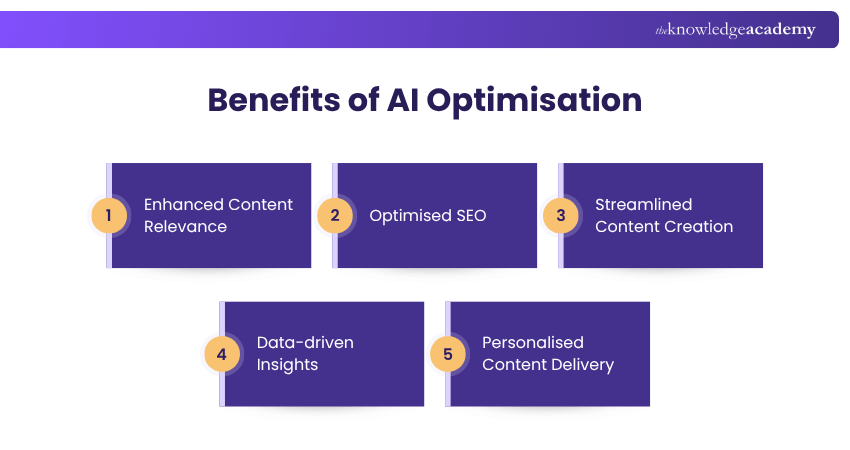
1) Enhanced Content Relevance
AI Optimisation analyses user behaviour, search intent, and demographic data to create content that closely matches audience needs. This improves engagement, increases click-through rates, and drives better conversion outcomes.
2) Optimised SEO
AI Optimisation helps to identify relevant keywords and optimise content for search engines. This improves visibility, increases organic traffic, and ensures content reaches the right audience more effectively.
3) Streamlined Content Creation
AI can automate repetitive tasks, such as tagging, categorisation, and optimisation. This reduces manual effort and allows teams to focus more on producing high-quality, strategic content. Also, it speeds up content workflows, enabling faster delivery and consistent output across channels.
4) Data-driven Insights
AI Optimisation provides valuable insights into audience behaviour, content performance, and market trends. These insights are valuable and help organisations make informed decisions to continuously improve their strategies.
5) Personalised Content Delivery
AI Optimisation enables personalised content delivery based on individual user preferences and behaviour. This is beneficial for creating more engaging experiences, improving customer satisfaction, and building stronger long-term relationships.
Automate IT processes with precision and transform systems with the AI Automation Course For IT – Sign up now!
What are the Challenges of AI Optimisation?
While AI Optimisation offers significant benefits, organisations may face several challenges during implementation and management. Addressing these challenges is essential to ensure reliable, ethical, and effective AI performance. Let’s explore them below:
1) Data Quality
AI systems are dependent on highly accurate and relevant data to perform effectively. Poor-quality data, such as incomplete, outdated, or incorrect information, can lead to unreliable outcomes. Also, ensuring clean and well-structured data requires time, effort, and strong data management practices.
2) Cost
Implementing AI Optimisation can involve high costs, including investment in tools, infrastructure, and skilled professionals. For many organisations, especially smaller ones, these expenses can be a barrier. Also, it is important to evaluate whether the long-term benefits justify the initial cost of the investment.
3) Change Management
Adopting AI requires changes in workflows and employee responsibilities. Some team members may feel uncertain or resistant to new technologies, which can slow down adoption efficiency. So, it is important to provide proper training and support to ensure a smooth transition.
4) Adapting to Rapid Technological Advancements
AI technologies evolve rapidly. This means organisations must stay updated with the latest tools and advancements. This involves continuous learning, regular system updates, and ongoing investment. Failing to keep pace can reduce competitiveness and limit the effectiveness of AI initiatives.
Future Trends in Artificial Intelligence Optimisation
As Artificial Intelligence evolves, AI Optimisation strategies are advancing to handle more complex systems and data. Technologies like quantum computing can improve how quickly complex problems are solved, while edge computing focuses on running efficient AI models on devices with limited resources. This will lead to a faster and more responsive performance.
At the same time, self-optimising AI systems are emerging, allowing models to improve automatically in real time. Also, Automated Machine Learning (AutoML) is making optimisation more accessible by simplifying model development. Together, these trends are making AI Optimisation more efficient, scalable, and widely usable across industries.
Conclusion
AI Optimisation plays a crucial role in helping organisations improve how AI systems perform, adapt, and deliver value. By refining models, enhancing workflows, and using data effectively, businesses can achieve better outcomes and stay competitive. As AI continues to grow, focusing on optimisation will ensure systems remain efficient, scalable, and aligned with real-world needs.
Redefine productivity and power your future with AI automation by joining the AI Automation Training today!
Frequently Asked Questions
What is an Example of AI Optimisation?

AI Optimisation can be seen in engines used by platforms like Netflix and Amazon, where AI analyses user behaviour to suggest relevant content or products. Also, it is used in logistics, predictive maintenance, and dynamic pricing to improve efficiency and decision-making.
Do I Need Technical Expertise to Use AI Optimisation Tools?
No, you do not need deep technical expertise to use most AI Optimisation tools. Many tools are designed for non-technical users, offering intuitive interfaces, drag-and-drop features, and simple workflows. These tools make it easier for teams to implement and benefit from AI effectively.
. What are the Other Resources and Offers Provided by The Knowledge Academy?
The Knowledge Academy takes global learning to new heights, offering over 3,000+ online courses across 490+ locations in 190+ countries. This expansive reach ensures accessibility and convenience for learners worldwide.
Alongside our diverse Online Course Catalogue, encompassing 17 major categories, we go the extra mile by providing a plethora of free educational Online Resources like Blogs, eBooks, Interview Questions and Videos. Tailoring learning experiences further, professionals can unlock greater value through a wide range of special discounts, seasonal deals, and Exclusive Offers.
What is The Knowledge Pass, and How Does it Work?
The Knowledge Academy’s Knowledge Pass, a prepaid voucher, adds another layer of flexibility, allowing course bookings over a 12-month period. Join us on a journey where education knows no bounds.
What are the Related Courses and Blogs Provided by The Knowledge Academy?
The Knowledge Academy offers various AI Automation Training, including the AI Automation Course For Operations, AI Automation Course For Product Management, and AI Automation Course For Marketing. These courses cater to different skill levels, providing comprehensive insights into Chain of Thought Prompting.
Our Data, Analytics & AI Blogs cover a range of topics related to AI Optimisation, offering valuable resources, best practices, and industry insights. Whether you are a beginner or looking to advance your AI Optimisation skills, The Knowledge Academy's diverse courses and informative blogs have got you covered.

Lily Turner


Senior AI/ML Engineer and Data Science Author
Lily Turner is a data science professional with over 10 years of experience in artificial intelligence, machine learning, and big data analytics. Her work bridges academic research and industry innovation, with a focus on solving real-world problems using data-driven approaches. Lily’s content empowers aspiring data scientists to build practical, scalable models using the latest tools and techniques.
View Detail
Upcoming Data, Analytics & AI Resources Batches & Dates
Date
 AI Automation Course for Operations
AI Automation Course for Operations
Fri 21st Aug 2026
AI Automation Course for Operations
Fri 13th Nov 2026

 If you wish to make any changes to your course, please


