


 Top Rated Course

We may not have the course you’re looking for. If you enquire or give us a call on + 1-866 272 8822 and speak to our training experts, we may still be able to help with your training requirements.
What is Information Management? A Beginner's Guide
The Knowledge Academy 12 February 2026Information Management is a necessity today. They help organisations to access information easily when needed. Continue reading this blog, where we shall uncover What is Information Management, tips & challenges, and other practical insights. So, let's embark on the thrilling blend of information with technology.

Training Outcomes Within Your Budget!
We ensure quality, budget-alignment, and timely delivery by our expert instructors.
Table of Contents

Data is everywhere, from your smartphones to large enterprises. A report by "Exploding Topics" shows that approximately 402.74 million terabytes of data are created daily. This is around 80.55 trillion songs per day (considering each song of 3 MB size). So, for such an enormous amount of data, you require a professional to draw conclusions and make informed decisions.
That's where the Information Management department steps in! In this blog, you will learn about what is Information Management, its roles & responsibilities, and other fascinating yet valuable insights.
Table of Contents
1) What Is Information Management?
2) The Role of Information Management in the Workplace
3) Effective Information Management Tips
4) Information Management Challenges
5) Future of Information Management
6) Conclusion
What is Information Management?
Information Management refers to the systematic process of collecting, storing, organising, maintaining, and using Data and Information. This practice is crucial for organisations as it enables efficient decision-making, improves productivity, and ensures the security and accessibility of information. Effective Information Management involves using technologies and methodologies that can handle both digital and physical information resources.
A key component of Information Management is the establishment of policies and procedures that govern the ways information is handled within an organisation. This includes setting data privacy and security guidelines and complying with relevant regulations.
For example, securely and organised patient records in a healthcare setting. This ensures that healthcare providers have access to accurate and up-to-date patient information, facilitating better patient care and decision-making. Electronic Health Records (EHR) systems are a standard tool used for this purpose, allowing for the digital storage and retrieval of patient information.
Another example is in a business environment, where Information Management might involve using Customer Relationship Management (CRM) systems. These systems help businesses seamlessly manage customer data, track interactions, and analyse customer behaviour. This allows companies to enhance customer service, streamline operations, and tailor marketing efforts based on data-driven insights.
The Role of Information Management in the Workplace
The Information Management plays a crucial role in the workplace success. Here are some of the roles of Information Management you might be dealing with every day:

1) Manages the Creation of Records
Information Management oversees the systematic creation, classification, and storage of records, ensuring all necessary documents are accurately generated and organised for easy retrieval and future reference.
2) Ensures Regulatory Compliance
It ensures that all information handling practices comply with relevant laws and regulations. This safeguards the organisation from legal issues and penalties related to data mismanagement and non-compliance.
3) Reduces Operating Costs
Effective Information Management minimises unnecessary data duplication and storage, streamlines workflows, and reduces manual tasks. This approach reduces operational expenses and resource wastage.
4) Facilitates Adoption of New Technologies
It supports integrating new technologies by ensuring data is structured and managed effectively. The approach is implemented so that new systems can easily access and use it, promoting innovation and digital transformation.
5) Enhances Productivity and Efficiency
Information Management helps employees quickly access the necessary information by organising and centralising data. As a result, it reduces the time spent searching and increases overall workplace efficiency and productivity.
6) Mitigates Risks
Proper Information Management identifies and addresses potential risks related to data security, privacy breaches, and information loss. This protects the organisation from various threats and vulnerabilities.
7) Safeguards Proprietary Information and Preserves Corporate Memory
It protects sensitive and proprietary information from unauthorised access while preserving historical data and corporate knowledge, supporting long-term business continuity and strategic planning, as outlined in the ISO 27701 Guide
Master data privacy management with ISO 27701 Training. Ensure compliance and protect sensitive information!
Effective Information Management Tips
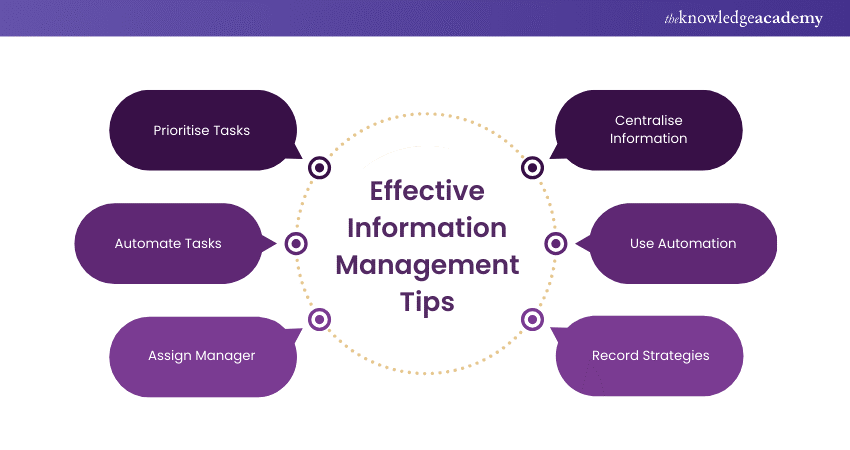
There are specific tips that can help you achieve higher workplace efficiency through understanding What is Information Management, when implementing Information Management practices successfully. Those tips are described below:
1) Prioritise Tasks
Identify and focus on the most critical Information Management tasks first. Prioritising helps allocate resources efficiently, ensuring that essential data is managed effectively, and urgent matters are addressed promptly, thus maintaining smooth operations.
2) Automate Tasks
Implement automation tools to handle repetitive and time-consuming tasks. Automation increases efficiency, reduces human error, and frees up valuable time for employees to focus on more strategic activities, enhancing overall productivity.
3) Assign Manager
Designate a dedicated information manager to oversee data management processes. This ensures accountability, consistent application of policies, and effective coordination among team members, leading to improved management of information resources, along with considerations like Information Manager Salary for attracting skilled professionals.
4) Centralise Information
Create a central repository for storing and accessing information. Centralisation simplifies data retrieval, ensures consistency, and enhances collaboration by providing a single source of truth for all organisational information.
5) Use Automation
Leverage advanced automation technologies like AI and machine learning for data analysis and management. These tools can quickly process large volumes of data, providing insights and improving decision-making processes while reducing manual effort.
6) Record Strategies
Document Information Management strategies and policies. Having well-defined strategies ensures everyone understands the procedures, promotes consistency in data handling, and provides a reference point for training new employees and maintaining best practices.
Become a certified Lead Auditor with ISO 27701 Lead Auditor Training. Lead privacy audits with confidence and expertise!
Information Management Challenges
Information Management faces several challenges that impact organisational efficiency and effectiveness.
One significant challenge is data overload. The exponential growth of data can overwhelm systems and personnel. For example, a multinational corporation might need help processing and analysing vast amounts of customer data, leading to delays in decision-making and lost opportunities. Data security and privacy are another critical issue. Protecting sensitive information from breaches is crucial.
Compliance with regulations presents another challenge. Adhering to various data protection laws across regions can be complex. For instance, the General Data Protection Regulation (GDPR) in the European Union imposes strict data handling rules. Companies like Google have faced hefty fines for non-compliance, highlighting the need for comprehensive compliance strategies.
Integration of new technologies with existing systems can also be challenging. For example, a healthcare provider adopting electronic health records (EHR) might face difficulties integrating them with older systems, causing disruptions and requiring extensive staff training.
Ensuring data quality and consistency is critical. A retail chain with multiple branches might need more consistent sales data reporting, leading to flawed inventory management and sales forecasting. Additionally, adapting to new Information Management practices can meet resistance from employees. When a company transitions to a digital document management system, employees accustomed to paper-based processes might resist the change, slowing down the implementation.
Lastly, investing in advanced Information Management systems can be expensive. Small businesses might find it difficult to allocate a budget for high-end solutions, leading to reliance on less efficient methods and potential competitive disadvantages.
Future of Information Management
The future of Information Management is poised to be transformative, driven by advancements in technology and evolving business needs. As organisations continue to generate vast amounts of data, the focus will shift towards harnessing this data for strategic advantage. Emerging technologies like Artificial Intelligence (AI) and Machine Learning (ML) will play a crucial role in automating data processing, enhancing accuracy, and providing deeper insights.
One significant trend is the increased use of AI for predictive analytics. For instance, in healthcare, AI can analyse patient data to predict disease outbreaks, personalise treatment plans, and improve patient outcomes. This predictive capability allows for proactive decision-making, ultimately enhancing the efficiency and effectiveness of healthcare delivery.
Another development is the rise of blockchain technology for secure and transparent data management. In finance, blockchain can streamline transactions, reduce fraud, and enhance compliance.
For example, banks are exploring blockchain to manage financial records and contracts, ensuring data integrity and reducing the risk of tampering.
Integrating Internet of Things (IoT) devices will also revolutionise Information Management. In manufacturing, IoT sensors can collect real-time data on equipment performance, enabling predictive maintenance and reducing downtime. This leads to increased productivity and cost savings, as issues can be addressed before they escalate into significant problems.
Moreover, cloud computing will continue to be a cornerstone of Information Management. Cloud solutions offer scalable storage, seamless data access, and collaboration capabilities. Companies like Amazon and Microsoft are expanding their cloud services, providing businesses with the flexibility to manage data efficiently and support remote work environments.
Conclusion
We hope you find the blog useful on What is Information Management. Information Management streamlines organisational processes by enabling efficient data handling and decision-making. One key component in managing and monitoring these systems is the Management Information Base (MIB), which stores information used by network management protocols. Whether employing automation for productivity or implementing robust security measures, effective Information Management is essential for modern businesses.
Take charge of privacy compliance. Gain expert skills with ISO 27701 Lead Implementer training!
Frequently Asked Questions
What are Information Management Procedures?

Information Management procedures are systematic guidelines that outline how to collect, store, organise, maintain, and use data. These procedures ensure data security, compliance with regulations, and efficient access to information, ultimately supporting informed decision-making and operational efficiency.
What are the 5 Keys of Information Management?
The five keys of Information Management are collection, gathering accurate data; storage, ensuring data is safely stored and accessible; organisation, structuring data for efficient retrieval; maintenance, regularly updating and securing data; and usage, effectively utilising data for decision-making and operations.
What are the Other Resources and Offers Provided by the Knowledge Academy?
The Knowledge Academy’s Knowledge Pass, a prepaid voucher, adds another layer of flexibility, allowing course bookings over a 12-month period. Join us on a journey where education knows no bounds.
What is the Knowledge Pass, and How Does it Work?
The Knowledge Academy’s Knowledge Pass, a prepaid voucher, adds another layer of flexibility, allowing course bookings over a 12-month period. Join us on a journey where education knows no bounds.
What Are The Related Courses and Blogs Provided by the Knowledge Academy?
The Knowledge Academy offers various ISO 27017 Trainings, including the ISO 27017 Information Security Controls for Cloud Services Course. These courses cater to different skill levels, providing comprehensive insights into the Information Security Risk Management.
Our IT Security & Data Protection Blogs cover a range of topics related to ISO 27017, offering valuable resources, best practices, and industry insights. Whether you are a beginner or looking to advance your knowledge of IT Security & Data Protection, The Knowledge Academy's diverse courses and informative blogs have got you covered.

The Knowledge Academy


Global Training Provider
The Knowledge Academy is a world-leading provider of professional training courses, offering globally recognised qualifications across a wide range of subjects. With expert trainers, up-to-date course material, and flexible learning options, we aim to empower professionals and organisations to achieve their goals through continuous learning.

Upcoming IT Security & Data Protection Resources Batches & Dates
Date
 ISO 27701 Foundation Training
ISO 27701 Foundation Training
Mon 11th May 2026
ISO 27701 Foundation Training
Mon 17th Aug 2026
ISO 27701 Foundation Training
Mon 7th Dec 2026

 If you wish to make any changes to your course, please


