


 Top Rated Course

We may not have the course you’re looking for. If you enquire or give us a call on +44 1344 203 999 and speak to our training experts, we may still be able to help with your training requirements.
Magento vs WooCommerce: Key Differences Explained
Lily Turner 16 July 2026In the Magento vs WooCommerce debate, choosing the right platform is crucial for your long-term eCommerce success and future growth. This comparison explores their key features, costs, and growth potential, helping you decide which aligns with your vision and goals. Which one will power your dreams? Let’s dive in and find out!

Training Outcomes Within Your Budget!
We ensure quality, budget-alignment, and timely delivery by our expert instructors.
Table of Contents
Launching an online store is a thrilling journey, but it all starts with one pivotal decision: which eCommerce platform will power your success? In the battle of Magento vs WooCommerce, the stakes are high. Do you pick the feature-rich, customisable platform or the one with seamless WordPress integration? It’s more than functionality—it’s about finding the perfect fit for your business's growth.
Which platform aligns with your vision—Magento or WooCommerce? This comparison will assist you through their essential features, costs, and potential. Let’s dive into the key differences between Magento vs WooCommerce to help you make the best choice for your eCommerce venture.
Table of Contents
1) What is Magento?
2) What is WooCommerce?
3) Magento vs WooCommerce: Key Differences
4) Advantages and Disadvantages of Magneto
5) Advantages and Disadvantages of WooCommerce
6) Conclusion
What is Magento?
Magento is an Open Source eCommerce platform known for its robust features and scalability. Launched in 2008, it's ideal for businesses needing customisable, expansive online stores. With advanced SEO, marketing tools, and product management, Magento suits medium to large enterprises with complex requirements.
Magento is accessible in two main versions: Magento Open Source (formerly Magento Community) and Magento Commerce (formerly Magento Enterprise). The former is free and Open Source, while the latter offers additional features and support but comes with a significant price tag.

What is WooCommerce?
WooCommerce is an extension for WordPress that transforms a basic website into a fully functional eCommerce store. WooCommerce, launched in 2011, gained popularity for its user-friendliness and seamless integration with WordPress. WooCommerce is free to use, although there are paid extensions available to enhance its functionality. For those looking to hire a professional to tailor the platform to their needs, it’s important to consider the WooCommerce Developer Salary, which reflects the expertise required to maximise the platform’s potential.
Designed with small to medium-sized businesses in mind, WooCommerce is perfect for those who already have a WordPress site or are familiar with the WordPress environment. It provides a straightforward, user-friendly way to start selling products online without requiring a lot of technical expertise.
Unlock the secrets of WooCommerce: master the essentials with our expert WooCommerce Training today!
Magento vs WooCommerce: Key Differences
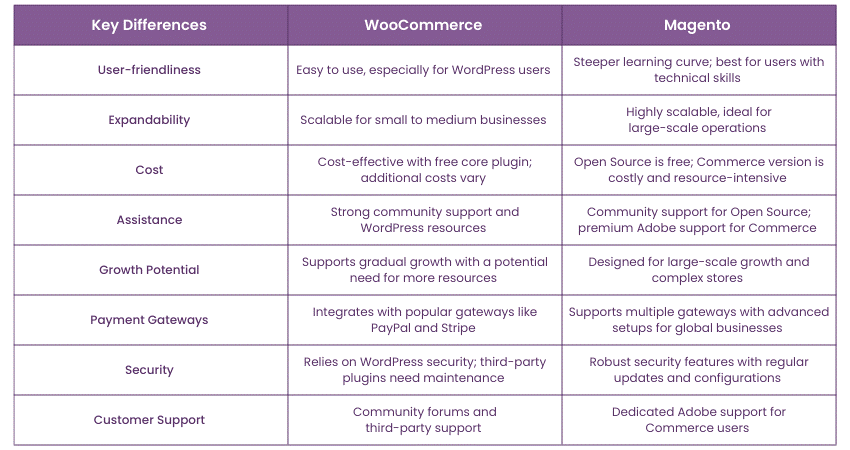
The following is the difference between WooCommerce and Magento, understanding their key differences is essential to determine which platform best suits your eCommerce needs.
1) User-friendliness
When it comes to user-friendliness, WooCommerce takes the lead. Since it's a WordPress plugin, users familiar with WordPress will find WooCommerce intuitive and easy to navigate. The setup process is straightforward, and managing products, orders, and customers is hassle-free.
Magento, on the other hand, has a more challenging learning curve. Its extensive features and customisation options can be overwhelming for small business who lack technical expertise. However, for those with the right resources, Magento offers unparalleled control and flexibility, making it worth the effort to learn.
2) Expandability
Both platforms offer high expandability but in different ways. Magento is known for its scalability, enabling businesses to grow their online stores without worrying about performance issues. It can handle thousands of products and process large volumes of transactions, making it ideal for large enterprises.
WooCommerce, while also scalable, relies heavily on WordPress's infrastructure. It can handle a large amount of traffic and products, but it may require additional plugins or server resources as your store grows. WooCommerce's expandability is more suited for small to medium-sized businesses, whereas Magento is better for large-scale operations.
3) Cost
The cost of setting up and maintaining an eCommerce store varies significantly between Magento and WooCommerce. WooCommerce is generally more cost-effective, especially for small businesses. The core plugin is free, and while there are costs associated with hosting, themes, and extensions, these are often more affordable compared to Magento.
Magento Open Source is free, but the associated costs can add up quickly. Magento Commerce, which offers advanced features and support, comes with a hefty price tag. Additionally, the cost of hosting a Magento store is higher due to the platform's resource-intensive nature. Businesses may also need to hire developers to manage and customise their Magento store, further increasing costs. As a result, the demand for skilled Magento developers drives up Magento Developer Salary, especially for those with experience in managing large-scale projects.
4) Assistance
When it comes to support, both platforms offer different levels of assistance. WooCommerce has a large and active community with extensive documentation, forums, and tutorials available. Additionally, because it’s a WordPress plugin, WooCommerce users can also tap into the vast WordPress community for help.
Magento also has a strong community, especially for the Open Source version. However, due to its complexity, the support resources for Magento are more technical. Magento Commerce users benefit from dedicated support directly from Adobe. This premium service is not available to Open Source users.
5) Growth Potential
Magento is designed with growth in mind. Its powerful architecture and extensive feature set make it capable of supporting large, complex online stores with ease. As your business expands, Magento can handle increased traffic, more products, and additional customisations without compromising performance.
WooCommerce is also capable of supporting growing businesses, but it is better suited for gradual growth. While it can handle a large number of products and customers, it may require additional resources and optimisations as your store scales. For businesses planning rapid or large-scale growth, Magento might be the better long-term solution.
6) Payment Gateways
Both Magento and WooCommerce support a wide range of payment gateways. WooCommerce offers integrations with popular options like PayPal, Stripe, and Square, as well as numerous other payment processors through extensions.
Magento supports multiple payment gateways, offering flexibility in payment options. It also allows for more complex payment processing setups, benefiting businesses operating in multiple countries or handling high transaction volumes. Magento's flexibility in payment options is one of its standout features, especially for larger businesses with more complex needs.
Discover our top-rated Framework Courses to enhance your skills and achieve your career goals efficiently!
7) Security
Security is a critical evaluation for any eCommerce platform. Magento is known for its robust security features. It provides frequent updates and security patches to protect your store from vulnerabilities. Additionally, Magento allows for advanced security configurations, which can be customised to meet particular business requirements.
WooCommerce, being a WordPress plugin, benefits from WordPress’s security updates. However, because WooCommerce relies on third-party plugins for additional functionality, security can sometimes be a concern if these plugins are not properly maintained. To ensure a secure WooCommerce store, it's essential to keep both WordPress and all plugins updated regularly.
8) Customer Support
Customer support is another area where the two platforms differ. WooCommerce users primarily rely on the extensive documentation and community forums for support. There are also third-party providers that offer premium support services for WooCommerce, but this is not included with the plugin itself.
Magento Commerce users, on the other hand, have access to dedicated support from Adobe. This includes 24/7 technical support, cloud hosting services, and a range of other resources designed to ensure your store runs smoothly. Magento Open Source users rely more on community forums and third-party developers for support.
Boost Your Confidence! Learn the Must-Know Shopify Interview Questions and Answers.
Advantages and Disadvantages of Magneto
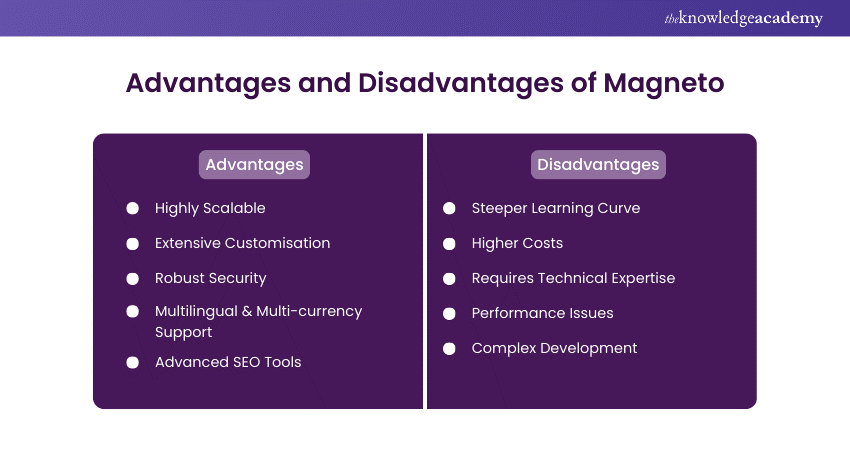
Here’s a look at the key advantages and disadvantages of using Magento for your online store.
Advantages:
a) Highly scalable and suitable for large businesses
b) Extensive customisation options
c) Robust security features
d) Support for multiple languages, currencies, and stores
e) Advanced SEO and marketing tools
Disadvantages:
a) The steeper learning curve is not ideal for beginners
b) Higher costs associated with hosting, development, and maintenance
c) Requires more technical expertise
d) Slower performance if not optimised correctly
e) Requires advanced skills for customisation and integration
Step up your eCommerce skills with our Magento Training - learn from experts and achieve online success!
Advantages and Disadvantages of WooCommerce
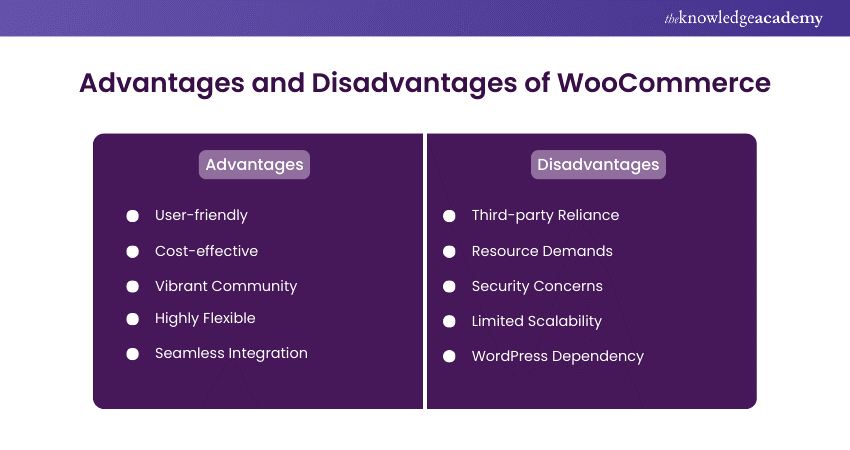
Below are the main advantages and disadvantages of WooCommerce.
Advantages:
a) Easy to use, especially for WordPress users
b) Cost-effective with a free core plugin
c) Large community and extensive documentation
d) Flexible with an extensive range of plugins and themes
e) Seamless integration with WordPress
Disadvantages:
a) Relies on third-party plugins for advanced features
b) It may require additional resources as the store grows
c) Security concerns with some plugins
d) Limited scalability compared to Magento
e) Dependent on WordPress for functionality and performance
Begin your Shopify journey today—register in our Introduction to Shopify Course to kickstart your online store adventure!
Conclusion
In the Magento vs WooCommerce debate, the best platform depends on your business’s unique needs and aspirations. Magento vs Shopify also presents a similar comparison where Magento offers unmatched customisation and scalability, while WooCommerce shines with its ease of use and WordPress integration. Choose wisely—the right platform will be the engine that drives your eCommerce success story.
Enhance your capabilities with our End User Training —real-world skills and expert knowledge to advance your career!
Frequently Asked Questions
What's the Simplest way to Create an Online Store?

The simplest way to create an online store is to use WooCommerce with WordPress. It's user-friendly, integrates seamlessly, and requires minimal technical knowledge to get started quickly.
Is Magento the Best eCommerce Platform?
Magento is one of the best eCommerce platforms for large businesses needing extensive customisation and scalability. However, its complexity may not be ideal for smaller businesses or beginners.

Lily Turner


Senior AI/ML Engineer and Data Science Author
Lily Turner is a data science professional with over 10 years of experience in artificial intelligence, machine learning, and big data analytics. Her work bridges academic research and industry innovation, with a focus on solving real-world problems using data-driven approaches. Lily’s content empowers aspiring data scientists to build practical, scalable models using the latest tools and techniques.
View Detail

 If you wish to make any changes to your course, please


