


 Top Rated Course

We may not have the course you’re looking for. If you enquire or give us a call on +41 315281584 and speak to our training experts, we may still be able to help with your training requirements.
What is Outsourcing? Types, Benefits, and Challenges
The Knowledge Academy 04 February 2026Outsourcing helps businesses save time, cut costs, and improve efficiency by hiring external experts to handle specific tasks. It allows companies to focus on their work while professionals take care of services like IT and manufacturing. This blog explains Outsourcing types, benefits and how businesses can use it effectively.

Training Outcomes Within Your Budget!
We ensure quality, budget-alignment, and timely delivery by our expert instructors.
Table of Contents
Have you ever wondered how businesses handle so many tasks without doing everything themselves? The answer lies is Outsourcing—a smart way for companies to hire outside experts for specific jobs like IT support, customer service, or manufacturing. Instead of struggling to do everything in-house, businesses focus on what they do best while specialists handle the rest. This saves time, reduces costs, and improves efficiency. In this blog, we will discuss What is Outsourcing, how Outsourcing works and its challenges. Let’s get started!
Table of Contents
1) What is Outsourcing?
2) How Outsourcing Works?
3) Outsourcing Types
4) Outsourcing Examples
5) Benefits of Outsourcing
6) Challenges of Outsourcing
7) Outsourcing Mistakes to Avoid
8) Top IT Outsourcing Companies
9) Insourcing vs Outsourcing
10) Conclusion
What is Outsourcing?
Outsourcing is when a company hires another business or individual to do certain tasks instead of doing them in-house. This can include services like customer support, IT management, marketing, or manufacturing. Companies outsource to save time, reduce costs, and focus on their main business activities.
Outsourcing is also common in big companies. For example, a technology company might hire a software development firm to build an app instead of creating an in-house team. This helps them save money and complete the project faster. When done correctly, Outsourcing improves efficiency and helps businesses stay competitive.
How Outsourcing Works?
Outsourcing allows businesses to hire external experts or companies to handle specific tasks. Here is how it works:
a) Identify the Task: The company decides which work to outsource, such as IT support, Customer Service Outsourcing, or marketing.
b) Find the Right Provider: Businesses choose a trusted Outsourcing company or freelancer who has the right skills.
c) Set Clear Terms: Both parties agree on work details, deadlines, and payment.
d) Start the Work: The Outsourcing provider begins the task while the company focuses on other business needs.
e) Monitor Progress: Regular updates and feedback ensure the work meets company expectations.
f) Evaluate Results: Once completed, the company reviews the work and decides if they will continue Outsourcing.
Outsourcing Types
Here are the key types:
Offshoring
This is when a company hires a service provider in another country, usually far away. Businesses do this to save money, access skilled workers, and work around the clock due to different time zones. Many companies offshore IT services, customer support, and manufacturing to countries with lower costs.
a) Reduces business costs by hiring in countries with lower wages
b) Provides access to a bigger talent pool with specialised skills
c) Allows work to continue 24/7 due to different time zones
Nearshoring
This is Outsourcing work to a nearby country instead of a faraway one. It helps businesses save money while keeping the same time zone or cultural similarities for easier communication. Many European companies nearshore to neighbouring countries for better cost and efficiency.
a) Makes communication easier due to the same time zones
b) Reduces costs while keeping high-quality services
c) Improves collaboration with similar languages and cultures
Onshoring
This is when a company outsources work to a provider in the same country. This keeps jobs within the country and ensures better control over quality and service. Businesses choose onshoring when they want to support the local economy and avoid international challenges.
a) Ensures better quality control and easy monitoring
b) Avoids language and cultural barriers
c) Supports local businesses and creates more jobs
Advance your career in ISO Training with ISO Certification - Join today!
Outsourcing Examples
Some of the examples include:
Customer Support Outsourcing
a) Companies hire call centres in other countries to handle customer service
b) Online businesses use chat support services to help customers 24/7
c) Many brands outsource email and social media support to save time
IT and Software Development Outsourcing
a) Businesses hire IT experts from other countries to build websites and apps
b) Companies outsource Cyber Security services to protect their data
c) Tech firms hire remote software developers instead of keeping a full-time team
Manufacturing Outsourcing
a) Clothing brands produce their products in factories in other countries
b) Car companies get parts from suppliers instead of making them in-house
c) Electronics companies outsource assembly to reduce costs and increase production
Benefits of Outsourcing
Here are the advantages of it:
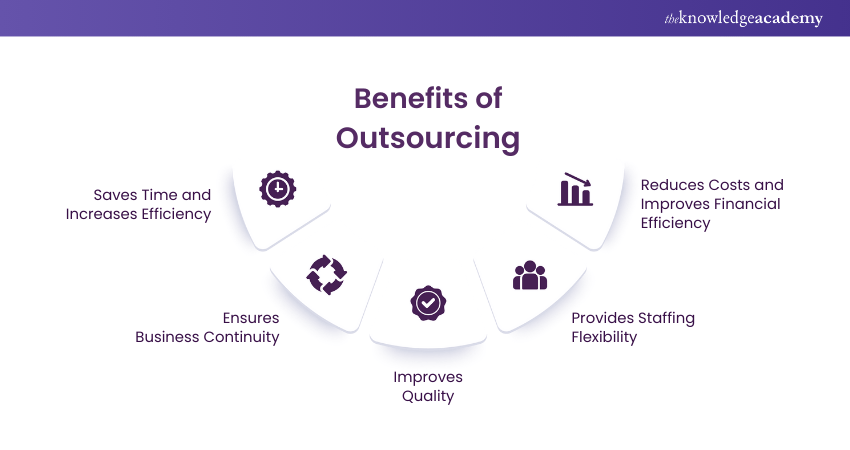
Saves Time and Increases Efficiency
a) Businesses can focus on important tasks while experts handle outsourced work
b) Outsourcing company's complete tasks faster with their skills and experience
c) Reduces delays by assigning work to specialists who know the job well
Ensures Business Continuity
a) Work continues even if there are staff shortages or unexpected issues
b) Outsourcing partners provide backup support to avoid disruptions
c) Helps businesses run smoothly without interruptions
Improves Quality
a) Experts ensure high-quality work with their specialised skills
b) Businesses get better results by hiring professionals in specific fields
c) Outsourcing companies use the latest tools and technology to improve work
Provides Staffing Flexibility
a) Companies can scale up or down based on business needs
b) No need to hire full-time staff for short-term projects
c) Allows businesses to adjust to changing demands
Reduces Costs and Improves Financial Efficiency
a) Saves money by hiring skilled workers in lower-cost locations
b) Reduces expenses on hiring, training, and maintaining staff
c) Helps businesses get quality work at a lower price
Challenges of Outsourcing
Here are the limitations of it:
Confidentiality and Security Risks
a) Sharing business data with external teams can lead to privacy issues
b) Outsourcing companies may not have strong security measures
c) Companies must ensure contracts protect sensitive information
Reduced Control Over Operations
a) Businesses rely on external teams, which may affect quality and deadlines
b) Harder to monitor daily work compared to in-house teams
c) Communication gaps can lead to misunderstandings
Language and Cultural Differences
a) Different languages can create communication problems
b) Cultural differences may affect work style and expectations
c) Businesses must ensure clear instructions and regular updates
Learn to improve innovation management with our ISO 56000 Innovation Management Training – Join today!
Outsourcing Mistakes to Avoid
Here are key mistakes to watch out for:
Undefined Scope
a) Not clearly explaining tasks can lead to mistakes
b) Work may take longer if goals and deadlines are unclear
c) A detailed plan helps avoid confusion and keeps projects on track
Inexperienced Vendor
a) Hiring a low-cost but unskilled provider can lead to poor work
b) Checking reviews and past projects helps find a reliable vendor
c) Choosing an expert ensures better results and fewer problems
Poor Communication
a) Misunderstandings happen when instructions are unclear
b) Regular updates help keep work on schedule
c) Using emails, calls, or meetings ensures smooth teamwork
Unrealistic Expectations
a) Expecting perfect work in a short time can cause disappointment
b) Outsourcing takes planning, feedback, and time for quality results
c) Setting fair deadlines and budgets leads to better outcomes
Top IT Outsourcing Companies
Here are some of the top IT Outsourcing companies:
Tata Consultancy Services (TCS)
a) Provides IT solutions, consulting, and Outsourcing services
b) Operates in over 40 countries, serving multiple industries
c) Helps businesses with cloud computing, AI, and automation
Infosys
a) Specialises in software development, cloud computing, and AI
b) Works with businesses to improve digital operations
c) Has offices in many countries, making global Outsourcing easier
CGI Inc.
a) A Canadian IT company offering consulting and system integration
b) Serves industries like finance, healthcare, and government
c) Provides business process Outsourcing and digital solutions
Cognizant
a) A US-based company providing IT services and AI solutions
b) Works with clients worldwide, with a strong presence in India
c) Offers cloud computing, Cyber Security, and software development
HCLTech
a) Helps businesses with cloud computing and IT security
b) Provides AI, automation, and software development services
c) Supports industries like banking, healthcare, and telecom
Wipro
a) Focuses on IT support, software development, and Outsourcing
b) Known for innovation, sustainability, and AI-driven solutions
c) Works with businesses to improve digital transformation and security
Learn to develop different objectives with our ISO 10002 Quality Management Training – Join today!
Insourcing vs Outsourcing
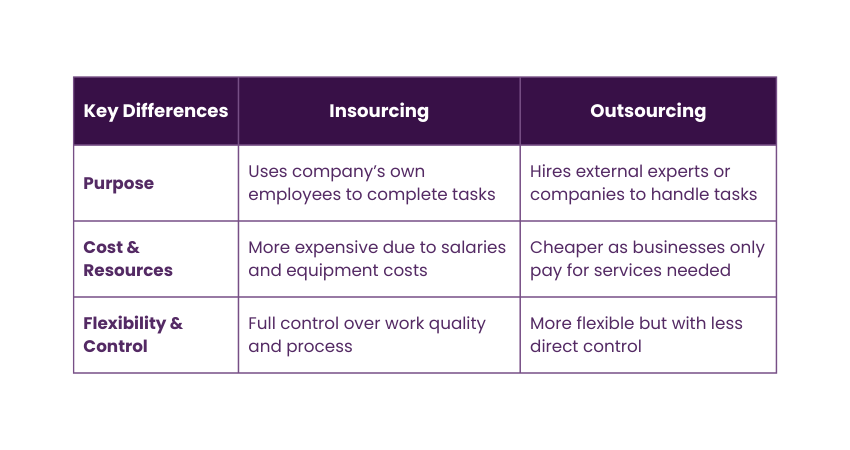
Here are the key differences of them:
Purpose
Insourcing is when a company uses its own employees to do a job instead of hiring an external provider. On the other hand, Outsourcing is when a company hires an outside business or expert to handle certain tasks, often to save time and money.
Cost and Resources
Insourcing can be more expensive because businesses need to pay salaries and invest in equipment. In contrast, Outsourcing is often cheaper since businesses pay only for the services they need, without extra costs like training or office space.
Flexibility and Control
Insourcing gives businesses full control over processes. It ensures tasks are done exactly as needed. On the other hand, Outsourcing offers more flexibility as companies can quickly scale up or down according to demand. However, they have less direct control over the work.
Conclusion
We hope you now understand What is Outsourcing and how it helps businesses save time, cut costs, and improve efficiency. Outsourcing allows companies to focus on their actual work while experts handle specific tasks. It has many benefits but also challenges that need careful planning. Choosing the right Outsourcing strategy helps businesses grow, stay competitive and work smoothly.
Learn Outsourcing management with our ISO 37500 Guidance on Outsourcing Training – Join today!
Frequently Asked Questions
What are the Four Factors to Consider Before Outsourcing?

Businesses should consider cost, quality, reliability and security. It is important to choose a provider that offers good service and protects company data.
What Does Outsourcing Depend on?
Outsourcing depends on business needs available skills. Companies outsource tasks when they need expert help, want to save money or focus on other important work.
What are the Other Resources and Offers Provided by The Knowledge Academy?
The Knowledge Academy takes global learning to new heights, offering over 3,000+ online courses across 490+ locations in 190+ countries. This expansive reach ensures accessibility and convenience for learners worldwide.
Alongside our diverse Online Course Catalogue, encompassing 19 major categories, we go the extra mile by providing a plethora of free educational Online Resources like Blogs, eBooks, Interview Questions and Videos. Tailoring learning experiences further, professionals can unlock greater value through a wide range of special discounts, seasonal deals, and Exclusive Offers.
What is The Knowledge Pass, and How Does it Work?
The Knowledge Academy’s Knowledge Pass, a prepaid voucher, adds another layer of flexibility, allowing course bookings over a 12-month period. Join us on a journey where education knows no bounds.
What are Related Courses and Blogs Provided by The Knowledge Academy?
The Knowledge Academy offers various ISO Certification, including the ISO 37500 Guidance on Outsourcing Training, ISO 10002 Quality Management Training and ISO 56000 Innovation Management Training. These courses cater to different skill levels, providing comprehensive insights into ISO 22301 Clauses.
Our ISO & Compliance Blogs cover a range of topics related to Outsourcing, offering valuable resources, best practices, and industry insights. Whether you are a beginner or looking to advance your Outsourcing skills, The Knowledge Academy's diverse courses and informative blogs have got you covered.

The Knowledge Academy


Global Training Provider
The Knowledge Academy is a world-leading provider of professional training courses, offering globally recognised qualifications across a wide range of subjects. With expert trainers, up-to-date course material, and flexible learning options, we aim to empower professionals and organisations to achieve their goals through continuous learning.

Upcoming ISO & Compliance Resources Batches & Dates
Date
 ISO 37500 Guidance on Outsourcing Training
ISO 37500 Guidance on Outsourcing Training
Mon 1st Jun 2026
ISO 37500 Guidance on Outsourcing Training
Mon 14th Sep 2026
ISO 37500 Guidance on Outsourcing Training
Mon 21st Dec 2026

 If you wish to make any changes to your course, please


