


 Top Rated Course


We may not have the course you’re looking for. If you enquire or give us a call on +41 315281584 and speak to our training experts, we may still be able to help with your training requirements.
Python Operators: Everything You Need to Know
Scarlett Adams 02 February 2026Python Operators are special symbols used to perform operations on variables and values. They are crucial in coding for Data Science, Machine Learning and more. They include arithmetic, comparison, logical, assignment, bitwise, identity, and membership operators. Each operator type serves a unique purpose in Python programming tasks.

Training Outcomes Within Your Budget!
We ensure quality, budget-alignment, and timely delivery by our expert instructors.
Table of Contents
Curious how Python effortlessly handles numbers, makes decisions, or checks if something exists, all with just a few characters? That’s the magic of Python Operators! These tiny symbols let you manipulate data, compare values, and control the flow of logic with just a few symbols.
From simple calculations to complex condition checks, operators make your code clean, powerful, and easy to read. Read on to learn about Python Operators and how to use them effectively in your programming journey!
Table of Contents
1) Understanding Python Operators
2) Types of Python Operators
3) Python Special Operators
4) Uses of Python Operators
5) Conclusion
Understanding Python Operators
Python is a popular and easy-to-use programming language. One of the main reasons for its simplicity is its operators. Operators in Python are special symbols or keywords that perform operations on values and variables. They are used to do maths, check if things are equal and even change values in your code.
In short, Python Operators help you control how your program works. They make it easy to write smart code that can solve problems and do tasks in fewer lines.
Types of Python Operators
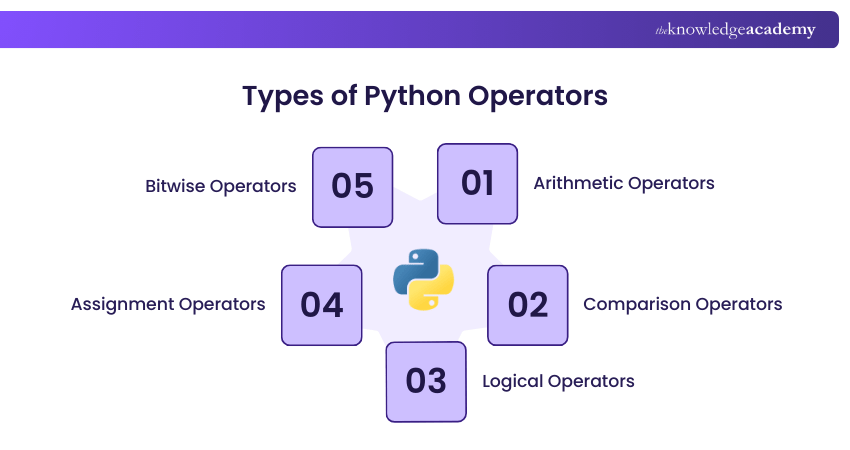
Python has different types of operators. Each operator is made for a specific job. Let’s look at those types.
1) Arithmetic Operators
Arithmetic Operators are used to do basic Mathematical calculations like addition, subtraction, multiplication, and division. Python also lets you find the remainder (%), raise a number to a power (**), or do floor division (//), which gives the whole number part of the result. These operators are commonly used in calculations, loops, and data processing.
2) Comparison Operators
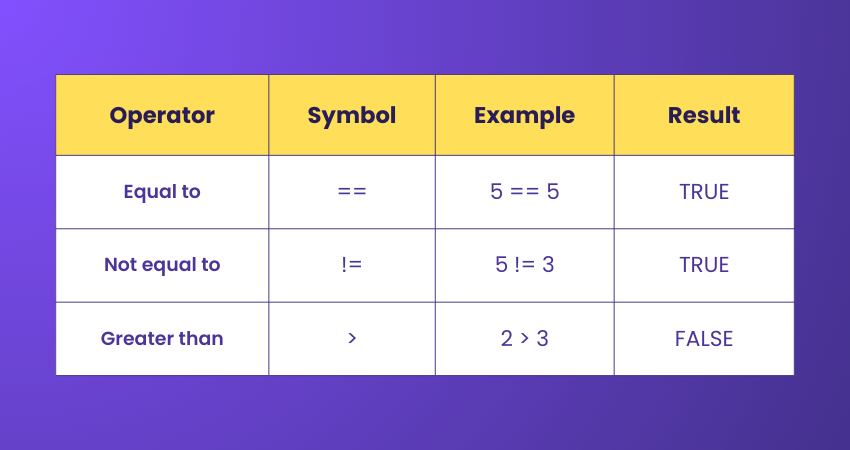
Comparison Operators are used to check if they are equal, greater, or smaller. With this, you can compare the values. You can check if one value is equal to another (==), not equal (!=), greater than (>), less than (<), greater than or equal to (>=), or less than or equal to (<=). These operators return either True or False statements. They are often used in if statements and loops to make decisions in your code, too.

3) Logical Operators
Logical Operators help you combine two or more conditions and check if they are true or false. They are used when you need to test more than one condition at the same time. The “and” operator returns “True” if both conditions are true. The “or” operator returns “True” if at least one condition is true. The “not” operator is used to reverse the result of a condition.

4) Assignment Operators
Assignment Operators are used to assign values to variables or update them with new values. For example, x = 5 assigns the value 5 to the variable x. Python also provides shortcut operators like +=, -=, *=, and more. These make it easy to update a variable’s value without rewriting the whole expression. For example, x += 3 adds 3 to the current value of x.

5) Bitwise Operators
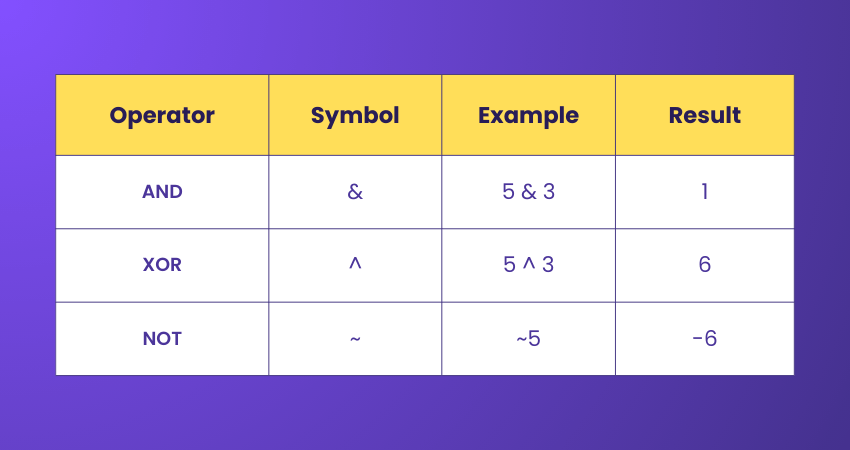
Bitwise Operators work directly with the binary numbers like 0s and 1s. These include & (AND), | (OR), ^ (XOR), ~ (NOT), << (left shift), and >> (right shift). These operators are mostly used in hardware programming, cryptography, and performance-sensitive tasks. Overall, they are mostly used in advanced programming tasks.
Turn raw data into powerful insights with our R Programming Course – Register immediately!
Python Special Operators
Python also has a few special operators that work differently. They help with checking items and writing short conditions. Here are some of the Python Special Operators for you:
Membership Operators
Membership Operators are basically used check if a value exists within a sequence, like a list, string, or tuple. The “in” and “not in” keywords are used for this purpose. For example, 'a' in 'apple' will print True because 'a' is part of the word "apple". If the value is not found, you can use not in to check the output as well.
These operators are helpful when working with collections or filtering data. They simplify checks in loops, conditions, and data validation tasks.

Ternary Operator
The Ternary Operator is used for writing simple statements of “if-else” in a single line. It follows the if conditions of “value_if_true” and “value_if_false”. If the condition is True, Python returns the first value. If the condition is False, Python returns the second value.
The ternary operator is great for simple decisions and is often used in Python to make code more compact and efficient.
Build robust web applications using Python and Django by joining our Python Django Training soon!
Uses of Python Operators
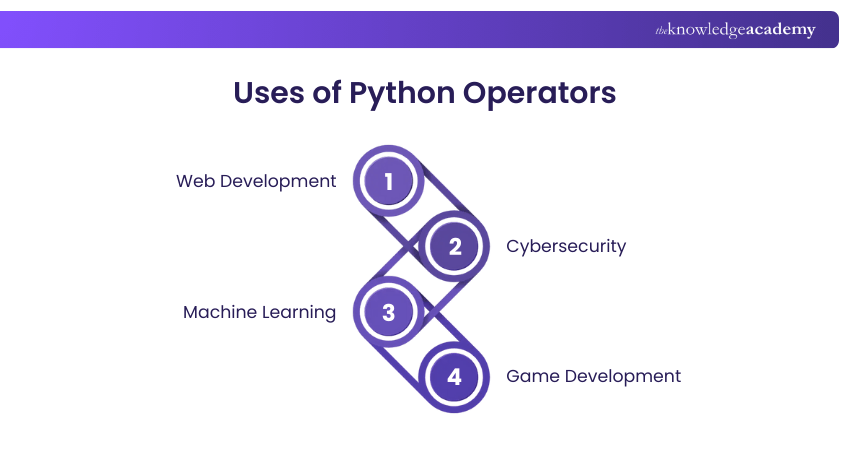
Python Operators are used across many fields in Software Development. Here's how they make an impact in different domains:
1) Web Development
In web development, Python is used to build websites, handle user data, and create web applications. Operators are used in many parts of this process:
1) Form Validation: Checks if the user input meets certain conditions using comparison and logical operators.
2) User Login: Checks if the username and password entered by the user match the stored data with the assignment and comparison operators.
3) Data Processing: Arithmetic operators calculate prices, discounts, or total amounts when someone places an order.
4) Condition Checks: Ternary and logical operators help show different messages based on what the user does.
2) Cybersecurity
In cybersecurity, Python is often used for writing scripts that check for weak passwords, scan for threats, or protect data.
1) Password Matching: Comparison operators help check if the entered password is correct or not.
2) Access Control: Logical and identity operators are used to allow or deny users based on their roles or permissions.
3) Monitoring Activity: Membership operators can check if something unusual appears in logs like, a strange IP address.
4) Data Encryption: Bitwise operators are useful in encryption and decryption processes where data is converted into unreadable code for security.
3) Machine Learning
Python is widely used in Machine Learning for models to learn and make decisions from data. Operators play a big role in this process.
1) Data Preparation: Arithmetic and comparison operators are used to clean and process data. For example, it helps by replacing missing values or scaling numbers.
2) Training Models: Logical operators are used in loops and conditions to run training processes, like stopping a model when it reaches a high accuracy.
3) Testing Models: Comparison operators are used to check how close the model’s predictions are to the actual results.
4) Performance Tracking: Arithmetic operators calculate accuracy, error rate, and other evaluation metrics.
4) Game Development
In games, Python is used to control game logic, manage scores, and create interactions between players and game elements.
1) Score Tracking: Arithmetic operators increase or decrease scores based on what happens in the game.
2) Winning Rules: Comparison operators are used to check if a player has reached the target or finished a level.
3) Collisions and Movements: Logical and bitwise operators are used to detect if objects touch or move in a certain way.
4) Game States: Assignment and ternary operators help set the current game level, mode, or player's status.
Conclusion
Python Operators are essential tools that give structure and logic to your programmes. They may look small, but they are very powerful. By understanding each type and its use, you can write more efficient, readable, and effective code. Whether you’re developing a website, building a Machine Learning model, or writing a game, these operators are always at the core of the process.
Explore the fundamentals to write efficient and robust code with our D Programming Language Training – Sign up today!
Frequently Asked Questions
Why do We Use an Operator?

We use operators in Python to perform operations on variables and values. They help in tasks like calculations, comparisons, data manipulation, and decision-making, making the code more efficient and logical.
What is Python and the Uses of Python?
Python is a high-level programming language known for its simplicity. It’s used in Web Development, Data Science, Automation, Machine Learning, and more. Its readable syntax makes it an ideal choice for both beginners and professionals.
What are the Other Resources and Offers Provided by The Knowledge Academy?
The Knowledge Academy takes global learning to new heights, offering over 3,000 online courses across 490+ locations in 190+ countries. This expansive reach ensures accessibility and convenience for learners worldwide.
Alongside our diverse Online Course Catalogue, encompassing 19 major categories, we go the extra mile by providing a plethora of free educational Online Resources like Blogs, eBooks, Interview Questions and Videos. Tailoring learning experiences further, professionals can unlock greater value through a wide range of special discounts, seasonal deals, and Exclusive Offers.
What is The Knowledge Pass, and How Does it Work?
The Knowledge Academy’s Knowledge Pass, a prepaid voucher, adds another layer of flexibility, allowing course bookings over a 12-month period. Join us on a journey where education knows no bounds.
What are the Related Courses and Blogs Provided by The Knowledge Academy?
The Knowledge Academy offers various Programming Training, including the Python Course, PHP Course, and Visual Basic Course. These courses cater to different skill levels, providing comprehensive insights into C++ Programming.
Our Programming & DevOps Blogs cover a range of topics related to Python Operators, offering valuable resources, best practices, and industry insights. Whether you are a beginner or looking to advance your Programming skills, The Knowledge Academy's diverse courses and informative blogs have got you covered.

 If you wish to make any changes to your course, please


