


 Top Rated Course

We may not have the course you’re looking for. If you enquire or give us a call on +41 315281584 and speak to our training experts, we may still be able to help with your training requirements.
NLP Techniques: Everything You Need to Know
Charlotte Wilson 14 July 2026Neuro-Linguistic Programming (NLP) techniques are designed to enhance communication, understanding behaviour, and foster positive change. Some key NLP techniques include dissociation, reframing, incantations, imagery training, anchoring, mirroring, modelling, meta model, and building report, etc. Read on to learn more about them!

Training Outcomes Within Your Budget!
We ensure quality, budget-alignment, and timely delivery by our expert instructors.
Table of Contents
Consider this scenario: you’re stuck in traffic, running late for an interview. Your heart races, and self-doubt creeps in. Doesn’t it sound familiar? Now imagine flipping that script and walking calmly and confidently. That’s the power of NLP Techniques. These simple yet powerful tools help rewire how you think, speak, and act. But can changing your thoughts really change your life?
NLP Techniques are used by everyday people to overcome fear, build confidence, and break old habits. In this blog, you’ll learn how they work and how to use them to take control of your mindset.
Table of Contents
1) What is an NLP Technique?
2) What is NLP Used for?
3) Top 11 NLP Techniques
4) Benefits of NLP
5) What are the NLP Techniques for Trauma?
6) What are the Advanced Techniques of NLP?
7) Conclusion
What is NLP Technique?
NLP Techniques are widely recognised for their ability to facilitate self-growth, bring about desirable change, and enhance communication. These neuro-linguistic programming techniques leverage both verbal and non-verbal cues to influence behaviour effectively. Whether you're exploring an NLP Techniques list or focusing on specific methods, these techniques are designed to help individuals and teams communicate more effectively.
While the primary purpose of neuro linguistic programming techniques is to improve communication, they also have other valuable applications. Leaders often use them to convey messages clearly to larger groups, ensuring that the intended message is effectively received. Additionally, therapists employ these techniques to uncover underlying issues in their patients, enabling more targeted and impactful therapy sessions.
Within organisations, those in leadership roles frequently use neuro-linguistic programming techniques to inspire and motivate their teams, ultimately boosting productivity. Furthermore, Project Managers and leaders can utilise their knowledge of NLP Techniques to resolve conflicts, foster collaboration, and maintain a positive work environment.
What is NLP Used for?
Neuro-linguistic Programming (NLP) is a method that examines how our brain, language, and learned behaviours are connected. It suggests that by changing these elements, we can achieve specific personal and professional goals.
Key Uses of NLP
Therapy and Counselling
NLP is used to help treat conditions like anxiety, phobias and Post-traumatic Stress Disorder (PTSD) by modifying negative thought patterns and behaviours.
Education
Teachers use NLP to improve teaching strategies, enhance student engagement and address challenges in learning.
Business and Leadership
In the corporate world, NLP is applied to boost communication, improve leadership abilities and strengthen team collaboration.
Sports
Coaches and athletes use NLP Techniques to improve performance, increase focus and stay motivated.
Start your NLP journey and transform your life with our NLP Foundation Course – Join now!
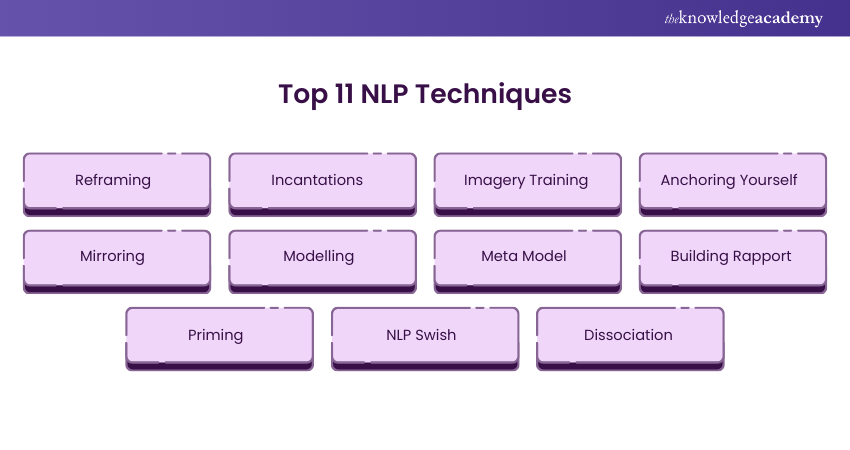
Top 11 NLP Techniques
Discover 11 powerful NLP techniques that can boost your mindset, communication, and overall effectiveness. These strategies are crafted to elevate both your personal and professional life by harnessing the power of your mind.
1) Dissociation
1) Dissociation is a Technique used to detach yourself from negative emotions or experiences.
2) Involves stepping outside of yourself and viewing the situation from a distance.
3) Helps reduce the emotional impact and provides a clearer perspective.
4) Useful for managing intense emotions and controlling reactions.
5) A helpful tool for coping with challenging situations.
Example: When overwhelmed by a stressful event, imagine watching it as if it were a movie.
2) Reframing
1) A powerful NLP technique that helps change the way you view a situation.
2) Shifts your perspective to see the situation in a more positive light.
3) Transforms negative emotions into positive energy and motivation.
4) Useful for turning stressful situations into opportunities.
5) Helps to create a more constructive outlook on challenges.
Example: Athletes reframe stress as excitement, turning nervousness into motivation.
3) Incantations
1) Involve repeating positive statements or affirmations with emotion and belief
2) A way to program your mind to adopt new beliefs and behaviours
3) Reinforces positive thoughts by saying affirmations aloud with energy
4) Boosts confidence, motivation, and overall mindset
Example: Repeating "I am confident and capable" can help you feel more self-assured
4) Imagery Training
1) A technique that uses your imagination to visualise success and positive outcomes.
2) Helps your brain prepare for real-life situations by mentally rehearsing them.
3) Creates a mental movie where you see yourself achieving your goals.
4) Enhances performance and reduces anxiety through detailed visualisation.
Example: Visualising yourself confidently giving a presentation and receiving positive feedback.
5) Anchoring Yourself
1) A method where you associate a physical action with a particular emotion or mental state.
2) Allows you to quickly access that feeling when needed, acting as a personal switch.
3) Helps maintain control over your emotions, especially in difficult situations.
4) Strengthens emotional resilience by creating a connection between action and emotion.
Example: Pressing your thumb and forefinger together while feeling confident, then using this gesture to bring back that sense of assurance.
Learn to enhance rapport-building skills with our Introduction to NLP Course – Join today!
6) Mirroring
1) Involves subtly copying the body language, tone, or behaviour of another person
2) Builds rapport and makes the other person feel understood and comfortable
3) Creates a connection and helps conversations flow more smoothly
4) Should be done subtly and naturally, so it doesn’t feel forced
Example: If someone crosses their arms, you might cross yours a moment later
7) Modelling
1) A technique used to learn from others by observing and imitating their successful behaviours.
2) Involves finding a role model and following their example to achieve similar results.
3) Helps fast-track learning by adopting proven strategies.
4) A powerful tool for personal growth and goal achievement.
Example: If you admire someone’s public speaking skills, study how they speak and practice those techniques.
8) Meta Model
1) A set of questions designed to uncover the deeper meaning behind someone’s words.
2) Involves digging beneath the surface to understand what’s really going on in someone’s mind.
3) Helps clarify vague statements and challenge limiting beliefs.
4) A tool for improving communication and resolving misunderstandings.
Example: If someone says, “I always fail,” ask, “What specifically do you fail at?”
9) Building Rapport
1) A technique to create a connection and sense of trust with another person.
2) Involves finding common ground where both people feel comfortable and understood.
3) Helps to influence others and make communication more effective.
4) A key skill for building relationships, whether personal or professional.
Example: Show genuine interest, listen actively, and demonstrate empathy to build rapport.
10) Priming
1) A technique used to prepare your mind for a specific outcome or experience
2) Involves focusing on certain thoughts or images beforehand to guide your responses
3) Helps steer your thoughts and behaviours in a desired direction
4) A powerful tool for shaping your mindset and improving your reactions
Example: Think about confidence before a meeting to feel and act confidently
11) NLP Swish
1) A technique used to replace negative thoughts or habits with positive ones.
2) Involves visualising the unwanted behaviour and then quickly “swishing” to an image of the desired behaviour.
3) Helps reprogram your brain to favour positive actions.
4) A powerful tool for breaking bad habits and creating healthier ones.
Example: If you want to stop procrastinating, picture yourself procrastinating and then immediately switch to a vivid image of yourself being productive.
Understand the practical applications of NLP with our NLP Foundation And Practitioner Training – Join today!
Benefits of NLP
Here are five key benefits of NLP:

Improved Communication
1) A technique to enhance your ability to understand and connect with others.
2) Makes interactions more fluid, impactful, and meaningful in both personal and professional environments.
3) Helps you read non-verbal cues and adjust your communication style accordingly.
4) Strengthens relationships by ensuring your message is received clearly.
Example: By adapting your communication to match the other person's style, you can build rapport more easily and improve the quality of your interactions.
Enhanced Problem-solving
1) A technique to shift your perspective, allowing you to approach challenges with creativity and an open mindset.
2) Helps you find solutions and overcome obstacles more efficiently.
3) Encourages you to reframe the problem and view it from different angles.
4) Leads to discovering innovative solutions that may have been overlooked.
Example: When facing a difficult situation, reframe the problem to uncover new, creative solutions
Better Emotional Control
1) A technique to manage stress, anxiety, and other emotions more effectively.
2) Helps you maintain a calmer, more focused approach to handling daily challenges.
3) Allows you to quickly shift from negative emotions to positive ones using NLP strategies like anchoring.
4) Enhances your resilience and ability to stay focused, even in stressful situations.
Example: Use anchoring to shift from feeling anxious to calm and in control during tense moments.
Increased Confidence
1) A technique to reframe negative thoughts and boost self-esteem and confidence.
2) Empowers you to face challenges with a positive and proactive mindset.
3) Replaces self-doubt with empowering beliefs, strengthening your sense of self-worth.
4) Helps you approach challenges with greater confidence, knowing you have the tools to succeed.
Example: Use NLP techniques to challenge negative self-talk and replace it with empowering beliefs to build confidence.
Goal Achievement
1) A technique that provides practical tools for setting clear goals and maintaining motivation.
2) Makes it easier to achieve success in different areas of your life.
3) Helps you break down larger goals into manageable steps, keeping you focused and driven.
4) Uses visualisation and positive affirmations to maintain momentum and reach your objectives.
Example: Break down your goals into smaller, achievable steps using NLP techniques to stay motivated and on track.
What are the NLP Techniques for Trauma?
Neuro Linguistic Programming Techniques like Visual-kinesthetic Dissociation, Anchoring, Reframing, Belief Change and Future Pacing help individuals process trauma. By changing how memories and emotions are perceived. These methods reduce distress; challenge limiting beliefs and promote resilience for emotional healing.
What are the Advanced Techniques of NLP?
Advanced NLP Techniques include Named Entity Recognition (NER), Sentiment Analysis, Dependency Parsing, Word Embedding, Machine Translation, Topic Modelling, Text Summarisation, and Semantic Role Labelling (SRL). These methods enhance language understanding for applications like translation, sentiment analysis, and more.
Conclusion
In essence, NLP Techniques are more than just algorithms; they’re the key to making data-driven conversations smarter and more impactful. By mastering these techniques, you can elevate communication, streamline processes, and unlock powerful insights from text. Step into the world of AI-powered language processing now.Learn about powerful communication
Techniques with our Neuro Linguistic Programming Course – Sign up today!
Frequently Asked Questions
Can NLP Techniques be Used to Enhance Public Speaking Skills?

Yes, NLP Techniques can boost your confidence and reduce nervousness when speaking in public. They help you connect with your audience and deliver your message more effectively.
How do NLP Strategies Enhance Leadership and Team Dynamics?
NLP strategies help leaders communicate clearly and build trust within their teams. They improve understanding, foster collaboration, and create a positive work environment.

Charlotte Wilson


Soft Skills and Business Training Manager
Charlotte Wilson is an expert in soft skills development, with over 14 years of experience helping individuals and teams improve communication, productivity and emotional intelligence in the workplace. Her training content is focused on enhancing interpersonal effectiveness and fostering positive, collaborative environments across all levels of an organisation.
View Detail

 If you wish to make any changes to your course, please


