


 Top Rated Course

We may not have the course you’re looking for. If you enquire or give us a call on +41 315281584 and speak to our training experts, we may still be able to help with your training requirements.
What is Extreme Programming? Principles and Benefits
William Brown 16 July 2026Extreme Programming (XP) is an Agile development method stressing rapid iterations, pair programming, test‑driven code, and constant customer feedback. It aims to deliver high-quality code quickly through simple design, frequent feedback, and teamwork. It helps adapt to change, reduce bugs, and improve customer satisfaction.

Training Outcomes Within Your Budget!
We ensure quality, budget-alignment, and timely delivery by our expert instructors.
Table of Contents

Struggling with frequent code changes, tight deadlines, or never-ending bugs in your software project? You’re not alone; many development teams face the same challenges in today’s fast-paced tech world. This is exactly where Extreme Programming (XP) comes in, offering a smarter and more flexible way to build high-quality software with confidence.
In this blog, we’ll explore What is Extreme Programming, how it works, and why it might be the solution your team needs right now. By understanding its principles and practices, you’ll see how XP can transform the way your team develops software. Let’s dive in.
Table of Contents
1) What is Extreme Programming (XP)?
2) When to Use Extreme Programming?
3) The 5 Core Principles of Extreme Programming (XP)
4) Life Cycle of Extreme Programming (XP)
5) Benefits of Extreme Programming (XP)
6) Limitations of Extreme Programming
7) Applications of Extreme Programming (XP)
8) What are the Extreme Programming Practices?
9) Conclusion
What is Extreme Programming (XP)?
Extreme Programming (XP) is an Agile Software Development method that focuses on rapid releases, continuous feedback, and collaborative team practices. It is a way to build software faster, better, and in small steps. XP helps teams handle problems like:
1) Fast-changing requirements
2) Short delivery time
3) Poor code quality
Teams in XP deliver software in small parts every few weeks. The customer gives feedback quickly, and the team keeps improving the product step by step. It drives customer satisfaction and simplicity through practices like pair programming, Test-Driven Development (TDD), continuous integration, and refactoring.

When to Use Extreme Programming?
XP is most suitable for your teams in the following situations:
1) The project requirements change frequently and unpredictably
2) The customer wants to talk to the team regularly
3) The project involves new technology or experimental features
4) Teams work in the same office or can work together easily
5) There's a strong need for rapid delivery and regular feedback
6) The product must maintain high quality despite tight schedules
XP is great for small or medium projects that need to move fast and stay flexible.
The 5 Core Principles of Extreme Programming (XP)
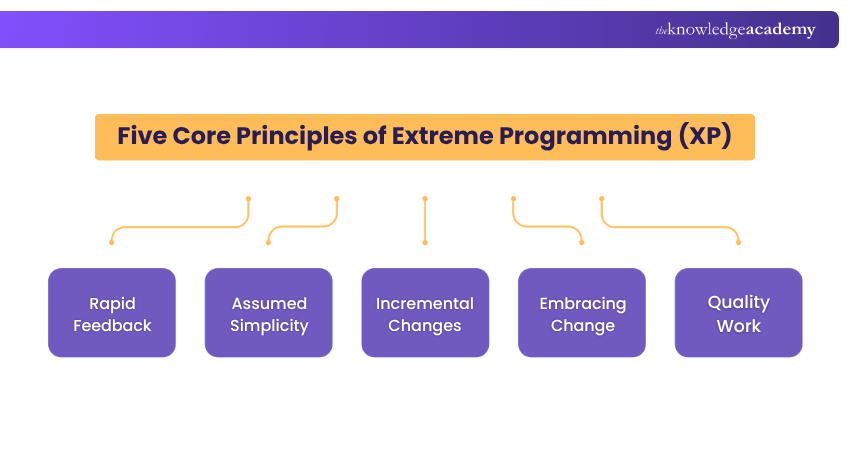
Beyond values, XP has five core principles that support its practices and help teams make good decisions in daily work. Here are those core principles:
1) Rapid Feedback
Rapid feedback means receiving and implementing the feedback as quickly as possible, whether from the customer, tests, or team members. For example, a feature isn’t working properly, or a user needs something different. So, the team updates the feedback in their system right away to work on it.
2) Assumed Simplicity
This principle encourages developers to treat every problem as having a simple solution. Rather than planning for every possible future case, XP teams focus on doing a good job today. It’s also about trusting your ability to add complexity later if required. This approach keeps the system easy to maintain and change.
3) Incremental Changes
Big changes made all at once can cause confusion and mistakes. XP encourages small, frequent changes to the design, plan, and codebase. When solving a large problem, XP teams break it into smaller parts and solve those one by one. This makes it easier to spot problems early and fix them without impacting the whole system.
4) Embracing Change
In many traditional approaches, change is seen as a problem. In XP, it’s expected. If a customer changes their mind or a business needs a shift, the team will be ready to adapt. They tend to support the customer’s new direction and may even suggest better ways to meet the new goals.
5) Quality Work
XP teams take pride in their work and aim to deliver high-quality code that meets the customer’s needs. This means writing tests first, refactoring regularly, communicating well, and making sure the software is always ready to use. A strong team that respects each other and works well together is essential for delivering quality results.
Discover the several types of testing with our Automation Testing Using TestComplete Training – Join soon!
Life Cycle of Extreme Programming (XP)
XP has five main steps that teams repeat over and over. These steps help the team move forward and adjust when needed. Let's check those steps involved in the lifecycle of XP:
1) Planning
The first step in the XP lifecycle is planning. Here, the clients will share what they want using short, clear sentences called user stories. Each story explains a feature or function in simple terms. After that, your team will:
1) Estimate the time and effort each story will take.
2) Discuss the features that are most important.
3) Build a plan to release the most useful features first.
This phase helps align business needs with development priorities.
2) Design
XP encourages simple design. Instead of designing everything upfront, XP teams only create the design needed for the current user stories. The focus is especially on simplicity. This ensures the design is clear, flexible, and easy to change if needed. Key ideas include:
1) Design is a shared responsibility across the team.
2) The design evolves as the code needs change.
3) Focus remains only on what is needed now.
To keep everyone on the same page, teams may use analogies or system-wide examples that help explain how the parts will work together.
3) Coding
This is the heart of Extreme Programming. Developers work in pairs, write code collaboratively, and follow the Test-Driven Development (TDD) approach. XP teams follow two important practices that include:
1) Pair Programming is when two developers work together on one computer. One writes the code while the other reviews it, improving quality and sharing knowledge.
2) Test-Driven Development (TDD) lets developers write automated tests before writing the actual code. This helps ensure the code meets the required function from the very start.
3) Continuous Integration (CI) is used to regularly combine the code into a shared system and run automated tests. This catches problems early and ensures the system always works.
With this, the code will be clean, simple, and easy to change when the project grows.
4) Testing
Testing is continuous. In XP, it is done at every step, not just at the end. Unit tests, integration tests, and customer acceptance tests are automated and run often. The tests conducted include the following:
1) Unit Tests are automated tests written by developers to check if each part of the code works correctly.
2) Acceptance Tests are run by the customers to make sure the system does what they asked for.
3) Regression Tests are carried out to re-run the tests to ensure new changes don’t disturb the existing features.
These tests are run often to identify problems early, reduce bugs, and make sure the system stays reliable.
5) Listening
XP teams don’t just write code; they will also listen carefully. Teams will regularly check retrospectives, gather customer feedback, and adjust plans and priorities based on new information. The feedback will be from:
1) Customers to check if the software is meeting their needs.
2) Team members to improve how the team works.
3) The system itself by using test results and performance data.
This helps the team make small adjustments, improve quality, and stay aligned with the customer’s goals.
Become familiar with the methodologies of manual testing with our Manual Testing Training – Sign up now!
Benefits of Extreme Programming (XP)
XP is widely employed in Agile teams because it has multiple benefits across quality, cost, and team dynamics. Let's explore its benefits:
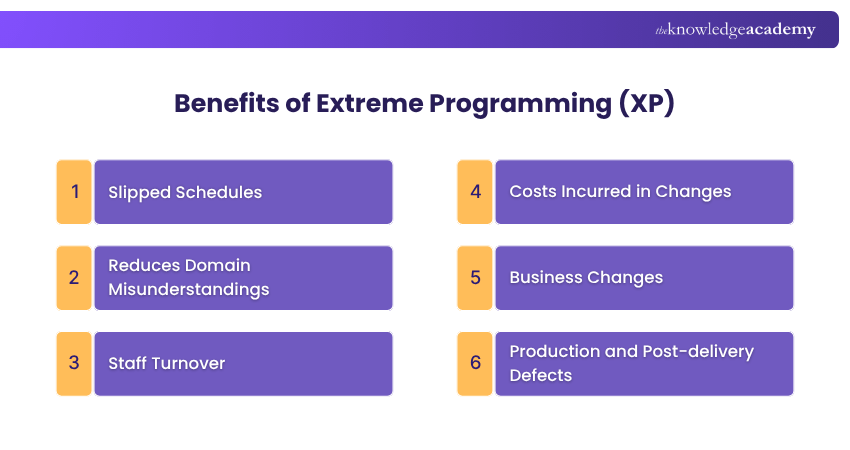
1) Slipped Schedules
1) Short development cycles are easier to track progress
2) Regular check-ins and feedback highlight delays early
3) Planning is done in small steps, so adjustments are simpler
2) Reduces Domain Misunderstandings
1) User stories are short and clear, reducing confusion
2) Feedback is implemented quickly, so mistakes don’t grow
3) Developers and customers stay aligned throughout the project
3) Staff Turnover
1) Pair programming spreads knowledge across the team
2) Collective code ownership means anyone can edit any part
3) Promotes teamwork by collaborating with each other
4) Costs Incurred in Changes
1) Continuous testing catches costly issues early
2) Code is kept clean, so changes are easier
3) Less rework is needed because feedback comes quickly
5) Business Changes
1) XP teams expect and welcome changes
2) Plans are flexible and can shift easily
3) Developers suggest new ways to meet changing needs
6) Production and Post-delivery Defects
1) Automated tests catch bugs before release
2) Continuous integration reduces merge errors
3) Better testing leads to happier users and fewer complaints
Explore the collaboration between testers and developers in Agile with our Agile Software Testing Course – Register today!
Limitations of Extreme Programming
Though XP can be highly beneficial, it has some limitations. Here are those:
1) Code Overcomes Design
1) Focus on coding may overlook the long-term system structure
2) Future scaling may become harder without a strong architecture
3) Developers might fix symptoms instead of root design issues
2) Location
1) Real-time communication is harder in remote teams
2) Time zone differences reduce collaboration speed
3) XP's practices work best with face-to-face interaction
3) Lack of Documentation
1) Minimal documentation can confuse new team members
2) Stakeholders may struggle without clear records
3) External teams (QA, legal, compliance) may need more detail
4) Stress
1) Continuous feedback can feel overwhelming
2) Pair programming for long hours may cause fatigue
3) Constant delivery requires strong time management
Equip yourself with the essential techniques and elevate your testing strategy with our Software Testing Green Belt Course – Register anytime!
Applications of Extreme Programming (XP)
Extreme Programming (XP) works well in projects where speed, flexibility, and quality are important. Here are some examples where it is applied effectively:
2) Projects Involving New Technology or Research Projects
Extreme Programming is ideal for projects that explore new technology or conduct experiments. These projects often face unknown tools and fast-changing requirements. With XP, teams can learn quickly, adapt easily, and solve technical issues early.
3) Web Development Projects
Short cycles, frequent updates, and customer feedback make XP applicable for fast-paced web and mobile development. Web applications are built in short cycles and need frequent testing. XP supports this by allowing teams to make fast updates and test often to meet user needs.
4) Collaborative Projects
When cross-functional teams like designers, developers, testers, and product owners need to work closely, XP helps smooth the collaboration. It becomes the right choice by encouraging regular communication, shared responsibility, and real-time feedback.
5) Projects with Tight Deadlines
XP speeds up delivery through frequent releases, test automation, and minimal documentation. It allows teams to deliver working software quickly, even under pressure. This is possible because of its simplicity and iterations.
6) Rapidly Evolving Requirements
If the customer keeps changing their mind or new needs arise often, XP allows teams to adjust the design and code without large delays or rework. Its short development cycles help teams stay flexible and respond quickly.
7) Projects Where Quality is a High Priority
XP uses Test-Driven Development (TDD), pair programming, and continuous testing to reduce bugs and improve software reliability from the start. Code is reviewed often, which helps catch mistakes early.
What are the Extreme Programming Practices?
There is a set of key practices in XP that support its values and principles. These include:
1) Pair Programming: Two developers write code together, helping each other spot mistakes.
2) Test-Driven Development (TDD): Write tests before writing the real code. This ensures the code works from the start.
3) Continuous Integration (CI): Add and test new code often, sometimes many times a day.
4) Small Releases: Deliver working software frequently in short iterations.
5) Refactoring: Improve the design of existing code without changing its functionality.
6) Simple Design: Only design what's needed right now.
7) Collective Code Ownership: Any developer can improve any part of the code.
8) Coding Standards: The team agrees on how the code should be written.
9) Sustainable Pace: Avoid burnout by working at a steady, healthy speed.
10) On-site Customer: A real user or customer is always available to ask questions and give feedback.
Conclusion
We hope this blog on What is Extreme Programming (XP) has helped you understand how this Agile method promotes simplicity, collaboration, and continuous improvement. XP empowers teams to stay adaptive, courageous, and focused on delivering quality results. If you’re working on a fast-paced, user-focused project, XP might just be the powerful approach your team needs to succeed.
Understand the software testing in an Agile environment with our Agile Software Testing Training – Start your journey today!
Frequently Asked Questions
How is XP Different from Agile?

Agile is a broad set of principles for flexible Software Development. XP is a specific Agile method that focuses on engineering practices like pair programming, Test-Driven Development, and continuous integration. While Agile is about how to manage projects, XP focuses on how to build software.
Is Extreme Programming Better than Scrum?
XP and Scrum serve different purposes. Scrum focuses on managing the workflow, team roles, and sprints. XP focuses on technical practices like clean coding and testing. Many teams use Scrum for project planning and XP for development to get the best of both worlds.

William Brown


Senior Business Analyst and Strategic Advisor
William Brown is a senior business analyst with over 15 years of experience driving process improvement and strategic transformation in complex business environments. He specialises in analysing operations, gathering requirements and delivering insights that support effective decision making. William’s practical approach helps bridge the gap between business goals and technical solutions.
View Detail

 If you wish to make any changes to your course, please


