


 Top Rated Course

We may not have the course you’re looking for. If you enquire or give us a call on +41 315281584 and speak to our training experts, we may still be able to help with your training requirements.
Decision Making Process: A Complete Step-by-Step Guide
Elizabeth Clark 26 March 2026The Decision-Making Process is a structured, step-by-step method to choose the best option, reduce risk, and make informed choices using proven tools and models. It improves clarity, strengthens problem-solving skills, and supports better outcomes. This approach helps individuals and organisations act confidently and strategically.

Training Outcomes Within Your Budget!
We ensure quality, budget-alignment, and timely delivery by our expert instructors.
Table of Contents
Have you ever found yourself stuck between options, unsure of the best path forward? Navigating the complexities of Decision-making can often feel like a daunting task. Whether you’re steering a business, managing a team, or making personal choices, understanding the Decision Making Process is essential.
From breaking down the seven key steps of the Decision Making Process to exploring various models and tools, this blog covers everything you need to know. Ready to enhance your Decision Making Skills and face challenges with assurance? Let’s dive in and master the art and science of making impactful decisions.
Table of Contents
1) What is the Decision Making Process?
2) Seven Key Steps in Decision Making Process
3) Tools for Better Decision Making Processes
4) Why is Implementing a Decision Making Process Important?
5) What are the Different Types of Decision Making Models?
6) When to Use Decision Making Models?
7) Conclusion
What is the Decision Making Process?
The Decision Making Process is a structured approach to identifying and solving problems by evaluating alternatives and choosing the best course of action.
It typically involves seven steps:
a) Identifying the problem
b) Gathering relevant information
c) Exploring available options
d) Evaluating the potential outcomes
e) Making the decision
f) Implementing the decision
g) Reviewing the outcomes
This process helps ensure that decisions are logical, well-informed, and aligned with goals. By following these steps, individuals or organizations can minimize risks, optimize outcomes, and ensure efficient problem-solving. The process may vary in complexity depending on the situation but is essential for making sound decisions, particularly in Supervisor Decision-Making.

Seven Key Steps in Decision Making Process
The Decision Making Process consists of seven essential steps that assist individuals or groups in reaching informed and effective decisions. Let's explore each of these steps:
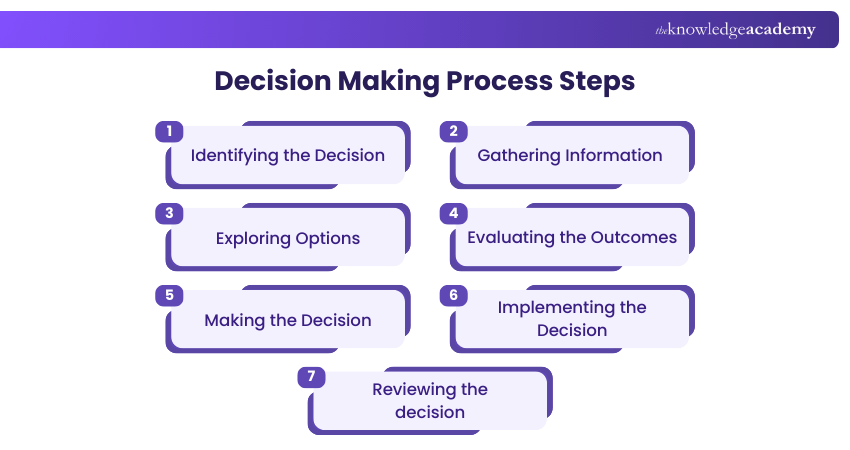
1) Identifying the Decision
The following steps help you clearly identify and define the decision before moving forward:
1) Clearly define the decision or problem at hand
2) Ask key questions:
a) What problem are you solving?
b) What goals do you aim to achieve?
c) How will you measure success?
3) Use these questions as part of goal setting to assist you toward an optimal solution
2) Gathering Information
The points below highlight how to gather reliable and useful data:
1) Collect accurate and necessary data for informed Decision-making
2) Review past data or previous efforts to solve the issue
3) Expand research beyond internal sources to include:
a) Market research
b) Industry consultants
c) Peers or colleagues in similar roles with relevant experience
4) Use external insights to uncover additional solutions and perspectives
3) Exploring Options
The points below highlight how to explore options in a structured and inclusive way:
1) Brainstorm multiple solutions to address the problem
2) Explore various options to meet different stakeholder needs
3) Consider how different teams or departments may have unique priorities (e.g., design team vs. development team).
4) Ensure that by evaluating multiple alternatives, you can make a more inclusive and well-rounded decision.
4) Evaluating the Outcomes
Listed below are key actions to evaluate the effectiveness of possible solutions:
1) Analyse each solution by determining how well it addresses the problem
2) Assess the pros and cons of each option to narrow down choices
3) Eliminate less effective alternatives
4) Use common evaluation tools such as:
a) Pros and cons lists
b) SWOT Analysis
c) Decision matrices
5) Making the Decision
Below are practical steps to move from analysis to action:
1) Make the final decision using the information gathered
2) Consider the impact of each alternative on all stakeholders
3) Be open to blending several alternatives for a more effective solution
4) Use creative problem-solving, avoiding limitations to conventional options
6) Implementing the Decision
The following steps support clear, organised implementation:
1) Develop a clear implementation plan to align everyone on the next steps.
2) Ensure all team members understand their roles and responsibilities.
3) Begin executing the plan.
4) Continuously monitor progress to evaluate if the decision is delivering the expected outcomes.
7) Reviewing the decision
Listed below are structured methods to review performance and outcomes:
1) Revisit the success criteria defined in Step 1.
2) Evaluate if the decision effectively solved the problem.
3) Assess both the positive and negative impacts of the decision.
4) Gather feedback from stakeholders on their response to the decision.
5) If necessary, adopt an iterative approach to refine and improve outcomes using available resources.
Transform your Leadership skills with our Agile Leadership Training today for success!
Tools for Better Decision Making Processes
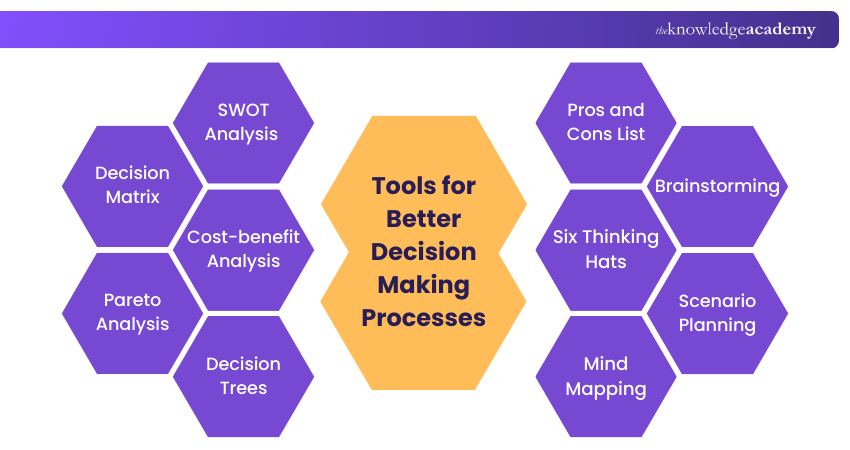
The following tools assist in organising and enhancing Decision Making Processes by defining options, contrasting results and facilitating objective decision-making:
1) SWOT Analysis
SWOT Analysis assists you in revising the internal strengths and weaknesses of an option as well as the external opportunities and threats. Arranging such factors in a simple grid, it provides a balanced perspective of all forces that might affect a decision. This is a tool that makes you think strategically because it points out what you have strengths in and where you should exercise caution. It is particularly helpful in planning as well as in comparing strategic options.
2) Decision Matrix
A Decision Matrix enables you to compare a number of options with a number of weighted criteria. It quantifies comparisons that would otherwise seem subjective by allocating a score to each of the options by the degree to which it satisfies a criterion. This facilitates the ability to make decisions based on irrefutable evidence, as opposed to being purely dependent on intuition. It is most useful when making complicated decisions that involve numerous variables.
3) Cost-benefit Analysis
Cost-benefit Analysis is a comparison of costs and benefits of a decision that are expected. It is used to calculate whether the advantages will exceed the expenses and to what extent, so it is best suited to financial or investment decisions. Placing numbers on either side of the decision enables comparison of the results in an objective manner. This tool assists organisations to select options that present the greatest value to minimum cost.
4) Pareto Analysis
Pareto Analysis applies the concept according to which approximately 80 percent of results are caused by 20 percent of causes. It will enable you to narrow down on the most effective issues or choices by prioritising a few high-value factors. It also helps to focus resources and efforts on areas where the greatest good can be brought as it focuses on what is important. It is a useful tool in problem solving and quality improvement.
5) Decision Trees
Decision Trees visually represent the available options and the results of each alternative in a branching structure. This simplifies the visualisation of the flow of decisions, risks, rewards, and outcomes. It assists in breaking down a complex decision and simplifying uncertainty since every step is explained one by one and long-term effects are evaluated. This tool is particularly applicable in decisions with multiple steps or events that are contingent.
6) Pros and Cons List
One of the easiest Decision Making tools is a Pros and Cons List, which will assist you in enumerating the positive and negative aspects of each option. It makes you think critically about the outcomes by clearly stating the benefits and shortcomings. It can be applied to smaller decisions or just a few alternatives when making comparisons. Although it is simple, it brings clarity and promotes level-headed judgement.
7) Brainstorming
Brainstorming can be effectively applied to the decision-making process through the application of structured methods such as Mind Mapping, SCAMPER, Brainwriting (6-3-5), and Nominal Group Technique to produce, arrange, and rank ideas. Top digital tools Virtual whiteboarding can be done using Miro, Lucidchart, and Coggle, whereas Zoom can support remote collaboration. These methods enhance creative thinking, reduce groupthink, and, combined with tools like decision matrices, lead to better, more objective decisions.
8) Six Thinking Hats
The Six Thinking Hats is a decision making tool created by Edward de Bono which employs six metaphoric coloured glasses to organise group brainstorming or personal thinking to promote parallel thought and decrease conflict. Isolating thinking into different modes Facts (White), Emotions (Red), Risks (Black), Benefits (Yellow), Creativity (Green) and Management (Blue) will help teams to solve issues unproductive and contradictory arguments.
9) Scenario Planning
Scenario planning Scenario planning is a strategic decision-making instrument that allows to navigate uncertainty by modeling alternative futures -best-case, worst-case, and, say, high-growth vs. recessionary environment, to test strategy, determine risks, and enhance agility in the organisation.
10) Mind Mapping
Mind mapping enhances Decision Making Process through the use of pictorial structuring of complex information, brainstorming, and mapping of consequences in a non-linear, radial manner. It divides big problems into small, related subunits, which eliminate the feeling of overwhelmingness and reveal previously unknown links between concepts.
Master the strategies to lead high-performing teams for exceptional success with our High Performing Teams Training – Join now!
Why is Implementing a Decision Making Process Important?
A well-organised Decision Making Process should be implemented as it allows organisations to make meaningful, well-informed decisions that cause meaningful changes. Strategic thinking assists managers and team leaders in identifying opportunities, enhancing operations, presenting effective tools, and even creating new departments that promote long-term goals. It also makes sure that the employees know where the organisation is going and share common success.
Decision making is a business skill essential to business performance across all levels. The decision that an organisation takes can directly influence the revenue, workplace culture, and the reputation of the organisation in the community. When companies base their choice on research, analysis, and clear guidelines, they are better placed to choose the most appropriate course of action and execute it successfully.
The systematic approach also contributes to the growth of business; it assists organisations to weigh risks, align their actions with the strategic objectives, and apply the information to set the direction. Notably, it ties strategic plans with responsive action, so that firms can stay focused on long-term goals and act decisively to dynamic environments.
What are the Different Types of Decision Making Models?
Decision Making models provide structured approaches to analysing and solving problems using various Decision Making Techniques. Here’s a list of different types of Decision Making models:
1) Rational Model:
a) Based on logical, structured, and step-by-step processes.
b) Involves identifying the problem, gathering information, evaluating alternatives, and selecting the best solution.
c) Often used in business and strategic Decision-making.
2) Bounded Rationality Model:
a) Recognises the limitations of Decision-makers in terms of time, information, and cognitive capacity.
b) Decision-makers opt for a solution that is "good enough" rather than optimal.
c) Often used when time or resources are limited.
3) Intuitive Model:
a) Relies on gut feelings, instincts, or subconscious reasoning
b) Decision-makers draw on experience and intuition to make quick decisions
c) Often used in fast-paced or uncertain environments
4) Creative Model:
a) Involves generating innovative and out-of-the-box solutions to problems.
b) Focuses on brainstorming, lateral thinking, and exploring alternatives beyond traditional approaches.
c) Used when decisions require new, novel solutions.
5) Collaborative Decision-Making Model:
a) Involves group input and consensus-building.
b) Encourages collaboration and collective input from different stakeholders or team members.
c) Often used in team or organisational settings where different perspectives are valued.
6) Vroom-Yetton Decision Making Model:
a) A situational model that adjusts Decision-making styles based on the situation's requirements.
b) Outlines different Leadership styles (Autocratic, consultative, and group-based) depending on the complexity and the need for team involvement.
7) Incremental Decision-Making Model:
a) It focuses on making small, gradual decisions instead of big, comprehensive decisions all at once.
b) Decisions are made step by step, often revising or improving on previous steps.
c) Used when long-term decisions require continuous adjustments.
8) Analytical Decision Making Model:
a) Focuses on using data, facts, and logical reasoning to guide decisions.
b) Involves in-depth analysis of all available information before reaching a conclusion.
c) Ideal for solving complex issues that require careful consideration of multiple variables.
d) Used in Business strategy, finance, engineering, and other fields where precision and detailed evaluation are essential.
9) Heuristic Decision Making Model:
a) Uses mental shortcuts or rules of thumb to simplify Decision-making.
b) Helps Decision-makers make quick, efficient choices, especially when faced with complex situations.
c) Often used when time is of the essence or when there's a lack of complete information.
10) Satisficing Decision Making Model:
a) Decision-makers choose the first satisfactory solution rather than seeking the best possible one.
b) Similar to the bounded rationality model, this model focuses on "good enough" choices.
Elevate your Leadership skills to lead with confidence and empower your team with our Leadership Skills Training - sign up now!
When to Use Decision Making Models?
Decision-making models are helpful in various situations, particularly when:
a) Complexity is High: When faced with complex decisions involving multiple variables, models like the Analytical or Rational models help structure the process.
b) Uncertainty Exists: When outcomes are uncertain, models such as Scenario Planning or Decision Trees are ideal for exploring potential futures and outcomes.
c) Need for Structured Decisions: Models like SWOT Analysis or Decision Matrices are useful when a structured, methodical approach is needed.
d) Group Decision Making: For team-based decisions, models like Collaborative or Six Thinking Hats help gather diverse perspectives and build consensus.
e) Limited Time or Resources: Models like Heuristic or Intuitive Decision-making are useful for making quick decisions when time and information are limited.
f) Incremental Improvements: The Incremental Decision-Making model is suitable when small, gradual changes are preferred over large, sweeping decisions.
Transform your business strategies with cutting-edge innovation techniques in this Business Model Innovation Training – register now!
Conclusion
Mastering the Decision Making Process empowers you to tackle challenges with confidence and clarity. By applying these structured steps, you can transform uncertainty into opportunity, make smarter choices, and drive better outcomes. One of the strategies that can help you is Business Model Innovation, which allows you to adjust your business model to better meet market demands and sustain long-term success. Start implementing these strategies today for lasting success!
Take the next step in developing your Leadership skills by registering for our Leadership Courses now!
Frequently Asked Questions
How Can Individuals Reduce Cognitive Bias in Decision Making?

Individuals can reduce cognitive bias in Decision-making by:
a) Seek Diverse Perspectives
b) Use Data and Evidence
c) Apply Structured Decision Making Tools
d) Practice Self-awareness
e) Reflect on Past Decisions
How Can Individuals Adapt Their Decision Making Process to Accommodate Uncertainty or Dynamic Environments, Ensuring Agility and Adaptability?
To adapt Decision-making in uncertain or dynamic environments, individuals can:
a) Embrace Flexible Strategies
b) Make Incremental Decisions
c) Foster Continuous Feedback
d) Encourage Team Collaboration
e) Prioritise Agility
What are the Other Resources and Offers Provided by The Knowledge Academy?
The Knowledge Academy takes global learning to new heights, offering over 3,000+ online courses across 490+ locations in 190+ countries. This expansive reach ensures accessibility and convenience for learners worldwide.
Alongside our diverse Online Course Catalogue, encompassing 17 major categories, we go the extra mile by providing a plethora of free educational Online Resources like Blogs, eBooks, Interview Questions and Videos. Tailoring learning experiences further, professionals can unlock greater value through a wide range of special discounts, seasonal deals, and Exclusive Offers.
What is The Knowledge Pass, and How Does it Work?
The Knowledge Academy’s Knowledge Pass, a prepaid voucher, adds another layer of flexibility, allowing course bookings over a 12-month period. Join us on a journey where education knows no bounds.
What are the Related Courses and Blogs Provided by The Knowledge Academy?
The Knowledge Academy offers various Leadership Courses, including Decision Making Course, Leadership Skills Training, Creative And Analytical Thinking Training and Agile Leadership Training. These courses cater to different skill levels, providing comprehensive insights into Delegating Leadership Style.
Our Business Skills Blogs cover a range of topics related to Decision Making, offering valuable resources, best practices, and industry insights. Whether you are a beginner or looking to advance your Decision Making skills, The Knowledge Academy's diverse courses and informative blogs have you covered.

Elizabeth Clark


Senior Leadership Trainer and Business Strategist
Elizabeth Clark is a senior trainer and strategist with a strong background in leadership, business management, and operational improvement. With more than 15 years of experience, she has worked with leaders across industries to enhance their influence, communication, and strategic planning skills. Her writing is known for being insightful and focused on real-world leadership challenges.
View Detail
Upcoming Business Skills Resources Batches & Dates
Date
 Successful People Management and Team Leadership
Successful People Management and Team Leadership
Fri 3rd Jul 2026
Successful People Management and Team Leadership
Fri 2nd Oct 2026

 If you wish to make any changes to your course, please


