


 Top Rated Course

We may not have the course you’re looking for. If you enquire or give us a call on 01344203999 and speak to our training experts, we may still be able to help with your training requirements.
Why Choose Data Science as a Career: Future Scope and Opportunities
Lily Turner 26 August 2026Learn why a Career in Data Science offers exciting opportunities, valuable skills, strong earning potential and the flexibility to work across a wide range of industries.
Home
 Resources
Data, Analytics & AI
Why Choose Data Science as a Career: Future Scope and Opportunities
Resources
Data, Analytics & AI
Why Choose Data Science as a Career: Future Scope and Opportunities
Resources
Data, Analytics & AI
Why Choose Data Science as a Career: Future Scope and Opportunities

Training Outcomes Within Your Budget!
We ensure quality, budget-alignment, and timely delivery by our expert instructors.
Table of Contents

Key Takeaways
1. Data Science combines analytical thinking, technology, and business understanding to solve practical problems.2. A Data Science career can lead to diverse roles across multiple industries and specialisations.3. Mathematics, Programming, Machine Learning, visualisation, and communication form the core Data Scientist skill set.4. Generative AI, automation and real-time analytics are shaping the future scope of Data Science.5. Continuous learning supports long-term growth as Data Science tools, technologies and applications continue to evolve.
“I want a career that lets me ______.”
Solve challenging problems?
Work with AI?
Explore different industries?
Build something meaningful?
Keep learning?
Data Science can tick more than one of those boxes. Rather than locking you into a single path, it gives you opportunities to combine technology, numbers and problem-solving in ways that can evolve alongside your interests and ambitions. So, could Data Science be the career you’re looking for? Let’s explore Why Choose Data Science as a Career in this blog!
What is Data Science?
Data Science is the field of collecting, processing and analysing data to uncover meaningful patterns, trends and insights. It combines statistics, mathematics, programming and domain knowledge to transform raw data into useful information that can support better decisions and solve real-world problems.
Data Science also uses techniques such as Artificial Intelligence (AI), Machine Learning (ML), predictive modelling and data visualisation to understand past behaviour and anticipate future outcomes. Today, it is applied across industries such as healthcare, finance, retail and technology to improve operations, understand customers, manage risks and identify new opportunities.

Who is a Data Scientist?
A Data Scientist is a professional who turns complex data into practical solutions for organisations. Their responsibilities can include defining data-related problems, preparing datasets, developing and evaluating models, interpreting results and presenting recommendations to support business goals.
The role is also highly collaborative. Data Scientists often work with Data Analysts, Data Engineers, Machine Learning Engineers, Software Developers and business stakeholders to take projects from initial questions to usable solutions. This requires a balance of technical expertise, problem-solving ability, business understanding and communication skills.
What Skills Does a Data Scientist Need?
A successful Data Scientist typically develops a mixture of technical and interpersonal capabilities. Important skills include the following:
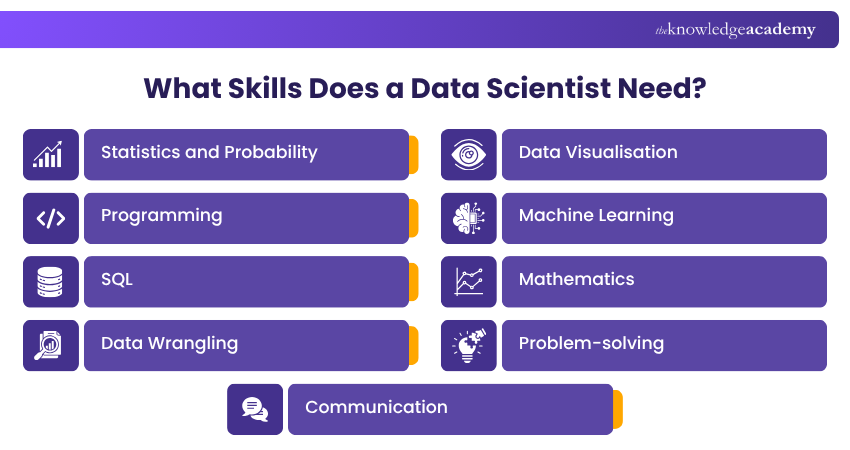
1) Statistics and Probability: To analyse patterns, relationships, uncertainty, and results
2) Programming: To manipulate data, automate tasks, and build analytical solutions
3) SQL: To query and work with information stored in databases
4) Data Wrangling: To clean, transform, and prepare data for analysis
5) Data Visualisation: To communicate complex findings clearly
6) Machine Learning: To build and evaluate models that learn from data
7) Mathematics: To understand the concepts behind statistical and ML methods
8) Problem-solving: To translate real-world challenges into analytical questions
9) Communication: To explain findings to technical and non-technical stakeholders
The exact skill set required will depend on the role. For example, some positions may emphasise Machine Learning, while others may focus more heavily on analytics, experimentation, or business decision-making.
Career Opportunities in Data Science
A background in Data Science can lead to several career paths. Each role focuses on a different part of working with data. Below are the career opportunities that you can explore:
1) Data Scientist: Develops analytical models and investigates complex datasets to support organisational objectives.
2) Data Analyst: Examines data and communicates findings through reports, dashboards, and visualisations.
3) Data Engineer: Creates and maintains the infrastructure and pipelines required to collect, transform, and store data.
4) Machine Learning Engineer: Develops and deploys Machine Learning systems for practical applications.
5) Business Intelligence (BI) Analyst: Transforms organisational information into dashboards and reports that help stakeholders monitor performance.
6) Data Architect: Designs the structures and frameworks organisations use to organise, integrate, manage, and access data.
Future Snapshot
As per the World Economic Forum’s Future of Jobs Report 2025, Big Data and AI/ML roles are among the fastest-growing careers through 2030, highlighting strong future opportunities for professionals with advanced data skills.
Convert data into actionable insights with Advanced Data Science Certification Training – Register today!
Why Choose Data Science as a Career?
Data Science offers a combination of technical challenges, career versatility, and opportunities to solve real-world problems. Here are some key reasons to consider it as a career:
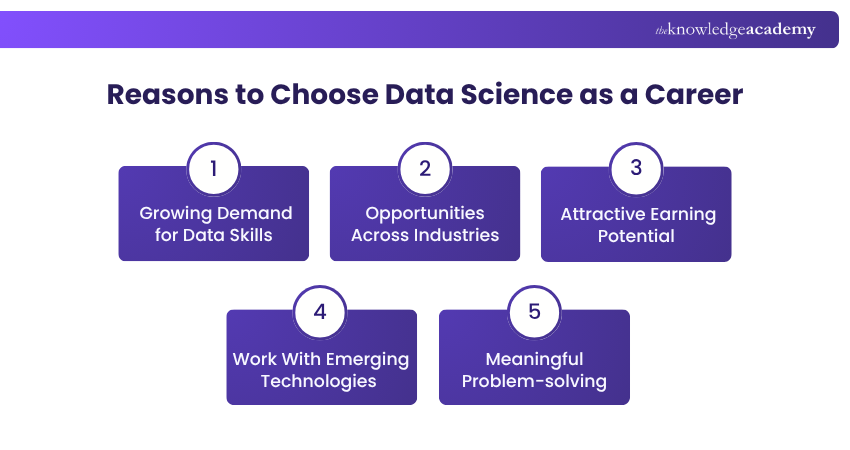
1) Growing Demand for Data Skills
Organisations are generating and collecting increasing amounts of data. As businesses become more data-driven, they require professionals who can transform this information into practical insights.
2) Opportunities Across Industries
Data Science is not limited to technology companies. Professionals can find opportunities in sectors such as finance, healthcare, retail, manufacturing, telecommunications, education, e-commerce, and consulting.
3) Attractive Earning Potential
Data Science can offer strong earning potential at different stages of your career. As you move from entry-level positions into senior, specialist or leadership roles, your earning opportunities can grow, making it an attractive choice for long-term career progression.
4) Work With Emerging Technologies
A career in Data Science gives you opportunities to work at the forefront of technological innovation. As organisations adopt new ways of collecting, analysing and using information, Data Scientists can contribute to developing solutions that improve how businesses operate, make decisions and serve customers.
5) Meaningful Problem-solving
Data Science extends beyond analysing data and interpreting numbers. Professionals use data to answer business questions, identify opportunities, predict outcomes, and recommend actions, making problem-solving a central part of the career.
Is Data Science Right for You?
Ask yourself:
• Do you enjoy solving complex problems?• Are you curious about patterns in data?• Do you enjoy technology and analytical thinking?• Are you willing to keep learning?• Can you communicate complex ideas clearly?
Mostly “Yes”? Data Science could be a career worth exploring.
The Future Scope of Data Science
The future of Data Science continues to expand as organisations rely more on AI, automation and data-driven decision-making. Emerging technologies and growing volumes of data are creating new applications, specialised roles and opportunities for professionals across industries. Let's check what the future holds for Data Science below:
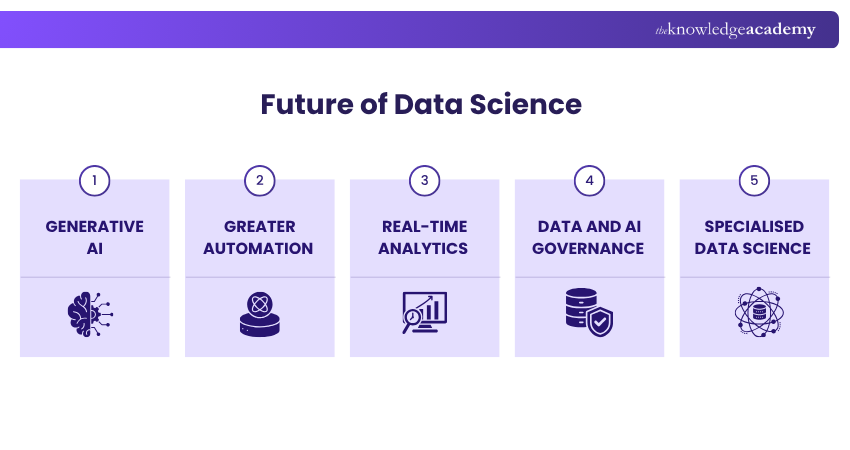
1) Generative AI
Generative AI creates new ways to search, summarise, create, and interact with information. Data professionals can contribute to preparing reliable data, evaluating outputs, and measuring the performance of these systems.
2) Greater Automation
More routine analytical activities can be automated, including parts of data preparation and reporting. This can increase the importance of skills such as problem definition, interpretation, experimentation, and strategic decision-making.
3) Real-time Analytics
Organisations increasingly need to respond to information as events occur. Real-time analytics can support areas such as fraud detection, operational monitoring, dynamic recommendations, and rapid decision-making.
4) Data and AI Governance
As organisations rely heavily on data-driven systems, issues such as privacy, bias, transparency, data quality, security, and accountability are becoming increasingly important.
5) Specialised Data Science
Data Science is becoming increasingly specialised. Professionals may develop deeper expertise in areas such as Natural Language Processing (NLP), Computer Vision, forecasting, experimentation, or industry-specific analytics.
Career Tip
Don’t try to learn every Data Science tool at once. Build strong foundations in Python, SQL, statistics and data analysis first, then specialise based on the roles you want to pursue.
Harness Python for Data Science success with our Python Data Science Course - Sign up now!
How to Become a Data Scientist?
Becoming a Data Scientist needs a combination of analytical knowledge, technical skills, and practical experience. While there is no single route into the profession, the following steps can help you build the required capabilities:
1) Understand the Fundamentals
Start by understanding how Data Science works and how data is used to solve problems. Build a foundation in statistics, probability, data analysis and basic ML concepts before progressing to more specialised areas.
2) Choose Your Core Tools
Become comfortable with the tools commonly used in Data Science. Python and SQL are useful starting points, alongside libraries and platforms for analysing, visualising and working with data.
3) Practise With Real Datasets
Move beyond tutorials by working with real-world datasets. Explore the data, clean inconsistencies, investigate patterns and answer practical questions to understand how Data Science projects work outside controlled exercises.
4) Build a Portfolio of Projects
Create three to five well-rounded projects that demonstrate different capabilities. Document the problem, your approach and the results so employers can clearly understand your contribution.
5) Gain Practical Experience
Look for opportunities to apply your knowledge through internships, freelance work, competitions, open-source projects or workplace assignments. Practical experience can strengthen your problem-solving abilities and help you understand how Data Science supports real business needs.
6) Choose a Specialisation
As you gain experience, explore an area that matches your interests and career goals. You might specialise in ML, Natural Language Processing (NLP), Computer Vision, forecasting, experimentation or industry-specific analytics.
7) Apply for Entry-level Opportunities
Once you have developed practical skills and a portfolio, start exploring entry-level Data Science and related roles. Tailor your CV and portfolio to each opportunity, highlighting relevant projects, technical capabilities and the outcomes you achieved.
Conclusion
Data Science offers a career that combines analytical thinking, technology and practical problem-solving. With opportunities spanning industries and emerging areas such as AI, automation and advanced analytics, the field provides multiple paths for professionals to develop and specialise. Building strong fundamentals, gaining practical experience and continuously updating your skills can help you create a career that evolves alongside the field.
Transform data into decisions with R expertise – Start your Data Science with R Training today.
Frequently Asked Questions
Is Data Science an IT Job?

Data Science is generally considered part of the technology and IT field, but its applications extend far beyond traditional IT. Data Scientists combine programming, statistics, ML and business knowledge to solve problems across finance, healthcare, retail and other industries.
Which Language is Mostly Used in Data Science?
Python is the most widely used programming language in Data Science due to its simplicity and powerful collection of libraries for data analysis and visualisation. SQL is also important for working with databases, while R is popular for statistical analysis.
Is Data Science Full of Coding?
Data Science involves coding, but it is not entirely programming-focused. Coding is mainly used to prepare data, build models and automate tasks, while much of the role involves interpreting results, exploring patterns and turning findings into practical recommendations.

Lily Turner


Senior AI/ML Engineer and Data Science Author
Lily Turner is a data science professional with over 10 years of experience in artificial intelligence, machine learning, and big data analytics. Her work bridges academic research and industry innovation, with a focus on solving real-world problems using data-driven approaches. Lily’s content empowers aspiring data scientists to build practical, scalable models using the latest tools and techniques.
View Detail

 If you wish to make any changes to your course, please


