




We may not have the course you’re looking for. If you enquire or give us a call on +49 8000101090 and speak to our training experts, we may still be able to help with your training requirements.
Scrum Master Roles and Responsibilities: A Complete Guide
ByThe Knowledge AcademyLast updated on: 23 November 2026
Explore Scrum Master roles and responsibilities, including coaching, event facilitation, impediment removal and team effectiveness. Understand how Scrum Masters support Product Owners and organisations, and discover the steps to start this career.
At a Glance
1. Core Roles: Scrum Masters work as coaches, facilitators, servant leaders and change agents.2. Key Responsibilities: They help establish Scrum, facilitate events, remove impediments and improve team effectiveness.3. Team Support: Scrum Masters encourage self-management and collaboration without directing individual tasks.4. Organisational Contribution: They support Product Owners, guide Scrum adoption and help address organisational barriers.
A Scrum Team is working towards its Sprint Goal, but unclear priorities, communication gaps and recurring obstacles are slowing progress. Who helps the team address these challenges without taking control of its work? That's where a Scrum Master plays an important role.
Their contribution goes beyond resolving immediate problems to helping teams and organisations understand and apply Scrum effectively. This blog explores what Scrum Masters do, how they support others and the practical steps towards entering the profession.
Who is a Scrum Master?
A Scrum Master is a member of the Scrum Team who is accountable for establishing Scrum as defined in the Scrum Guide and improving the team's effectiveness. They help people understand Scrum theory and practice while supporting a self-managing, cross-functional team.
A Scrum Master serves as a coach, facilitator and leader who supports the team rather than directing its work. Unlike a traditional project management role, the Scrum Master accountability does not involve assigning individual tasks or controlling how Developers complete their work.
Key Roles of a Scrum Master
Scrum Masters take on different roles to guide teams, strengthen collaboration and encourage effective Scrum practices. These roles describe how they support people and organisations, rather than separate formal Scrum accountabilities.
1) Process Coach and Teacher
A Scrum Master uses coaching and teaching approaches to help people learn, question assumptions and develop a shared understanding of Scrum. They adapt their guidance to the team's experience and needs.
2) Facilitator
As a facilitator, the Scrum Master guides discussions, encourages balanced participation and helps people reach decisions collaboratively. They remain neutral about the outcome rather than directing the discussion towards a preferred decision.
3) Servant Leader
A Scrum Master puts the team's needs first and creates conditions for people to perform effectively. They support individuals, encourage trust and help team members take ownership of their work rather than relying on instructions.
4) Change and Improvement Catalyst
A Scrum Master encourages openness to change and helps people question practices that no longer serve their goals. They support an environment where teams and organisations can learn, adapt and improve.
Key Responsibilities of a Scrum Master
Scrum Master responsibilities focus on establishing Scrum, supporting effective teamwork and helping the Scrum Team deliver value. Here are the eight key responsibilities:
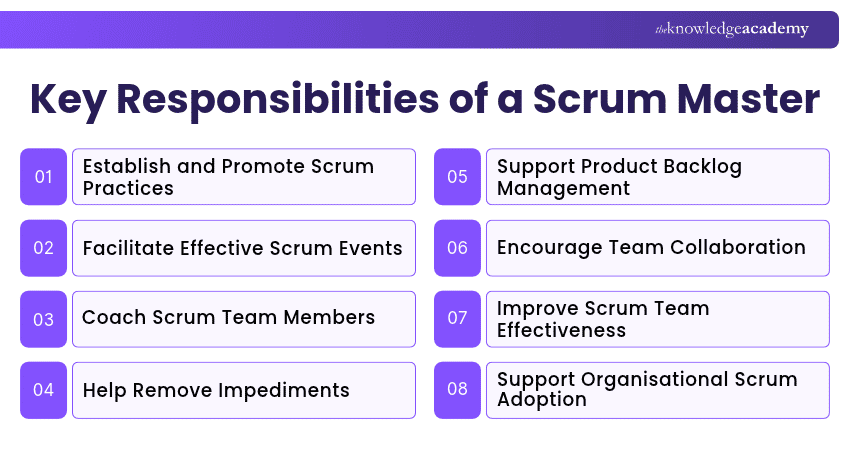
1) Establish and Promote Scrum Practices
A Scrum Master helps everyone understand Scrum theory, values, accountabilities, events and artefacts. They explain how the framework works and encourage its consistent application across the Scrum Team.
This includes helping people apply Scrum's three pillars of empiricism: transparency, inspection and adaptation, so that decisions are based on experience and observed results.
2) Facilitate Effective Scrum Events
The Scrum Master ensures Scrum events take place and remain productive and within their prescribed timeboxes. The Sprint contains four other events: Sprint Planning, the Daily Scrum, Sprint Review and Sprint Retrospective.
For example, they may help participants understand the purpose of Sprint Planning or support effective discussions during a Sprint Retrospective.
Trainer's Insight
The Daily Scrum is not a status meeting led by the Scrum Master. It is a 15-minute event for Developers to evaluate progress towards the Sprint Goal and adapt the Sprint Backlog as needed. The Scrum Master helps ensure the event is understood and effective without taking ownership of the developers' decisions.
3) Coach Scrum Team Members
The Scrum Master coaches team members in self-management and cross-functionality, helping them develop the skills needed to organise their own work and collaborate across different areas of expertise.
They also encourage individuals to take responsibility for their decisions, address challenges constructively and become less dependent on external direction.
4) Help Remove Impediments
A Scrum Master helps identify and address impediments affecting the Scrum Team's progress. These might include organisational dependencies, unclear processes or difficulties obtaining essential information.
For example, if a team repeatedly experiences delays because another department has not provided access to a required system, the Scrum Master may work with stakeholders to resolve the issue.
5) Support Product Backlog Management
The Product Owner is responsible for maximising product value and effectively managing the Product Backlog. The Scrum Master supports these activities without taking over the Product Owner's accountability.
This includes helping identify techniques for effective Product Goal definition and Product Backlog management, supporting empirical product planning and helping the Scrum Team understand the need for clear backlog items. They may also facilitate stakeholder collaboration when needed.
6) Encourage Team Collaboration
The Scrum Master encourages open communication and constructive collaboration among Scrum Team members and stakeholders. They help people understand different perspectives and address communication barriers that may affect teamwork.
This includes supporting conflict resolution, encouraging mutual respect and creating opportunities for productive discussions, particularly when disagreements affect collaboration.
7) Improve Scrum Team Effectiveness
A Scrum Master is accountable for the Scrum Team's effectiveness. They help the team focus on creating valuable Increments that meet the Definition of Done and examine whether its working practices support the Product Goal.
For example, during a Sprint Retrospective, the team may identify recurring testing delays. The Scrum Master helps create conditions for the team to agree on improvements, implement them and assess their impact.
Pro Tip
After each Sprint Retrospective, encourage the team to select one meaningful improvement, agree on how to implement it and review its impact during the next Sprint.
8) Support Organisational Scrum Adoption
Scrum Masters help organisations understand and adopt Scrum beyond individual teams. They support implementation by training employees, advising on Scrum practices and encouraging an empirical approach to complex work.
They also help address barriers between stakeholders and Scrum Teams, making it easier for teams to work within the framework effectively.
Shape the product vision and deliver what matters most with the Scrum Product Owner Certification Training – Join now!
How to Become a Scrum Master?
Becoming a Scrum Master involves understanding Scrum, developing interpersonal skills and gaining opportunities to apply the framework. Here are the practical steps to consider:
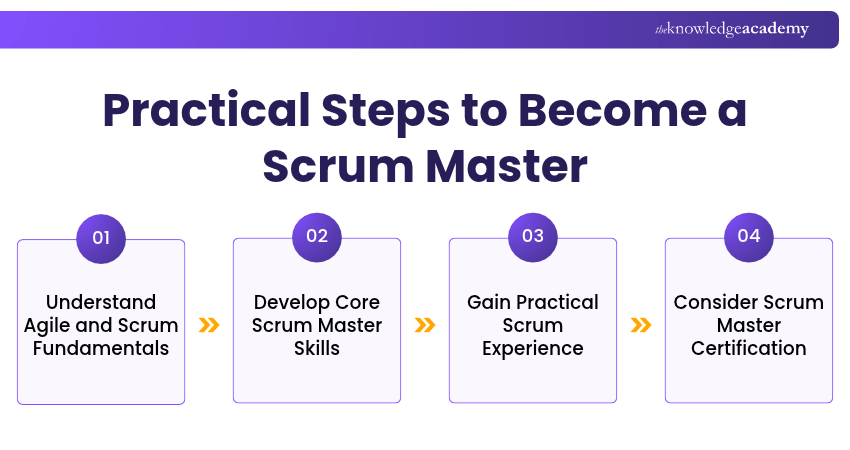
1) Understand Agile and Scrum Fundamentals
Start by learning Agile principles and the Scrum framework. Understand Scrum accountabilities, events, artefacts, commitments and values.
Reading the official Scrum Guide is an important first step because it defines how Scrum works and clarifies the accountabilities of the Scrum Master, Product Owner and Developers.
2) Develop Core Scrum Master Skills
Strong communication, facilitation, coaching and conflict-resolution abilities are important for Scrum Masters. These skills help them support discussions, address challenges and encourage collaborative working.
Developing an understanding of empirical decision-making, self-management and continuous improvement also helps professionals apply Scrum in practical situations.
3) Gain Practical Scrum Experience
Look for opportunities to work with Scrum Teams or observe how Scrum events, product planning and continuous improvement activities operate.
Relevant experience may come from software development, business analysis, project coordination, product development or other collaborative environments. Participating in team improvement activities can help build practical understanding of the Scrum framework.
4) Consider Scrum Master Certification
Relevant training and certification can help demonstrate knowledge of Scrum and support professional development. Scrum Master training typically covers Scrum principles, team accountabilities, facilitation, coaching and practical application.
When choosing a course or certification, check its syllabus, assessment requirements and awarding organisation. Certification can support career development, although it is not a universal requirement for working as a Scrum Master.
Scrum Master Career Readiness Checklist
Before applying for a Scrum Master role, consider whether you can:
□ Explain Scrum accountabilities, events and artefacts.□ Facilitate productive discussions without directing the team.□ Demonstrate active listening, coaching and conflict-resolution skills.□ Recognise impediments and help teams address them.□ Describe a practical example of supporting team improvement.
Turn every sprint into an opportunity to build better by signing up for the Scrum Developer Training now!

The Knowledge Academy develops accessible learning content across Project Management, IT, Cybersecurity, Data Science, Business Analysis, HR, Accounting and Finance, Leadership and Health and Safety. Its resources combine subject research with clear explanations to help professionals build practical knowledge across a wide range of disciplines.
View Detail

 If you wish to make any changes to your course, please


