


We may not have the course you’re looking for. If you enquire or give us a call on 01344203999 and speak to our training experts, we may still be able to help with your training requirements.
Product Manager Job Description
ByThe Knowledge AcademyLast updated on: 26 October 2026
A Product Manager job description outlines the responsibilities, skills, qualifications and experience required to manage a product successfully.

Quick Overview
1. Product Managers guide product development and improvement by balancing customer needs with business goals.2. Their duties include market research, product strategy, planning, prioritisation and performance monitoring.3. Communication, analytical thinking, problem-solving, leadership and customer focus are important.4. Employers may look for relevant education, product management experience and industry knowledge.5. Responsibilities and requirements vary depending on company size, product complexity and organisational needs.
Ever wondered who decides which features make it into your favourite apps or how businesses create products that customers love? Behind many of these decisions is a Product Manager who connects customer expectations, business objectives and product development. But what exactly does this role involve, and what do employers look for when hiring one?
Understanding the Product Manager job description can help you explore the role, identify essential skills and recognise the expectations associated with different positions. In this blog, you'll discover the responsibilities, qualifications, skills and salary expectations of Product Managers, along with practical job description templates for startups and large organisations.
Who is a Product Manager?
A Product Manager is a professional responsible for guiding a product through its lifecycle, from initial planning and development to launch and continuous improvement. They identify customer needs, define product goals and work with cross-functional teams to deliver products that align with business objectives.

Roles and Responsibilities of a Product Manager
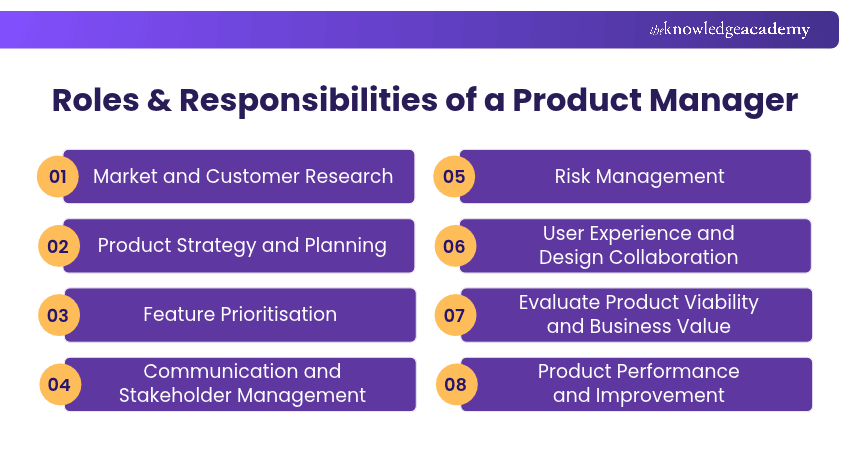
Product Managers perform several responsibilities to ensure that products meet customer expectations and support business objectives. Their exact duties depend on the organisation, industry and type of product. The following are key roles and responsibilities of a Product Manager:
1) Market and Customer Research
Understanding the market and customer expectations is an important responsibility of a Product Manager. They conduct research to identify customer challenges, market trends, competitor activities and potential product opportunities. Product Managers gather insights through customer interviews, surveys, feedback analysis and market research.
These findings help them understand customer requirements and make informed product decisions. For example, a Product Manager working on a mobile banking application might analyse customer feedback to identify difficulties with the payment process.
2) Product Strategy and Planning
Product Managers help define a clear product vision and develop strategies that align with organisational goals. They identify the problems a product should solve, determine its intended value and establish priorities for development. They also translate product strategies into actionable roadmaps.
This involves collaborating with relevant teams to understand requirements, technical feasibility and available resources. A well-defined strategy helps ensure that product decisions support customer needs and long-term business objectives.
3) Feature Prioritisation
Product Managers often receive numerous feature requests, improvement suggestions and changing customer requirements. However, limited time, resources and budgets mean that not every request can be addressed immediately.
Prioritisation involves assessing potential features based on customer value, business impact, development effort and strategic importance. Product Managers work with relevant teams to determine which improvements should receive attention first.
Example: Prioritising Product Features
Imagine a Product Manager responsible for an online shopping application. The development team has two requests:1) Option A: Introduce a new product recommendation feature.2) Option B: Fix a recurring checkout problem affecting customers.If customer research shows that the checkout problem is causing significant purchase failures, resolving it may deserve higher priority than introducing a new recommendation feature.This illustrates how Product Managers can use customer impact and business value to guide priorities.
4) Communication and Stakeholder Management
Product Managers collaborate with stakeholders across different departments, including development, design, marketing, sales and senior management. Effective communication ensures that everyone understands the product vision, priorities and expected outcomes. They share product updates, discuss requirements, gather feedback and address conflicting expectations.
Product Managers also help stakeholders understand the reasoning behind important decisions. Strong stakeholder management supports collaboration and helps maintain alignment between teams working towards common product goals.
5) Risk Management
Product development involves uncertainties such as changing customer preferences, technical limitations, budget constraints and competitive pressures. Product Managers identify risks that could affect product outcomes and work with relevant teams to assess their potential impact.
They may adjust product priorities, validate assumptions or explore alternative approaches to reduce uncertainty. For example, if customer testing reveals that a planned feature is difficult to use, a Product Manager may recommend further testing or improvements before its release.
6) User Experience and Design Collaboration
A successful product should not only function effectively but also provide a positive user experience. Product Managers collaborate with UX Designers and researchers to understand user behaviour and ensure product decisions address usability needs.
They review customer feedback, examine usability findings and help prioritise improvements that address user difficulties. For example, if customers regularly abandon a registration process, a Product Manager may work with designers to identify unnecessary steps and explore ways to simplify the experience.
7) Evaluate Product Viability and Business Value
Product Managers assess how product decisions influence business performance by considering development costs, revenue opportunities, competitive positioning and potential Return on Investment (ROI).
They evaluate whether proposed features or improvements support commercial goals while delivering meaningful value to customers. This responsibility involves assessing product opportunities, comparing potential investments and making informed trade-offs between expected customer value, costs and business returns.
8) Product Performance and Improvement
A Product Manager's responsibilities do not end when a product launches. They continue to monitor its performance and identify opportunities for improvement. This involves analysing relevant product metrics, gathering customer feedback and reviewing whether the product is achieving its intended outcomes.
Depending on the product, useful performance indicators may include:
a) Product Adoption: Measures how many customers begin using a product or feature.
b) Customer Retention: Shows how effectively a product retains users over time.
c) Customer Satisfaction: Helps assess how customers perceive their experience.
d) Feature Usage: Indicates how customers interact with particular product features.
These insights help Product Managers identify areas requiring further development and make decisions about future improvements.
Discover how to accelerate innovation and maximise business value with the SAFe® Agile Product Management Training – Sign up now!
Product Manager Job Description Templates
A Product Manager job description helps organisations communicate the responsibilities, skills and qualifications expected from candidates. It also provides job seekers with a clearer understanding of what a particular position involves. The following two templates illustrate how job descriptions may differ between startups and multinational organisations:
Pro Tip
Avoid using the same job description for every Product Manager vacancy. Adjust responsibilities, qualifications and experience requirements according to the product, team structure and level of ownership.
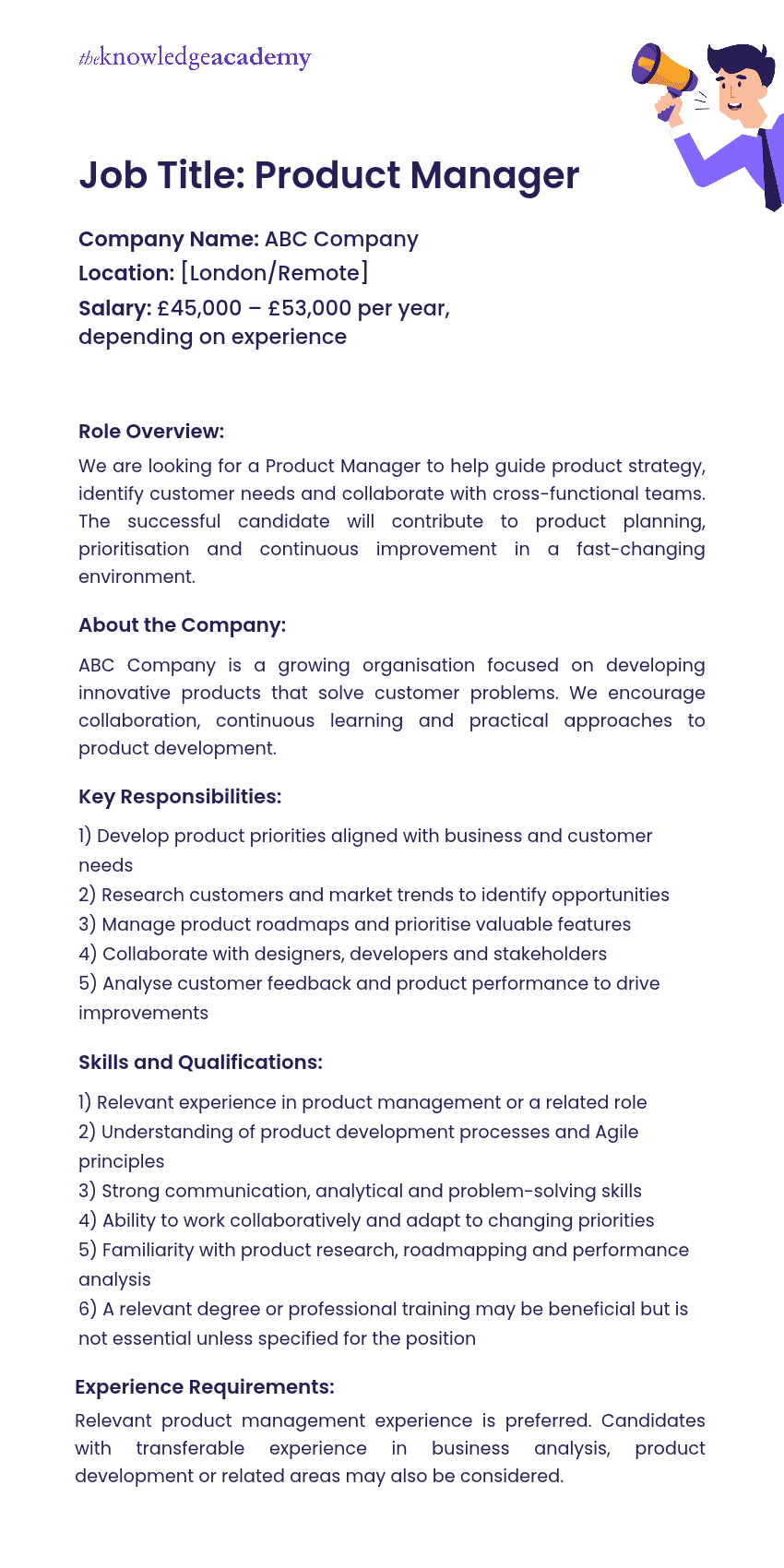
Template 1: Startup Product Manager Job Description
Here's a sample template of a startup Product Manager job description:
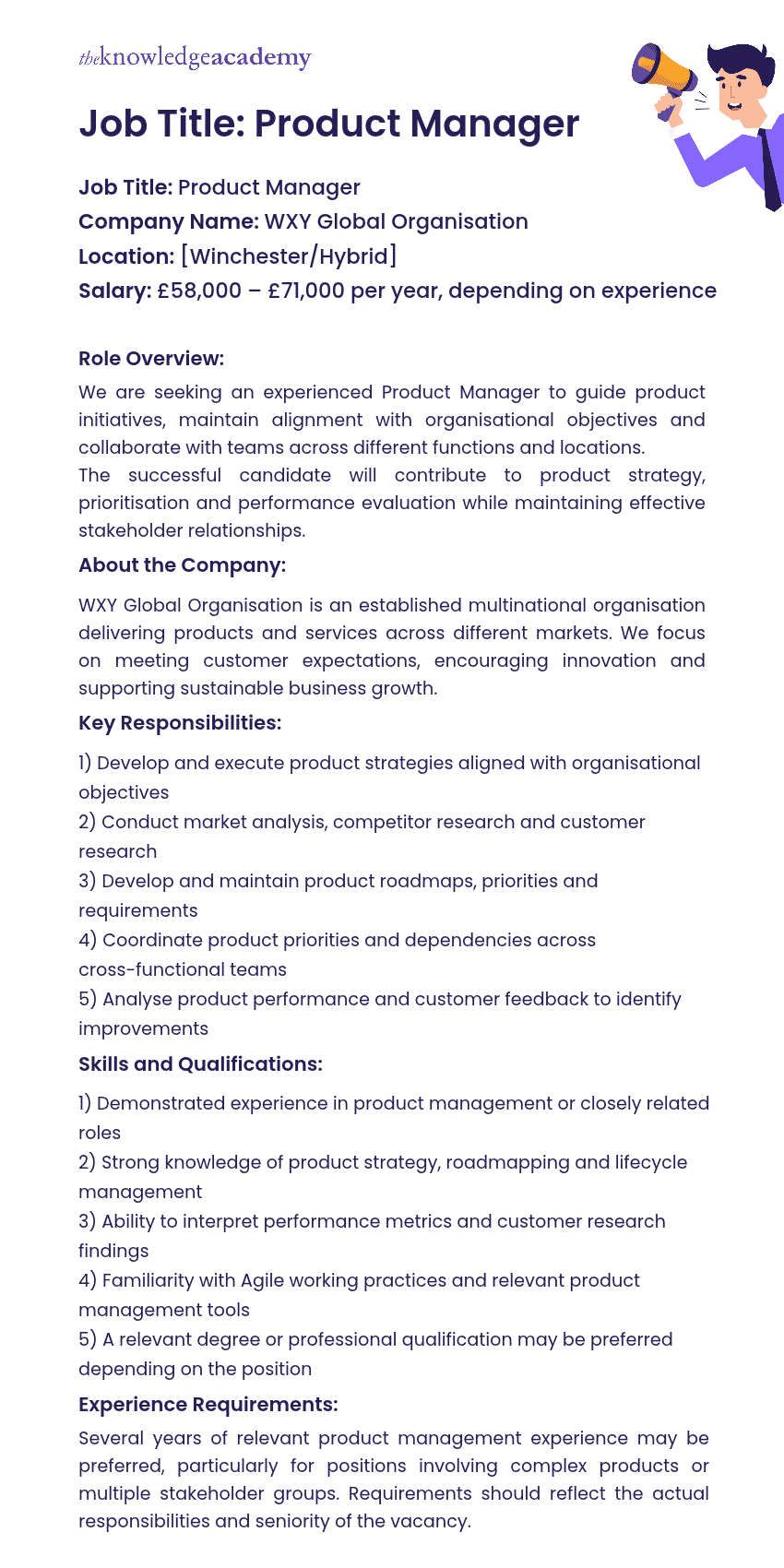
Template 2: MNC Product Manager Job Description
Here's an example of a Multinational Corporation (MNC) Product Manager job description:
Product Manager Salary
Product Manager salaries vary depending on experience, location, industry, employer and level of responsibility. Here are the average annual salaries across three major regions:
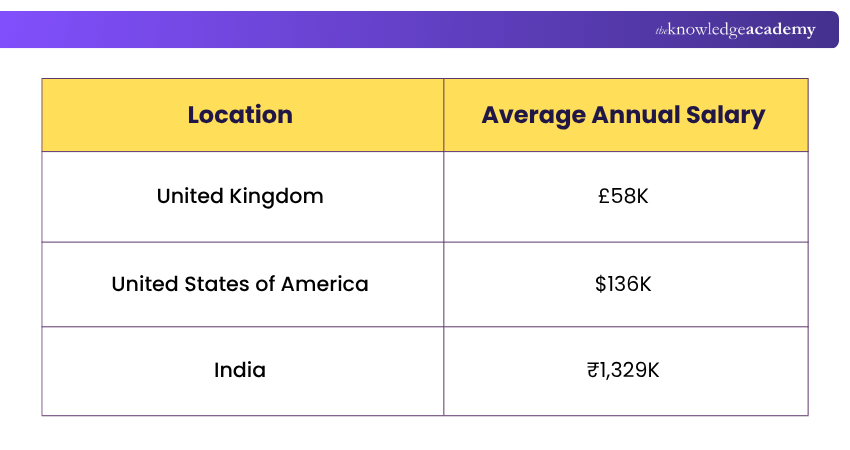
Source: Indeed
The following factors influence Product Manager salaries:
1) Experience Level: Product Managers with extensive experience generally earn higher salaries than entry-level professionals. Senior roles often involve greater responsibility for product strategy, decision-making and business outcomes.
2) Geographical Location: Salaries vary across countries and cities due to differences in living costs, local demand and employment market conditions. For example, Product Managers in London may earn more than those working in smaller UK cities.
3) Industry: The industry in which a Product Manager works can influence earnings. Sectors such as financial technology, software development and healthcare technology may offer different salary levels based on product complexity and market demand.
4) Company Size: Larger organisations may offer higher salaries and additional benefits due to their resources and complex product portfolios. However, startups may provide competitive packages that include equity or performance-based incentives.
5) Skills and Expertise: Specialised knowledge in areas such as data analytics, Agile methodologies, product strategy and technical product development can boost earning potential.
6) Job Responsibilities: Product Managers responsible for complex products, multiple product lines or significant business outcomes may receive higher compensation. Seniority and the scope of decision-making also influence salary levels.

The Knowledge Academy develops accessible learning content across Project Management, IT, Cybersecurity, Data Science, Business Analysis, HR, Accounting and Finance, Leadership and Health and Safety. Its resources combine subject research with clear explanations to help professionals build practical knowledge across a wide range of disciplines.
View Detail

 If you wish to make any changes to your course, please


